Friday, August 27, 2010

Does "God" really need an Oscar?

Every self-respecting film fan knows that the Oscars are a game that Hollywood plays with the world (and itself). Mainstream multiplex fare is worse than it has ever been in history, even the best films are pathetically derivative and the biggest stars are blander and less talented than ever. But at the Oscarcast each year they tell us about how today’s best films (maybe 10 out of the few hundred they produce every year) are part of a continuum, they are the current-day “descendents,” so to speak, of the masterworks made during Hollywood’s Golden Age, and Silver Ages like the stunning period in the early Seventies when some of the best-ever American films were made with major studio backing.

Each year’s Oscar telecast has less and less time for anything to do with Hollywood’s past, though. The old-movie montages get quicker and shorter, each dead-this-year tribute now lasts maybe 10-20 seconds instead of a minute or two (unless you're John Hughes!), and finally, this past ceremony saw the “erasure” from the official telecast of the Lifetime Achievement winners (Roger Corman, Lauren Bacall, studio exec John Calley, and cinematographer Gordon Willis), which I wrote about here.

So this week the new Lifetime Achievement winners were announced, and they are as worthy of the prize as Corman, Bacall, Calley, and Willis. The announced honorees are the most pre-eminent writer about silent cinema, Kevin Brownlow (right)(the first time a film historian has gotten an Oscar), character actor extraordinaire Eli Wallach, a “Hollywood maverick” generation director who still is trying to make challenging cinema (Francis Ford Coppola), and a legend who is one of the greatest living filmmakers, Uncle Jean, aka Jean-Luc Godard.

Now I winced as I heard that Godard was up for this award, since I knew that either it meant he was severely ill — the Oscars seem to have the inside track on old filmmakers who are dying — or that they were prepping “Godard fan” Quentin Tarantino to make a presentation and gush about Band A Part once more. The award seems to be pegged to the fact that this is the 50th anniversary of A bout de souffle (Breathless), and someone at Oscar Central decided that seminal film needed to get some belated recognition. Hey, they passed on giving Citizen Kane anything way back when, so Orson got the same kind of honorary business many, many years down the line — pictures that change cinema don’t really have top priority in the skewed vision of the movies that guides the Oscars (Kubrick never really nabbed anything for being a visionary, so just forget about connecting the Oscars to what is taught in film school as genius filmmaking).

Ah, but this blog entry isn’t just a chance for me to carp about how this belated gesture seems too little, too late (since you know they’re not honoring Godard for the whole of his stunning cinematic oeuvre, but more for his having made a trendsetting pic back in the era of Mad Men). The “story” surrounding the announcement that Godard will receive this honorary award has become more about the fact that he hasn’t yet gratefully acknowledged the prize than the fact that he’s not likely to show up to receive it. Vanity Fair published a bizarre blog piece today noting that Uncle Jean hadn’t yet answered the Academy — a whole 24 hours after their representative called! (hey, be grateful we even considered you for this high honor, which we won’t be making part of our official ceremony!).

Another blogger mocked the ginned-up non-story, and noted that Kevin Brownlow, who is currently 72, was woken up out of a sound sleep at night in England to be told the news by an Oscar rep (Hollywood does not acknowledge that the rest of the world lives in different time zones). All these gents are being invited to a prestigious shindig that is taking place on November 13 of this year, which will most likely be glimpsed in a two-minute quick-cut montage on the actual Oscarcast.

Godard has a history of not showing up in recent years to any film festivals where his work is showing, or to fests that honor him with Lifetime Achievement Awards. He seemed to be considering accepting the European Film Awards' 2007 Lifetime Achievement Award when he agreed to a few interviews a few weeks before the ceremony — and then he never showed up to claim the prize (then again, please check out the EFA’s list of honorees — much as I dearly love the Monty Python troupe, their "lifetime achievement" in cinema is in the realm of one excellent and four very fun movies). The official quote he gave at the time to the EFA was "I say at the same time ‘thank you’ and ‘no, thank you,’" which is thoroughly consistent with his behavior in the past 45 years or so.

I believe that the Academy might waive its no-Lifetime-Achievement-presentations-on-air rule for Coppola, if only because his friends, and one assumes, presenters, are A-list names in the business. But the incredibly important Mr. Brownlow and the hardworking Wallach will certainly get merely what Corman and Bacall got this year on the televised ceremony — a quick mention from the stage, and a wave to the camera from the audience (I was surprised the honorees weren’t moved to the back where resident senior Mickey Rooney is always seated; so much for Hollywood’s pride in its past….).

I’ll end on a note that is quite familiar to Godard fans, his letter to the New York Film Critics Circle in 1995 when they announced they were giving him a Lifetime Achievement Award. It is written with tongue-in-cheek and with film references galore (including ones familiar only to students of his career). Ah... the Bleecker Street Cinema!

Dear Sir,

Thanks for your electronic mail dated January 20 — 11:24 am. Too little good health. Too big snow to the airport, and too few banknotes saved for the ticket. Hollywood always used to say that your servant is not fit for telling stories. I therefore said in the last chapter of my stories of cinema [Histoires du cinema(s)] that nothing is lost, except honor.

And it is then my duty — no copyright, only copyduties — not to accept any longer the honor of your reward. Do please accept the incomplete following reasons for such genuine and shy statement.

JLG was never able through his whole movie maker/goer career to:
Prevent M. Spielberg from rebuilding Auschwitz,
Convince Mrs. Ted Turner not to colorize past and dear funny faces,
To sentence M. Bill Gates for naming his bug's office Rosebud,
To compel New York Film Critics Circle not to forget Shirley Clarke,
To oblige Sony ex-Columbia Pictures to imitate Dan Talbot / New Yorker Films when delivering accounts,
To force Oscar people to reward Abbas Klarostami instead of Kieslowski,
To persuade M. Kubrick to screen Santiago Alvarez shorts on Vietnam.
To beg Ms. Keaton to read Bugsy Siegel's biography.
To shoot Contempt with Sinatra and Novak, 
etc., etc.,

I'm still not over, dear Sir, through my long voyage to the home of cinematography, but I missed indeed quite a lot of ports of call — no girls in every port, but no honors neither I could deserve.

Do please ask the distinguished audience some indulgence for the piteous English of your colleague and send the reward to the Bleecker Street Cinema if remaining.

Faithfully yours,
Jean-Luc Godard


Thanks to David Arthur-Simons for passing on the text of JLG's letter.

Thursday, August 26, 2010

Rare audio docs on Speechification

Like most possessed fans and collectors, the first thing I want to do when I find a trove of really top-notch material is to share it. Thus, I offer a bunch of links here to a new site I love, called Speechification.

**UPDATE: I found out today (10/20/10) that this site has been taken down by its owners. I leave this post up as a bookmark/gravestone that such a great archive existed for a few years. Thanks to its owners for all their hard work.**

The site contains literally hundreds of complete recent-vintage documentary radio shows as MP3 files, most of the programs having aired on the BBC. There are a few stray American NPR items (we do have pathetic radio over here, and NYC radio is absolutely abysmal), but the bulk of the material comes from England, and the shows are absolutely terrific “101” introductions to the artists being profiled.

I’m only at the beginning of my “dumpster dive” through Speechification’s collection, but I’ve liked all I’ve heard to date. I offer a list of the titles I think will be of most interest to the readers of this blog.

Filmmaker portraits and interviews:
-A Withnail and I reunion
-Mike Leigh interviewed

Portraits of authors:
-Philip K. Dick
-Jorge Luis Borges
-William Blake
-Another Blake profile

Music-related shows:
-Kraftwerk profile
-Patti Smith on songwriting
-Flight of the Conchords
-A tribute to Malcolm McLaren’s radio work
-”Jarvis Cocker’s Musical Map of Sheffield”
-A docu on The Ed Sullivan Show, hosted by Joan Rivers
"Killer Bs" (A great discussion of B-sides; awesome BBC production, but I spotted two factual errors – yes, I’m a geek)

Next, comedy and uncategorizable specialty docus:

-“The Life and Crimes of Lenny Bruce”

-“Great Lives: Groucho Marx”
-“I Was Dudley Moore’s First Bandleader”
-Comedian Tommy Cooper profiled
-“Stephen Fry’s English Delights”
-Comedian Josie Long talks about plants
-On Chaplin and the creation of the concept of celebrity
-“I Was Douglas Adams’ Flatmate”
-A show on museums which includes a contribution from Ken Nordine
-A weirdly obscure docu that helped explain to me one of my fave-ever Alan Partridge moments: Telly Savalas hypes the city of Birmingham
-Stephen Merchant (of The Office and Extras) offers a history of HBO
-A documentary on Columbo!
-British pro wrestling
-George Harrison and George Formby
-Moondog profiled

And lastly, three portraits of a trio of great eccentric artists from the UK:

-Scottish poet Ivor Cutler
-Painter-poet-rocker Billy Childish
-Spoken-word god John Cooper Clarke

Enjoy and recommend anything great *you* might find.

Turning Japanese (for a paycheck): Celebs in '80s TV commercials

For almost four decades now, the Japanese have been luring American and European celebrities to do their ads with big paychecks and the promise that the commercial will only be aired in Japan. Of course now with YouTube, nothing is country-specific, and so posters like this one provide with endless amusement.

This gent seems to have specialized in collecting Japanese ads from the Eighties, so forthwith I present these kitschy little items:

Jane Bikin


Jodie Foster (to the tune of “She Drives Me Crazy”):


A very shabbily dressed Peter Falk (and would we have him any other way?):


The personification of class, Marcello Mastroianni:


Mickey Rourke, with his original face:


An odd choice for studliness, Anthony Perkins:


Even more gawky studliness from Tony:


And since we’re in the Eighties, we need some of the stunning ladies of that time. First, Nastassja Kinski:


The gorgeous Diane Lane:


The fantasy of every teen boy at that time, Phoebe Cates:


And the absolutely perfect Mademoiselle Sophie Marceau:


Sean Connery, who turned 80 years old this week!


And a little more Sir Sean:


To close out, I return to the kinetic and busy-as-fuck Mr. Sammy Davis Jr. If you thought he was ubiquitous on U.S. TV when we were young, he also blitzed the airwaves in other countries. Here he’s older and pitching coffee and something called “the stick”:


There are two versions of this one, a longer one that loses sound midway through and this twangy sucker:


From a 1974 campaign, where he pitched whiskey and did impressions. Here it’s Bogart:


Here it’s Brando as Don Vito:


A dance video, with the trademark “con-chicki-con-con”:


And lastly, a frenzied Jerry Lewis impression:

Friday, August 20, 2010

…and God Against All: Deceased Artiste Bruno S.

I am a deep disciple of the work of Werner Herzog, but every so often his films hit a disturbing note because the viewer becomes aware that the person onscreen may or may not be aware of how they are being used in Herzog’s strange and brilliant film world. This is most prominent in his documentary study of the blind and deaf, Land of Silence and Darkness. And it also is the case with the two very raw starring performances he got from street musician and all-around strange person Bruno S., who died this week at the age of 78. Bruno did seem aware of what was going on, but the emotional changes his characters go through have an incredible resonance that comes from the actor’s own deep perception of his character’s situation and how it mirrored his own real life.

Bruno was an incredible personality onscreen, as Herzog used him pretty much for what he was — a bright and imperturbable person who apparently suffered some mental and/or emotional disability. His obits this week noted the exact nature of that disability, and it is indeed as sad as the fate his characters confront in his two films with Herzog. Born Bruno Schleinstein, it is reported that his prostitute mother used to beat him as a little child, which made him temporarily deaf. He was committed to an asylum during the Nazi era, and was the subject of experiments conducted on mentally disabled children.

The savvy that Bruno showed onscreen, despite his handicap, was perfectly showcased by Herzog who starred him first in The Mystery of Kaspar Hauser (1974), which was released in Germany as “Every Man for Himself and God Against All.” Bruno was the perfect incarnation of the real-life figure who lived his whole life in a cellar and then emerged to innocently experience the world as an adult. Herzog wrote Stroszek (1977) expressly for Bruno S., and it is one of his masterpieces: the story of an unusual street musician who leaves Germany with a prostitute (the wonderful Eva Mattes) and his landlord, only to land in Wisconsin, where they are as alien and alienated as the dancing chicken seen in the film’s indelible final scene.

As a tribute to this unusual and extremely earnest and sincere performer, here is the trailer for a documentary made about him in 2003 (without English subtitles). This is the only feature he was in since the Herzog duo:


Here Bruno confronts logic in the guise of Kaspar Hauser:


A gorgeous scene from Stroszek that shows both what a great writer Herzog is and also what a fine actor Bruno was. Here he discusses those people who “hurt you with a smile”:


And because we should end on an up note, here is a scene from the same film in which Bruno lets loose on his chosen instrument, the glockenspiel. This is how he earned his living since the Herzog films many years ago, along with art he made that was indeed exhibited in galleries:


A final, newer clip of Bruno singing and playing:

Thursday, August 19, 2010

Chacun Son Cinema: the "missing" sequence

This blog mostly functions on a separate level from the Media Funhouse cable-access show I do here in Manhattan, but every so often I feel compelled to put up a post supplementing what I’m doing on the show that week. In this instance, I’m presenting some terrific shorts from the anthology film Chacun Son Cinema, which very much needs to have a distributor over here.

The film was conceived of by Gilles Jacob, the head of the Cannes Film Festival, to celebrate the fest’s 60th birthday, and the filmmakers who participated are a roster of the best contemporary talents. Their names can be found in this trailer for the feature:


Some pieces of the film are available online, including two of the segments I’m showing this week, the contributions by Roman Polanski (a great comic bit of business) and David Cronenberg (making a pungent, and very depressing, point about the state of cinema). Also available on YouTube are the press conference for the film, with many of the filmmakers in attendance (the clip is unfortunately dubbed into Italian, so the English interviews can’t be understood, unless you’re fluent in Italian) and a totally non-verbal bit of Cannes fluff (again from Italian TV), the red carpet entries of the the filmmakers at the premiere.

Also of interest on YT is one missing segment from the feature. There are only two contributions by American filmmakers (which gives an impression of how much the gents in question are respected by the festival), one from David Lynch and another from Gus Vant Sant (both shorts, in my humble opinion, are interesting but gimmicky and seem to have been “dashed off”). The third American filmmaker is actually a pair, those Coen guys, who did something that is quite charming and actually more in league with what the other filmmakers in the anthology did:


At its best, Chacun Son Cinema communicates the deep emotional connection that great movies make with their audience. The range of ways in which this is expressed by the contributors — and the wonderfully creative ways in which tributes are made to Chaplin, Bresson, Fellini, Godard, and Fred and Ginger, among others — make the picture “essential” viewing, but, as noted, it is sadly “unfindable” in the U.S., unless one orders an overseas disc of it.

Friday, August 13, 2010

Queen of the Robot Women: Deceased Artiste Lorene Yarnell

I remain fascinated by the TV variety shows of the Seventies, which basically offered viewers their last glimpse of the weird, anything-goes formula that had been around since vaudeville (today’s talent-competition shows are unbelievably mawkish and possess none of the pizzazz of the classic variety show — I have no patience for "inspirational" amateurs). So why not pay tribute to variety-show vet Lorene Yarnell, who died this week at the age of 66? (I’m passing on Patricia Neal, who will be better covered elsewhere).

Best known — by those who were around at the time — as half of the “Shields and Yarnell” mime duo, Yarnell started out as a dancer who had quite a lot of gigs on variety TV. She was one of the dancing girls on Shindig, The Dean Martin Show,and The Carol Burnett Show, among others. She danced in the movie Sweet Charity and was an all-around theatrical vet when she met street mime Robert Shields in 1972. The two met when they worked on “Fol-de-Rol,” a 1972 Krofft TV special, and became a couple both professionally and privately (they were married until 1986).

At the time S&Y were doing their act, an occasional mime might show up on a talk show or Ed Sullivan, but aside from the master, Marcel Marceau, it’s doubtful that any other mime act got as much attention and screen time as the husband and wife duo. And why was this? Well, it all comes down to one word: ROBOTS. Shields and Yarnell were simply the best fuckin’ robot duo on TV, in a time when Star Wars was about to hit big, and variety shows still had slots for “unusual” talents.

Thus, the pair became regulars on The Mac Davis Show and The Sonny and Cher Show (if my calculations are right, this was the jaw-dropping post-divorce Sonny and Cher show the couple were doing just to get back into starring gigs on TV). S&Y got a summer replacement show in 1977 — that phrase would no doubt need to be explained to anyone under 40, but at one time the networks cared enough about keeping viewership throughout the year that they brought on short-lived variety shows just for the summer months. The pair got the nod for a winter run in January of 1978 but were killed in the ratings by Laverne and Shirley, and from that point went back to doing guesting and stage gigs for the next decade.

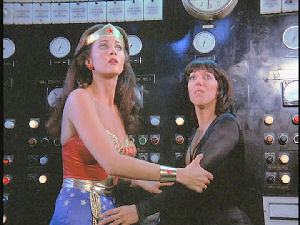
In the Eighties, the couple broke up, and Yarnell went back to performing in the theater and acting on television (check out the Wonder Woman role below) and in the movies (Spaceballs). She reunited with Shields many times in the decades since their breakup, and it is indeed safe to say that no one incarnated a robot like those two did — I was initially sorta creeped out by what they were doing when I was younger (it was the not-blinking aspect, they never freaking blinked while playing “the Clinkers,” the robot husband and wife), then I grew to enjoy its sheer strangeness, and now I just think of it as part of a much simpler (and yes, more interestingly weird) time in TV history.

For a little Yarnell trip through variety TV, here’s her dancing behind Donna Lauren on a 1965 Shindig show (with Darlene Love in the backup singing group):


And continuing the go-go mood, here’s a slice from a 1969 show called What’s It All About, World? that I had never heard of before today. Here, Lorene dances to a number by Paul Revere and the Raiders:


Another segment from that show, which obviously was cued into the “nostalgia” vibe of the time. Host Dean Jones sings “The Roses of Success" with Lorene as one of the singer-dancers. Talk about yer Sixties time-trip:


Time-trip you say? What about Tony Randall singing a song about Calvin Coolidge with, again, Lorene Yarnell and Kathy Gale:


And just to truly mess with your head, consider a time when Eve Arden sang Jacques Brel on American television — now, as our society becomes more and more “multi-cultural” for real, the media does nothing to acknowledge music being made anywhere else in the world. For the sublime original by Jacques you can go here, but the Eve Arden version (backed, again, by Yarnell and Gale) is certainly a far weirder experience:


Here, Robert Shields looks back on his time with Yarnell (christ, he hasn’t aged much in 35 years!)


And yes, I have to include the robots. Actually there’s a marionettes bit that can’t be embedded, but here’s some of that Seventies robot stuff:


More robots. Yes, it was the body movement that made the bit, but that not-blinking business sold it.


S&Y do a little robotic turn for a local FM radio station:


And now we turn to some solo Yarnell, which is fascinating. She played the “evil superpowered ant queen” Formicida on The New Adventures of Wonder Woman. There is a hell of a lot of stunt work going on in this fight scene:


And evidently Formicida became Wonder Woman’s comedic sidekick at some point (can an Ant Queen be a comedic sidekick?):


This is the single strangest thing I found in connection with Yarnell’s name, a rather bizarre 1983 ad (which is apparently real) for a child abuse hotline:


Since the last clip is sorta bizarre, let me end on a mellower note with Shields and Yarnell guesting on The Muppet Show. It’s odd to hear Shields talking during their act, but it’s a nice mix of both his initial talent (mime) and hers (dance). And the felt folk too:

Thursday, August 5, 2010

Follow the Bouncing Beard: Deceased Artiste Mitch Miller

All-American kitsch is deeply engrained in the legacy of Mitch Miller, who died this week at ninety-freakin’-nine years old. As a record producer, Miller was responsible for some early experiments with layering sound, echo chambers, and using unusual instruments to achieve jarring effects. As a musician, he was considered one of the foremost oboists in the American philharmonic world (and how many oboe players can ya really name?). As a performer and TV host, he was perhaps one of the corniest guys this side of Lawrence Welk, presenting homespun entertainment that was dated even as it was being broadcast for the first time.

Let’s first deal with his work as a producer. As an A&R man and producer for Columbia, he did purportedly discover Aretha Franklin and brought public attention to several singers — including Tony Bennett, Johnny Mathis, and Rosemary Clooney — who later went on to do interesting work, once Mitch stopped personally producing them. The long string of hit records that he produced at Columbia during the early Fifties are rather amazing for their corny appeal — I mean, I do enjoy these songs, but they were basically novelty records with more talented singers providing the vocals (not that there’s anything wrong with novelty records, I love many of ’em). The highlights were no doubt (yikes) “I Saw Mommy Kissing Santa Claus,” Rosie’s “Come On-a My House” (which one obit notes Miller wanted Clooney to sing in an Armenian accent, per the original dialect-driven version by Saroyan and Bagdasarian; what she wound up doing was an Italian accent), and the song that will always and forever sound wonderfully ridiculous (Mel Brooks’ satire couldn’t beat the real thing), Frankie Laine’s “Mule Train,” which found Miller playing a wood block to simulate a cracking whip.

Miller did get Columbia artists their first major hit, but he felt compelled to create a musical “commotion” around ’em. The only one he couldn’t do much of anything for was former big-band vocalist Frank Sinatra, whom he made sing the best/worst jaw-dropper of the Columbia novelty-songs-sung-by-mainstream-singers, “Mama Will Bark,” in which, yes, Old Blue Eyes does make doggy noises to the bored-sounding TV star Dagmar (see link below). “Mama…” actually isn’t the worst Sinatra song from the Columbia period (I have one on a CD that I may never play again ever, which finds Sinatra being forced to do some kind of godawful choral business). Mitch made Frank sing gimmicky dance numbers, like “The Hucklebuck,” but one of the songs from that period is indeed awesome, “Bim Bam Baby” (which most folks know from its use in a Kids in the Hall piece of film).

So now onto Mitch’s main claim to fame, the amazing series of LPs and subsequent TV series (1961-64) known as “Sing Along with Mitch.” We had the Miller Xmas album in my house and it was indeed dragged out every year and played (sometimes more than once). The sound of all these male voices singing in unison in pretend-happy voices was at first reassuring, then oddly creepy to me as a kid (what was this, a prison choir?). Mitch’s LPs were calculated to “counteract” the rock ’n’ roll music that he hated so dearly, so you’d get a group of songs that “everybody knew” and in case they didn’t, the lyrics would be included in the album’s gatefold.

I have been told that my uncle (a distant one, and now you will know why) brought one of these suckers over to my grandmother’s house, and had everyone listen to it (few seemed willing to actually sing along with the crap). The tune that particularly tormented my parents was the traditional “Go Tell Aunt Rhody (the old gray goose is dead),” which ain’t fun in even the best of folkie arrangements. So, yes, there was Mitch Miller abuse in my family history, the man’s work brought “smiles” (he loved them goddamned smiles on his TV series) to millions of simple-minded souls, but he and his uniformly-jacketed male singers were just damned creepy, the definite precursor to those CIA plants in “Up with People” (and when are we gonna hear more about that, Glenn Close… huh?).

Here’s the hitch, though: I have grown up into an adult who is fixated by camp and kitsch, and so even if I have certain odd sense-memories, I probe the wounds in my present state. And so I will link ya to some Miller MOA-mania. And as you listen, just keep in mind that the same Miller Xmas album I was subjected to as a kid was used by the government to torment David Koresh and the Camp Davidians into giving up their weapons and leaving their compound. And we all know how badly that went.

If we’re going to talk about Miller as a producer, let’s go straight for the throat and have the “singing rage, Miss Patti Page” (oh yes, I listened to William B. Williams as a kid) sing her big hit, “How Much is that Doggie in the Window?”


Without further ado, here is the record that Sinatra hated until his dying day, the aforementioned “Mama Will Bark”:


And because nothing beats singing the bizarreness that was “Sing Along With Mitch,” I urge you watch at least a few mind-numbing minutes of one YT poster’s panoply of Miller episodes. Here’s a good introduction. And what WAS up with Mitch's weirdo method of conducting? (Facing *away* from his singers...):


But if you need the old Sixties variety-show incentive of a guest star, here is a show with George Burns guesting:


Uncle Miltie shows up on this one:


And, in one of the odder convergences of wholesomeness, the grown-up Shirley Temple guest-stars and does sing here:

Wednesday, August 4, 2010

Quick goodbyes to the latest Deceased Artistes

Some show-biz departures this week: Tom Mankiewicz (son of Joseph and nephew of Herman), who wrote a few of the “segueway” Bond films during the later Connery/early Moore period. I prefer Movin’ with Nancy to anything he did on film — esp. the pics he directed, the bad Dragnet redo and the really awful John Candy vehicle Delirious. (Okay, okay, I know there are Mother, Juggs & Speed fans out there… it’s all right!)

Ah, but then there is Dan Resin. Resin left us this week at 79, and his face is one that is familiar to everyone over 35. He was a steadily employed character gent who mostly played rigid WASPy figures of authority. I combed his IMDB filmo to see if there was any reason his name and face Resin-ated with me (ouch). There are only 18 entries on that list (no television episodes), and in that small number one can see patterns — films made by NYC filmmakers Larry Cohen and Harry Hurwitz, including the spotty but occasionally wonderful That’s Adequate and something I’d like to see, Richard, yet another no-budget Nixon-abuse comedy that has disappeared from sight (which starred Tricky Dick lookalike Richard M. Dixon and Mickey Rooney!)

Most folks know Resin for his supporting role as “Dr. Beeper” in the fun but way-too-cultified Caddyshack. His obits centered in, though, on the one part that no one over a certain age could forget: the Ty-D-Bowl man, a guy in a yacht floating around in a toilet tank. You don’t really find TV commercials as deranged anymore — as a child, my constant viewing of these ads made me believe (as I had with Chuck McCann hiding behind the bathroom mirror) that there might indeed be some little guy floating around in the toilet. It was a very weird era:


And, because the best way to conclude nearly everything is with a song, let’s hear from another gent who kicked off this week, one of the Sixties’ biggest one-hit wonders, the hard-working Bobby Hebb. His biggest hit was, of course, the indelible “Sunny.” You can watch James Brown or Marvin Gaye sing it on YouTube (or Tom Jones and Ella Fitzgerald in a spirited duet), but Hebb’s version is the one everyone remembers:


But in reading his obits, I was happy to become reacquainted with this Lou Rawls number that Hebb wrote, “A Natural Man.” You don’t hear this one on oldies radio:

Tuesday, August 3, 2010

“The morbid urge to gaze”: How the Chelsea Clinton wedding is connected to stylish movie murders

I haven’t got the slightest bit of interest in the recent wedding of Chelsea Clinton to Mark Mezvinsky. However, if you can hook that over-examined and discussed media event in with one of the best thrillers ever made (strike that, and just say one of the best films ever made), Michael Powell’s Peeping Tom (1960), THEN I’m interested.

It was reported today that the love poem that was read by Clinton and Mezvinsky at the wedding was a sweet little bit of verse that goes “The life that I have is all that I have/And the life that I have is yours/The love that I have of the life that I have/Is yours and yours and yours….” The poem was written by Leo Marks, a man of many talents whose poems were the product of his work as one of England’s leading cryptographers during WWII. Marks had felt that the codes that had been up to that time secreted in the poems of Tennyson, Keats, and Racine (among others) could be easily broken. Thus, he began writing his own verse and using it as the vehicle for “unbreakable” codes.

And how exactly does all this relate to Powell’s masterpiece about a man afflicted by “scoptophilia”? (Described by one character so memorably as “the morbid urge to gaze…”) Well, Marks’ work as a code-maker and poet was only part of his legacy (besides the fact that he grew up as the son of the man who ran the famed bookstore located at 84 Charing Cross Road). In the 1950s, he became a playwright, and then began writing movies (including the blissfully titled Twisted Nerve, which I hope very much to catch up with some day). His masterpiece without question is the screenplay for Peeping Tom, which is commonly thought these days to be a perfect thriller, but was in fact the work that completely ruined the reputation of the well-regarded Powell (the most-quoted contemporary review said that the best way to dispose of the film would be to “shovel it up and flush it swiftly down the nearest sewer. Even then, the stench would remain.”).

The film was hailed in its time by French critics (yeah, the same perceptive ones who get lots of grief from doltish Americans for enjoying the comedies of Jerry Lewis, but first cemented the reps of Ford, Hitchcock, Cassavetes, Altman, et al, et al), including Bertrand Tavernier. By the late 1970s the film was being restored and “presented” by one of its biggest fans, Martin Scorsese (who borrowed liberally from its final tableau for the big shoot-out in Taxi Driver).

Thus, a lovely little poem read in an innocent way at the insanely over-scrutinized wedding of a President’s daughter to a guy no one has ever heard of (or cared about) was indeed the work of the same man who gave us the single grimmest depiction of a life ruled and ultimately destroyed by filmmaking — plus one of the single coolest murder weapons in the history of cinema (if you haven’t seen the film, you owe it to yourself to watch it as soon as possible). A nice little daydream news event linking to one of the best filmic nightmares of all time. Now THAT’s the kinda story I’m interested in….

The best news for those who haven’t seen the film is that it is currently available in its entirety on YouTube in the restored version that was released by the Criterion Collection. The yobs who put it up decided to disable embedding (a better way to force you to see YT’s ads on the page), but the film is available for instant viewing here.

Oddly enough, yet another upload of the film is available here:


Here is the original British trailer for the film. No one in England knew what Powell was unleashing upon them...:

Thursday, July 29, 2010

Lionel returns!

They just don’t make brilliant social commentators of the curmudgeon variety like they used to. Time was, you had guys on the radio like Henry Morgan and Jean Shepherd (who sounded warm and friendly, but his take on modern culture was always acidic) who could summarize the social scene in a few carefully chosen put-downs and do it with style. That, sadly, is a thing of the past — we now have the occasional comedian who will venture into that territory (Lewis Black is performer who comes the closest), but they are stand-ups first and foremost, and don’t have (or most likely want) a daily forum for their disquisitions on modern life. (And no, I’m not going to put Andy Rooney into the category that once contained leading lights like Morgan and Shepherd….)

There is one gentleman, though, who has taken on the mantle of smart social commentator with a cranky (or, as he puts it, “contrarian”) outlook. It is Lionel, the “logodaedalus and expert” radio host who was last heard on the late, lamented Air America (curse you for the Montel stunting, Mark Green!) and is beloved by NYCers for his stints on WABC and WOR. Lionel is unafraid to tackle literally any topic, from the loftiest of philosophical notions to The Real Housewives of New Jersey. He has now reappeared in two guises: on his own site, doing audio commentaries and writing blog entries; and as a commentator on the WPIX nightly news here in the NYC metro area.

I really can’t describe what it is that Lionel does — the man should speak for himself. So I’ve linked here to a bunch of his best recent commentaries on WPIX, as they are posted on YouTube, since that site allows for easy embedding. If you’re interested in the full range of the topics he’s covered, you can go to his page on the WPIX site, which offers every commentary he’s done thus far on PIX (I’d recommend the bit he did this past Monday on the issue of the “Wikileaks” about Afghanistan). They are tight little pieces that, like most good humor, hit the target and then vacate the premises quickly. Three minutes may seem like too little time to develop a thesis on television, but Lionel has the rhythm — and he most definitely has the vocabulary.

Perhaps it’s best to start out with the family reminiscence, a genre that Shepherd of course did to perfection. Here, Lionel offers us a reflection on funerals and wakes:


A kind of urban personal-madness piece that is done with good pacing, about a stolen wallet:


There can be no greater perfection than a man complaining about the insanity of the NYC subway system:


On a subject dear to Lionel’s heart, the life lessons one could learn by watching pro “wrasslin’”:


And just so you don’t think that politics and policy aren’t explored, a piece from last week on the latest airport outrage that will just become a regular ol’ part of life, the new “nude” full-body scanners:


I recommend Lionel’s writing (including his book, Everybody’s Crazy Except You and Me (and I’m Not So Sure About You)). He is currently blogging on a regular basis on his site, Lionel Media. The audio commentaries are good, with the ones that come in under 20-30 minutes being best. On a popular radio message board it had been noted that Lionel’s politics have changed over the years, from seemingly conservative to Libertarian to progressive and back to a centrist viewpoint. I can say without qualification that whether or not I agree with his take on a specific issue, he definitely holds my attention and, most thankfully of all, doesn’t insult my intelligence. I’d love to see him back inhabiting the radio landscape in NYC (god knows we need something besides the two good interview shows on NPR and the idiosyncratic folks of Pacifica). Here’s hoping these current endeavors last for a long time to come!

Wednesday, July 28, 2010

A Brooklynite Goes North: Deceased Artiste Maury Chaykin

I’m not trying to stay in a “locked groove” on the subject of character actors, but when one of the major players from the world of supporting folk Up North takes a powder, a short salute is in order. Maury Chaykin was one of those few performers whose presence in a film seemed to signal “this film was shot in Canada” for a lot of the Eighties, Nineties, and then the 2000s. He had sturdy supporting roles in both comedies and dramas, and was featured in Canadian films, American films shot in Canada, and American films both indie and mainstream (yes, even the dreaded Dances With Wolves and My Cousin Vinny benefitted from his character work).

For those regular moviegoers who are aware of character people, Chaykin was literally everywhere, so it was interesting to learn that at the time of his death he was only 61 years old. Born in Brooklyn, raised in NYC, and having graduated from the University of Buffalo, Chaykin moved to his mother’s native country of Canada as a young man, and the rest is character-person history: one of his first roles was in an episode of The King of Kensington with Al Waxman (another thoroughbred character guy whose name always, always signaled “Canadian funding”or, yes, “tax shelter”!) and one of his last performances was in a mockumentary fake-reality show spinoff of The Trailer Park Boys. Thus, while he could play many ethnicities and different sorts of individuals, he definitely was a proud Canuck, even when appearing in such mainstream American fare as Boston Legal and CSI.

I haven’t seen Chaykin’s best-regarded film, Whale Music, in which he plays a Brian Wilson-inspired character, and it unfortunately isn’t represented online. A lot of his work is indeed found in the obvious place; it seems that the bulk of the attention he got online was for his starring role as Nero Wolfe in A Nero Wolfe Mystery, which was on A&E from 2001-2002. Entire episodes of the show are up on YouTube, and fans have selected their fave moments like this one where the very staid “Stout detective” [pun=bad] gets angry:


A few interviews with Chaykin are online, including this one with he and Kid in the Hall Mark McKinney, about the dysfunctional family sitcom Less Than Kind, which McKinney produced and found Chaykin playing an angry dad. Possibly the best view of Chaykin (and a nice little insight into the mindset of a dedicated character actor) is in this mellower-than-mellow interview with a Canadian DJ type (very Seventies FM radio, extremely laidback), who interviews him about his work on Less Than Kind, his childhood and parents, his dual citizenship, his thoughts on L.A., and what it was like to be a character actor (and whether that term is an insult to a performer):


Some of Chaykin’s best work was done for one of the greatest Canadian filmmakers, Atom Egoyan, from The Adjuster to Adoration. Here he’s interviewed about his work with Egoyan on the latter:


Finally, two snippets of Chaykin’s work with Egoyan, the trailer for The Adjuster:


And the very, very American — note the corny-as-fuck narration and those distracting mag pullquotes — trailer for perhaps Egoyan’s best film, the extremely moving The Sweet Hereafter:

Saturday, July 24, 2010

Udo-mania

Continuing on the thread of character actors introduced below, let me now celebrate the unique presence (and that’s what it’s all about, kats and kitties, screen presence) that is Udo Kier. Udo can be, by turns, the scariest and the campiest actor in a film, and that definitely calls for some celebration. So I offer you a clip uploaded by friend Paul Gallagher, a condensation of the oh-so-Eighties-looking sci-fi kitsch-a-thon that is The Invincible, directed in 1985 as Der Unbesiegbare by Gusztáv Hámos. Udo plays a kind of mega-camp Ming the Merciless here, and the faux video stylization is a bit overwhelming, to say the least:


I had long ago linked to what I considered one of the strangest meetings of Nina Hagen and another individual (check it out!), but I can truly say that there may be no finer pair of German eccentrics than the equally intense Nina and Udo:


And an interlude of Udo dancing, for no known reason (does he need one?):


And what set me off on this Udo-journey? Friend John Walsh sent me this wonderful clip of Udo being interviewed at the London Film and Comic Con in 2008. It was conducted by the French network Tele 7, but Udo speaks English, has had at least one drink (we see it in his hands at the outset), and requests that the cameraman follow him into the men’s room. Udo is one of a kind!


And since my initial blog entry on Udo was on the Funhouse blog which preceded this one (and is sadly defunct), I have to end this entry with the links I had included there to Udo's music videos (yes, you read that right). Here, in his Eighties syntho-pop prime is Udo with “Musik a Go Go”:


And quite possibly one of the most entertainingly crazy music vids I’ve ever seen, Udo’s “Der Adler.” He’s always watching us (or so he sez in this video), and we’re always watching him:

Grizzled Glory: Deceased Artiste James Gammon

I’ve sung the praises of great character actors on this blog before, so I have to note the death of James Gammon, who was both a good actor and a real presence onscreen. He had the look and the feel of a guy who’d seen a lotta life in his years, and thus even if the movies you watched him in were absolutely dreadful, he was 100% authentic.

His weatherbeaten looks ensured that he constantly got roles in Westerns, backwoods dramas, and family sagas, usually with an alcoholic character at the center of things. The guy worked steadily for five decades, and I should note that one of his first credits (after the always awesome Wild Wild West) was Captain Nice, the show that starred… Ann Prentiss (see entry below). Gammon did a LOT of work, and while I like his gruff-overdose in the brilliantly dopey Cabin Boy, the man had a serious reputation as a theater actor, having collected Los Angeles Drama Critics Circle Awards, and being someone for whom Sam Shepard groomed roles.

To honor Gammon, I uploaded a short scene from the documentary This So-Called Disaster (2003), which shows Shepard directing a production of the play The Late Henry Moss in San Francisco in 2000. Gammon plays the title role, and proves himself equal to his movie-star colleagues Nick Nolte, Sean Penn, and Woody Harrelson. Check out Gammon’s voice and stage presence:

Friday, July 23, 2010

Sisterly Menace: Deceased Artiste Ann Prentiss

Sometimes an obit’s juiciest, strangest details are contained at the end. For instance, I was referred this week (by friend M. Faust) to the mini-bio/obit that is circulating around the Net for actress Ann Prentiss, who is best known for three things: being Paula Prentiss’s younger sister; being one of the female leads in Altman’s terrific California Split; and starring in the short-lived but well-remembered superhero sitcom Captain Nice.

She was born Ann Ragusa and had pretty regular TV work in the Sixties, plus bit parts in a few other films. What is most amazing about reading her bios and obits, though, is that she died on January 12th of this year in prison at the age of 69, serving a 19-year sentence for having solicited the murder of her father and her brother-in-law, Richard Benjamin. The conviction was also for “making terrorist threats, assault with a firearm, and battery.” I’m not sure which family member she battered, but this is quite a surprise, as Benjamin and Paula Prentiss have had one of Hollywood’s longer-lasting, quieter marriages over the past few decades. Ann was apparently not the shy, retiring type.

Ann P. is good in California Split (on the right), but she seemingly never quite clicked in Hollywood, perhaps because she looked and acted much like her older sister. I’ve liked Benjamin and Paula P. since my childhood viewings of He and She and Quark. His subsequent career as a director has been very spotty (some titles, after the entertaining My Favorite Year and Racing With the Moon: My Stepmother is an Alien, Mermaids, and Marci X); of course, no matter how really bad his movies have gotten, nobody deserves an armed assault on their ass.

This case certainly didn’t have the “sex appeal” of Lindsay Lohan serving a shortened sentence for a drunk-driving offense, but you’d think Ann’s arrest might’ve been given a little bit of tabloid press at some point. I guess the readers of the Enquirer and TMZ don’t remember The Stepford Wives or Goodbye, Columbus — never mind a critical hit/box-office flop like California Split….

Friday, July 16, 2010

"Friday, for a change, a little more nothing": Deceased Artiste Tuli Kupferberg

The fact that poet-rocker-activist-access pioneer-wildman Tuli Kupferberg died this week wasn’t a great surprise, as he had been having some heavy health problems for months now. The fact that he continued to have videos put up on YouTube until only a month ago was the real surprise, a further indication that Tuli was a dedicated creator of poetic anarchy until the end. He gave away his best work in his latter years, and we in Manhattan (as his access audience) and around the world (as the viewers of his YouTube “perverbs”) were all the better for it.

I already wrote a blog post paying tribute to Tuli, on the occasion of seeing a Hal Willner-produced tribute to his work, and that of his legendary band the Fugs, at St. Ann’s in Brooklyn. I direct you back to that blog post, as it contains some of the best links to Tuli’s work then and now.

To present an update, I would simply like to link to the latest additions to Tuli’s channel on YouTube. Here is yet another clip from Coca Crystal’s terrific cable-access show of the 1980s-90s. Coca’s own channel (with a great Tuli clip) can be found here. Tuli seems to be pretty somber here, but he’s in his prime singing “Where is My Wandering Jew?”:


An invaluable video link is below: the entirety of a show at the Bowery Poetry Club held to raise money for Tuli’s medical costs is up on Vimeo. I attended the show, which was called “A Little More Nothing” and was an awesomely humble little event (none of the heavy star power of the Willner show, but incredibly heartfelt and filled with local talent):

Tuli Kupferberg Tribute A Little More Nothing Part 1 from Thelma Blitz on Vimeo.


In case, you don’t want to watch the whole show, a few highlights are on YT. Here is a great moment, wherein the latest incarnation of John S. Hall’s awesome King Missile combo perform Tuli’s “The Ten Commandments” in a very Fugs-like style:


And one of Tuli’s colleagues, a former Fug himself, the legendary Peter Stampfel, performed one of his own tunes, an intense acoustic ditty called “Stick Your Ass in the Air” that showed that he, like Tuli, has not mellowed with age. Check out that voice!


Tuli’s final vids for YouTube were not “perverbs” (as he called his aphorism one-liners), but they were, each and every one of them, terrific. Here is a tape shot for Tuli’s MNN show, Revolting News, in which he performs his classic “Slum Goddess of the Lower East Side” in a few different versions (the “minor poet” one is pretty fuckin’ brilliant). When asked about what he thought of his first trip to NYC, Iggy Pop noted he was just looking for “that Slum Goddess of the Lower East Side that the Fugs sang about.”


I believe this is Tuli’s final video for YT. He talks about and performs the Rubaiyat of Omar Khayyam. Tuli’s colleague Thelma Blitz notes on the video “this is the song Tuli would like to be remembered by” (which is interesting, in light of his beautiful “Morning, Morning”):


Tuli supplied this brief but pungent closing video for the St. Ann’s night. Heed his words, kats and kitties!


And a very touching way to end this tribute, Tuli singing “Summer is A-Coming In,” a very early English poem:


And since like any good poet, Tuli dealt very beautifully with the specter of death, here is the Fugs song he created from that poem, the haunting “Carpe Diem,” which substitutes the Reaper for summer. The thing about Fugs recordings like this one is that they are so blissfully “out of tune” and yet the song sounds just fucking perfect. “You can’t out-sing the Angel of Death/Sing, cuckoo, sing!”


NYC is a lot poorer without Tuli.