Let's take a little weekend journey through YouTube music postings, and I promise I won't try and sound too old and cranky ("these kids today... they couldn't craft a hooky riff if their life depended on it!"). Let's start out with two 1979 one-hit wonder bands. First, a public access clip (from San Leandro, California's "Girl George" show) of Pearl Harbor and the Explosions doing their only "hit" called "Driving." I love this song and have been haunted by the well-produced single, but this spare little performance is amazing for what it exhibits about the time and place, and Pearl's wonderfully goofy dancing:
That clip led me to this sad bit of radio history concerning one of Pearl's former bandmates, the actress/singer-turned-traffic-reporter Jane Dornacker, whose helicopter crashed into the Hudson River while she was on the air with WNBC's Joey Reynolds (who's now the all-night host on WOR in NYC, and an amazing AM-radio institution). Not something you want to listen to for a happy weekend, but it's a tragic bit of radio that comes up when you're searching for one-hit wonders (Dornacker's professional bio is fascinating, though). Back onto the happy stuff: the second 1979 one-hit wonder band, again this one was a "hit" on New Wave stations (in my case back then, WPIX-FM in NYC), the Sinceros doing "Take Me to Your Leader":
And since the poster for that vid notes that the musicians played with Lene Lovich, I must melt back into my youthful self and confess my never-ending love for Ms. Lovich. This was her own big 1979 hit, but I have chosen instead to give you an industrial-strength taste of second-LP Lene, killing me with her melodrama (yes, I loved/still love Kate Bush and Rachel Sweet also):
And since I'm in a New Wave vein on this weekend afternoon, let's remember perhaps the greatest unusual one-hit wonder band, Rockpile. Unusual in that they had two starring lead vocalists, Dave Edmunds and Nick Lowe, and had been touring behind each guy, and accompanied each on his solo albums (the band was Edmunds, Lowe, Terry Williams, and Billy Bremner). This was their 1980 one-hit wonder, but I much prefer this high-energy version of Elvis Costello's "Girl Talk" from a show called "Countdown 1979." (See, there is some thought to this...) You have to love a song that includes the lines "Was it really murder/were you just pretending/lately I have heard/you are the living end..."
Here's Dave proclaimed as lead vocalist on "I Knew the Bride," one of Rockpile's absolute killer tracks, but he's actually engaged in some Everly-like double-vocals with Mr. Lowe. There is a terrific, prob alcohol-fueled version of this fronted by Nick the Knife on "Live Stiffs, Volume 2":
And, flipping back to 1978, one of the best live clips I've seen of long-haired young Nick warbling "So It Goes" (but where it's going, no one knows!) with the same band o'boys. This stuff is in my brain-pan forever, and I'm quiet pleased about it:
And since I'm on a free-form journey here, let's journey a few years hence (hence sometimes is a good direction to take) for this vintage bit of Nick with his bespectacled friend doing their greatest hit, which never dates (hippie sentiments in a "new wave" jacket):
And I'll move backwards to the early Seventies for song Lowe told us he Nicked the "Peace, Love" riff from. A beautiful ditty from a truly troubled but sublime and lovely singer-songwriter who died long before she should've, Judee Sill. Labelled a "religious" songwriter, she was actually in the vein of a lot of early Seventies spiritualists who embraced all kinds of religious imagery but favored an open theology (wherein you're allowed to worship what ya like, even nature, which the pious truly, truly hate). As a nonbeliever, I'm very touched by this song, thanks to Judee's lyrical skill, plaintive singing, and the classic early '70s arrangement (and here's the the only publicly released film of Sill performing it live). I thank Nick for confessing to his riff-copping on the "Old Grey Whistle Test" DVD:
Since there's so little Sill in existence, I might as well link to the other two extant clips, this live bit of video from USC and this UK TV appearance.
And since this whole post started out about one year, let me return to my "high" and "low" formulation by contrasting the beauty of Judee Sill with the eternal song of 1979 (and there is nothing like seeing the "group" trying to perform it in a live context, albeit lip-synching). And perhaps the finest trash legacy the year had for us (and remember this is when disco fever was at its peak, and even punk had gotten sorta silly), the German group Dschinghis Khan at the Eurovision song contest. There's nothing left to be said:
Friday, October 3, 2008

Voices of yesteryear
Two wonderful TV ads from 1974, both presenting a famous narrator speaking about a new record release. First up, it's Ringo shilling for his former bandmate Dr. Winston O'Boogie:
And an even more obscure cult figure, the "Old Philosopher" Eddie Lawrence, touting the joys of the Harry Nilsson LP "Pussycats" produced by the selfsame Jock (of Jock and Yono). I'd heard Harry do an Eddie Lawrence impression (with Flo and Eddie), but never knew the man himself was recruited for marketing:
And an even more obscure cult figure, the "Old Philosopher" Eddie Lawrence, touting the joys of the Harry Nilsson LP "Pussycats" produced by the selfsame Jock (of Jock and Yono). I'd heard Harry do an Eddie Lawrence impression (with Flo and Eddie), but never knew the man himself was recruited for marketing:
Bollywood Beatles and Boone
What can I say, I can’t stay away from the “rabbit hole” that is YouTube. I should regularly thank the folks who’ve put up the clips that most grabbed my fancy in any given week, but I either forget or haven’t got enough time, or [insert excuse here]. I will give a salute to a guy who would like to be called Rick Rude’s Mustache for his “ravishing” video clips. He hasn’t put anything up in a year, but I still have to thank anyone who would share with us Pat Boone losing his toup:
And I don’t know as much as I’d like to about Bollywood (I really need a thorough course in this stuff, given my love of melodrama and sudden musical numbers), but I do know of the great, immortal Shammi Kapoor. Thus my thrill at seeing him cover the Fabs:
There are over 700 Shammi clips on YouTube, I will return to this motherlode at a future date....
And I don’t know as much as I’d like to about Bollywood (I really need a thorough course in this stuff, given my love of melodrama and sudden musical numbers), but I do know of the great, immortal Shammi Kapoor. Thus my thrill at seeing him cover the Fabs:
There are over 700 Shammi clips on YouTube, I will return to this motherlode at a future date....
Saturday, September 27, 2008
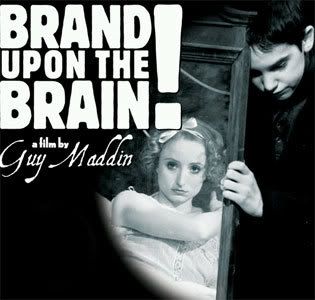
Underground in the Arthouse: Guy Maddin's Brand Upon the Brain!

I’ve been featuring clips from Guy Maddin’s films nearly since the Funhouse began, and have been very gratified to see that as the years have gone by, Guy hasn’t “gone Hollywood.” I don’t think it would be possible for him to do so anyway, given the special eccentricities of his art, but it’s been particularly interesting to see the ways in which he’s moved further and further from the multiplex “model” of bad mainstream cinema.
If a Maddin fan attempts to describe his work to the uninitiated, the first phrase that always comes out is “he makes tributes to silent movies.” That he does, but in fact he makes movies in the primitive, low-budget ways that silent moves were actually made (one of the myriad of reasons we can’t see him helming a multi-million dollar cookie-cutter H’wood pic). He pays tribute to the silent style, but his plotlines have always been particularly strange and self-aware — the scripts constructed for his films by Maddin and George Toles contain quirks and (especially) kinks that exaggerate and transcend the sleaziness of even the great outré silent filmmakers (including a Maddin fave, the great “Von,” Erich Von Stroheim). Add onto these Freudian-symbolic storylines the editing style that Maddin has recently adopted — in which simple actions are repeated, sped-up, slowed down, or even completely elided — and you’ve got a very special, particular style that seems to have more to do with the classic American underground films of the 1950s and ’60s than it does with silent movies.
Maddin has made a practice of borrowing from, and seriously exposing, his own family mythology in his recent work. Thus his most recent picture My Winnipeg was an uncategorizable dream film in which Maddin reflected on his hometown through the crucible of his childhood, with historical details, local legends, and yet another portrait of a domineering but loving mother thrown in for good measure.
The film before Winnipeg, Brand Upon the Brain! has just been released in the Criterion Collection, and so Maddin fans have the unique experience of seeing Guy enshrined along with the classic arthouse directors, and for once not suppying an audio commentary for the feature — his past films have nearly all had Guy expounding in detail on his filmmaking methods, while imparting his own personal neuroses. In fact, I’ve noticed that as his public persona has become more self-deprecating, his art has become more assured, as if the “Guy Maddin” who publicly represents the films is a Woody Allen-type construct, concealing a dedicated artist who has a found a way to more than work through his Freudian dilemmas and can appear bashful, but must be secretly delighting in turning his relatives into wildly colorful characters (as his real-life beauty-parlor owning aunt was turned into a hot blonde Madam in his Cowards Bend the Knee).
As I’ve noted more than once on the Funhouse, and have mentioned to Guy in an interview, if there is a single more Freudian scene than the urinal moment in Cowards where “Guy” sees that his father has a much, much bigger penis than he, I’ve yet to see it.
While Cowards and Winnipeg seemed like broader cartoon shadings of his family, Brand is an out-and-out fantasy scenario that he contends in the accompanying featurette is “97 percent true” because the familial relationships reflect the Maddin clan. The plot, about a lighthouse where a domineering mother sucks brain juice out of tots to keep herself looking young (in consort with her dead naked mad-scientist husband), is enriched by a host of unusual plot threads, my favorite being the adventures of a teen girl detective disguised as a boy who is the groom in the silver screen’s first lesbian Fantomas marriage (the detective babe wears the eyemask of the legendary French master-criminal).
 Guy’s fascination with silent movies led him to conceive of a live-performance aspect to Brand that was undertaken in several cities, including Toronto, NYC, and L.A. These performance featured the film being projected while a live team of Foley artists created old-radio style sound effects, an orchestra playing the soundtrack (accompanied by a “castrato” singer, more anon), and a live narrator for the pic.
We missed out on Udo Kier here in N.Y. (dammit!!!), but we did have the largest array of narrators, or rather “interlocutors” of the kind in Japan who used to “explain” the action in silent-movie houses (the explanations here being a torrid text by Maddin friend Louis Negin). Among those who appeared here were Lou Reed, Laurie Anderson, Eli Wallach, Anne Jackson, poet John Ashbery, Tunde Adebimpe of the band TV on the Radio, Crispin Glover, and the woman who supplied the permanent audio track on the movie (permanent until this disc came along), Isabella Rossellini, who performed the narration at the NY Film Festival. The Criterion disc thus features a record eight variant soundtracks, as you can choose to hear Ms. Rossellini in the “finished product” mix or live, Guy himself, Negin, or from the live performances Anderson, Ashbery, Wallach, and Glover.
The most interesting aspect of Brand is that it actually works as a silent feature without the narration, but certainly the melodrama quotient was seriously heightened. To give you a taste of what’s on the disc, I offer the following two snippets, Guy holding forth on the lure of “melodramma” (I misspell on purpose to approximate Guy’s Canadian pronunciation of the word) and the opening half of his bizarro short “It’s My Mother’s Birthday Today,” starring the aforementioned “castrato” who is actually a male singer with a falsetto voice (and presumably a real set of teeth – sorry, too much Marx Bros. training). "Mother's Birthday" is one of two new shorts that appear on the Criterion disc (along with a deleted scene that has some wild action, but I could see how it needed to be cut out):
Here we have three of the narrators doing the same brief story told to the orphans in the lighthouse (oh yeah, the lighthouse is an orphanage, thus Mom has her pic of victims to get brain juice from). I chose to excerpt the versions done by the very placid and ironic Ms. Laurie Anderson, a slightly more frenzied version by the always quirky Mr. Crispin Glover, and a full-fledged “melodrammatic” live reading by Ms. Isabella Rossellini. Listen to the voice levels rise….
And, just for good measure, here again is a segment from my own interview with Guy, where he discusses his work appearing on YouTube and his unusual and amazing new editing style:
Saturday, September 20, 2008
Inside the Mind of Comics Genius Alan Moore

Comics-writing wizard Alan Moore is my Kilgore Trout. As I remember it in the Vonnegut novels (I haven’t read ’em in a few years now), Trout is a sci-fi author whose stories only see the light of day in the form of lurid paperbacks and as filler in porn mags. In the meantime, however, he’s a brilliant writer dispensing cosmic wisdom in his works, while remaining unappreciated and certainly unknown to the public as a whole.
Moore is certainly not unknown, he’s one of the best-regarded writers of (that phrase, again!) “graphic novels” and is one of the gents who elevated the comic book into the realm of true literature. His works have been made into some middling movies (kudos to V for Vendetta for keeping the radical politics, though dispensing with much of the poetry of the piece), so he therefore can’t be too obscure. Still, Moore is thought of by those who aren’t familiar with his work as a toiler in the vineyard of capes and costumes, a superhero scribe who did that Watchmen thing everybody was raving about back in the Eighties.

Moore’s writing has always been compulsively readable, and he has been working in different genres since his start with the cartoon “Maxwell the Magic Cat” and short sci-fi and comedy features in 2000 AD. However, the last decade and a half has seen him grow into one of the most intriguing writers in the medium (a fact begrudgingly admitted in one of those alternative-comix-are-the-only-kind-to-read articles in The New York Times magazine section a few years back). In interviews and in a series of experimental and fascinating (and, yes, compulsively readable) comic series, he began to pass on a truly developed worldview that encompasses culture, politics, religion, and sex. Still, he is conceived of by the vast majority of folks (most definitely those who see the middling movies being made from his works) as a pulpsmith with a talent for plotting, but certainly not a visionary or modern-day soothsayer. The further I delved into his works a few years back, from his titanic, brilliant From Hell to the mind-bogglingly inclusive myth/culture/religion commentary in Promethea, it became apparent to me that this reclusive comic book writer, legendary for having opted out of the fan-con and personal-appearance circuit, is one of the most talented writers around. Who happens to be working in… yeah, comic books.

And why do I bring all this up? Well, because there are a few British television documentaries on Moore that are up in their entirety on YouTube, and a newly made docu about him is coming out next week from the Disinformation Company. The film called The Mindscape of Alan Moore may not be for those who are not familiar with Moore’s work or life, as it plunges you straight into his ideas without supplying context for who he is and what he represents in comic (and pop culture) history; for the background, you would need the docus on YT (plus the knowledge that he took up at age 40 heavy research into the worlds of magic, the occult, and religion). For those who are familiar with Moore’s writing in any way, however, Mindscape is a heady dose of the shaggy shaman’s philosophy on a whole host of topics. The presentation is extremely trippy, as befits Moore’s appearance and garb, but the picture essentially functions like a very interesting illustrated lecture by Alan on everything from war, politics, and culture to fame, pornography, and… quantum physics?
Moore has a terrific way of linking up disparate subjects, and I am a massive fan of artists and entertainers who connect things that ordinarily aren’t connected, or speak about the “imponderables” in layman’s terms. Moore does a lot of the latter in the film, giving us the gist of what he’s learned in his exploration of the occult, which is not so much about the spooky side of things as it is the threads between ideas. He has previously spoken about the notion of “idea-space” in interviews, but here he develops it at length (and with pitchas!) so we have the equivalent of an Errol Morris treatment of concepts that could be as dry as dust, but are vibrant, and yes, just a tad strange, but are first and foremost comprehensible reflections on the world around us. And, yeah, he does talk about his comics too (although the director, the colorfully named DeZ Vylenz, seemingly didn’t have him touch on a few of his key works like Promethea and Miracleman).
The two-disc set of Mindscape comes with an additional disc that contains six interviews, one with a comic historian (who doesn’t really offer a contextual overview, just his own reflections on Moore’s work) and five artists who have brought Moore’s work life. Of the latter, Dave Gibbons of The Watchmen provides the most interesting information about the working process — the other four artists (the men and women who illustrated V for Vendetta, The League of Extraordinary Gentlemen, Promethea, and Lost Girls) wind up discoursing on various topics and proving that, as smart and talented as they are, they are not as engaging speakers as Moore himself.
The trailer for Mindscape can be seen here:
Here’s the four –part1987 British TV docu “Monsters, Maniacs and Moore” from the show England, Their England.:
For the comics-minded, Moore provides background about four of his most famous series on the show “Comics Britannia.” The gent who put up most of these clips on YT maintains a Moore interview site here
A unique interview with Moore for a low-budget video (could this be the British equivalent of pub-access?) can be found here, and those who understand French can see a translated interview
here, plus listen to a radio interview here.
An excellent intro for those who want to delve into the spiritual/supernatural side of Mr. Moore is this “Comic Tales” interview, cut into a bunch of smaller pieces:
Wednesday, September 17, 2008
Godard's latest short available online
Our hero Uncle Jean has once again produced a short film, weaving a "trailer" from old film, poetry, and classical music. I can’t tell you how happy I am that he is still around (a very young 77), providing us with gorgeous telegrams from his Swiss hideout, delighting our eyes, minds, and emotions. He is one of the finest poets the cinema has ever known.
The film is intended as a “trailer” for the Venice International Film Festival (click on the "Viennale Trailer 2008" link). For best visual quality visit their site:
http://www.viennale.at/english/index.shtml
If you just need a quick fix, it's up on YT from about five posters:
The film is intended as a “trailer” for the Venice International Film Festival (click on the "Viennale Trailer 2008" link). For best visual quality visit their site:
http://www.viennale.at/english/index.shtml
If you just need a quick fix, it's up on YT from about five posters:
Friday, September 5, 2008
Flaming Creature: a new Jack Smith docu
When considering certain filmmakers whose work I haven’t gotten around to seeing, I always think of Andrew Sarris’s phrase in The American Cinema, “Subjects for Further Research.” In this case, I note that this week I got my first dose of the work of an American underground legend when I was given the assignment to review the excellent documentary by Mary Jordan entitled Jack Smith and the Destruction of Atlantis, which has come out on DVD from Arts Alliance America. I’m a massive fan of the Kuchar Bros. (especially the greatest complainer in the history of video art, Mr. George Kuchar) and their fan John Waters, but I confess to being a Smith-less film lover.
Jordan’s documentary offers a superb introduction to Smith’s work and his artistic allure (as well as his unrepentant eccentricities). Included in the documentary are interviews with a host of Sixties downtown types, including big George K. himself, Judith Malina, Mary Woronov, John Zorn, Richard Foreman, Tony Conrad, Ronald Tavel, Jonas Mekas, Ken Jacobs, and John Waters (oh, and the further-researcher himself… Andrew Sarris!). Their comments on Smith and life in the Village film/theater scene are fascinating, but what I was particularly taken with (besides Jack’s all-consuming loathing of his landlords… yay, man!) were the scenes from Smith’s films, which have the layered beauty and costumed elegance of Kenneth Anger, with the playful satires of Hollywood (on no budget) of the Kuchar Bros. The trailer for Jordan’s docu:
In an earlier entry in this blog I presented YouTube and Ubuweb links to the works of George Kuchar, so herewith I present the only Smith film available on YT. Of course, you must keep in mind that what Jordan’s film reveals is that Smith made a practice of not finalizing any of his movies after his landmark Flaming Creatures (1963). This is an earlier item, Scotch Tape, which evidently showed up on the Sundance Channel at some point:
As a bonus, here’s a link to an “underground movie flip book” by Smith that can be found on Ubuweb.
Since there is so little Jack Smith work available on the Web, and because I am utterly obsessed with one-hit wonders, here’s a link to the amazing, and completely unrelated, Whistlin’ Jack Smith’s 1967 chronically hook-driven “I was Kaiser Bill’s Batman.” I would make a very strong bet that you ain’t getting this tune outta your cranium once you hear it:
UPDATE (9/8): Just this past weekend Anthology showed Flaming Creatures, so I finally was witness to the crazed genius of Jack S. Much has been said about the picture, and it remains (esp. in these tight-assed times) a work that is confrontational, by turns kinetic and reflective, ugly and beautiful, profound and extremely silly. And you still couldn't air the thing on any cable channel save Sundance (who slip in some exceptionally "challenging" images every now again, as with Pink Flamingos and The Purified).
Jordan’s documentary offers a superb introduction to Smith’s work and his artistic allure (as well as his unrepentant eccentricities). Included in the documentary are interviews with a host of Sixties downtown types, including big George K. himself, Judith Malina, Mary Woronov, John Zorn, Richard Foreman, Tony Conrad, Ronald Tavel, Jonas Mekas, Ken Jacobs, and John Waters (oh, and the further-researcher himself… Andrew Sarris!). Their comments on Smith and life in the Village film/theater scene are fascinating, but what I was particularly taken with (besides Jack’s all-consuming loathing of his landlords… yay, man!) were the scenes from Smith’s films, which have the layered beauty and costumed elegance of Kenneth Anger, with the playful satires of Hollywood (on no budget) of the Kuchar Bros. The trailer for Jordan’s docu:
In an earlier entry in this blog I presented YouTube and Ubuweb links to the works of George Kuchar, so herewith I present the only Smith film available on YT. Of course, you must keep in mind that what Jordan’s film reveals is that Smith made a practice of not finalizing any of his movies after his landmark Flaming Creatures (1963). This is an earlier item, Scotch Tape, which evidently showed up on the Sundance Channel at some point:
As a bonus, here’s a link to an “underground movie flip book” by Smith that can be found on Ubuweb.
Since there is so little Jack Smith work available on the Web, and because I am utterly obsessed with one-hit wonders, here’s a link to the amazing, and completely unrelated, Whistlin’ Jack Smith’s 1967 chronically hook-driven “I was Kaiser Bill’s Batman.” I would make a very strong bet that you ain’t getting this tune outta your cranium once you hear it:
UPDATE (9/8): Just this past weekend Anthology showed Flaming Creatures, so I finally was witness to the crazed genius of Jack S. Much has been said about the picture, and it remains (esp. in these tight-assed times) a work that is confrontational, by turns kinetic and reflective, ugly and beautiful, profound and extremely silly. And you still couldn't air the thing on any cable channel save Sundance (who slip in some exceptionally "challenging" images every now again, as with Pink Flamingos and The Purified).
In her "own natural element": Deceased Artiste Roberta Collins

Roberta Collins was not an exploitation star of the first rank, but she made her sexy blonde presence known in a variety of top-notch Seventies genre classics for the drive-in and grindhouse crowd. She played a tough babe in some extremely memorable Seventies sleaze pics, from the terrific roller derby saga (starring Claudia Jennings and edited by some film student named Scorsese) Unholy Rollers (1972) and Deathrace 2000 (1975, as Matilda the Hun!) to Three The Hard Way (1972) and Eaten Alive (1977). In her later career, she appeared some really sub-par but still watchably awful Eighties sleaze, including Hardbodies (1984) and School Spirit (1985).
Why would you know Roberta? Well, if you’re a fan of the finest sleaze genre there, is the Women’s Prison picture, Roberta distinguished herself as the “hot, mean blonde chick” in a number of chicks-in-chains features. Starting with Jack Hill’s seminal exercise in Filippino prison-camp joy The Big Doll House (1971), and then in Women in Cages (1971), Jonathan Demme’s transformative, revisionist masterwork (I’m serious about that, it is terrific) Caged Heat (1974), and the latter-day revenge-behind bars classic Vendetta (1986), Roberta was at her best when imprisoned.
To illustrate the allure of Ms. Collins in her short prison shift, I offer the trailer for Hill’s The Big Doll House
And just in case you’re still drawing a blank as to exactly which blonde prisoner Roberta was, I do think that this fistfight/mud wrestling scene from Doll House where Roberta meets to settle matters with the queen of Blaxploitation (and Jack Hill discovery) Pam Grier should remind you (or at least just brighten up your day). No one has offered the official vote on this yet, but this scene has to one of the Top 5 Movie Catfights, if only for its raw sleaze factor:
and we leave Roberta in actually the finest movie she took part in, Demme’s Caged Heat, which does for the women’s prison picture what mainstream mavericks Altman and Peckinpah’s films were doing for the Western, the caper movie, the hardboiled detective saga, and a host of other genres. It’s rare that a B-budget film included so much imaginative weirdness — warden Barbara Steele’s odd Blue Angel nod alone is worth the price of admission — but Caged Heat certainly showed Demme to be a consummately talented filmmaker, and I have to say… I actually prefer it over a bunch of his mainstream pics.
Roberta left us at 62. Farewell, hot, mean blonde chick.
Wednesday, August 27, 2008
Scariest Jerry Lewis tribute. Ever.
I can't really add anything to this, except that the song is quite lengthy and staring at the image made me "trip." In a very bad way.
And if you enjoyed that clip (I really don't know if that verb could ever cover it), please check out this poster's other offerings. He has done tribute songs for Marilyn, Jackie O., Ben Franklin, Diderot, Blaze Starr, JFK, Elvis, Voltaire, and Che Guevara. King Frederick of Prussia and Lyndon Johnson "singing" are indeed great, but MLK is a personal fave of mine.
And if you enjoyed that clip (I really don't know if that verb could ever cover it), please check out this poster's other offerings. He has done tribute songs for Marilyn, Jackie O., Ben Franklin, Diderot, Blaze Starr, JFK, Elvis, Voltaire, and Che Guevara. King Frederick of Prussia and Lyndon Johnson "singing" are indeed great, but MLK is a personal fave of mine.
Tuesday, August 26, 2008
Jerry's live 1963 TV show — with amazing guest star Muhammad Ali
Even a Jerry Lewis fan can still be surprised. I discovered that when I finally saw a kinescope of one of the episodes of his ill-fated 1963 live TV experiment called, appropriately enough, The Jerry Lewis Show. Much has been said about the show, but only when you've seen it can you judge how much of a massive indulgence it really was. The biographies of Jerry note that he demanded full artistic control of the show from ABC, as well as a central Saturday primetime slot and that it be aired live from a theater to be constructed especially for the program (later renamed the "Hollywood Palace," it is of course the source of one of Dean's nastiest bon mots, the opening line from the first Hollywood Palace ep he hosted, wherein he thanked "Jerry, for building this lovely theater for me").
The program was taken off the air by ABC in a few weeks, as the ratings were dismal — Jerry never conquered TV after the Martin & Lewis teaming, even in the early Sixties when his films were riding high at the box office. However, we do have a record of this amazing (I have to use the word again, it's the only fitting one) indulgence. Here is another episode that someone has posted in its entirety on YouTube. I often mention the "old" and "new" being mingled on '60s variety series, you can't get any more hardcore than a guy who starts off his program with an up-tempo version of "When the Red, Red Robin Comes Bobbin' Along." (Jerry has never shed his utter devotion to Jolie):
And here is the moment when Jerry interviews (as the show was turned into a talk show somewhere in its short run) young dynamo Cassius Clay. Two big mouths tangle, and Jer does get "tough" with the mighty Ali, but both he and Phil Foster (not yet using the "YouthHair"!) are only teasin'. Having just finished the tough, grim, and beautifully written Nick Tosches bio The Devil and Sonny Liston, I found it interesting to hear Ali's remarks about the "big ugly bear." (He also likens Liston to a monkey, remarks that must've been enjoyed by some members of the audience who were not, let us say, sympathetic to the African-American cause):
The program was taken off the air by ABC in a few weeks, as the ratings were dismal — Jerry never conquered TV after the Martin & Lewis teaming, even in the early Sixties when his films were riding high at the box office. However, we do have a record of this amazing (I have to use the word again, it's the only fitting one) indulgence. Here is another episode that someone has posted in its entirety on YouTube. I often mention the "old" and "new" being mingled on '60s variety series, you can't get any more hardcore than a guy who starts off his program with an up-tempo version of "When the Red, Red Robin Comes Bobbin' Along." (Jerry has never shed his utter devotion to Jolie):
And here is the moment when Jerry interviews (as the show was turned into a talk show somewhere in its short run) young dynamo Cassius Clay. Two big mouths tangle, and Jer does get "tough" with the mighty Ali, but both he and Phil Foster (not yet using the "YouthHair"!) are only teasin'. Having just finished the tough, grim, and beautifully written Nick Tosches bio The Devil and Sonny Liston, I found it interesting to hear Ali's remarks about the "big ugly bear." (He also likens Liston to a monkey, remarks that must've been enjoyed by some members of the audience who were not, let us say, sympathetic to the African-American cause):
Steve's "Letters to the Editors" with guest-star Jerry
Yes, folks, I have indeed been reviewing the Jerry Lewis footage available on YouTube. I must point you to Jer appearing with one of my major heroes, Steve Allen, aiding him in the terrific "Letters to the Editor" bit.
And since we're on the topic of Jer, who doesn't wanna hear what Joey Piscopo (son of Joe) has to say about Joseph Levitch? Here Joey reveals that his dad's heroes besides the obvious (Jerry and Sinatra) are Peter Sellers and Alec Guiness. (Can ya hear the sound of the versatile dead Brits revolving in their coffins?)
And since we're on the topic of Jer, who doesn't wanna hear what Joey Piscopo (son of Joe) has to say about Joseph Levitch? Here Joey reveals that his dad's heroes besides the obvious (Jerry and Sinatra) are Peter Sellers and Alec Guiness. (Can ya hear the sound of the versatile dead Brits revolving in their coffins?)
Politically correct comedy from Dean and Jer
Yes, it's Labor Day time again, folks, so the Jer footage must flow. Here is a rarity from The Colgate Comedy Hour that I've never seen included on the VHS and DVD compilations thus far issued. It will become obvious why very early on in the routine.
Thursday, August 14, 2008
Kubrick's "missing" debut Fear and Desire up on YouTube
Now explain this one to me. Stanley Kubrick spent the better part of his life burying his first feature, the perfectly fine fledgling effort Fear and Desire (1953). I remember he was rather furious when it played at the Film Forum sometime in the 1990s, as he was loathe to have it seen in public.
After his death, the story I heard was that his family permitted the film to be seen once on a European TV channel (can’t confirm or deny this). In any case, it’s noted online that a print of it is held by the Eastman House in Rochester, and it’s obvious that it has done the rep circuit. A few years back, bootlegs of it started appearing for sale, although most were grainy, bleary-looking, and most bounced. Now, it has been pointed out to me by illustrator and fellow blogger Stephen Kroninger that the whole damned thing is up on YouTube in its bleary, crappy-lookin’ state, and has been for, oh, ten months!
The odd part about this is that this must have been brought to the attention of the Kubrick estate, which is looking the other way. A very cool and wonderful maneuver, but wouldn’t it make sense to just make the film publicly available in a pristine print from dad’s own archives? (You just know that Stan had a copy sitting around somewhere in his British archive.) Perhaps Kubrick put some provision in his legal papers to keep the thing from ever coming out, but it’s strange that it has surfaced so readily, when we all still are waitin’ to see those goofy pie-fight scenes from Dr. Strangelove that reportedly exist in British archives but are, natch, legally barred from being shown in public.
I haven’t seen the film since it played Film Forum, but my take on it was that it’s a very competent first effort, plagued by only some corny narration and a pat screenplay. It plays like a “student film” (though made at a time when there were no film schools), and shows Kubrick’s debt to the Soviet masters and other “noble peasant” pictures. It’s actually not that bad at all — but you’d be hard pressed to know that from this print.
After his death, the story I heard was that his family permitted the film to be seen once on a European TV channel (can’t confirm or deny this). In any case, it’s noted online that a print of it is held by the Eastman House in Rochester, and it’s obvious that it has done the rep circuit. A few years back, bootlegs of it started appearing for sale, although most were grainy, bleary-looking, and most bounced. Now, it has been pointed out to me by illustrator and fellow blogger Stephen Kroninger that the whole damned thing is up on YouTube in its bleary, crappy-lookin’ state, and has been for, oh, ten months!
The odd part about this is that this must have been brought to the attention of the Kubrick estate, which is looking the other way. A very cool and wonderful maneuver, but wouldn’t it make sense to just make the film publicly available in a pristine print from dad’s own archives? (You just know that Stan had a copy sitting around somewhere in his British archive.) Perhaps Kubrick put some provision in his legal papers to keep the thing from ever coming out, but it’s strange that it has surfaced so readily, when we all still are waitin’ to see those goofy pie-fight scenes from Dr. Strangelove that reportedly exist in British archives but are, natch, legally barred from being shown in public.
I haven’t seen the film since it played Film Forum, but my take on it was that it’s a very competent first effort, plagued by only some corny narration and a pat screenplay. It plays like a “student film” (though made at a time when there were no film schools), and shows Kubrick’s debt to the Soviet masters and other “noble peasant” pictures. It’s actually not that bad at all — but you’d be hard pressed to know that from this print.
Doo Dah Doo Dah: the Sensational Seventies
It’s coming onto that special time of the year when Jerry Lewis hosts the telethon, and once again we can hear the strains of music made famous by the late, great Al Jolson (Jerry will never forsake of his love of Jolie). I thought Jer’s Jolie-medleys were the height of rarified pop-culture… and then I discovered the clip below. Unfortunately, it cuts off before the medley is finished, but yes, it’s from a Johnny Cash special where Big John wanted to pay tribute to the South. Thus, he and his guests Roy Clark and Funhouse deity Tony Orlando do a selection of songs by Stephen Foster. There is no blackface, but the spirit of minstrelsy lived on quite well in the Seventies variety show and holiday special.
Hal Willner, king of the summer freebie concerts in NYC

For those who make a habit of attending these shows, the name Hal Willner looms larger than large: the celebrated record producer/musical guru puts on at least one blow-out musical marathon each year (three hours long!), and it is always a once-in-a-lifetime affair, crammed to capacity with (gasp) quality muzik. I know that Willner has put on these tribute concerts in other other cities (L.A., London, Sydney), but we have been particularly blessed to have played host to celebrations of uncommonly great tunesmiths, usually in the “Celebrate Brooklyn” series at Prospect Park.
This summer Willner put on two overstuffed concerts in the City. Although I am currently steeped in personal difficulties which I’m not going to get into now, I made sure to play “hooky” from the travails to see both shows, and am very glad I did. The first concert was a tribute to the work of Bill Withers. One’s first impulse is to say “Bill Withers?” Willner answered that question for three hours-plus on Saturday, presenting as he always does a simply gorgeous (no choice but to use Vin Scelsa’s favorite overused adjective) collection of vocal stylists singings Withers’ songs, making the argument that his work is worth exploring well beyond the mega-hits “Lean on Me” and “Ain’t No Sunshine…”
The show turned out to be a sort-of-milestone in Willner trib-history, as the guest of honor showed up, and proved to be a ham who misses being on stage (Withers quit the biz in the 1980s and hasn’t returned since). He’s also hesitant to sing again in public — although he spontaneously joined guitarist Cornell Dupree on a tuneful version of his “Grandma’s Hands,” he would not (repeat, would not) take the hint and join his daughter on the obvious duet set-up “Just the Two of Us” (his daughter obviously hoping for a pre-mortem variation on the Nat/Natalie Cole “Unforgettable” business). Check out Bill at his Seventies’ best for a minute:
The Withers show was a solid evening of terrific music and standout performances by both “name” performers and folks I’d never heard of. Willner’s shows thus serve not only as an exploration of the honoree’s work, but also provide a valuable first look for many of us at performers with killer voices (like the “gay Joe Cocker,” the amazing Antony). Heavily recommended is the close-up happy but musically exquisite concert pic Leonard Cohen: I'm Your Man, which shows one of the Willner tribute shows.
Last night I attended the second Willner show in five days, a tribute to jazz and pop record producer Joel Dorn. The show was an unusual one for a Willner presentation, as it was both a de facto memorial service, as Dorn died just a few months back, and it was a celebration of a man who never wrote the music he’s associated with. Willner has assembled tribute albums to Nino Rota, Kurt Weill, Disney music, and Mingus; his tribute concerts have saluted Doc Pomus (twice!), Leonard Cohen, Neil Young, et al.).
The fact that Dorn was a producer in fact made his tribute the most eclectic Willner show I’ve seen to date. The performances ranged from top-notch jazz (Jacob Fred’s Jazz Odyssey covering Rahsaan Roland Kirk, surprise guest Hugh Masekela) to doo-wop (The Persuasions’ “Ten Commandments of Love”) to ballad perfection (Roberta Flack doing the Dorn-produced classic “The First Time Ever (I Saw Your Face)”) to New Orleans gold (Dr. John tackling “April Showers”) to some guy playing a fuckin’ killer electric guitar rendition of the “Spiderman theme” (augmented with the Green Hornet’s bumblebee flight).
The performances were, dare I use the word again, killer. The nicest touches during the evening were moments in which we were played records produced by Dorn (Yusef Lateef’s “In a Spanish Town” conjured up happy memories for me of Buster Keaton; Aaron’s Neville’s “Mona Lisa” was broadcast from the near side of Heaven).
The Funhouse is all about juxtapositions, so I will note that Willner’s shows are chockfull of beauts, and the Dorn tribute had tucked away in it an absolute joy: a short-lived ’70s funk band, Black Heat, reunited to perform their one hit “No Time to Burn,” turning this mutha out, and then cabaret singer Jane Monheit offerd a flawless, emotional “Somewhere Over the Rainbow.” Some impresarios might’ve put the funk band after the cabaret babe, but Willner takes chances with the audience’s attention and commitment, and for this he deserves massive plaudits.
And when ya consider that you can’t even sit in the rafters of the Beacon or MSG these days for less than a hundred (and the tourist-trap theme restaurants provide a 20-dollar show for 50), the Willner musical lovefests are all the more remarkable.
The Dorn show ended with Les McCann reprising this 1969 gem, “Compared to What?”
Thursday, August 7, 2008
"You Have to Know a Man Like a Brother to Kill Him": review of Blast of Silence (1961)

For film noir fans, one of the most significant recent DVD releases was the Criterion Collection editon of Blast of Silence. The 1962 film has never been legally available before on either VHS or DVD, and is without question one of the very last great noirs made in the U.S.
I say “last” because film noir has been best defined (by Raymond Durgnat and Paul Schrader, among others) as a cycle rather than a genre, and the start/stop dates of the production of purebred noirs is generally thought to be 1944-55. A few gems came after ’55, including Robert Wise’s quietly beautiful Odds Against Tomorrow and Orson’s absolutely perfect Touch of Evil. By 1962, the date of Blast, however, noir had disappeared from movie screens and was seen to best advantage on the TV series Naked City. The cycle may have been over, but filmmaker-star Allen Baron supplied it with a beautiful coda with the exquisitely cold, visually gorgeous Blast.
The film follows hitman Frankie Bono (Baron) as he returns to New York City to take out a mobster. From the start, we know Frankie is a doomed man (see my previous entry on Classe Tous Risques) and to add insult to injury, he’s an unrepentant tough guy who, like all hitmen, is all business and would not make a very good drinking buddy.
The low-budget NYC production pretty much flew under the radar upon its initial release — though lauded (natch) in Europe, Blast was dropped on double bills by Universal, its distributor. The complete saga of the film is recounted in a very in-depth German-produced video documentary (insanely detailed, with a full tour of the NYC locations) included on this disc. What made the film such a cult hit on the rep circuit (I first saw it at the Thalia Soho in the late ’80s), is its pitch-perfect combination of elements.
The cast are all “no-names” except for Larry Tucker (seen in Shock Corridor, and a Paul Mazursky collaborator), but they perfectly incarnate the shady characters moving around the indelibly real NYC locations (the film was made on a meager budget; as with the Italian Neo-Realists and the French New Wave, poverty is the mother of cinematic invention).
But then you’ve got the piece de resistance, the narration. Credited to “Mel Davenport,” the second-person narration, which directly addresses our antihero (“baby boy Frankie Bono, out of Cleveland”), was written by the brilliant blacklisted screenwriter Waldo Salt (Midnight Cowboy, Serpico, Coming Home). And it is delivered by the most hardboiled voice ever, Lionel Stander. Stander isn’t credited, Baron reveals in the documentary, because he said he’d need more money if they used his name on-screen (which seems odd, as he too was blacklisted at the time the film came out), but his voice lends an unmistakably grim yet compelling tone to the proceedings — there is no question, the guy sounds like the tough-as-nails, no-bullshit conscience of Frankie Bono. He also dispenses with philosophical statements and no-exit existential reflections on mankind that must’ve surely thrilled the French, and linked Blast close to another late-late hitman noir, Irving Lerner’s terrific Murder by Contract (1958) (DVD release, please!).
Noir fans owe it to themselves to see and re-see the picture, but it always brings up a serious question: why didn’t we hear more from Baron as a filmmaker, noir or otherwise? Well, he is quite open in the documentary included here about the fact that Hollywood beckoned, and he answered the call. He only made two theatrical features after Blast (neither of which I’ve seen, so I can’t judge if they are in the BOS ballpark), but he worked steadily for decades on successful but formulaic series television (Charlie’s Angels, Dukes of Hazzard, my favorite non-guilty pleasure, Fantasy Island, and the immortal Kolchak: the Night Stalker). We’ll never know what Baron might’ve created if he had stayed an indie working on the East instead of West Coast, but we do have Blast, and is a serious dose of hardcore noir. Rent it, and lose yourself in the tunnel of desperation that comprises the life of “baby boy Frankie Bono” — and check out Manhattan back when it was a noir paradise.
Some helpful poster put up the film’s trailer:
These scenes, though, illustrate best what the film is all about. First its stark opening:
And then a beautiful bit of noir Christmas, as Baron’s character walks through Rockefeller Center at Christmas. This truly is the lonely poetry that best defines the film noir:
Haircut 101

Pop culture is all about personal taste, so I might as well declare that I think the 20th century started seriously sucking — in terms of film, music, and television — in the Eighties, and it has never quite recovered. Yes, I guess love of pop is always a generational thing (you will over-romanticize the period you grew up in, or "just missed" growing up in), but jeez, just look at the slide from “pure pop (for now people)” to pure pap, and you’ll realize the Reagan era did us mediaholics in but good. More choices, but the mainstream got awful, incredibly awful.... I like plenty of current-era items, but the move from quality pop culture being actually (ahem) popular to being niche or "alternative" that started in the Eighties and was thoroughly defined in the Nineties was an insidious one.
I say this because I have been revisiting my old records in the weeks past, and once again have been lost in the joys of songs you just can’t get outta your head. And yes, the occasional item does come from those Madonna/Reagan-mediocre Eighties. As is the case with the 1982 single, Haircut 100’s “Love Plus One.” The video for this catchy-as-hell tune can be found here and here and here.
As an aside, I’m fascinated by posters on YouTube who don’t allow for embedding, as is the case with the three people who put up the "Love Plus One" vid. I don’t think it really fakes out the copyright holders at all (does it indeed? I’d be interested to hear if this is the one way to keep things from being taken down but still properly i.d.’ed). Thus, the posters seemingly don’t want us blog-folk to share ’em. Well, clicking through is still allowed, so just go ahead and enjoy the song….
Friday, August 1, 2008
Magnificent Mabel: review of The Extra Girl

To continue the discussion of brilliant woman comedians/comic actresses (see below), I thought I should move back a bit from the Seventies. Actually quite a bit — let’s talk about the Twenties and the absolutely adorable comic pioneer Mabel Normand.
I do this on the occasion of the Kino release of one of her best features, The Extra Girl (1923). There is an excellent biography (Mabel by Betty Harper Fussell) and a really good tribute site that outlines her place in movie history, so I’ll just emphasize that she was a crucial part of Mack Sennett’s Keystone studio, directed some of her own movies (making her the first comedienne to do so, predating Mae West’s screenwriting by two decades), and had a completely winning presence on camera. She was an attractive woman who most likely could have “gone straight” at any time in her short career (1910-27) but wisely followed the example of her Keystone partner Charlie Chaplin, and continued to make comedies with strategically-placed bursts of pathos.
The plot of The Extra Girl offers just such melodramatic moments: Mabel is a small town girl who dreams of movie stardom, but is being forced by her parents to marry a drip. Through characteristically goofy circumstances, she wins a contest and winds up working in a Hollywood studio in the wardrobe dept (no matter the title — she never works as an extra), and is later “discovered.”
These days silent comedy is seen as a very rarified taste, fit for only two hours on TCM every few Sunday nights. I believe that there is something incredibly pure about silent comedy, and some of the purest silent comedies came from Mack Sennett and Keystone. Mack was the master of shooting on the spur of the moment and the early Keystones are an absolute joy (and remarkable slices of L.A. county history) for this very reason.
The bios of Sennett stress his complicated love for Mabel (and hers for him); it’s also noted that he financially undervalued his stars, and kept having them plucked from under his nose. In The Extra Girl he provides an excellent showcase for Mabel’s talents, preparing her for later features like Mickey and The Nickel Hopper, both of which deserve legal releases on DVD (especially the last-mentioned).
Mabel was a subtle comic actress who could camp it up when the scene required, as at the end of the Keystone short included as a bonus on this disc, The Gusher (1913). She also presents an array of “smaller” gestures to match the situation. In The Extra Girl the most famous sequence finds her dragging around a lion that she believes is a dog in a lion suit. The situation is ridiculous, but she keeps the deadpan for the duration and carries it off beautifully (she is actually together with the lion in just about two shots; the sequence is carefully edited so she wasn’t in too much danger).
Kino has been doing exemplary work in issuing silent cinema for many years now. The company’s supreme achievements have been the Art of Buster Keaton collection and their release of German Expressionist classics. Their “Slapstick Symposium” series of releases are proving to be as fascinating and indispensable as their “Slapstick Encyclopedia” releases were on VHS (that set is now available on DVD through Image). Separate “Symposium” releases are each devoted to the work of a silent comedian (Lloyd, Langdon, the underrated Charley Chase, solo Laurel, solo Hardy), and The Extra Girl now breaks the gender line and shows off to good advantage the funniest (and one of the cutest) ladies in the silent era.
Friday, July 25, 2008
"Soul Coaxing": Deceased Artiste Raymond Lefèvre

The world of easy listening, what used to be called “beautiful music” on the airwaves here in the U.S., lost one of its Gallic icons, the composer Raymond Lefèvre, at 78, the other day. I will refer you to his greatest international hit, something that I hadn’t heard in literally decades but which is imprinted soundly on my brain pan, the instrumental “Soul Coaxing.” Lefèvre worked with both the immortal Dalida (French singer and heavy-duty gay icon) and Eddie Constantine (yes, “Lemmy Caution” used to sing). He also did scores for several hit comedies featuring “Rabbi Jacob” himself, Louis de Funès.
Take a listen to “Soul Coaxing” (have I mentioned lately how much I love the French?), and just float away on its cushion of mega-plush sound. Thanks to M. Faust of Buffalo’s Mondo Video for passing this one on.
Thursday, July 24, 2008
"Living well and ripping your enemy's still-beating heart out with your bare hands is the best revenge": the forgotten work of Michael O'Donoghue

Since the post below begs the question, what exactly do you find funny, Ed, if you can’t laugh at the hee-larious antics of that tall, gawky, spontaneous, and oh-so-glib Will Ferrell whom millions’a happy souls think is really a panic? Well, I have already offered a few dozen answers on this blog, but I will supply one more: Michael O’Donoghue, aka “Mr. Mike,” the rapier-sharp nasty black humorist whose wit was exhibited in The National Lampoon (both the magazine and the radio show).
He was no doubt the best writer ever to toil in the Lorne Michaels “we’re gonna run this fuckin’ character into the ground” factory that seems to amuse so many folks who want to watch TV in real time on Saturday evenings (hey, in NYC, just flip over after you’re done laughing yourself into unconsciousness, and give the Funhouse a try — I may be tackling a topic that doesn’t suit your fancy, but I can guarantee it won’t insult yer intelligence).
O’Donoghue’s life was well-chronicled in the essentially biography Mr. Mike by Dennis Perrin, but the true guts of the man’s material is to be found in a bunch of old Seventies (and, surprisingly, Nineties) magazines, plus on the discs of vintage SNL that are now slowly being shuffled out. He was the natural extension of the “sick humor” gods of the Fifties/Sixties (Bruce, Berman, Sahl, Nichols & May), but he added a very nasty rock ’n’ roll/punk sensibility (without ever playing the “rocker” roll himself, unlike the great Bill Hicks or the wafer-thin “Dice” Clay).

There isn’t a lot of free Mr. Mike on the Web — a search on the official SNL site produced none of his “Least-Loved Bedtime Stories” or his odder creations like the Ricky Rat program. Instead we must turn (natch) to YouTube, where some helpful soul has uploaded the first five minutes of his Mr. Mike’s Mondo Video, which I was so taken with as a teen that I sat through it twice in a theater (it was short, and christ, when you alternate between sacrilegious and sexy material, and Root Boy Slim and his Sex-Change Band and El Sid himself, you couldn’t lose).

The site doesn’t have the one wherein [paraphrase, I'm doing this from memory] he notes that Whoopi Goldberg has done charity work for every humanitarian organization except the “Give Whoopi Goldberg a facelift because she’s an ugly bitch fund.” O’Donoghue took no prisoners when writing humor, which is the way it should be. He also hit on some universal truths in his seemingly scattered and angry rants. Check out the fourth column included here, which is his final word on the Rat Pack (this years before the heavy-duty sentiment set-in for Sinatra’s “clan” of compares. In discussing Liza Minelli, he gives us this bit of pop-cult wisdom:
"The person in the most pain wins."
This simple truth is the basis of all daytime chat shows-- "Notice me, Phil. I'm a woman and my husband beats me." "Notice me, Sally. I'm a woman and I'm black and my husband beats me and my father sexually abused me." "Notice me, Ricki. I'm blind -- so blind that I don't even know if I'm black or a woman -- and somebody -- it's so dark it's hard to tell -- beats and rapes me and I weigh 850 pounds." "Notice me, Montel. I'm a woman, I'm handicapped, I'm fat, everybody from the mailman to the parish priest beats and rapes me, my son has Gay Bowel Disease, my daughter was born with pot holders for hands and I'm on fire right now." "Notice me, world. I'm Liza."
I think he hit that target with a bullseye (and years before the even more pathetic ceremonial-ritual of the reality show “confession booth” came into being). I also think he was an incomparably funny individual.
Gilda, We Miss Ya, or when comedy was (gasp) funny

Occasioned by my finally listening to the audio book (on audio tape, yessir, it is) of Gilda Radner’s at times heartbreaking cancer-chronicle It’s Always Something, I offer a little bit of joy from her terrific retrospective show Gilda Live, which I did indeed see when it had its limited time on B’way.
Thinking about Gilda again, I was brought to mind of the fact that the recent Vanity Fair cover proclaiming a heyday for female comedy had it all wrong: comic actresses/sketch goddesses had their heyday back in the Seventies, and the wimmen plying the trade today, while fine and okay to watch, just simply ain’t funny (Tina Fey=snark, Sarah Silverman=deadpan, with “shocking” subject matter; Amy Poehler=perky and… well, who cares?). They are, simply put the female equivalents of today’s biggest movie comedy star, Will Ferrell, a big void on screen. A pleasant, friendly void, mind you (the guy, and those ladies, seem to be well-loved in the biz), but not bright, witty, brilliant, and funny in the way that the classic screen and TV comedians were (yes, call me middle-aged and cranky, but you stack any of these sorry-assed Lorne Michaels discoveries up to Groucho, W.C. Fields, Laurel and Hardy, Sid Caesar, Kovacs, Lenny Bruce, Steve Allen, Richard Pryor, the late Carlin, and you’ll see how the national funnybone is now equivalent to the voting sentiments: “well, he/she seems like they’d be fun to have a beer with…”). It's the triumph of the funny guy at the company picnic, or the office clown, whose humor only has relevance in that same workplace.
Thus, I think back fondly to the Seventies, when Gilda, Catherine O’Hara, and Andrea Martin showed what it’s like to have a range in comedy (please don’t tell me Amy Poehler has played many characters on SNL— they all register as the exact same person in a different wig and costume). I salute them and miss their presence on the tube (Gilda's presence is missed in general). Women in comedy is a tricky subject: there are goddesses at certain times, and the rest are are the grinning wives on sitcoms and women who do wacky/crappy skits on shows like SNL and Mad TV.
There are also women stand-ups who break down barriers, but who don't seem to be eternal as the male comedians (for instance, in the world of comedy records, a world I have delved too deeply into, it's hard to think of an LP by a woman comic, save Elaine May's eternal contribution to the perfect three Nichols/May records, that you'd easily break out and replay countless times). The pioneers were the housewife ladies (Phyllis DIller, Joan RIvers); the stalwarts were the filthy ol' dames (Belle Barth, Pearl Williams, Rusty Warren); and at any given time there are about two-three "famous" (read, in today's favorite term, "branded") women stand-ups. Today, they are Sarah Silverman (again, deadpan, deadpan, deadpan, some funny lines, but it's all 'bout the deadpan), and Lisa Lampanelli (all-out filthy, taking the guys on on their own turf, with the addition of the "I fuck black guys" trope).
Whenever anyone writes about this subject, one steps delicately around the possible assertion that their comedy may not be "for the ages" as it is for the handful of male comic icons. You run the risk of being called a sexist (which I'm doing right now), but I think the best way to counter that assertion is to note the perfection of a small number of female sketch comedians, from Imogene Coca (and, okay okay, Lucy) to the ladies mentioned above, who brought versatility into the mix for good (and then Lorne Michaels' crew sucked it out, with decades of really, really shitty comedy).
To sum it all up (and get down to the clip below), what we’ve got now in the way of comedy “stars” in American sketch comedy and major motion picture crappy-vehicle pics is a sorry, sorry lot indeed. I am reminded of the wonderful Albert Brooks “comedy institute” short film that aired on the show-that-has-now-been-seriously-reeking-for-decades, Saturday Night Live. In that little flick, Albert is cornered by an angry man who has been dying to tell him that he’s not funny. The gent pushes Albert against a wall, and accosts him, telling him that he’s not funny at all, why the hell did he think he was funny, etc.
You know the sad, sorry thing about today’s lackluster “friendly” bunch of comic lights? They’re not even worth pushing up against a wall and screaming at (Chris Farley, now there was one monstrously unfunny performer, worthy of a “what the fuck?” confrontation; Carrot Top, good for an attack; Adam Sandler, doing that fucking high-voice shit for the thousandth goddamned time — but who could even get angry about how tediously deadpan and UNFUNNY Ferrell and his comic posse are, it ain’t even worth it).
I am glad that there are a few folks who are doing quality material (the "fake news" folks on Comedy Central, Larry David, and Brits like Gervais and Coogan, who can construct a comedic concept like it’s nobody’s business). American moviegoers, on the other hand will actually pay to see Ferrell, Ben Stiller (funny for the run of his terrific Ben Stiller Show, rough, truly rough since), and Jack Black (ah, the appeal of rotund "cool" guys — I'm not even getting into that).
Let me, finally, soothe my achin’ comedy-fan head with the words of the late god “Mr. Mike” as sung by our fair Gilda. Who else could add the proper amount of cuteness to “fuck you, Mr. Bunny/eat shit, Mr. Bear/if they don’t love it, they can shove it/frankly, I don’t care…”? Play this one for the kiddies.
The YouTube poster didn’t want embeds (huh?), so click here.
A not-so-Dark Knight: Batman (1966) hits Blu-ray
Okay, first let me be honest and say I don’t have a Blu-ray player (someday, when that ship comes in…). That stated, I will note that the Adam West Batman movie, a theatrical feature that was made in the summer hiatus after the show had proven a major TV hit, has come out on this latest high-def, boy-does-it-look-good format. I will point you in the direction of some of the featurette snippets that are on the disc. And thus we have the original trailer. And Adam and Burt Ward reflecting on the series’ absurd humor.
Now that the film is out in the best of condition, it’s interesting to note that there’s currently no ETA on the release of the Batman series itself, since the various parties who hold the rights to the show and the character still haven’t made a deal. In that case, wouldn’t it be nice (ah, dream on) to have an actual rerun network that runs these things all the time…?
Now that the film is out in the best of condition, it’s interesting to note that there’s currently no ETA on the release of the Batman series itself, since the various parties who hold the rights to the show and the character still haven’t made a deal. In that case, wouldn’t it be nice (ah, dream on) to have an actual rerun network that runs these things all the time…?
Thursday, July 17, 2008
“End of the Road”: review of Classe Tous Risques
 The best film noirs are invariably about doomed characters, men and women who initially rail against, and then make peace with the fact that, as one title put it, “nobody lives forever.” Claude Sautet’s Classe Tous Risques (1960), which was recently released by Criterion, features one such doomed antihero, a crook named Abel Davos played by the great Lino Ventura.
Classe begins with Abel and a cohort successfully pulling off a theft, but inadvertently causing the death of Abel’s wife. The rest of the picture finds Abel struggling with the fact that his future is pretty much nil, but he still has to care for his two sons. Enter a rather convenient helpmate: a young hood (Jean-Paul Belmondo) who helps him avoid the cops and also watches out for his kids.
The fact that the melodramatic aspects in Classe don’t drag the film down is a testament to both fledgling director Sautet’s skill at pacing his curiously tripartite thriller, and to the film’s cast, particularly its two leads. For all the strangeness of his role (his character bonds with Ventura a mite too quickly), Belmondo makes a terrific costar — something he was never to do after he became a box-office god. Classe was made shortly after Godard’s A bout de souffle had been filmed, so JPB was still just a young eager performer who happens to get a nice showcase for his talents here, as you can see in the rather lengthy French trailer below. Ventura was a phenomenal talent possessed of an incredible face and a quiet simmering presence just made for noir: he gave two of his best performances for the king of French darkness, Jean-Pierre Melville in Le Deuxieme Souffle (coming out soon from Criterion — after not having played in the U.S. for decades!) and Army of Shadows (already out from… you guessed it).
Speaking of Melville, he is revealed to be a fan of Classe in the notes included with the package. He raved about the film and director Claude Sautet, perhaps because Sautet was not a member of the French New Wave, the group of young filmmakers for whom Melville served as an inspiration, and later became an antagonist (in the 1962 piece included here, he in fact vaunts Sautet by crackin’ wise about Truffaut). Another major fan of the film is consummate film-fan and Funhouse interview subject Bertrand Tavernier, who maintains he wrote his first-ever review about the film, and defended its reputation as a B picture by declaring “Better to be B like Boetticher than A like Allégret!” (thereby slamming a noted French director and praising another Funhouse favorite and interview subject). Tavernier mounts an argument that the film’s seemingly odd construction, including a rather sudden ending, is to its benefit.
Finally, since this is a review of a Criterion release, I have to praise the characteristically terrific obscure TV interviews they’ve dug up. First is a segment from a documentary on Sautet, in which he reflects back on this, his first complete feature as a director (he had taken over a preceding film), and the film’s initial box-office failure is discussed (it evidently was overshadowed by the new crime flicks like the aforementioned A bout de souffle). Ventura is seen being interviewed in both the Sixties and the Seventies, and proves to be as calm and reflective offstage as he was on (only don’t mess with him, alright? One sequence where he picks up a guy up and throws him over a table is explained by talk of his past as a Greco-roman wrestler). The most interesting supplement is an interview with the film’s scripter, Jose Giovanni, who adapted his own novel. Giovanni also wrote Le Trou and Le Deuxieme Souffle among many other films, and was unashamed to discuss his past as a crook (in fact Le Trou was his account of an unsuccessful jail break he took part in). He reveals that Classe was based on a real crook he knew when he was “inside” on death row. Now let’s see other crime-movie scripters compete with that sort of pedigree….
Here is the original French trailer for the film, which gave me a clue as to what the title was getting at, when the narrator pronounces it like “Classe Touriste”:
The best film noirs are invariably about doomed characters, men and women who initially rail against, and then make peace with the fact that, as one title put it, “nobody lives forever.” Claude Sautet’s Classe Tous Risques (1960), which was recently released by Criterion, features one such doomed antihero, a crook named Abel Davos played by the great Lino Ventura.
Classe begins with Abel and a cohort successfully pulling off a theft, but inadvertently causing the death of Abel’s wife. The rest of the picture finds Abel struggling with the fact that his future is pretty much nil, but he still has to care for his two sons. Enter a rather convenient helpmate: a young hood (Jean-Paul Belmondo) who helps him avoid the cops and also watches out for his kids.
The fact that the melodramatic aspects in Classe don’t drag the film down is a testament to both fledgling director Sautet’s skill at pacing his curiously tripartite thriller, and to the film’s cast, particularly its two leads. For all the strangeness of his role (his character bonds with Ventura a mite too quickly), Belmondo makes a terrific costar — something he was never to do after he became a box-office god. Classe was made shortly after Godard’s A bout de souffle had been filmed, so JPB was still just a young eager performer who happens to get a nice showcase for his talents here, as you can see in the rather lengthy French trailer below. Ventura was a phenomenal talent possessed of an incredible face and a quiet simmering presence just made for noir: he gave two of his best performances for the king of French darkness, Jean-Pierre Melville in Le Deuxieme Souffle (coming out soon from Criterion — after not having played in the U.S. for decades!) and Army of Shadows (already out from… you guessed it).
Speaking of Melville, he is revealed to be a fan of Classe in the notes included with the package. He raved about the film and director Claude Sautet, perhaps because Sautet was not a member of the French New Wave, the group of young filmmakers for whom Melville served as an inspiration, and later became an antagonist (in the 1962 piece included here, he in fact vaunts Sautet by crackin’ wise about Truffaut). Another major fan of the film is consummate film-fan and Funhouse interview subject Bertrand Tavernier, who maintains he wrote his first-ever review about the film, and defended its reputation as a B picture by declaring “Better to be B like Boetticher than A like Allégret!” (thereby slamming a noted French director and praising another Funhouse favorite and interview subject). Tavernier mounts an argument that the film’s seemingly odd construction, including a rather sudden ending, is to its benefit.
Finally, since this is a review of a Criterion release, I have to praise the characteristically terrific obscure TV interviews they’ve dug up. First is a segment from a documentary on Sautet, in which he reflects back on this, his first complete feature as a director (he had taken over a preceding film), and the film’s initial box-office failure is discussed (it evidently was overshadowed by the new crime flicks like the aforementioned A bout de souffle). Ventura is seen being interviewed in both the Sixties and the Seventies, and proves to be as calm and reflective offstage as he was on (only don’t mess with him, alright? One sequence where he picks up a guy up and throws him over a table is explained by talk of his past as a Greco-roman wrestler). The most interesting supplement is an interview with the film’s scripter, Jose Giovanni, who adapted his own novel. Giovanni also wrote Le Trou and Le Deuxieme Souffle among many other films, and was unashamed to discuss his past as a crook (in fact Le Trou was his account of an unsuccessful jail break he took part in). He reveals that Classe was based on a real crook he knew when he was “inside” on death row. Now let’s see other crime-movie scripters compete with that sort of pedigree….
Here is the original French trailer for the film, which gave me a clue as to what the title was getting at, when the narrator pronounces it like “Classe Touriste”:
Thursday, July 10, 2008
Playing games with his audience: Peter Greenaway’s Tulse Luper Journey website
 Several indie directors have taken the time to maintain blogs about the productions of their movies, or offer updates on their movements around the country/world. David Lynch has created a little world of his own at www.davidlynch.com. And now I find that another filmmaker of limitless imagination, Peter Greenaway, has had an interactive site up and running since 2006. The Tulse Luper Journey is an extension of a concept he began in his earliest shorts: the studies of Tulse Luper, fake expert who may or may not even exist.
Greenaway has stated in interviews that Luper is a sort of alter ego for him, but I also believe the character is his ultimate spoof of academia: an expert who contradicts himself and can't be trusted; a source of information that changes its definitions; an authority who may be full of shit. Greenaway offers a list of strange facts about Luper (“Tulse Luper, not knowing what else experiences were for, turned all of them into some form of literature. Even whilst having a heart attack, he was wondering how to spell the word "cardiac".” “Tulse Luper found it difficult to continue to be antagonistic forever. But he kept trying.” “Tulse Luper knew that without a God, the Universe could be considered to be even more amazing.”) at his website.
But that’s not all. Greenaway embarked in the early 2000s on a series of films called The Tulse Luper Suitcases, and created a site that allows “researchers” to go through the great man’s luggage (which is said to contain the sum total of Luper’s knowledge, plus maybe, quite possibly, the secrets of the 20th century). It seems that the site’s big “trip around the world” was indeed won by one gentleman (despite the fact that all 92 suitcases haven’t been “opened” to date), but there are at least 26 esoteric games available on the site, all for free.
I’m not a computer/video game-player, but I ante’d up and mostly lost points while having fun. The games include some of the usual attractions (dropping stuff from a plane, reassembling scrambled photos, a variation on “Clue”), but there are some pure Greenaway time-wasters (assembling photos out of narrative fragments, making a series of mouths saying words speak a sentence, and even creating “bloodied wallpaper” by punching the hell out of some unfortunate actors). I believe the entire site works by the three laws of thermodynamics that are quoted when you begin one game: 1.) You can’t win. 2.) You can’t break even. 3.) You can’t get out of the game.
Sorta like life, when you think about it.
Here’s a trailer for the site. Watch it, and then play a game or two at the the Luper site, which is structured, natch, like an academic research facility (in fact, a number of research facilities).
Sins of the Flesh: Dennis Potter’s Brimstone and Treacle
On any short list of things that MUST come out some day on DVD in America are the brilliant television plays of British TV genius Dennis Potter. Currently, the only place to discover these slices of innovation, raw emotion, and just incredibly fine writing are at the Paley Centers in New York and L.A., but at least one of Potter’s many “missing” masterpieces is available on YouTube. Two posters in fact have put up the original television version of his Brimstone and Treacle. I thank them both heartily, and any other Potter gems they can throw our way would be more than appreciated.
The 1976 play was banned from the BBC, and didn’t air until 1987, but by that time the British public had the opportunity to see it on stage (in ’77), and in a big-screen version starring Sting and Denholm Elliott. It concerns a drifter who scams his way into the house of a couple tending to their daughter, who is in a coma because of a hit-and-run incident years before. It is implied that the charming-yet-sinister drifter could well be Old Scratch himself. The play is only one of the many brilliant Potter productions that need desperately to reach a broader audience (currently it's only easy to find his Singing Detective and Pennies from Heaven in the U.S.). If I needed to make a short list (having seen most of the stuff the Paley Center has in its simply amazing coffers), I’d also include Moonlight on the Highway, Joe’s Ark, Schmoedipus, Double Dare, Blue Remembered Hills and, most definitely, Follow the Yellow-Brick Road. For the time being, feast thine orbs on the original Brimstone:
The 1976 play was banned from the BBC, and didn’t air until 1987, but by that time the British public had the opportunity to see it on stage (in ’77), and in a big-screen version starring Sting and Denholm Elliott. It concerns a drifter who scams his way into the house of a couple tending to their daughter, who is in a coma because of a hit-and-run incident years before. It is implied that the charming-yet-sinister drifter could well be Old Scratch himself. The play is only one of the many brilliant Potter productions that need desperately to reach a broader audience (currently it's only easy to find his Singing Detective and Pennies from Heaven in the U.S.). If I needed to make a short list (having seen most of the stuff the Paley Center has in its simply amazing coffers), I’d also include Moonlight on the Highway, Joe’s Ark, Schmoedipus, Double Dare, Blue Remembered Hills and, most definitely, Follow the Yellow-Brick Road. For the time being, feast thine orbs on the original Brimstone:
Thursday, July 3, 2008
For the July 4th weekend: high and low entertainment
To beckon in the holiday weekend, I can think of no better offerings than the following. For the high art, I give you the exquisite work of Hungarian filmmaker Béla Tarr. I have only seen two of Tarr’s movies, one of them being his overwhelming, hypnotic masterpiece Satantango (1994), which runs a mere seven hours, and his last film, The Man from London (2007). This week I was reviewing the Facets DVD release of the former (coming in July) for my freelance gig, and thought I’d pass on two small segments of work from a filmmaker whose work can, for the most part, not be excerpted (it’s about time, it’s about duration, it’s about sadness and sarcasm). And to experience his work for real, you really need to see it on a movie screen.
In SPITE of all that, I offer:
A dance sequence that contains an air of beautiful desperation from his Damnation (1988):
And a gorgeous short film he contributed to the film Visions of Europe (2004), which he calls “Prologue.” Tarr is a poet of black and white, and his films are sensory experiences.
And because the Funhouse is about nothing as much as the mingling of the high and the low, I give you an utterly ridiculous Swedish music video (yes, the Seventies were a particularly harsh time for the stylistically challenged, but man, are the misfires ever compelling):
And the accordion music heard in Tarr’s features has it all over that of the late great Lawrence Welk (“ah-one and ah-two”). I don’t know which is the more representatively godawful clip from the Welk program (which still runs all over America on public television, as if beamed from outer space, some planet where they still publish the Saturday Evening Post). Dig Larry in his hippie threads, circa any Beach Party movie or Sonny and Cher variety-show appearance (to quote Lenny's jazz cat auditioning, “you got a nutty wig there, Polack”):
and because the Seventies were a confused time, let us view a perhaps oddly chosen cover from the Welk program. “One Toke Over the Line” by Brewer and Shipley:
Thanks to Miss Kat and M. Faust for contributing to this madness.
In SPITE of all that, I offer:
A dance sequence that contains an air of beautiful desperation from his Damnation (1988):
And a gorgeous short film he contributed to the film Visions of Europe (2004), which he calls “Prologue.” Tarr is a poet of black and white, and his films are sensory experiences.
And because the Funhouse is about nothing as much as the mingling of the high and the low, I give you an utterly ridiculous Swedish music video (yes, the Seventies were a particularly harsh time for the stylistically challenged, but man, are the misfires ever compelling):
And the accordion music heard in Tarr’s features has it all over that of the late great Lawrence Welk (“ah-one and ah-two”). I don’t know which is the more representatively godawful clip from the Welk program (which still runs all over America on public television, as if beamed from outer space, some planet where they still publish the Saturday Evening Post). Dig Larry in his hippie threads, circa any Beach Party movie or Sonny and Cher variety-show appearance (to quote Lenny's jazz cat auditioning, “you got a nutty wig there, Polack”):
and because the Seventies were a confused time, let us view a perhaps oddly chosen cover from the Welk program. “One Toke Over the Line” by Brewer and Shipley:
Thanks to Miss Kat and M. Faust for contributing to this madness.
The Psychedelic Lenny Bruce: Murray Roman

While I’ve been immersed in George Carlin material since his death last week, I have been brought back, time and again, to thoughts of George’s stand-up hero, the one and only Lenny. George used the lessons learned from Lenny in an original and innovative way, and went from outright impersonations of the guy (on his LP with Jack Burns) to doing linguistic and social hypocrisy bits inspired by him, to simply using his groundbreaking work as a springboard for his own precise and wonderfully silly explorations of everyday stupidity. He jettisoned the umbilical cord to the Great God Len by the mid-’70s when he turned “observational” commentator, with an anti-social edge.
A comedian who emulated Lenny to an incredible degree, and is mostly forgotten today, is the great psychedelic comic Murray Roman. I first heard a Roman routine on WFMU, when the now-departed but never forgotten DJ “KBC” (of overstuffed Xmas tape fame) played a war movie routine off of his You Can’t Beat People Up and Have Them Say I Love You. I was struck by how much the material sounded like the Firesign Theater, but Roman’s nasal, hip delivery was surely Bruce-ian (Bruce-esque?). Roman made only four albums in his lifetime, and though only two of them can truly be called finished products, he does serve as a bridge between the genius social commentary of Lenny and the “head” humor of the Firesign Theater. His records are mindwarpingly strange and cool, and perfect time capsules of their era.
Roman began, like Carlin, Pryor, and everyone else in the Sixties, as a “straight” comic playing nightclubs. He carved out a specialty niche in Aspen, Colorado, humor about skiing, which is explored at length in his forgettable first LP Out of Control. By 1968, he had opened the Doors of Perception (in fact, he opened for the Doors at one point) and became a psychedelic stand-up, who combined Lenny’s hipster cadences and expressions with a speculative tone that makes him a forefather to such Seventies drug absurdists as Cheech and Chong. His most notable gig was as a staff writer for The Smothers Brothers Comedy Hour, undoubtedly one of the hippest shows on the air in ’68-’69. Following that show’s rapid finale, he apparently kept doing stand-up, and sadly died from injuries incurred in a car wreck in 1973 at the age of 44.
Roman worked as an opening act at rock concerts, but did very few TV appearances, aside from little acting gigs in Batman, That Girl, and the “Fairy Tale” episode of The Monkees (Michael Nesmith participated in his last album). Only two pieces of him as a comedian have survived: a bit from what appears to be a home movie shot at a social event with Keith Moon (see below) and the “writer’s episode” of The Smothers Brothers Comedy Hour which was rerun on the E! network in the early ’90s. Roman is a cipher, a guy whose cumulative legacy are his psych-comedy albums, the aforementioned You Can’t Beat People Up…, the black-covered album (decades before This is Spinal Tap….) called Blind Man’s Movie, and his final effort, a sort of mash-up of the previous two albums with some new material called Busted.
Very little has been written about Roman, aside from entries in a few comedy reference books and websites. It turns out, though, that one intrepid fan/journalist undertook some heavy research into the guy, and posted his findings on the WFMU Beware of the Blog site. A person known as Kliph Netsteroff (if that is indeed his name, as Ter Southern used ta say) has authored a great article on Roman that provides information on him gleaned from interviews with Tommy Smothers, Steve Martin, Bob Einstein, and Mason Williams. In fact, Kliph (who has written about other Funhouse faves like Henry Morgan and Arnold Stang) has even posted links to the unedited transcripts of his Roman/Smothers-related interviews (except for one thing Einstein refused to say “on the record”) on his blog, Classic Show Biz. The WFMU blog article also contains links to downloadable MP3 versions of You Can’t Beat People Up… and Blind Man’s Movie (1972). Check out the article and the albums. And also scope out this one tiny little remainder of this interesting comedian’s career:
From the folks who doted for way too long on "caning"....

In the dim dark days, back when I was in college, I used to regularly peruse adult materials. One of the most interesting mags to read at that time was Nugget, the skin mag that had turned from girlie photo spreads and writing by such dedicated toilers as Stephen King to a wholescale fascination with fetishes. Some of these kinks were perfectly understandable, some practically wholesome preoccupations (girl-on-girl) among the straight male of the species.
The magazine also included various things that were not as, well, easy to behold and consider sexy, to some/most of us. Since I am fascinated by things that are deemed sexy by some but that I find rather bizarre (seek out my past blog entry about the since-removed "Deviant Desires" fetish chart that included bug bites, sneezing, and clown shoes as fetishes), I would check out Nugget even as its definitions of "turn-on" started to move further and further afield (boredom in the boardroom? Editors need amusement too).
These included the “Roadside Leak” fascination (’nuff said) and photographic tribs to girls who were missing limbs, sprawled out in sexy lingerie and revealing their stumps. The amputee fetish may not have rung any of my bells, but there are a younger generation of British gentlemen who will now be apprised that, yes, that a girl missing an arm and a leg (or two) is really a hottie worthy of “meditation” (or research, or whatever you’d care to call it), thanks to the new BBC show Missing Top Model.
So, what are the girls missing? Well, an arm or a leg, but they’re not lacking in sensuality, and so they will compete for top prizes, and will no doubt participate in those fucking godawful “talking head” confessional bits that are the single most odious element of reality shows (“so I’m there, and I’m looking her right in the eye, and I can’t believe she’s telling me this…” Shot of girl looking other one in eye. Cut back to “I’m like, ‘uh-huh, that’s not true!’” Flashcut to confessional girl saying, “Uh-huh, that’s not true!” All things must be spoken of as well as seen in the threadbare and oh-so-carefully-prefab reality genre). I guess there are moments when fetishes do truly go “above ground” for a bit, freaking out some of the populace, and introducing the uninitiated into their pleasures. I for one am not so sure about the stump kink (I’m sure the girls are perfectly fine ladies, just as sexy as the next girl, different only in that they possess “one leg too few”). I will note that my perusal of Nugget ended for good when I encountered a fantasy letter that involved a colostomy bag. Anyone ready for another reality series…?
Subscribe to:
Posts (Atom)