The blog for the cult Manhattan cable-access TV show that offers viewers the best in "everything from high art to low trash... and back again!" Find links to rare footage, original reviews, and reflections on pop culture and arthouse cinema.
I haven’t talked much on this blog about my love for professional wrestling, which started when I was a kid and has been revived throughout the years whenever a master mic-worker has appeared. See, I’m not as interested in the matches as I am in the promos and in-between business when it’s amusing — which it only is when it’s in the hands of seasoned ranters or crazy people (and of course the best wrestling stars are both). “Macho Man” Randy Savage died a few weeks back, and I need to pay tribute to him because he was a mighty mic-worker, a guy whose promos at worst were vaguely coherent; at best they were, well… brilliantly, superbly insane.
There was a special on cable-access here in Manhattan years ago called “Professional Wrestling: The Spoken Word,” which simply intercut thirty minutes of the craziest interview segments from the more obscure federations (obscure to those of us up here in the North). Now that YouTube exists, you can readily find hours of this stuff, and when you watch it in sequence, you find that, yes, these guys are manic spoken-word artists, standup comedians, and even in some cases (the mute George “the Animal” Steeles and Bugsy McGraws), performance artists.
So we salute Randy Poffo, aka Randy Savage, who could wield a mic with the best of them (that’s why he became a cartoon voice-talent after his wrestling career was over). He came from a wrestling family (his father Angelo was in the business, as was his brother — "Leaping Lanny Poffo") and had a career as a minor-league baseball player before making his in-ring debut in 1973. Throughout the three decades he worked as a wrestler he was both a successful “heel” and a “face” — although he was FAR more interesting as a heel, it goes without saying.
Savage was diminished in WWE history since he left the franchise in 1994. Vince McMahon held a grudge over something — fans speculate on the Net over rumors that “Randy took Stephanie McMahon’s virginity” to “Randy gave Shane McMahon cocaine” to “he took Slim Jim's sponsorship with him when he went to WCW” to “there was a business deal that went sour between Randy and Vince.” Whatever the case was, McMahon has praised Savage since his death (including a few-paragraph statement in Time magazine), but was completely against him when he was around.
Sure, Savage had massive personal problems — he used drugs, was rumored to be extremely difficult, and sometimes the plot strands of his “storyline” (with women entering and exiting, and him punching out guys for lusting after them) mirrored what was going on in his real life. But I think the entertainment the guy afforded us playing a human cartoon (that he himself created, then lost control of, and then brought back to life as “the Madness” in WCW) compensates for whatever personal gripes people had against him. I offer in evidence the clips below.
The best way to start a very select survey of clips is to offer a solo Randy ramble, in which he notes that “history beckons the Macho Man!!!”:
Diehard fans have deep VHS collections. Here Randy is in 1980 in a fed called ICW that his father had a hand in founding. The joy of watching clips from the smaller feds is seeing how the mic-workers fill time (they sometimes had to fill large clumps of it in the clean-up between matches). The seeds of greatness lie in this insane rambling (the best bit: staring all night at a candle):
Randy’s brother Lanny was the poem-spouting wrestler “Leaping” Lanny Poffo. The two brothers made a music video set to an AC/DC song, but this beefcake-riddled, homoerotic item with the two set to “State of Shock” by the Jacksons and Mick Jagger is quite wonderfully nuts:
Looming large in Savage’s legend was his manager (and real-life wife) the “lovely Miss Elizabeth.” I never found her the least bit compelling in the ring or as a mic presence, but he had her in-ring with him for over a decade. Here he proposes to her, and here is her WWF debut, with the announcers trying to make her seem more glamorous than she was:
Here we hit the real mother lode, a feud narrative told in two frenzied interviews. The participants are the “Nature Boy” Ric Flair,” Mr. Perfect, Bobby “the Brain” Heenan, and Randy and Miss Elizabeth:
The King and Queen of Madness, Randy with his new manager Sensational Sherri, command the camera. Martel was everything Miss Elizabeth was not (a compelling presence on screen, an in-ring wrestler, a great villain):
And cross-promotion is important, so of course there had to be a cheeseball rap video for Randy (he did a later, mega-raspy-voiced rap album that is quite special). Here it is, with background singers praising what sounds like the "Matcho Man" (what do they care?):
Before I conclude with the best-ever period of Randy’s mic-work, let me flash forward to him doing a promo this year for Comic Con (and Macho Man action figures), looking much older (he died at 58), but still possessing a great raspy voice and capable of rambling ("that’s a secret, no it isn't…”) like nobody’s business:
I must close on Savage’s promos cut with the great “Mean” Gene Okerlund, a Howard Cosell-sounding announcer who was arguably the best straight man for wrestlers in the WWF. Take a look at Randy being interviewed by Jesse “the Body” Ventura, and then check out the condensed power of Savage cutting promos with Mean Gene:
My two favorite-ever Macho Man moments. First, he gives his hated opponent Ricky “the Dragon” Steamboat a small respite with “a cup of coffee in the big time” (awesome):
And what must be one of the most kinetic, crazy-ass interviews he ever gave to, of course, Mean Gene:
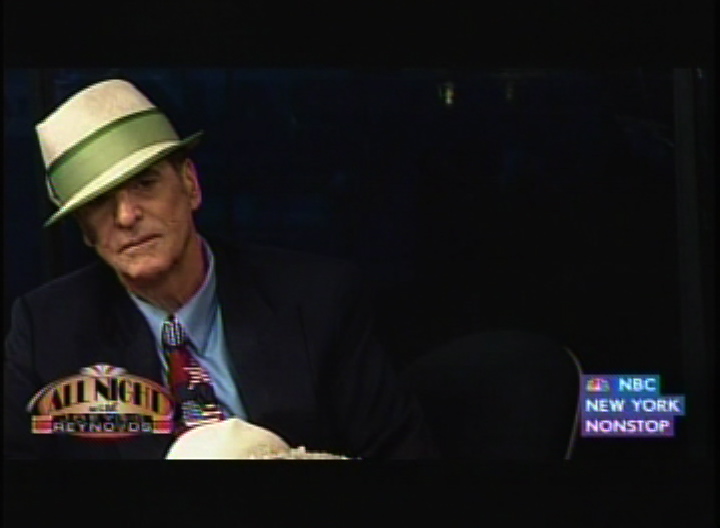
A few weeks back I wrote about one of the most unusual talk shows to ever appear on commercial TV, All Night with Joey Reynolds. A few weeks after I wrote that piece, the show suddenly disappeared, gone on a Wednesday evening in late April, never to return.
Since my blog post was literally the only lengthy piece written about the show, I thought I’d do a follow-up discussing the show’s biggest obstacle, namely its host. It’s been publicly stated by the show’s announcer and by Joey himself that All Night is on “hiatus” (initially a “vacation”) and will return. Since that is highly doubtful for several reasons, I herewith offer a “post-mortem” on the program. Most reading this will wonder why I watched a show that was so bizarre on a nightly basis. Well, there was the odd “hallucinatory” quality of the show that I mentioned in my last post, but there was also a “runaway train” aspect that made it compulsively watchable (as in “can this get any weirder?”). And yes, a viewer’s tolerance for the show would vary greatly depending on their preferred consumption of kitsch — as noted in my past entries, I have a nearly addictive taste for the stuff.
Before I discuss the eccentricities of one Joey Reynolds, let me link to the only Internet acknowledgement of how bizarre the show really was, on a local radio message board. Several Reynolds supporters said that All Night was a “breath of fresh air,” which reminded them of The Uncle Floyd Show or Soupy Sales’ 1960s Metromedia show.
However, one particularly disillusioned gent who apparently knew Reynolds from his radio days wrote a detailed and annoyed post talking about what he saw as the worst aspects of the show. His post reads like a screed, but I kinda know what he felt like — during the show’s three-month run, the chief topic of discussion between myself and the two gents I knew who watched the show regularly (my dad and an artist friend) was how self-indulgent and wildly unprofessional Joey’s behavior was getting. And yet… we kept watching! You can’t look away from a runaway train, and why should you?
So what made Joey such an off-kilter TV host? Firstly it was the fact that he began each show with a “monologue” that was basically him just standing on the set talking about random topics in a random fashion. Joey’s voice is *incredibly* friendly (thus his long career in radio). He chuckles as he speaks, and sometimes that chuckle is at odds with his angry, sarcastic, or un-p.c. comments. During these opening segments he would often get angrier and angrier about some person or situation, but he would laugh between nearly every other word. The only way out would be to cut to his man-on-the-street segment (detailed in my last blog post).
It’s hard to pick a best-ever episode of All Night, but my nomination would definitely be the show that spun wildly out of control because Joey’s monologue, which concerned his annoyance at Charlie Sheen, ate up a full-half hour of the two-hour program. He went on at such length that a crew member obviously told him that they should bring out a guest. Joey defiantly responded, “Thirty minutes in and we didn't bring out a guest? SO WHAT! What does it matter if I stand here for two hours and don't bring out a guest... is there a rule here?" He then started to invite out his guests for the evening. His green room had apparently been filled to capacity, and so in short order he brought out:
—comedian Dave Konig, who was seemingly the only guest allowed to rib Joey about his inability to stop talking
—a troup of self-described “disco yogis” (right), whose singer sang in Bengali as the dancers struck yoga poses to a "house" beat (one of the best things ever to appear on All Night — for all the wrong reasons)
—a psychologist brought on to discuss… Charlie Sheen (thus, all Joey had to say earlier could have been placed very neatly in this segment)
—an attractive cabaret singer whom Joey decided he simply had to sit next to and grin at as she sang. He smiled at her on-camera throughout her song, making the girl slightly unsettled. (Yes, it was creepy.)
—a Sinatra impersonator who attempted a very difficult song and was slightly off-key
—three magicians who did the kind of tricks you’d see at a children’s party
—and finally, a Barbados theater troupe did a musical number and presented Joey with a gift basket. Joey then turned around and gave the basket to one of his crew, who was celebrating a birthday. End of show.
If the above has confused or amused you, imagine the response of those few of us who were watching — especially when Joey revealed he couldn't get out of the chair he sat in backwards to watch the attractive cabaret singer (hey, the dude is 71...). It was supremely weird to watch a television show that was running completely off the rails because its host kept a total of seven acts waiting while he delivered an unscripted, directionless diatribe that basically no one wanted to hear. (And, given that the show is now gone, apparently no one did hear.)
Joey’s introductions to his musician guests were also astonishing. A group would be ready to play on the raised platform that served as a “stage” in the NASDAQ-window-studio in which the show was shot. Joey would go over to the platform to make the introduction — and then proceed to tell the group stories about his accomplishments in show business, his acquaintances, his beliefs, and just what he thought of the clothing they wore or the instruments they played. (Again, the lack of a studio audience and Joey’s not being a professional comedian made the silence in these segments mind-boggling.)
The musician would stand there with his guitar in his hand or a keyboard in front of him, and Joey would start to reminisce… and keep on talking until the musician’s forced smirk and “oh, really?” response turned into a “what is this guy talking about?” look. The only musical act that figured out a solution to this dilemma was a band that performs in the NYC subway system. As Joey did his intro and wandered conversationally further and further off, one of the guitarists just began to play, to sort of provide a musical “bed” for Joey’s remarks. As he did so, Joey angrily told him with a chuckle that he should stop “noodling”… and then went right back to complaining about how his daughter’s conversations with him on Skype always end up costing him money!
*****
NYC talk show legend Joe Franklin was often mocked for asking his guests about long-dead show-biz figures out of the blue (“…and do you have any thoughts on the late Eddie Cantor?” went both Billy Crystal and Uncle Floyd’s Franklin impressions). Joey did the same thing, and it was equally surreal. Frankie Valli, an old Reynolds chum (Joey’s place in Four Seasons mythology is much spoken about — by Joey!)) and perhaps the biggest name to appear on All Night, was on the show answering a question about the changes that have taken place in show biz over the past half-century. He responded with a thoughtful answer about the closing of numerous nightclubs and how entertainment is not the central industry in Las Vegas anymore… when Joey swerved and hit him with a question about what he thought of the uprising in Egypt. Valli answered that question somberly and reasonably but, let’s be honest, who really cares what Frankie Valli thinks about populist uprisings overseas?
There were several examples on the show of how Joey liked to “wing” his interviews, something he had done on his radio show, as mentioned in this New York Times article; what worked on radio, though, fell very flat on TV. For example, when actor Maxwell Caulfield guested to promote the Broadway revival of Cactus Flower, he came on with his wife, Juliet Mills.
Mills hadn’t been announced in the show’s opening guest roster, which was almost invariably wrong, but she was willing to answer any question, especially when Joey brought up his having attended a memorial service for Sir John Mills. He went on and on about how great John Mills was, then paused for a second, and asked her point-blank, “and he was… what, to you?” The fact that Joey had no idea she was John’s daughter made him look like the laziest TV host there had ever been (why research when you can ask the guest to tell you who they are?), and also rendered his preceding discussion of the man nothing short of insane.
Perhaps the best example of a “winged” interview occurred when actor Michael Imperioli appeared as a guest. Joey made sure we knew that Imperioli was a “good friend” of the Reynolds radio show and thanked him for having been kind enough to appear as a guest on the pilot for All Night that “sold” the show to the channel that aired it, the digital NY-area NBC Nonstop.
On this last point, it should be noted that the more one watched All Night, the more it became apparent that the show seemed to be on NBC Nonstop as a paid program, an informercial-type item that was “brokered,” a la the various Byron Allen comedy and press-junket-interview shows that appear all over America in late-night hours on local affiliates and are paid for by Allen’s production company. Joey often griped about meetings with an NBC executive at 30 Rock that hadn’t gone well (as if he was a functioning part of the NBC TV family), yet Nonstop never aired commercials for his show at any time during the week when its other shows were on.
But back to the Imperioli appearance: Joey rhapsodized about how great an actor Imperioli is, but then it became apparent he hadn’t taken the time to watch Imperioli’s ABC primetime show Detroit 1-8-7. He also misnamed the program, didn’t know what network it was on, and wasn't sure if he was supposed to show a clip from it. The crew then came up with a clip in short order — and, in perfect can-this-show-be-for-real? fashion, the clip that was shown didn’t feature Imperioli. Joey topped this bit of absolutely sublime interview incompetence with an exhortation to Imperioli to star in more movies.
At 71 Joey has obviously absorbed a lot of interesting show business lore and has interacted with many interesting celebrities. After a certain point (one week in?), viewers of All Night became familiar with the oft-repeated stories that he wanted to impart to his guests, as he lectured them on topics that had nothing to do with their area of expertise.
My favorite examples of this kind of conversational “swerve” (wherein Joey sounded like an old relative holding forth at Thanksgiving dinner): he rambled on about Phil Spector to a woman who does a Dusty Springfield tribute act (even after she mentioned that Phil never produced Dusty); he told an author of a book about the Black Panthers in NYC about Patty Hearst (even after being reminded that Patty Hearst was in California and was never involved with the Panthers); and he provided a fairly disinterested Greenwich Village hatmaker (sometimes a Reynolds guest would lose their “oh, really?” expression) with a detailed pocket-history of Murray the K for no particular reason, other than the fact that he thought he looked like Murray in one of her hats (see below). In each instance the brief glimpses of the guest’s face would become more and more amusing as Joey went right on moving the conversation into outer space….
I should make it clear that All Night did feature some very talented guests in performance — perhaps if the guests had indeed been the focus of the show, it might still be on. The most mind-boggling “runaway train” moments occurred, though, when Joey was onscreen alone and decided to gift us with his idea of “honest TV” — not the kind of “scripted” stuff (Leno, Letterman, Conan) that he railed against on a nightly basis. These honest moments included Joey making and receiving cellphone calls while hosting the show, texting his daughter on-air before conducting an interview (the daughter whose substance-abuse problem he felt compelled to discuss in a public forum — there is no "anonymous" for Joey), and, my personal fave, his self-destructive jokes about how pointless and meandering All Night was. (Yes, he did go for the Seinfeld reference — “we’re really doing a show about nothing!”)
Part of Joey’s personal mythology is how he was a rebel “shock jock” on AM radio and used to clash frequently with his bosses. On All Night he was pretty much left to his own devices (for some reason, the show had very flexible boundaries as to where the commercial breaks would go), and his old self-destructive impulse would assert itself at least once an evening, which is why I feel it’s so important to chronicle the show. How many times can you watch a host self-destruct in front of your eyes?
Thus, it was “I don’t know if anyone likes what we’re doing” one night, “Can you imagine if someone sponsored this crap?” another. I was recording the show on a regular basis (again, to verify that it wasn’t a hallucination), but on the sole night that my DVD-r recorder conked out, I missed a moment my dad and friend spoke about with a mixture of amusement and amazement — in an odd, most likely unintentional, echo of the film Network, Joey jokingly said he’d off himself on-air if the show didn’t start to get good ratings.
On the nights when Joey seemed particularly peeved at someone or something, he let loose with casual ethnic jokes that sank like a stone; on others, he flirted awkwardly with female guests. In closing, I can only repeat Joey’s public statement that the show is on hiatus and will be retooled. I can only hope that it does come back — either as the streamlined, incredibly valuable survey of unknown NYC talent that it could have been all along, or else so we can see more supremely absurd moments like this one:
When the above occurred, I immediately thought of one of my favorite moments from Mary Hartman, Mary Hartman, wherein crooked politican Merle Jeeter (Dabney Coleman) decided during a television appearance to convince the citizens of Fernwood he was honest by letting them look in his eyes. Thus, throughout the rest of that particular episode of MH, MH, no matter where a character went, there was a TV on with Jeeter staring at them. It was a brilliant, underplayed joke that I was stunned to see played out by Joey as a moment of profundity. (What I assume he was trying for was the calming tone of a relaxation therapist or a yoga teacher — instead he conducted this “experiment” while pissed off, and it was, well, you decide….)
All Night was the strangest, most unpredictable thing I’ve ever seen on television outside of public access. The superior quality of some of its musical moments and a few of its comedic ones indicated that it could have been a fascinating slice of local NYC color. One element of the program hastened and secured its downfall: its host.
I knew the day would come, but I figured it would occur after Le Jer had shuffled off this mortal coil, or else I had. Although I’m around half his age, I fully expect Jerry to outlive me and many of my middle-aged friends (“Le Increvable Jerry” — the indefatigable/unkillable Jerry — was the French title of The Disorderly Orderly).
It was announced a few months ago that the Labor Day telethon would be reduced from 21 hours to a mere six. This came after the 2010 show was a mind-blower, reverting back to the crazy show-biz glitziness and eclecticism that had made the telethon a must-see event from the mid-Sixties through the late Eighties.
Most interestingly, Jerry did not publicly comment on the show being abbreviated to the length of the Chabad telethon, or an all-night marathon of CSI or Law and Order episodes. It was obvious, though, that he was not in favor of this decision — check out the official MDA USA press release and notice that Jerry’s name is mentioned nowhere in it, except in a reference to the famous moment in 1976 when he was reunited with Dean!
So when Jerry remained silent, it was obvious something was up. But the announcement that he is “retiring as host” of the telethon this year was still something of a surprise because, as has been noted before, he’s one of the only individuals in recent memory whose name has been inextricably linked with a disease that he’s never suffered from. (Lou Gehrig, Damon Runyon, etc, died of the diseases that were named after them, or had charities created to battle the condition that killed them.)
One can speculate what brought about Jerry’s “retirement.” Is he not feeling well enough to run a six-hour program? (Highly doubtful) Were the politically incorrect comments he has made over the past few years — from referring to those afflicted with MD as “cripples” and “half a person” to his casual dropping of the word “fag” on-air a couple of years back — responsible for what looks to be an ousting from the program? (Possible) Or did the MDA want to move away from Jerry’s old-fashioned “pity-based” fundraising method and go for the new, star-studded model embodied by the various quickly-put-together natural-tragedy fundraisers, or the snarky-but-sincere, multiplex-hip “Night of Too Many Stars” on Comedy Central? (Very likely)
Whatever the case may be, I’m sure this year’s ’Thon will be packed with emotion as Jerry signs off — presumably lots of celebrity talking heads, as was the case with Larry King’s last weeks on the air. But what will we, the viewing public that remembers classic variety shows and deeply craves pure, undiluted kitsch, do once Jerry folds up his tent and the “new telethon” appears in place of his annual extravaganza?
The Jerry Lewis telethon (muscular dystrophy is still part of the program’s official name but it was subsumed by Jerry’s moniker at some point in the Eighties) has been a TV tradition for the past 45 years, a frenzied end-of-summer broadcast that always signaled the return to school and fall weather. It has also been Lewis’s premier platform since his films lost traction at the box office in the early Seventies. Most importantly for those who care about such things, it has been the last bastion for “old show-biz” — Jerry has been the last host who would bring on Sixties nightclub acts like Jack Jones and Norm Crosby, and he definitely offered the last national platform for beloved shtick-meisters like Charlie Callas and Henny Youngman.
If the “unseating” of Jerry as host (I’m going to assume that is what happened) was what the MDA needed to be able to raise more funds for those who suffer from neuro-muscular diseases, then it was the right thing to do. It does qualify as a loss, though, for those of who did watch the program each year, wondering as it wound on exactly what the hell would happen next. (If any of you haven’t yet detected “the common thread” in everything discussed in a positive fashion on this blog and on the Funhouse TV show, it’s that the unpredictable is what unites the “high” and “low” in art and entertainment. It’s what makes things interesting….)
The telethon has been, by turns, tacky, touching, boring, exciting, ridiculous, entertaining and — often in the early morning hours when the weirder acts from Vegas came on — downright surreal. One year a gentleman came on whose act consisted of nothing more than squishing his face against a sheet of plexiglass, inflating his mouth while crossing his eyes and such — the kinds of things a kid does against a car window. Somehow this was the man’s talent, and he was on the ’Thon. I’m gonna miss those moments!
For those looking to celebrate the Jer’s reign as “king of comedy” and King of Telethons, here is a fan site I had found under its original domain name (which was impossible to remember), and which has now reappeared under the very memorable name “Italian Jerry Lewis” (meaning it’s been put up by an Italian fan of Jerry’s). Check out this gent’s trove of Jerry memorabilia here.
****** And because I have lionized him on the Funhouse TV show for the last few years, I have to bring up Tony Orlando, who has served as the host and driving force behind the NY/NJ arm of the telethon for most of the 2000s.
Tony is an old-fashioned performer who will kill himself onstage (metaphorically) to entertain you. He mixes his own Seventies pop hits with Sixties AM-radio classics, doo-wop, salsa, mock-rap, and outlandish cover tunes that he makes his own — I’ve gone on the record several times saying that I prefer his cover of Led Zep’s “Whole Lotta Love” to the real thing. (Heresy, I know, for Zep fans — and that's probably why I say it.)
Tony has stayed up for the duration of the telethon in the years he’s hosted the NYC arm and has supplied local viewers with a boatload of peformers from his favorite period in pop history (one that he took part in as a songwriter and demo singer), the Brill Building era. Tony spotlights the stars of that period and is generous to them as a host, whether they are in top condition (Ben E. King, Mary Weiss, Gary “U.S.” Bonds) or sadly have seen better years (a pop princess of the early Sixties looked to be in very bad shape last year, but Tony was still quite wonderful to her).
Sure, Tony goes for the schmaltz very often, but you can sense a sincerity behind what he’s doing, a sense that he’s not putting on an ironic “act” for us. The guy is genuinely excited about helping those afflicted with muscular dystrophy (I guess the phrase “Jerry’s Kids,” always a problem for adult sufferers, will leave the MDA lexicon with Jerry’s exit from the program…. ), and he makes a helluva dynamic and unpredictable host. There is probably no chance he’ll get to fill Jerry’s shoes on the national end of the show, but I do hope we at least can continue to see him host the NY/NJ arm (if there will indeed even be local hosts). With Jerry gone, we will need all the old-school show-biz we can get….
The passing of Poly Styrene, best known from the band X-Ray Spex, causes a special pang in the hearts of people of a “certain age,” since she, like Joey and Johnny Ramone, died of cancer and will seem forever linked to the world of youthful rebellion, even though she was seemingly a very well-settled middle-aged woman at the time of her death. She was the first “punk crush” for many a guy in the U.K. and U.S., since she was perhaps the first “real” punk female presence — we’re not counting that cat-girl model here — and was young enough that she seemed more relatable than Debbie Harry (way too glamorous, and not punk herself at all) and Patti Smith (overwhelming in behavior and talent). She stood with Siouxsie Sioux (also overwhelming) as the premier punk woman.
She was of Scots/Irish-Somali descent and had a life-changing experience on her 18th birthday when she saw the Sex Pistols (she described herself as being a “barefoot hippie” before that). She took out an ad in Melody Maker looking for “young punx who want to stick it together,” and shortly thereafter founded X-Ray Spex with friend Lora Logic, who played saxophone. Logic was reportedly thrown out of the band before their first album Germ Free Adolescents, but her sax arrangements were used (and she was part of a Nineties reunion of the band).
The importance of the very small body of work produced by X-Ray Spex (one LP, some singles) can’t be overstated, since Styrene’s lyrics and melodically shrieking voice was totally “new” for the time, and the honking saxphone sound perfectly underscored the urgent-sounding tunes. Although there were four other members of the band (all guys after Logic’s departure) the band seemed to be all about Poly, thanks to her great, commanding stage presence, and her unerring sense of odd fashion (the braces on her teeth were not a statement, she noted at the time — she just wore braces).
Again, the joy of punk music always came when the bands were not *just* punk — the best acts in that loosely defined “movement” went well beyond the jagged fashion bullshit and the DIY who-needs-guitar-lessons ethic, and wound saying something as well as defying the clichés that sprouted up very quickly, thanks to McLaren and company. X-Ray Spex didn’t make quite the eternal impression that the Clash or X did, but their music has remained fresh because of how raw and how “right” they sounded. Here’s a perfect example, with the fashion and the music right upfront:
Poly’s best-remembered anthem, and it truly is an anthem, is the terrific “Oh Bondage, Up Yours!” which never dates (although its sound and notion have been copied endlessly) since it’s both a raw cry and an oddly cool feminist statement, right from its perfect spoken-word intro (there were a WHOLE buncha bands ripping that off at the time). More on that tune below (Poly herself knew she’d be forever identified with it, but did wish later on that she could’ve been known for something “more spiritual”).
After the extremely solid LP Germ Free Adolescents was released, Poly began to have problems, which were diagnosed as schizophrenia at the time but were later seen to be bipolar disorder. There’s an oddly touching documentary about the young Poly on YouTube that documents the era when she was just beginning to experience fame with the Spex but was feeling extremely uncomfortable with it.
The picture that comes from the documentary is of a highly creative young woman who’s being looked at as a new sort of role model. She is clearly not happy with any of that, and is facing a crossroads. She virtually “retired” from performing after the initial diagnosis, and thus this documentary offers a fascinating look at the point at which she’s starting to explore what she’s capable of as an artist and performer, but her life is starting to come apart:
She did come back to performing and recording in the Eighties (her first solo LP was released in 1980) and in 1981, she became a follower of the Hare Krishna faith. Her later solo music is much mellower and at points (as with a 1986 EP and her last single, “Virtual Boyfriend”) was dance music with smarter lyrics. She accepted the mantle of “punk pioneer” in later years and seems incredibly mellow in all her latter-day interviews.
In February of this year she revealed in the press that she had breast cancer. She died two months later, on April 25, with her website declaring that she had “won her battle on Monday to go to higher places.” She had a new album coming out and was perfectly at ease with her life — as with the story of Phoebe Snow (below), one begins to feel that she was “robbed” of time on the planet and suffered a lot while she was on it, but then again that’s just our view, from outside. As Marianne Elliott-Said and definitely as “Maharani Dasi” (her name after the conversion to Krishna), Poly seemed quite peaceful. The “punk” label came out of her being uncomfortable as a teen with the stuff around her, but in her later years, she seemed quite okay with the stuff inside.
Here is a terrific interview with the 21-year-old Poly, who seems pretty level-headed and sweet as hell. She speaks about not wearing the standard punk fashion of the time:
There is nothing like the Internet in terms of fandom for musical figures. Here is an early single by Mari Elliott, pre-X-Ray Spex:
And here is a bizarre trio: Poly, Carol Channing, and Jackie Collins. Talk about the trappings of fame: posing with these two highly cartoonish ladies can't have seemed normal for young Poly....
The theme tune to the Spex's only album, from Top of the Pops:
The live clips truly convey what the band was like. Here they do “Warrior in Woolworth’s” on The Old Gray Whistle Test:
And a last great live clip that Poly’s official account on YT made available. The band does “I Live Off You”:
Poly recorded two Xmas songs. The most recent was for her new album Generation Indigo, written with her daughter Celeste Bell-Dos Santos. It’s got a pretty wonderfully grim lyric, inspired by a guy in L.A. who killed people dressed as Santa. Ah, the joy of the holiday conveyed in a tuneful reggae nightmare, fun stuff:
And because we’re far enough away from the holiday at the moment to really enjoy it, let me link to a more traditional Xmas tune, “City of Christmas Ghosts” that Poly recorded with a band called Goldblade in 2008. It definitely takes a leaf from the Pogues’ “Fairytale of New York” but has a nice Ramones-ian guitar riff and the singer sounds like he’s channeling Strummer. One of the stirring lines in the chorus reminds us to “raise a toast to the friends we lost last year”….:
Poly’s latest single, released this year, the techno-savvy (and dance-tune-ish) “Virtual Boyfriend”:
A bit of Poly in her Maharani guise, during which time she released a dance tune called "Sacred Temple." Here she is interviewed about her new faith, talking about creating “something that I can bring to my next birth”:
Before I close out, a listen to Poly’s mellow side, a very pretty tune called “Shades” from her 1980 solo album Translucence. The album shows the range of her talent, and is a world away from the work she had done with the Spex just three years earlier:
And because there is no fucking way I’d miss the opportunity to spotlight it, HERE is her anthem. She might not have wanted it to be her sole credit of note, but goddamn, it is a a great tune. Angry teenage girls don’t compose anything this awesome any more….
Here she is performing it two years ago as a middle-aged lady. And the original:
I have nothing to add on the subject of the most grisly celebrity death in the past few weeks — that of poor Yvette Vickers, who was found mummified in her house. I do want to offer tributes here, though, to two generation-defining female singers who left us too soon. The first is Phoebe Snow, the soulful singer-songwriter turned incredible nightclub belter whose death was sad, but whose life for three decades was devoted to what they used to call a “higher purpose.” The fact that she selflessly devoted her life to her disabled daughter and then died after a year-long coma that followed a stroke at the age of 59 definitely for me files her life neatly into the “…and you’re telling me there’s a god?” category.
Her first LP spawned her one and only hit single, the super-mellow and wonderful “Poetry Man” (yes, there were nice things on AM radio back then — see below). Only a year after that album came out, her life changed for good when she gave birth to a daughter with brain damage. The story of that relationship is recounted touchingly in this CBS Sunday Morning news story. Suffice it to say that she definitely qualifies for the Singer Mom Hall of Fame, along with Kirsty MacColl:
What is conveyed in that interview is that her daughter’s disability wasn’t a “tragedy” for her, although most of those watching from outside the relationship probably viewed it as such. Although she withdrew from the music business to tend to her daughter, she did keep working as a singer and definitely became a “musician’s musician.” This is very apparent in the duets she did with other women singers, as with Linda Ronstadt on that scary-awful show on Saturday night, back when it wasn’t so painful to behold. Here they belt the hell out of “The Shoop Shoop Song”:
And here is a priceless trio: Janis Ian, Phoebe Snow, and Odetta, singing together on a song called “Hymn” for a 1976 Ian album called Aftertones. The YouTube poster who put this one up shared something very special:
The best way to close out is to hear her biggest hit again — god knows, the oldies stations with the telescoped playlists don’t really go this “wide” anymore. Here’s “Poetry Man,” as done for the late-night rock concert show produced and hosted by that guy who died recently (initials DK), whose clips were all pulled from YT right after he went — thanks, you friendly folks at Solt Productions!
More interesting to me is the fact that the other Phoebe Snow song I knew well, but couldn’t’ve told you the title of for a million dollars, was a tune called “Harpo’s Blues,” which I found out this evening was actually the flipside of “Poetry Man.” This is some jazzy warbling for a mainstream pop record, and a fine way to remember Snow’s very special talent:
 I haven’t talked much on this blog about my love for professional wrestling, which started when I was a kid and has been revived throughout the years whenever a master mic-worker has appeared. See, I’m not as interested in the matches as I am in the promos and in-between business when it’s amusing — which it only is when it’s in the hands of seasoned ranters or crazy people (and of course the best wrestling stars are both). “Macho Man” Randy Savage died a few weeks back, and I need to pay tribute to him because he was a mighty mic-worker, a guy whose promos at worst were vaguely coherent; at best they were, well… brilliantly, superbly insane.
 So we salute Randy Poffo, aka Randy Savage, who could wield a mic with the best of them (that’s why he became a cartoon voice-talent after his wrestling career was over). He came from a wrestling family (his father Angelo was in the business, as was his brother — "Leaping Lanny Poffo") and had a career as a minor-league baseball player before making his in-ring debut in 1973. Throughout the three decades he worked as a wrestler he was both a successful “heel” and a “face” — although he was FAR more interesting as a heel, it goes without saying.