Friday, November 7, 2014

What We Think About When We Think About Sex: the out-of-print writings of Allan Sherman (part 2 of two)

Now I move on to the moment where Allan Sherman truly became “My Son, the Author.” While his 1965 autobiography A Gift of Laughter was reportedly ghostwritten – yet many sections are clearly Sherman's own opinions and wording – his second, and sadly last, book, The Rape of A*P*E* (American Puritan Ethic), The Official History of the Sex Revolution 1945-1973, subtitled “The Obscening of America, An R*S*V*P* Document (Redeeming Social Value Pornography)” (1973), was his own work from start to finish.

The first thing that distinguishes the book is its length. Rarely does a “new” humorist come up with a nearly 500-page book that tries to both chronicle and mock the history of mankind. Toward the end of the book, Allan notes that he's been writing it for two and a half years. This isn't surprising, given that he clearly assembled (perhaps aided by interns or assistants?) mountains of info that he could use as fodder for sharp points and jokes about American hypocrisy.

By the late Sixties, Sherman's musical career was at a dead end. He had relationship and health problems, and was undergoing an identity crisis. He shed his trademark glasses and attempted to lose weight (the former worked out better than the latter). He grew a beard and was attempting to reinvent himself as a social satirist. A*P*E* indicates that he was a very talented humor writer, but his health problems got the better of him – he died two months after its publication at the age of 49.

The book charts the progress of Western civilization from the caveman (a simple, primal being that Allan calls “Sap,” short for “homo sapiens”) to the sexual revolution that Sherman dates as having occurred from 1945-'73. His introduction to the concept is terrific: 

[pp. 8-9, paperback edition] If anything is fun, Thou Shalt Not;

If anything feels good, Thou Shalt Not;

If anything is natural, or promises to give pleasure, or even relief,

Thou Shalt Not. Thou Shalt Not. Thou Shalt Not.

Thus the APE turned us all into liars and hypocrites.

The APE made us ashamed of our bodies, our thoughts, our feelings.

The APE robbed us of certain inalienable rights, and among these rights were sex, nudity and the pursuit of horniness.

The APE was always with us — in the street, in the office, in the living room; it haunted every bedroom and hovered in every toilet. The APE’s most effective work was done inside our very souls, in those dark unexplored places we still call by mystical icon-names like id and libido and superego, and other such mumbo-jumbo. Deep down there, each American came to believe that he or she was dirty and worse — that everyone else was clean and wholesome.....

[p. 12] And so in the quest of human intercourse, it became necessary to overthrow the APE.

What followed was the American Sex Revolution, certainly the most lunatic episode since man crawled out of the primeval ooze. Legions of Lolitas joined the battle with battalions of Babbitts and platoons of Portnoys. Manners and moral and great institutions bit the dust. Waterbeds splashed and vibrators jiggled. And when the air was cleared, people were calling it The Great Fire-Happening, because the world was never going to be the same again. No one knew exactly how, but Western civilization had been caught with its pants down. This book documents the whole ridiculous experience in a hurry — before we all wake up and start denying it really happened.

The youth culture of the late Sixties and early Seventies stirred Allan. He clearly responded to its honesty and also its sexual freedom (he had discussed his obsession with sex in his autobiography). The Vietnam War was so repellent to him that he felt motivated to speak directly to college students around the country (see below).

He also reveled in the fact that he was freed from the constraints that ruled his novelty-music career. A*P*E finds him discussing the sex act quite openly as “fucking.” He remained conservative in one regard, though – he clearly loathed rock music. On the other hand, he embraced the changes in comedy that were brought about by Lenny Bruce.

Two pages from A*P*E* scanned by the Enso On blog.
A*P*E isn't a “dirty book,” it's a well-structured, intelligent, and resolutely moral satire of American hypocrisy. Interestingly Mark Cohen, the author of the new Sherman bio Overweight Sensation, claims that “the middle section of the book is funny," but that the opening and closing portions are full of “hot air.”

I would argue that the sentimental and Utopian passages that Cohen dislikes are of a piece with the rest of the book – if you're imagining the world through the view of a caveman, it's not inconsistent to then be wistful about the possibility of love in sex, however corny it may sound.

The bulk of the book is concerned with sex, but Allan also tackles war, religion, education, the devaluation of women, parents putting down the youth culture, and (my favorite) the American addiction to “things”: 

[pp. 226-227] American technology produces trillions of odds and ends, curios, whatnots, gadgets, bric-a-brac, trinkets, notions, gewgaws. There is no scientific name for this incredible conglomeration of unrelated objects, except — Things. 

The Game consisted of making, buying, selling, and/or consuming Things. Things were never out of the American mind, even in the ceremonial greeting, “Hello, How are Things?”

Children were imbued from infancy with a lifetime goal: Try to get all the Things. Adults realized this was impossible; to them, it was important to be first to acquire a new Thing. If a family was successful in acquiring at least one of each Thing, its members turned to collecting the most of one Thing.

Some Americans collected only brand-new Things, discarding them at the first sign of wear. Others preferred old Things, used for 100 year or more, with enough cracks and bruises to be called “distressed.” To some Americans it was important to possess big Things; others took special pride in owning miniature Things….

A big portion of the book follows the Everyman caveman “Sap” and his mate “Lala.” This part of the book is much, much better than it sounds, since it allows Allan to ridicule our most sacred institutions by viewing them from the perspective of a simple, uncomplicated individual.

In the best section of the story of “Sap,” the caveman encounters a figured named “Dawg-muh” who outlines to him the different kinds of actions that humans undertake (“dassendooz” “shoodnadunnits” “fessups”) that require them to confess and pledge allegiance to the dubious moral code that is religion.

After he becomes acquainted with religion, “Sap” learns about the ways that countries must fight to the death over a plot of land, and how one can “own” property but there are many things one can't get away with on one's property: 

[p. 180-81] Fuck on your private front porch.

Walk around naked on your private lawn.

Plant marijuana in your private garden.

Sell or rent your private property to any of the following:

A hippie commune, an abortion clinic, a Methadone treatment center, a branch of Alcoholics Anonymous or Synanon, the Church of Satan, a black family, a mixed (black and white) family, a Spanish-speaking family.

Make a gift of your property to Fidel Castro, to do with as he wishes.

Try to give it to a friendly government like England.

When the tax assessor comes around, tell him you're starting your own country on your land and that from now he'll have to pay you taxes.

The book is a very funny one, but Sherman clearly also had a serious purpose. At one point, in talking about “the new violence” in the U.S., he discusses battered children. Here he uses his old friend from A Gift of Laughter, italics. He notes that his editor didn't like the “sudden complete change of tone. It isn't funny.” Allan's answer is that “life was still funny, but a different kind of funny. On November 22, 1963, America entered the What-the-Hell era, and real life became indistinguishable from black humor.

A few pages earlier, before discussing the American love of guns, he offers the formula that begat the Warren Commission: “When confused, try to bring everybody else to your level of confusion. Appoint a commission and while they study the problem for a year, make sure everybody will forget the whole thing. Then, to make sure nobody gets too clear a picture of what happened, arrange for the most important evidence to be locked up for 75 years.”


The most interesting thing about the book is the way that Sherman (who was 46-49 at the time he was writing the book) indicts his age group and sides with the youth culture. Early on in A*P*E*, he coincidentally uses the later Tom Brokaw encomium about those who served in WWII by calling that same group “the greatest generation of hypocrites.” He maintains that the hypocrisy existed for the most part because “we were jealous of our own children.”

He refers to attending school as “your daily penance for being a child.” He also wryly notes how kids wise up to the lies told in advertisements: “ABSOLUTELY FREE, the coupon says – but the small print says you have to spend four dollars to get the 'free' prize. The 'giant' malts at the drugstore are served in glasses with fake bottoms. The candy bars made to look an inch longer by the cardboard inside the wrapping.” He begins the section: “By the time you're a teenager you've been had a thousand times.”

He zeroes in on one mythic figure of the post-war period, Sonny Wisecarver, a teenager who had a series of sexual affairs (and marriages) with older wives/moms who left their husbands for him. Allan includes a quote from the judge who was examining the 16-year-old Wisecarver's records before he married him to a 25-year-old who left her husband for him. The judge called him “an incorrigible sexual delinquent,” but added, “You've won your spurs as a man.”

I've been emphasizing the more serious side of Sherman's social criticism in this review, because A*P*E* does indeed stand as a fascinating reflection of the time in which it was written (and the thoughts of a comedian who was striking out in a new direction).

I noted when talking about Sherman's autobiography A Gift of Laughter that he identified with sad and lonely people. Here he discusses the honesty and strangeness of personal ads (“I am a male who is female and I want a female who is male. No men. Tom. PO Box XXX, Pasadena Calif.”). He concludes this section by declaring “Now at last we could gauge the range of the American Dirty Mind – and estimate the unfathomable depth of loneliness in America.”
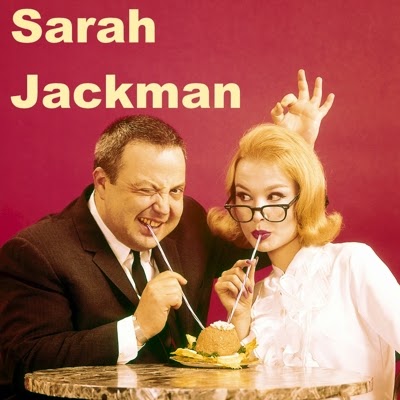
I will close out with perhaps my favorite concept in the book, one that Allan calls “thinkery-fuckery.” in his first discussion of it he emphasizes “how difficult it is to stop thinking.” He asks the reader to set aside the book and try for ten seconds not to think of a zebra. He then says that that will be all we will think about, in an effort to show how impossible it is to stop thinking while having sex.

Much later in the book he returns to “thinkery-fuckery” to examine the “subtle gradations” of what we think about while we're having sex. Naturally the notion of specific tastes come into play: 

[pp. 314-315] If you are on the receiving end of one of these specialized fucks, you have to suddenly ask yourself: “Why is he/she fucking me? Is it my tits, my money, my membership in the Bel-Air Golf Club?” Whatever it is, it isn't you. Once you begin to realize that people find your tits attractive, you react in one of two ways: Either you go around pushing your tits in everybody's face, or you try to hide them, hoping that someone will see some of your other marvelous qualities. 

Unfortunately specialization has a way of becoming even more specialized. Soon people will fall in love with you because of your left nostril, or the fact that you own a 1913 Liberty-head nickel, or because you can sing “I Wish I Was in Dixie” in perfect Swahili.

He then offers a list of “specialists” who can't stop thinking about the type of people they're fucking. One of the best entries is called “statisticians”: 

[p. 316] Some people enjoy measurements; their pleasure comes from the arithmetic of fucking: the size of partner's sex organs, the precise timing, the angle of entry. I know an attractive young woman who is a member of Mensa, an organization restricted to people in the top two percent of intelligence. One night she ran in all excited and said, 'Last night I laid a man who made 302 strokes!' Another Mensa looked at her and said, 'You weren't fucking, darling. You were counting.'"

A*P*E* is both a fascinating time capsule and a very funny – and, yes, sorta wistful – history of attitudes towards sex in the post-war period. It is indeed sad that Allan kicked off just as a second career seemed to be opening up for him.
*****

Here are a few great related videos. Although Sherman's comedic songs were all “rated G,” some of them jibe perfectly with his views in A*P*E*. For instance, the tale of an ex-urbanite couple, “Harvey and Sheila” (especially the line about the moment the couple “switched to the GOP/that’s the way things go…”). The song starts at 13:49.


This is the most pertinent clip, but sadly it's also the least funny. It's audio of Allan speaking at UCLA in late 1970. He speaks about the Vietnam War and gets into a rather lengthy routine about “Agnew-grams” – short statements that reflect the narrow views of then-Vice-Pres Spiro Agnew (presumably the funny part is that Allan is switching around letters on a screen to make the words... but we can't see that...):


A much sillier and shorter clip, Sherman on a variety show doing “Secret Code” (his variation on “Secret Love”):


Even snappier, here he is on The Hollywood Palace singing “Crazy Downtown” and dueting with host Tony Randall on “One Hippopotami”:


There are a few other pertinent clips, including Sherman doing a campaign song for Lyndon Johnson at a rally – one assumes that, like many others, he felt sold out by LBJ. Also, a tune from a later album by Allan, his spoof of “Spanish Flea” by Herb Alpert and the Tijuana Brass (as I noted above, he couldn't deal with rock, since he disliked it so much).

The piece of music he released that has the most to do with the opinions he expresses in A*P*E* is his variation on “Peter and the Wolf,” Peter and the Commissar. This album is not included in the big Rhino box set of Sherman's music, because it was recorded for a different label (RCA Red Seal). Recorded with the Boston Pops, the piece expresses his loathing for bureaucracy and conformity. It's a charming piece, mostly because it is so unabashedly emotional (according to his autobiography, he took its creation very seriously).


Note: this blog entry is intended as a enthusiastic review of a book that has been out of print for four decades at the time of writing. If the Sherman family or other rights holders have any objections, contact me at the Media Funhouse site.

Thursday, October 30, 2014

The return of Coven – 'Jinx'

Last Halloween I wrote a blog entry about the pioneering shock-rock band Coven and its lead singer, Jinx Dawson (read it here). That piece evidently interested a bunch of readers, as it has been one of the most popular entries on this blog.

At the end of that article, I noted that Jinx had announced on her Facebook page that the band was back together recording an album. A few months after my post, Nevoc Music (spell the first word backward) released the first new album by the band since 1974. The CD is titled Jinx, and it is a kind of “sampler” that finds Ms. Dawson and company tackling a number of different rock genres. As a result, not every track will please every listener, but when it works, it does indeed sound like the group is picking up where they left off.

The ten tracks on the album fit nearly into about a half-dozen genres: “old school” metal, thrash metal, Sixties “hard rock,” early Eighties “new wave,” dance music, and the coolest throwback to the infamous banned debut LP by the band (Witchcraft Destroys Minds & Reaps Souls), spoken-word Satanic prayers and spooky sounds (making this, of course, an ideal album for Halloween).

The brief liner notes indicate that Jinx features the five original band members: Jinx, Steve Ross, Oz Osborne, Rick Durrett, and Chris Neilsen; the bands Wolfpack 44 and We Are Hex play on three tracks. The album breaks somewhat neatly into two halves: the first “side” contains the tracks on which, unfortunately, Jinx's voice is hidden beneath the instrumentals (if I could pinpoint any problem with the album, it is that). The second side features the songs on which she is front and center, and the results are great.


The songs all involve the occult (even the dance tune is called “Danger/Ju Ju Goat”; it can be heard on YT here). Those familiar with the infamous first Coven LP will recognize the single from that album, reborn here as “Wicked Woman '13.” This reworking is done in thrash-metal style and does indeed obscure Jinx's vocals. By comparison, here is the original track as it appeared on the debut LP (with images from the movie Heaven Can Help, a film I've seen since I wrote the entry on Coven – Jinx is fascinating, the movie, not so much):


Jinx brightens incredibly – if it's OK to use the word “brighten” for a band that travels “the left-hand path” – when Jinx's vocals emerge in “Epitaph” and “WDMRS” (named after the aforementioned debut LP; take a listen to the song here). The two sharpest, most atmospheric songs were wisely put at the album's end, right before the closing prayer, “Ave Satanas.”

“Black Swan,” which had first appeared on the Metal Goth Queen – Out of the Vault” CD (now out of print) is top-notch, old-fashioned rock melodrama that has all the atmosphere and vocal trills of Seventies hard rock.


The longest track on the album, “Quick and the Dead,” benefits from two great instruments: Jinx's voice and a killer organ, played by the great Rick Durrett.

Photo by gregthemayor
At its best, Jinx reminder of how versatile and underrated Coven were and are. I hope there will be more music from Jinx and her associates before another decade passes. Are live performances too much to hope for? (Today's squeaky-clean pop-rock scene could benefit from a nice Satanic mass on stage.)
*****

An “ad” for Jinx is on YouTube. This contains only songs from the first “side,” plus a greeting from Jinx:


The album is available on iTunes and Amazon, but it's best to buy straight from the artist. The discs Jinx sells on eBay are signed and numbered by the lady herself; she also sells jewelry, “left-hand path” materials, a legal CD of the first Coven album, and ornamented jackets, like the one she's wearing in the photo -- the lady doth not age! Enter her eBay store here. 

Note: all pics in this blog entry come from Jinx's Facebook page and the Coven FB fan page.

Monday, October 27, 2014

Uncle Jean in three dimensions: 'Goodbye to Language'

Older filmmakers are not big on innovation. Funhouse deity Jean-Luc Godard is not your standard older filmmaker, though. He’s an icon, a cinema-poet who has always attempted to engage and provoke viewers. His latest feature, Goodbye to Language (opening in NYC this Wednesday “with a national release to follow”), is a prime example of this — shot in 3-D, the film is an exploration of themes that have obsessed him for decades. It is also a sensory experience in which nearly every shot seems composed with the notion of “deep focus” in mind.

3-D is a mostly ridiculous gimmick, which re-emerged about a decade ago for the same reason it was invented in the Fifties, to lure movie fans back into theaters. It has primarily been used for big-budget action movies and kiddie features. Three filmmakers have used the technique beautifully for artistic rather than commercial reasons: Werner Herzog (in Cave of Forgotten Dreams, 2010), Wim Wenders (in Pina, 2011), and Martin Scorsese (Hugo, 2011).
 

Godard has always been head and shoulders above most other filmmakers in terms of bringing cinema “back to zero.” With his use of 3-D here (he already experimented with the format for a short included in the 2013 feature 3x3D), he toys with the nature of image-making, the notion of counterpointing silence and sound, and the idea that a series of narrative incidents can be assembled into a plot if the viewer wishes (if not, just enjoy the ride).

Goodbye isn't meant to be “received” like the average multiplex movie, or even the latest indie or arthouse hit. It fills – and sometimes confuses – the senses, as Godard toys with the “life-like” clarity of digital filmmaking by editing crystal-clear, jarringly beautiful images together with shots that are disorienting (even sporadically out of 3-D “focus”) and take a few seconds to process.

The characters here act out the “battle of the sexes” that has been one of JLG's main concerns since Breathless (1960). In this instance, the film's action involves only a few characters, but only two really matter – a couple who spend time in an apartment talking, fucking, and arguing. The man (Kamel Abdelli) looks a great deal like Serge Gainsbourg and indulges in some Gainsbourgian toilet humor (the sensory trip here does briefly include shitting noises, a first for Uncle Jean's cinema!).

Both the man and the woman (Heloise Godet) are seen naked, but Godard as always dwells on the woman's body, providing us with yet another painterly study of a nude (see Passion, 1982). In this case one can't help but think that the woman's one imperfection – a scar above her lip – holds another fascination, since the 3-D allows Godard to “explore” his actors like never before.

The “performer” who attracts the most attention here, though, isn't one of the human actors, it's Godard's dog Roxy (whose last name is Mieville, meaning he is co-owned by Uncle Jean and his partner Anne-Marie Mieville). He uses the dog as a sort of “anchor” for the film, as it wanders from place to place and is shown both in beautiful, bucolic settings and in the apartment, where the two lovers have presumably “adopted” it.


Roxy takes part in his master's playful spacial dislocation. One of the many eye-catching shots in the film finds the dog in the foreground as the background is switched using digital effects. As is the case with all dogs, Roxy doesn't care, but we are reminded once more that the life-like quality of digital video is just one more element in the modern filmmaker's bag of tricks. 

Godard could've delivered a visually intoxicating feature, filled with gorgeous landscape shots and beautiful 3-D images like the one we repeatedly see of a woman and man behind a barred gate. Instead, as noted, he mingles crisp, visually arresting sequences with ones that are somewhat indistinct or “off.” He returns frequently to a dark image where our attention is grabbed by a small white dot – as in an eye exam, Godard wants your eye to travel exactly where he wants it to go.


But the moments that stay with one most deeply are indeed Godard's gorgeously composed exterior shots (many featuring his pooch) and his “studies” of the couple. He plays with the parameters of 3-D throughout, and in one case “violates” visual logic by having a character move from one space to another, visually “rupturing” the image. In the two instances in which he uses this technique, a character moves quickly to screen right, with one eye's visual information remaining static while the other's continues to move, until different images are being transmitted to the left and right eyes.

The character who broke the image serves as the focal point, and the images in both eyes coalesce shortly thereafter. It's a bravura editing trick that underscores how receptive Godard is to technical innovation, and also to new methods of conveying how artificial and manipulative film and video can be.
   

The content of Language is thus so inextricably linked to its form that I'm not certain how it will play as a 2-D feature. As it stands, the film is yet another of Godard's cinematic poems (with distinct elements of essay) that revels in objets trouvés – snippets of classical music, film clips (including moments from Les Enfants Terribles, Only Angels Have Wings, Metropolis, the Frederic March Dr. Jekyll and Mister Hyde, and The Snows of Kilamanjaro), and a plethora of quotations from a host of writers.

But the whole picture is tied together by the visual experimentation. In this regard, Goodbye continues the poetic and mostly non-narrative approaches of his recent films Film Socialisme (2010) and Notre Musique (2004). It helps, of course, if one has seen the recent work that JLG has been doing; his fragmentation of cinema started in his classic Sixties works, but he's been following a brilliant, very unique path since his best work of the 21st-century, In Praise of Love (2001), his first fiction feature to incorporate digital effects.

As I've noted before, we are very lucky to still have new Godard features coming out on a regular basis. It's rare than an octogenarian (Uncle Jean is currently 83) can continue to redefine the medium he's working in, but Godard does so with each new release, and will hopefully continue to do so for the foreseeable future.

Monday, October 20, 2014

“Hail to Thee, Fat Person”: the out-of-print writings of Allan Sherman (pt 1 of two)

Like every maniacal book collector, I have several shelves of tomes I’m dying to dig into. As I accumulate more and more books, the older “items I must read” get buried further and further back in the collection until they are obscured from sight. When I am reminded of a title and finally do read it, I’m usually delighted and wonder “Why *did* it take so long for me to get around to reading that?”

Anything can spur on these dives into “the stacks” — in the case of Allan Sherman’s out-of-print 1965 autobiography A Gift of Laughter, it was attending Hal Willner’s recent “songbook” show devoted to “My Son, the Nut.”

Sherman’s autobio is a curious item — an obvious by-product of his enormous popularity during the Kennedy era, the book could’ve been a quick “cash-in” that simply celebrated Sherman’s rise to fame and his discovery that the silly songs he performed at his friend’s parties could be enjoyed by millions of people.

The book is more than that, though. It’s a funny, sincere self-portrait that finds Sherman talking about his depression, self-pity, binge-shopping, binge-eating, and drinking (all of which cumulatively caused his early death at 49). The book contains two “voices” — one in roman type that tells the stories of Allan’s life in a straightforward manner, and another in italics finds Sherman offering his thoughts and reflections on the topic at hand.

This “schizo” approach is fascinating, in that it offers us the sad underside of the happiest moments in Sherman’s life – even at the height of his fame he remembered being unemployable in show business. It is also quite curious, given that the book was cowritten by ghostwriter Maurice Zolotow.

The participation of Zolotow is mentioned in the new Sherman biography Overweight Sensation. The author of that book, Marc Cohen, introduces the notion that Zolotow wrote the book for Allan, but he also quotes it quite liberally — each time he needs Allan's own words, he turns to Gift, introducing each quote with the phrase "Allan wrote..."

Allan's high school yearbook photo.
He also notes the inclusion in Gift of a story about how Sherman suffered a sad fate as a teen (an atrophied testicle) when he chose to ogle a sexy family cleaning girl while having the mumps. Interestingly, Cohen quotes the story and then says, “Sherman wrote,” indicating that some items in the book are indisputably Allan's (read: the all-too-honest and sad items). This and a few other teen-sex stories cost Sherman a contract with General Mills. (Cohen quotes Allan's wife at the time: “The sex scene cost us $50,000. I told him not to, but he said it's the truth and I've got to tell it.”)

As I write this, I’m nearly through Sherman’s second “adult” book (he also created a short humor tome and two kiddie books), the sharply funny 1973 study of the sexual revolution with the unwieldy title The Rape of the A*P*E* (American Puritan Ethic). This book is entirely Sherman’s work, according to Cohen, and so it’s a good guide by which to judge the authorship of Gift. [Note: Cohen learned about Zolotow's close friendship with Allan and his ghostwriting of Gift from Zolotow’s daughter, the poetically named “Crescent Dragonwagon.”]
The Shermans and the Zolotows

Comparing the two books, it’s evident that, Sherman’s “voice” is definitely present in the italicized segments of Gift, and even in some of the sections in roman type. If anything, Zolotow most definitely “cleaned up” Sherman’s prose, as A*P*E* indicates that Allan was prone to cursing a lot (or was that just a function of subject of that book, namely sex?).


In any case, being a big fan of Sherman’s albums, I found Gift fascinating, especially because of its many passages in which Sherman “preaches” about social hypocrisy (which is the raison d’etre of A*P*E*). He also dwells on the decision that changed his life — when he was asked by his mother to choose which parent he wanted to live with: 


[p. 43, paperback edition] I think all the indecision and disorganization in my character since then comes from having been asked to make such a decision so early in life. It’s absurd, it’s damaging to a child’s soul to be asked to choose between his mother and his father at the age of six…. Since that day, I can’t say no to anyone; I can’t reject another human being. 


Cohen refrains from quoting Gift, presumably because the book was ghostwritten. This happens to be one of the strangest cases of ghostwriting then, though, because if Zolotow was speaking for his good friend Allan (their friendship is mentioned in the book), he saw fit to assume the voice of Sherman discussing his “increasing withdrawal from reality” during difficult times in his life: 


[p. 49] All my life I have refused to face reality. I have lived in a Walter Mitty world of great expectations and daydreams where I could be Cary Grant or Fred Astaire for a few minutes if I wanted to, and it doesn’t really hurt anybody, does it?

Since one assumes a ghostwriter would, by necessity, “brighten” his/her subject’s autobiography, it’s both fascinating and sobering to read passages in which Sherman’s moods are discussed. Considering that the book was written in 1964, when his records were still selling, it’s very revealing: 

[pp. 54-55] I wonder why, when I started to write a chapter about sex, I began with the missing trains. I guess it was because I wanted you to understand, and I wanted myself to understand, that since the morning those trains disappeared in Chicago, since the night my family fell apart in Los Angeles, since the first time I was sent away to live with distant relatives, I have lived with the terror that there is nothing tangible, that there is no one who really wants me, and that anything that is any fun — anything in the world that is any fun — is not going to last. One morning I’ll look for it, and it just won’t be there anymore.

Allan was a humorist first and foremost, though, and so the book does contain numerous instances in which the tangents are delightfully funny instead of achingly sad. When speaking of the Yiddish plays his grandfather used to bring him to, Sherman reflects that the actors didn’t just act out a death scene, their characters would proclaim, “I am dying! I am dying! Oh, God, I am dying!” The character would then give a speech that includes “all of the philosophical Talmudic learnings of his life, and it is chock full of advice to his sons and daughters and farewells to his daughters and his wife, and this speech alone lasts five minutes.”

Once the speech is over, the character tries to stand up and… “he lets out this horrible, croaking groan and stumbles over the entire stage again, knocking over what’s left of the furniture and family, and finally he dies…. If the play is a musical, it is exactly the same, except with singing and dancing and very melancholy music underscoring the whole thing.” The audience, “who have troubles of their own,” enjoy the scene, “and they moan and groan and weep, and when he is finally dead, they sigh with relief and they feel this wonderful sense of total satisfaction.”

Gift thus offers some great bits that are perfectly in line with the humor on Sherman’s LPs. Although a good deal of it is timeless, thanks to his deft wordplay and downright strange and fun outlook on life, a chunk of Sherman’s music is tied up with the Fifties “exodus” of city-dwellers to the suburbs, as well as the industry that seemed to define the era (and the “Camelot” period that followed), the advertising business.

Sherman had no use for the latter, referring to the “gray flannel snake pit” that ruled TV in the Fifties. Gift contains many complaints about the rigidness Sherman encountered while working for Goodson Todman as the producer and co-creator of I’ve Got a Secret.

The opinions about advertising expressed in Gift are a product of the same mindset that produced the Sherman songs that serve as “snapshots of an era,” like his Gilbert and Sullivan rewrite “When I Was a Lad” (found here at 23:35):


And his superb laundry list of bogus terms and chemicals utilized by ad agencies to convince the public to keep buying familiar products (seen here with snappy animation accompaniment):


Allan also had many pungent (and, as ever, catchy and tuneful) things to say about the “urban flight” to the suburbs. In Gift he discusses how owning a home in the burbs meant constantly being in a state of renovation. He also showcases his favorite pithy summation of the situation by his friend, the great Carl Reiner (who gave us one of the most idyllic portraits of suburbia in The Dick Van Dyke Show). Said Reiner: 

[p. 160] “I have been living in the suburbs for three weeks now. You want the world’s shortest description of it?” he asked. “Twenty-three Sparrowfart Lane.” 

Allan’s most sublime commentaries on suburban living were of course expressed in his songs. Here is his excellent update of the English folk tune “Country Gardens” called “Here’s to the Crabgrass” (at 15:28):


After tackling the ad game and suburbia, Allan examines Los Angeles in Gift. He discusses how you’re only as good as your last hit in L.A., and comes up with a beautiful snapshot-phrase to describe the place: 

[p. 168] “...you get the impression — which is true — that Los Angeles is not a city, but twenty-four shopping centers in search of a city.”

Sherman was thought of as a singer of “Jewish parodies” but, as his albums indicate, his skill at wordplay transcended his ability to hone ethnic spoofs of popular songs. He definitely felt hemmed in by this definition and was in fact not fond at all of the main stomping ground for Jewish entertainment, namely the Borsch Belt: 

[p. 248] They want me to fit in a mold I never made but they did. They want me to be a professional Jew, an inside Jew, and they want me to sit there and laugh their version of the hipsters' laugh – “I dig you but the Goys don't.” And I can't give them that. That's too much Jewish. 

I don't know why those same people go ever summer to the Catskill Mountains. I don't know why they want to be in a ghetto, even one that's full of mink and thick carpets and championship golf courses and costs as much as a trip to Europe or California or Hong Kong or Israel, for that matter. What are they afraid of?

Don't be afraid, please, you people up there. Don't be afraid any more. Jump in, the water's fine in the human race.

As Gift moves on, Allan namechecks colleagues and close friends in show business. The former are folks like he who started out writing gags for TV variety shows and moved on to bigger and better things (like author Max Wilk and the superb screenwriter-playwright George Axelrod). At one point he notes that an average dinner party guest list of his closest friends in the biz would include Everett Sloane, screenwriter Ernest Lehman (North by Northwest), Steve Allen, and Jim Backus. He also does crow at times — we learn that various superstars told him they liked his albums; among these were George Burns and Jack Benny (early supporters of his songs), as well Frank Sinatra, Sammy Davis Jr., and Jack Kennedy.

The sweetest salute to a celebrity who was both a fan and a friend of Allan’s comes at the book’s finale when he pays tribute to his next-door neighbor Harpo Marx (who, like Burns and Benny, had urged him to record his “party songs” and then promoted My Son the Folk Singer to everyone he knew). Sherman devotes the last chapter in the book to an account of two concerts that he did with Harpo (who apparently, from the text, opened for Allan).

He notes with chagrin (and a touch of anger) that Harpo’s name was left off the marquee, and so he had to threaten to walk off to ensure that Harpo received equal billing with him. He then goes on to talk about how Harpo decided that the second of the two shows would be his last-ever live performance.

Allan found it hard to tell the audience that they’d just seen Harpo’s farewell to performing, so the world-famous mime comedian came out and took over the microphone — and proceeded to give a long farewell speech, in which he reviewed most of his career (his opening line, according to the book, was “Now as I was about to say in 1907...”).

Thus, while Gift was reportedly ghosted by Maurice Zolotow, I found that it contains quite a large dose of emotion (and, sadly, depression) that clearly came from Allan himself. It’s currently well out of print, but worth reading if you’ve enjoyed Sherman’s albums and are curious about his life. (Note: I will indeed review Overweight Sensation at a future date.)
*****

I’ll close out with just a sample of the many Sherman songs that are floating around on YouTube. First, a wistful little love tune he wrote for his wife, performed here to a little girl (who seems perplexed by the lyrics — and quite rightly so).


Allan hosted a bunch of variety-show episodes (here he is with Herman’s Hermits). In honor of the fact that Halloween is coming up, thought, I present his one and only horror novelty 45, a little ditty called “My Son, the Vampire”:


One of the nicest finds currently “hiding in plain sight” is a 1965 TV special called “Allan Sherman’s Funnyland” that features guest stars Jack Gilford, Lorne Greene, and Angie Dickinson.


As the title indicates, the show was meant to be funny (and is), but at the end Allan slips in one of his few serious tunes, the touching “His Own Little Island” (at 7:30 here) from the Broadway flop Let It Ride, as a sort of goodbye theme. The public was not much interested in Sherman as a serious singer-songwriter, but he was an incredibly talented man who, again, did have his sad side — from which, no doubt, his desire to make people laugh sprang.


At various points in Gift Allan supplies his personal philosophy: “Nothing is impossible!” Not a bad way to end any tribute to him.

Friday, October 10, 2014

Review: A new album by ‘sleeptalker’ Dion McGregor

It’s no surprise when a music label comes up with a live recording of a major deceased comedian. The fact that we can now hear more from renowned “sleeptalker” (read: monologist) Dion McGregor is indeed a surprise, though, and a very pleasant one at that. If you’ve never heard of McGregor (who died in 1994), I wrote a sort of “101” intro to him here. The short version of the story is that he was a songwriter and playwright whose music never made him famous, but his penchant for talking in his sleep did.

Legend has it that McGregor’s roommate Michael Barr was so amazed by the crazed, imaginative monologues that Dion was dispensing while asleep that he began to record them. He taped hours of these monologues, known as “somniloquies,” and the result was an uncategorizable 1964 Decca LP called The Dream World of Dion McGregor (He Talks in His Sleep) and a book of “transcripts” of the dreams (also 1964), with memorable illustrations by Edward Gorey.

As I noted in my last post about McGregor, I was very surprised to find that additional CDs of previously unheard dreams had been released in 1999 (Dion McGregor Dreams Again) and 2004 (The Further Somniloquies of Dion McGregor). The new release is called Dreaming Like Mad and has been released by Torpor Vigil Records.

McGregor’s monologues range from playful and silly to delightfully grim and even “sick” (in the manner of what was called in the Fifties “sick humor” — foremost practitioner: Lenny Bruce, namechecked in one dream here by Dion). McGregor is the monologist equivalent of Charles Addams, sketching outlandish first-person scenarios in which something unusual is happening and our narrator is either accepting it as commonplace or growing steadily more uneasy, until his voice begins to rise and he starts signaling the end of the piece (in keeping with the “sleeptalk” mythology, this would be the point where Dion would awaken, or fall out of bed).

There are 15 tracks on Dreaming Like Mad. All are great, but a third of the entries are exemplary slice of weirdness. The opening track sets the mood with Dion explaining how he and his friends have disappeared into the Sunday New York Times. As is common with McGregor’s dreams, this surreal transformation is recorded in a deadpan fashion. Take a listen to this strange odyssey for free, courtesy of Torpor Vigil Records.

A more “adult” dream finds Dion talking about a woman whose face is located near her “snatch” — her obvious dream man being a guy whose face is located in his crotch as well. Perhaps the most fitting entry has a quartet tossing a disembodied head from person to person. McGregor’s funniest monologues are always delivered with both an urgency and a sense of childlike innocence, making the dark aspects even more ghoulish.

The piece that has the most urgency to it is Dion’s invitation to join the “TYN” club. He implores a friend to come to a demonstration at the New York Herald Tribune where everyone will thumb their noses (thus the “TYN”) at dour film critic Judith Crist.

“There are big lists all made up, controversial people. Everybody knows about TYN! You get your pin, you get a placard…. [The police] threatened to put us in jail — we said ‘Come right ahead.’ We thumbed our noses. ‘TYN to you too, police!’ That’s right… Oh well, I don’t know — it doesn’t accomplish any good…” Dion then reveals that the club had a dilemma: one of the members wanted to thumb his nose at Lenny Bruce. But since Lenny founded the club, they just can’t do that (although they’re not racist — Eartha Kitt is also on their list for a thumbing).

One of the finest nightmare scenarios on the album is a refined gathering of couples. McGregor often “dreamed” deranged versions of very straight suburban scenarios (Dion, for the record, was gay). Cocktails or a meal are not the reason for this get-together, though — this is an “execution party,” in which guests are drilled with a machine gun and their bodies placed in piles. Always thinking of orderliness (even while asleep?), Dion cautions a woman guest to calm down or “we’ll throw your body on the female pile!”

Three things distinguish McGregor’s oddball humor. The first is the fact that his monologues are delivered in a NYC apartment late at night — there’s no audience, no laugh track, no “professional” aspect to his performances. The second thing that makes McGregor unique is his conversational tone, which makes it seems like the pieces are organically growing as they continue. The last striking thing about his “somniloquies” is the fact that these recordings serve as a peculiar portal to the past. Whether he’s awake or asleep (more on that below), we’re hearing a man in his apartment in the Sixties (his roommate recorded him from 1961-‘67) spinning these tales as street sounds intrude on a regular basis.

As I mentioned in my last entry on McGregor, the people who knew him firmly maintained that Dion was doing these monologues while he was sound asleep. I find this extremely hard to believe, since his dreams are not only uncannily linear (albeit wild, bizarre, surreal, and grim) but they also explore the situation at hand from every possible angle (as an author or comedian would, for maximum results).

Some of his dreams simply trail off and some end with his trademark strangled scream — which his neighbors must’ve loved in the late-evening hours — but some actually do have punchlines. A few of his monologues also have the gradual revelation of some pivotal piece of information, as with the revelation that “TYN” stands for “thumb your nose.”

I will admit that there is one thing that supports the notion that he really was sleeping — the fact that he seemed unable to write this kind of material in his “waking life.” My contention that McGregor’s dreams seem pre-scripted (or at least pre-structured) is perhaps a reflection of my own inability to have a linear, “conceptual” dream that comes anywhere near the twisted poetry that Dion came up with. (His name, btw, was short for “Dionysus” — it wasn’t pronounced like Mr. DiMucci.)

As I wrote this piece, I received a note from Steve Venright of Torpor Vigil, which I will quote from here to offer the other side of the story. After noting that McGregor’s previous roommate Carleton Carpenter (yes, this guy) was bothered by Dion talking in his sleep, Steve notes “I have no reason… to disbelieve the lovable Michael Barr when he told me, and many others before, that the first recording he made of Dion was without his friend's awareness, and that Dion was truly surprised the next morning when he heard the extent to which he somniloquized. The dream tapes became a lifelong obsession for Barr.

“Some of the unreleased recordings in the archive are absolutely not the sounds of someone attempting to convey convincingly a narrative. They're mumbled, moaned, delirious-sounding. They're not the ones that make it onto track lists. Despite my own certainty that Dion was not in a waking state or even merely in a ‘trance oratory’ state, I welcome discussion on the matter of just where these emanations came from. It does seem impossible that so many literary devices would be at play when someone's not consciously producing the plot — but that, to me, is part of the absolute wonder of these recordings and of the McGregor phenomenon.”

Whether McGregor’s dream-monologues represented an unconscious form of “automatic writing,” or his friends and he created a fanciful “package” for his ideas, doesn’t really matter in the long run. What matters is that McGregor was a very creative humorist whose visions of urban life and casual morbidity are unforgettable. Steve V. has noted to me in correspondence that there are stil many more unheard “somniloquies.” If they’re all as good as the items on Dreaming Like Mad, that’s nothing to thumb your nose at.
*****

The fine folks at Torpor Vigil (order the album from their website) have made three of the tracks from Dreaming Like Mad available here for free.

A trippy remix of snippets of McGregor audio has been posted to promote the new album:


And the whole first album — which is now priced at 500 dollars on Amazon (the Gorey-illustrated book is only a mere 100 bucks-plus) — can heard here, thanks to a helpful fan.

Thursday, October 2, 2014

Shameless self-promotion: more DVD reviews by yrs truly

I try to put up a blog entry each week, but sometimes I miss a week and then inevitably come up with a titanic post for the week after. In the meantime, I continue to do the Funhouse TV show (all details about that can be found at the official show site). I also do DVD reviews for the Disc Dish site.

I haven’t posted any of my reviews on this blog since late last year, so I thought I’d play “catch up” and put all of the 2014 reviews (thus far) into a blog post. [Note: it ordinarily takes about 10-15 seconds to load the DD site, but in the week I'm posting this there are a few server probs that mean it might take a minute or two to load the DD page in question — I'm always good with timing....] Onto the reviews:

David Lynch’s brilliant and disturbing debut feature, Eraserhead (1977)

Oliver Stone’s *insane* debut feature, Seizure (1973), starring Jonathan Frid

John Cassavetes’ last personal film, the exquisite mess Love Streams (1984)

Groucho, Harpo, Chico on the small screen in The Marx Brothers TV Collection

The Essential Jacques Demy featuring a half dozen of the musical visionary’s works

Billy Wilder’s quirky and imaginative The Private Life of Sherlock Holmes (1970)

Henry Morgan is a sarcastic hick visiting the big city in Richard Fleischer’s So This Is New York (1948) 

Georges Franju’s melding of “poetry and pulp,” Judex (1963)

Douglas Sirk’s visually sumptuous All That Heaven Allows (1955)

Howard Hawks’ seminal western Red River (1948)

Billy Wilder’s dark critique of the media, Ace in the Hole (1951)

A stunning slice of early Sixties character study, Il Sorpasso (1962), Dino Risi

A tribute to the great essayist by filmmaker Emiko Omori, To Chris Marker, An Unsent Letter (2012)

Douglas Sirk’s noir twist on Gaslight, Sleep, My Love (1948)

Errol Morris tackles Stephen Hawking’s theories in A Brief History of Time (1991)

The passionate and touching arthouse hit Blue is the Warmest Color (2013)

Alain Robbe-Grillet’s cerebral thriller Trans-Europ-Express (1967)

Godard’s controversial Hail Mary (1985)

Kaurismaki’s beautifully small La Vie de Boheme (1992)

The political anthology Far From Vietnam (1967)

Altman’s masterwork, Nashville (1975)

Chris Marker’s cinema verite landmark, Le Joli Mai (1962)

A wonderful, thus far “missing” variety series gets the deluxe treatment: Here's Edie: the Edie Adams Television Collection, '62-'64

The Dean Martin Roasts: Complete Collection: yes, I watched all 54 roasts in this 25-disc set (over several weeks…)

Francois Ozon’s playfully reflexive In the House (2012)

Better than the last 29 years of SNL, it’s the Best of Fridays collection