Friday, March 7, 2014

On aging, beauty, the Oscars, and Kim Novak

She was the “anti-Marilyn” sex symbol, a defiantly sensuous creature onscreen who seemed to defy the viewer's lustful gaze. She was a “thinking man's bombshell” who wasn't the greatest actress in Fifties Hollywood, but her virtues as a intoxicating presence were wonderfully showcased by the wildly underrated Richard Quine, the bombastic George Sidney, and the of course, the master of suspense (and obsessive-compulsive behavior), Hitchcock.

This week Kim Novak was back in the news for the first time in decades because she appeared as a presenter on the Oscars looking as if she had had bad plastic surgery on her cheeks and mouth (she also behaved somewhat stiffly, as if she was on sedatives — speculation was that this might have been a result of her having a horse-riding accident in 2006).

A debate was thus sparked on the Net about what is “expected” of female stars as they grow older, led mostly by women bloggers who were (justly) annoyed at the many bad “Kim Novak's face” jokes that have appeared online since Sunday night.

One of the most interesting tweets having to do with Novak's appearance on the Oscars came from actress Rose McGowan (herself a performer who has been rapped on the knuckles for having had plastic surgery, following a car accident). She wondered why there was no standing ovation for Novak – on a program, it must be added, where all the musical performances and pretty much any beloved performer gets a “standing O” as a matter of course.

Novak was a major star in the Fifties and early Sixties, but she was also an outsider — she was one of the last major-studio “creations,” remade and remodeled by Columbia president Harry Cohn to star in a string of notable high-profile pictures (and serve as a “threat” to Rita Hayworth, much in the way that Marilyn was a threat to Betty Grable).

While she underwent all of Cohn's demanded changes — she had actually been discovered by a Columbia talent scout in a chorus line of “heftier” girls grouped together to make Jane Russell look slimmer — Kim retained as much of her identity as she could. “I had to fight not to be manufactured, “ she told an interviewer recently. This brash attitude made her the polar opposite of the Monroe/Mansfield/Van Doren model of the blonde bimbo sexpot.

There are only two books thus far about Novak, and one of them – the one by Peter Harry Brown in which she supplies “commentary” in between the chapters – is quite accurately called Kim Novak: Reluctant Goddess (St. Martin's Press, 1986). It is her reluctance to be part of the Hollywood machine that made her recent foray into plastic surgery such a surprise and a sad event for those who've followed her career.

Kim's “comments” in the Brown biography are very enlightening in this regard, especially one about being a sex symbol: “You become a slave to the glamour-girl syndrome. They require certain public rituals, and, though I smile and go through the motions, I guess I'll never get used to them. You have to play a role – the star, the glamour girl. That gives me an uneasy feeling. Even though you appreciate the attention of the fans, you wonder if people who come to watch would like you if they knew who you really are.


“...But no matter how much makeup they put on me, no matter how much of a facade they thrust on me, I know the public was always able to see through it – to see the real me – that was some compensation. I fought, and fought hard, to maintain my own identity.” (pp 40-41)

Let me emphasize that I am not condemning Novak for having gone in for “de-aging” surgery. I am merely saddened to see that she finally did consent to play Hollywood’s game, and at such a late point in her life. At this point she has quit acting, often citing Mike Figgis’ 1991 film Liebestraum as her final disappointment. (She has spoken in interviews about how she argued with Figgis in regard to her character. He disagreed with her, and proceeded to cut most of her part out of the picture. As it stands, my only memory of her performance is a vague one of a quite sleazy line of dialogue involving another woman's smell on a man's fingers....)

In the 1986 Brown biography, she is quoted as saying “I have also never been afraid of getting old. To tell you the truth, I never cared that much about my career.... I was more interested in trying to find myself so I could express that essence onscreen.” (p. 255) She apparently underwent the surgery (or series of botox injections) sometime in late 2010, as is evident from this photo promoting the release of a box set of her movies.

There have been several sad cases of actresses deforming their faces with surgery in the last two decades – mostly notably Faye Dunaway, comedic actresses Mary Tyler Moore and Carol Burnett, and the Jocelyn Wildenstein of comedy, Joan Rivers.

Younger, very successful actresses like Nicole Kidman have indulged and have subsequently seemed to try to “set things right” by “un-freezing” their features. The most extreme example found Cher, who had developed an extremely respectable career as an actress, sabotage it entirely with face work that made her look as if she was performing behind a Kabuki mask (this as far back as 1990’s Mermaids, where she is unable to cry convincingly because of the immobility of her face).

As for Novak (seen right at the age of 71 in 2004), she was all the more special as a Hollywood star because she “pulled a Garbo” and got the hell out of town while the gettin’ was good. True, her fortunes were uncertain after the mid-Sixties, but she didn’t stick around to play a slew of aging matrons, maids, and (the eventual) grandmothers. She made a handful of movies and TV appearances in the Seventies and Eighties, with only a scant few (The Mirror Crack’d) being worthy of her talents and presence.

Thus, she would be one of the last older stars one could imagine worrying about wrinkles. However, those who saw the TCM interview with her that aired in March of last year witnessed a side of her personality that was well hidden during her heyday as one of America’s top box-office attractions: the vulnerable, sad woman who could still break down and cry when talking about her father’s disinterest in her accomplishments.

In that interview she also spoke openly about being bipolar. The moment when she cried on-camera was heartwrenching because it didn’t seem staged or phony, as so many interviews do (pick any of the many, many apologies made on television by public figures). It explained why she hadn’t consented to being interviewed at length in a very long time.

If a cream-puff interviewer like Robert Osborne could unintentionally lead to a topic that would make her break down, one can only imagine the kind of fascinating chat she could’ve had with the dean of star interviewers, the great Dick Cavett, in his prime.

Despite her wonderfully defiant presence, Novak was and is a fragile soul who has often noted that she never really wanted to be a star. She has also, as was noted by the bloggers who rose to her defense, lived through seeing her possessions go up in a fire in 2000, had the aforementioned horse-riding accident, and survived breast cancer just a few years ago.

Thus, when not mentored by major-studio advisers — from the nasty but effective Cohn to her one-time companion Quine — she seems like a woman adrift. And there we again collide with the question that sympathetic bloggers have been discussing in the past week — namely “how should an aging movie star look?”

Perhaps the only two stars who kept their privacy in their later years — one can’t help but cringe thinking of the final months of Bette Davis, where she continued to perform post-stroke, heavily made up — are the “Glimmer Twins” of Thirties glamour, two of the most beautiful women ever in film, Garbo and Dietrich. Garbo’s solution we all know; she simply left Hollywood and never came back — I know she toyed with returning at one point (with the amazing Max Ophuls), but the project sadly lost its financing.
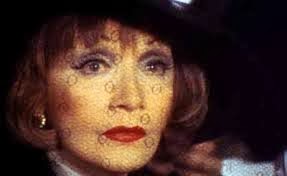
Dietrich (who coincidentally had her last movie role in David Hemmings’ film Just a Gigolo, which costarred Kim) took a more radical approach. She stayed hidden in her Paris apartment, not granting interviews and not allowing pictures to be taken of her — only her voice is heard in the late Maximilian Schell’s superb 1984 portrait Marlene. Along the same lines, Billy Wilder told documentarian Volker Schlondorff a wonderful tale about Dietrich ducking him on the phone (affecting a bad French accent) in her later years when he tried to connect with her in Paris.
Novak certainly doesn’t have to be as extreme in her behavior as Greta and Marlene. One could easily imagine her going the route of another one-time Hollywood pin-up girl, Janet Leigh. Leigh might have had “touch-ups” as she got older, but I was always impressed that she let herself get wrinkled — something that is absolutely verboten in Lotus Land. The result might have been that some assholes made jokes about her appearance, but Leigh’s face was still her own, not a surgeon’s “project,” until her death.

For the male equivalent, take a look at Anthony Hopkins. Hopkins’ creased forehead is so much more laudable than the odd appearance of, say, Mickey Rourke.

Nathanael West taught us 75 years ago in The Day of the Locust that Hollywood eats up and spits out its denizens. There is no better example of this than the Oscars, a deadly dull affair (leavened in theory by attempts at “comedy”) that these days allows no time for an appreciation of the history of American movies.

The film-clip montages are few and far between, and contain nearly no b&w material; the Lifetime Achievement Awards are presented at another, prior ceremony, and aren’t allowed on the main broadcast anymore; and, of course, older stars are rarely seen on the program.
Sidney Poitier, Robert De Niro, and Harrison Ford were the only other “older” [read: over 70] performers on this year’s Oscars; Hollywood’s idea of “veteran performers” now points strictly to TV stars who later became movie stars (60-somethings Sally Field, Goldie Hawn, John Travolta, and Bill Murray). Glenn Close is over 60 but best known for film.

Why all these names? To illustrate that Novak was the ONLY person on the program who had a link to old Hollywood, and they had her curiously present the Best Animated Feature award.

Hollywood essentially spits on its past (unless it can merchandise it — thus the Wizard of Oz trib), and we get to watch it on television every year. This time out a great star who had one of the most intriguing screen presences of the Fifties became a laughingstock because she chose to eliminate her wrinkles and went to the wrong surgeon.

The fact that she felt that was necessary is attributable not only to her own insecurities, but to the fact that America has a problem with age and thus does not want to see stars who carry their age proudly, like Janet Leigh or Anthony Hopkins.

Kim’s star will continue to shine brightly. I hope that she can “do a Nicole Kidman” and possibly reverse whatever procedures she underwent, but even if she can’t she will remain a luminous presence, and her films will live on. From the terrific noir Pushover (1954) and the iconic Fifties “lust-drama” Picnic (1955) to Billy Wilder’s brilliantly nasty Kiss Me, Stupid (1964) and Robert Aldrich’s equally incisive and brutal The Legend of Lylah Clare (1968), she has given movie viewers a lot more than we’ve given her.

Friday, February 28, 2014

“They say I'm tetched...”: Deceased Artiste Harold Ramis

The recent death of Harold Ramis brought back memories of his great work as both a performer and head writer on the first season of SCTV. His output as a movie director was wildly uneven (I’m being kind here). I'm of the right age demographic to be hailing Ramis for, as the writer of one insanely hyperbolic piece on Gawker contended, being the man who “wrote and/or directed the greatest American movies of my generation.”

That isn't the case, though – Ramis's comedies are pleasant on first viewing (especially if you're a teenager or younger), but there is little to no reason to revisit them (Groundhog Day excepted), unless you're looking for a trip down Memory Lane. It's true that Ramis crafted the Bill Murray movie persona that everyone knows and loves, but the films just don't stand up to repeated viewings.
Yes, there's a line or two here, a situation there, but Meatballs, Caddyshack, Stripes, and the Ghostbusters duo (why is anyone at all, ever, even considering a third installment?) ain't The Producers (the original, not the appalling musical revamp). Ramis' later films were pure formula, from Analyze This and Analyze That to the godawful remake of Bedazzled (written by former Caesar writer Larry Gelbart!) to that goddamned Jack Black caveman comedy (his last feature film). 

A piece on time.com says that Ramis is responsible for the fact that modern vehicle comedies include space for the performers to improvise – is that so? The writer apparently neglected to remember that he scripted most of the “influential” comedies and didn't direct them. Of the ones he did direct, perhaps only Caddyshack adheres to the Time writer's Platonic ideal of Ramis as the Paul Sills of cinema.

So let's return to the good stuff bearing Ramis's name, why don't we? As a young upstart, fresh from the superbly nasty National Lampoon Radio Hour, he was truly terrific on the first year of SCTV. He wasn’t able to do perfect celebrity impressions like his castmates — in fact he looked pretty much the same in every sketch he was in. He did, however share their ability to write and craft sublimely cartoonlike characters – as with the perpetually sweating station manager Moe Green, guru “Swami Banananda” aka Dennis Peterson, and “Officer Friendly.”

Sadly, the Shout! Factory SCTV DVD releases never included the first year of the show. At that point the series had a truly miniscule budget, but the writing was wonderful, and the performer-writers were discovering their strengths as satirists of TV.

The Shout! collections unfortunately ended with the season many SCTV fans would say was its absolute worst — the season that introduced Tony Rosato, Robin Duke, and Rick Moranis. I assume that Shout! issued this season (as SCTV — Best of the Early Years) because of the inclusion of Moranis. In the meantime the early years with and without Ramis are “MIA,” as is the odd final season that aired on Cinemax.

Segments from the show’s first season are available online, and I have chosen four great bits featuring Ramis. The first reflects his National Lampoon background — a grim little mock-PSA that features the seven “warning signs” of death. The show’s odd, intentionally weird laugh track was in full effect in the early days:


The second is an equally grim bit starring Ramis as “Officer Friendly,” an abusive cop who doubles as a kiddie show host.


Ramis' most notable SCTV character was the always-nervous station manager Moe Green. Here is the episode in which a wonderfully ridiculous parody of Ben-Hur is bracketed by Moe Green hosting “Dialing for Dollars”:


And the piece de resistance, a truly bizarre bit of business called “Muley’s Roundhouse.” This is a spinoff from a Grapes of Wrath parody (“The Grapes of Mud”) that aired on the same episode.

Here a supporting character from Wrath, a “tetched” neighbor of the Joad family (played by John Qualen in John Ford’s 1940 film) is the host of a children's show. Qualen's character is quirky, as seen here, but Ramis' interpretation paints him as a blissfully cranky loon who dotes on words with the letter “b” in 'em. This is Ramis at his best, and weirdest, as a performer. [The character comes back after the "Three Dummies" short with Flaherty, Levy, and Candy; ignore the "host" of this vid, he's gone pretty quickly.]

Friday, February 14, 2014

El Sid!: Deceased Artiste Sid Caesar


Looking back at the pioneering comedy variety-show hosts of the Fifties, it's easy to slot them into categories: the “Vaudeo” hosts (the initial term for the variety show format – vaudeville + video), whose work is very much of its time, including Milton Berle, Jimmy Durante, and Jackie Gleason; the movie stars who moonlighted on TV (Martin and Lewis and their fellows on The Colgate Comedy Hour); the innovators, who were ahead of their time and much copied and admired by their colleagues, including Steve Allen and Ernie Kovacs. And then there was Sid Caesar, perhaps the most talented character comedian of them all.


The thing that is remarkable about Caesar – besides that stunning writer's room that contained several of the most important comedy writers and filmmakers of the following twenty years – was the fact that, unlike Gleason, Sid didn't run his characters into the ground. In fact he only did two with any regularity: the Professor and the “husband” character in sitcom-esque sketches with Imogene Coca as a couple called the Hickenloopers (this later appeared in Caesar’s Hour with Nanette Fabray).

Sid's overwhelming versatility and ability to mimic a wide variety of ethnic voices, accents, and languages made him a truly unique comedian – it's hard to think of anyone with that much range until the generation of British comic actors (Guiness, Sellers) who would play several leads in the same picture. Caesar operated on a much higher level of creativity than Uncle Miltie or “The Great One” – there was indeed a skill and art that went into his comedy, and as a result he was reportedly a very emotional individual prone to crazy gestures (as in hanging the young Mel Brooks out a window when he pissed Sid off one day).

Sid was like a supernova of energy that splashed all over the Fifties, to the extent that he seemed to have exhausted his talent (more accurately, exhausted himself) in the Sixties and Seventies. The title of his autobiography reflected those years in which he was lost in addiction: “Where Have I Been?” The best thing that happened to remind us all of just *how* brilliant he had been was the release in 1973 of the wonderful compilation movie Ten From Your Show of Shows.

That film remains the single best introduction to what Caesar did in his prime: ethnic voices, exuberant and extremely-physical physical comedy, playing the sole sane person in a world full of lunatics, and acting out gorgeously detailed pantomime bits with the equally wonderful Imogene.

However, the release some years back of the VHS and DVD sets of sketches from Your Show of Shows (1950-54) and Caesar's Hour (1954-57) was another momentous occasion, since we were able to hear from the individuals involved in the shows (all the writers, Sid himself, costars Carl Reiner, Howard Morris, and Nanette Fabray) just how extraordinary the writing process on Sid's shows was, as well as view the full range of Caesar's talents in hours of his best sketches. Steve Allen dubbed Caesar “TV's Chaplin,” and he was entirely right.

I full recommend those boxes and will be drawing from them for forthcoming tributes to Sid on the Funhouse TV show. In the meantime I will spotlight a few personal favorites from the items available online. There were several different types of sketches that Sid and company did on his two Fifties variety series. The first were music parodies. Here is a gorgeous bit of free-form nonsense called “What Is Jazz?”:


And Sid, Carl, and Howie become “The Three Haircuts.” This is a parody of hiccup-voiced singers like Johnny Ray and the general tenor of rock lyrics (Sid and his writing staff were jazz, big-band and classical people, what can I say?):


The second kind of sketch was the “interview.” Here Sid as his professor character is interviewed by Reiner about how to get to sleep:

The third is possibly the most wonderful, since you’ll rarely (if ever) see it on current-day comedy shows. It’s pantomime, done to a fine turn by Sid and Imogene. I know that Gleason did pantomime too, but his often ventured into the cloying and sentimental. Jerry Lewis performed various mime bits to music that were terrific, but Sid and Imogene were the supreme practitioners on TV.

Here they and Reiner and Morris do their classic “Swiss clock” bit that functions – well, like clockwork. And here is their perfect routine in which they play two bored classical musicians passing time between musical solos:


The various movie parodies that were done on Caesar’s shows allowed him to show the full range of his comic acting, as well as his uncanny ear for foreign accents and singular ability to make up nonsense language (that sounded just like the real thing) on the spot. A uploader on YT called “Vintage Comedy Vault” has been uploading a number of things from the DVD boxes, including some primo examples of the movie parodies.

One of the sadder items revealed in the “Sid Vid” VHS/DVD releases, in which the writers and others reminisce in between the sketches, is that the producers of Sid’s variety series were told by NBC to stop doing their sublime foreign movie parodies as time went on because more TVs were being sold in towns across America. The people in these “new” territories were not familiar with foreign movies, so the network feared they wouldn’t “get” what Sid and company were doing, and thus would tune out.

Thankfully we do have kinescopes of the movie parodies that were done on Your Show of Shows, when the writers were unabashed about doing humor based on foreign films and cultures. Here is a wonderful French sketch called “Le Honore du Juelle”:


This sketch called “La Bicylcetta” has nothing to do with “Bicycle Thieves” plot-wise, but the very fact that the Show of Shows team saw fit to do an Italian sketch about a bicycle being stolen meant they had seen the De Sica classic (these sketches are indeed funny whether or not you’ve seen the original film, btw — that idea was lost on the NBC heads).

And a beautifully detailed bit starring Sid and Howard Morris called “The German general,” which definitely reflects Murnau’s Last Laugh. This is silly, hysterical comedy that also has a brain (and a superb source):


The fifth type of sketch was one in which an ensemble is present and each new character that is introduced is crazier than the last. There are two perfect examples of this, the very funny “At the Movies” sketch and what is arguably one of the funniest sketches to ever air on American TV, a very broad and very brilliant spoof of the emotion-wrought series This Is Your Life. This is in the very top rank of Caesar sketches:


Sid was a consistently fine guest on other peoples’ variety shows in the Sixties and Seventies, when he was often paired with other Fifties icons like Berle (the two couldn’t have been further apart in terms of talent and comic approach). Here he is doing his professor character on The Dean Martin Show. Dean made a great straight man for Sid:

Much has been made of Caesar’s super-macho VHS workout tape (done when he was over 65), but I would like to highlight the fact that whenever Sid was presented with a Lifetime Achievement Award (as I noted here, the Mark Twain Prize people overlooked him entirely), he would ask the organization giving him the award to include Imogene, since he felt they had functioned so well as a team back in the early Fifties (the two reunited in 1958 for the short-lived Sid Caesar Invites You and did a short-lived British TV series in the late Fifties).

Here is a mellow and beautifully detailed piece of husband-and-wife pantomime the two did much later on (1977) on The Tonight Show:


Perhaps the most intriguing rarity for those who love comedy history is the full episode of The Admiral Broadway Revue that is available online. It’s a revelation, since this is in the very early days of TV, when “Vaudeo” was indeed the dominant style (specialty acts, including Marge and Gower Champion, are all over this show).

The three credited writers are, oddly, Mel Tolkin, Lucille Kallen, and producer Max Liebman (who I didn’t know had collaborated on the writing of Sid’s shows). The Admiral Revue was only on from January to June 1949 on both the NBC and Dumont networks. Admiral reportedly pulled the show when it proved so popular they received more orders for TV sets than they could possibly fulfill.

Sid did a bunch of his solo routines on the program, as with this “Five Dollar Date”:


The episode, which is up in its entirety on YT, has only three Sid segments and two with Imogene. They are:
— As a harassed dad with an Irish brogue (Imogene is one of his daughters), at 4:45

— As a Gorgeous George-style wrestler (17:30 in). Best line: “I’m supposed to win tonight – take it easy!”

— Imogene does a comic East Indian dance number at 27:00

— Sid does a piece “in one” in which he plays the part of a samba dancer dancing through the events of his life (37:30). Sid’s oddly Yiddish Spanish patter here isn’t his most accurate language impression, but it shows his ability to craft entire monologues in a fictitious language:


Caesar was the last of the Fifties TV icons to die, and he was certainly one of the most talented. “TV’s Chaplin” indeed.

Wednesday, February 12, 2014

Our Man in Mexico: Graham Greene and Deceased Artiste Shirley Temple

When Joan Fontaine died recently, the discussion among movie buffs naturally turned to the question “which Golden Age Hollywood stars are still among us?” Shirley Temple’s name was rarely if ever brought up, because she exited the business in 1950 (with a handful of “comeback” projects, including a TV show in the late Fifties), and her career — although massive at its height — didn’t last as long as those of Olivia de Havilland, Kirk Douglas, and the never-gonna-quit Mickey Rooney.

Still, Temple was the biggest child star of all time in America (“adjusting for inflation,” which makes the dimes spent going to the movies in the Thirties equal to the 12-14 bucks shelled out today).

She started attracting attention in the movies in the early Thirties, but her string of vehicles from 1933-38 made her a major star (from the ages of 5-10). She was a top box-office attraction from ’35-’38. The oddest bit of trivia: at the height of her fame, Fox had a 19-person team of writers at the ready to write Shirley’s vehicles (labeled the “Shirley Temple development team”).


In the Forties she became a pleasant teen performer, but the public wasn’t interested in seeing her star in films anymore; she did have nice supporting turns in Ford’s Fort Apache (1948) with her then-husband John Agar, and with Cary Grant and Myrna Loy in The Bachelor and the Bobby-Soxer (1947).

Her most notable film from that era, for movie “mythology” reasons, is That Hagen Girl (1947), a melodrama in which Shirley is believed to be the daughter of a lawyer, played by ol’ Bonzo himself, Ronald Reagan. The film ends with the two of them — father-figure and daughter-figure — going off together as a romantic couple (in real-life Temple was 19, Reagan was 36, so it’s not that unusual in a H’wood pic, but I guess the fact that their relationship changed so radically as the picture went on soured viewers and critics).

Temple liked the film, but noted that Reagan didn’t, and that prints of it seemed to “disappear” when he was president. The film came out of “hiding” in the Nineties and is now available on YT in its entirety:


Shirley distinguished herself as a diplomat from the Nixon administration through that of George H.W. Bush (she was a steadfast Republican throughout her adult years) and made an important decision to publicly discuss her bout with breast cancer in the early Seventies (she of course won, living 40 more years). She was that rarest of birds in Hollywood: a well-adjusted child actor, whose adult life may not have been spent in show business, but who made important contributions to society.

And then there’s Graham Greene… One of the most interesting things from today's perspective about the critical perception of Shirley Temple at the time of her amazing stardom was a review that the Third Man novelist wrote in October 1937 about the Temple vehicle Wee Willie Winkie, directed by the mighty John Ford (who did what Fox told him to do) and based on a Kipling tale. At the time Shirley was wowing Depression audiences with her moppet cuteness and chipper attitude. Greene, however, saw something else in her stardom.

In Night and Day magazine, he wrote of Temple: "Her admirers – middle-aged men and clergymen – respond to her dubious coquetry, to the sight of her well-shaped and desirable little body, packed with enormous vitality, only because the safety curtain of story and dialogue drops between their intelligence and their desire."

Greene was hit with a civil libel suit by the producer of the movie and fled to Mexico to avoid being prosecuted for criminal libel (the magazine went out of business). From January to May 1938 he stayed in Mexico writing The Power and Glory and avoiding extradition for the libel suit. Even forty years later he was not “allowed” to have the piece about Temple appear in one of his collections of articles.

The thing is, is that Greene was right. There was an odd underside to Temple's amazing success. It may not be as apparent in her squeaky-clean vehicle pictures (although author Jeanine Basinger has noted that there were weird Freudian symbols in those too), but the early series of shorts that Temple made called “Baby Burlesks” were sleazy as all get-out.

The premise is that little kids were parodying the adult movie hits of the day – quite like the “Dogville” series of shorts in which dogs acted out the hits of the day! It's not as disturbing to see dressed-up dogs pretending to be sexy and giving come-hither glances, a la Dietrich and Mae West. It is a little bizarre for kids dressed up in giant diapers to do it.

To strengthen Greene's argument, one would need only producer the short below, which is surprisingly deranged for its time (1933, still pre-Code!). Excuse the crappy colorization (it seems that most of Temple's kiddie vehicles were colorized in the Eighties). “Polly Tix in Washington” is insane:


So now that I've proven Our Man in Havana correct, I'll close out on a much sleazy note with the scene that has my vote for one of the silliest musical numbers of any Thirties musical (I'm not including Busby Berkeley items in this, as those are too bizarrely weird and kinky, and possessed of a very singular genius, to be classified as simply “silly”).

It's the moment in the 1938 Shirley Temple vehicle Little Miss Broadway in which our heroine wants to convince a judge that her adoptive father's show is a great one – so they stage a number from the damned thing IN the courtroom! (Methinks Lars von Trier was a fan, or at least had seen this moment of sheer craziness.) Here it is, again badly colorized, but you'll get the idea. RIP to the original “Little Miss Sunshine.”

Saturday, February 8, 2014

King Neurotic vs. the Ex From Hell (epilogue -- hopefully!)

After I wrote the two-part piece below, there was an explosion of media activity, not just from those who wanted to impart their personal opinion on the sexual abuse charge, but from parties who were friends with Woody and Mia, and finally Dylan and Woody themselves.

In the interests of posterity, I will list the most salient links below, as I already went through my opinions on the case in the two parts of this blog entry. Although my research was duplicated (or borrowed?) for the first link below, I'm very proud that mine has seemingly been the only piece to explore both Woody and Mia's on-screen personas and how they related to public perception of the case.

Firstly, on Jan. 27, 2014, the Curb Your Enthusiasm and documentary director (he did the two-part American Masters profile on Woody) Robert Weide decided to step forward to defend his friend and colleague.


Weide does use several of the same URLs I did to make his point, but he also supplies information he gleaned in the making of his documentary about Allen. He also made two interesting decisions that I had veered away from in writing the piece below. He chose to use Dylan's new name (Malone), which is a fact that's instantly retrievable from Google, but which Maureen Orth indicated as a kind of “family secret” (a not very well hidden one).

He also included a fact I left out of my piece, since I thought it swerved the reader's attention well away from the Woody/Mia relationship – namely, the fact that Mia's brother was a convicted sex offender.

The victim herself, Dylan, then decided to come forward and write an open letter to the public about her sex abuse. The New York Times columnist Nicholas Kristof printed her letter, along with a prologue noting that he is indeed a friend of the Farrow family. This piece was interesting in that it was the only lengthy adult reflection on the case by Dylan (should we just call her Malone now?) that wasn't penned by Maureen Orth and includes a picture of her along with the article. (The picture at right is from her Twitter account, easily found on Google.)

In the wake of these two statements from people “inside” the case, the press bloggers came out with their knives for the other side. I will only link to two of these, because they seemed to be most eloquent about their beliefs. Firstly, Michael Wolff on The Guardian site wrote a piece about the case that was pro-Allen, “Media Spin for the Farrow Family?” 

And then Jessica Winter wrote a two-part piece on the case, taking Dylan and Mia's side, trying to focus attention on what she saw as the dubiousness of Weide's statements about the early Nineties custody case. Winter actually provides a more reasoned argument than anything penned by Maureen Orth in VF.

Then another “insider” stepped into the public spotlight on February 5th to talk about the case from his own personal knowledge of the family. Moses, the third and oldest of Woody and Mia's children (he was adopted, but was indeed adopted by both of them as a couple), decided to talk to People magazine; he sided with his father and accused his mother of completely manipulating and fabricating the sex abuse charge. 

Dylan then decided to do an interview with People, which appeared on Feb. 6, to rebut Moses' claims. The two most interesting things here were, again, a picture of the grown-up Dylan/Malone (Picture credit: “Courtesy Mia Farrow”) and that she uses the phrase “my cross to bear.”

It's been noted that Mia returned to Catholicism after Woody took up with Soon-Yi. As an ex-(ex-ex-ex-)Catholic myself I will simply note that suffering is redemptive in the Catholic faith – it is in fact (in one of the faith's more horrifying teachings) a good thing. The more you suffer, the more secure is your place in Heaven and the more you are loved by the supposed deity.

Dylan clearly feels that she is a martyr, but then oddly adds that she needed to speak up about her abuse not because of herself but because of her family. “But I will not see my family dragged down like this. I can't stay silent when my family needs me.” Thus, she felt she needed to speak out again, because of the attack on her family by her estranged brother Moses (who works as a family counselor and stated that Mia used to hit her kids when she was angry at them).

Clearly Dylan is a very damaged young woman. I find it fascinating, though, that she places her family (which would clearly be Mia, since she was the focus of Moses' statements) above herself.


The ping-pong game kept going back and forth this week. On the same morning that Dylan's new interview appeared in People, Dick Cavett (a longtime friend of Woody's) spoke about the case in very measured terms on the Don Imus radio show. He exhibited a clear sympathy for Dylan/Malone, but also did defend his friend against the charges.

And finally, Woody decided to write a response to Dylan's “open letter” for publication in The New York Times on Feb. 9. In it he states his case plainly and defends himself against the charges.

In doing this he harkens back to a bunch of the issues I mentioned in my piece, in addition to adding two things I didn't have time or space to include: that he took a lie detector test and Farrow refused to; and that he is a claustrophobe, who couldn't have remained in the attic where he was accused of sexually abusing Dylan. He also talks about the fact that adoption agencies allowed him and Soon-Yi to adopt two children, conducting thorough investigations into his background in the process.

Most interestingly, he notes that the actress Stacey Nelkin has come forward to say that Mia wanted her to testify against him in the custody case saying she was underaged when Woody dated her, which Woody says is untrue. But wasn't that Nelkin's declaration from the beginning, in saying that she was the source for the Mariel Hemingway character in Manhattan?

He addresses the side-issues, including Mia's statement that she was “involved” with Sinatra while dating Woody, and that he is indeed the father of Satchel/Ronan. Woody's take on the matter is “Again I want to call attention to the integrity and honesty of a person who conducts herself like that.”

Allen states his sympathy for Dylan and declares that he hopes there will be a rapprochement in the future with his daughter. Most laudably, considering that this affair has now been debated ENDLESSLY in the “court of public opinion” that is the Internet, he concludes in a parenthetical note: “This piece will be my final word on this entire matter and no one will be responding on my behalf to any further comments on it by any party. Enough people have been hurt.” 

But I want to give the final word to Mia in this instance. As I researched this piece, I found an amazing interview with Farrow that has surprisingly not been quoted yet in the see-saw, ping-pong media coverage. In a June 2, 2006 interview for The Independent, Mia claimed she could FORGIVE Woody: Asked whether she has since forgiven Allen, she says: "In an instant. I can't carry any of that. That's too heavy for me. It really isn't up to me to forgive or not forgive, is it?" Remarkably, in such a small city as Manhattan, Farrow says that she hasn't once run into Allen - or his bride - since their rancorous split. "It's incredible, I know. But I've had the good fortune and that has never happened to me. No, thank God."

Asked about whether she'd like to reconcile with Soon-Yi, as she had stated in the years between '92 and '06, she says, "Well, I've got over it, you know. You can get over almost anything. You just can't go on mourning forever, and so I've moved on. It's been a long time now. And I really don't think of her as my daughter any more. I can't. She isn't. She's estranged - and strange."

Considering her recent outcries, that quote about forgiveness from 2006 ("In an instant") is rather startling.

Hopefully there won't be more about this matter in the press (although I know the Internet will continue to debate it for DECADES to come, as with the matter of the girl in the Polanski case, who has virtually pleaded with the press and public to move on, but whose wishes were countermanded by those who believe they know better than the victim). It would be best for everyone (critics and “avengers” of both sides) to let this be worked out in private, by those actually involved in the case.