Friday, October 4, 2013

Melody and melancholy: the Jacques Demy festival at the Film Forum, now until Oct. 17

Jacques Demy had one of the most curious careers in cinema history. He is often cited as being a filmmaker of the French New Wave but his work bears little resemblance to theirs – except for his debut feature Lola (1961), and even that is a more conventionally structured work than the early films of the nouvelle vague directors. He made three utterly sublime musicals starring Catherine Deneuve, but most of his other films are rarely revived, and the ones that were released on VHS and disc have for the most part gone out of print (or the companies releasing them went out of business).


Thus New Yorkers will get a rare treat when all thirteen of Demy's features will be shown at the Film Forum, running from today to October 17. I'm looking forward to the festival because it actually is two retrospectives in one: the first is comprised of the Demy films that have perennially been revived (these are the “essential” titles that everyone should see); the second is the group of films that *never* play in repertory. This latter group is the one that I'm eagerly anticipating, even though some of the rarer titles are reputed to be wildly uneven (to be kind about it).


Here is a quick montage of some of the livelier moments in Demy's films, compiled for a festival of his work at the Cinematheque Francaise in April of this year:


Demy was born in the village of Pontchateau and grew up in Nantes. After studying at the Technical College of Fine Arts in that small town, and the Technical School of Photography in Paris, he made a few short works, graduating to his first feature, Lola, in 1961. In that film he established his preoccupations: a broadly romantic love story, a simplistic plotline (one would almost say a “fairy tale,” but he got to those later on), and a bittersweet sadness underneath a cloak of gaiety.


His best films are all set in locations other than Paris. The second feature, Bay of Angels (1963), is a glamorous gambling drama starring Jeanne Moreau that highlights the city of Nice. Bay is a very good film, but its best moment happens right at the very opening:


Then came the trio of films with Deneuve (with a sojourn in the U.S. coming between the second and third). Here he took his love of American musicals and set to work evoking them while still creating something original and uniquely French with the aid of the great Michel Legrand. The Umbrellas of Cherbourg (1964) is his masterpiece and the film by which the rest of his works are measured.


It's a beautifully realized creation that becomes more and more poignant as the years go by, since Demy was evoking a type of musical that had died out by the time he made the film. In the nearly five decades since its release the film itself has been cited endlessly and has inspired a generation of European (and, in a cultural cross-current, American) filmmakers who want to pay homage to the “great musicals of the old days.”


The film has definitely become a cornerstone of Deneuve's career – take for example her role as Bjork's friend “Kathy” in the unsettling and brilliant Lars Von Trier musical Dancer in the Dark (2000). More recently, Francois Ozon evoked Demy's classic in Potiche (2010), with Deneuve playing a woman who successfully takes over her husband's business (which just happens to be umbrella-making).


Umbrellas solidified the aspect that I consider the most striking and important thing in his work – the bittersweet undercurrent that runs below all of his plots, whether they are happily resolved or not. The film won the Palme d'Or at Cannes and was undoubtedly the high point of Demy's career. He followed it with another musical, one that is marvelously over the top.


The Young Girls of Rochefort (1967) is a candy-colored, mega-hyper musical that finds twins (Deneuve and her real-life sister Francoise Dorleac) in love – while a sadistic murderer is at large. This last element is just a peripheral detail that is brought up from time to time in the film, and it is the one aspect that makes me certain that M. Demy possessed a definite air of melancholy (all right, possibly even depression) in amidst his sunny optimism.


He clearly loved the cinema of Vincente Minnelli, Stanley Donen, and Gene Kelly – who has a supporting role in Rochefort and is terrific, despite some rather feeble French dubbing provided for him (one needs to hear Kelly's gravelly, smiling voice). Unlike his Hollywood heroes, however, Demy's best films all have an acute sense of melancholy when they are not downright tragic (as in The Pied Piper and Une chambre en ville).


This aspect is what makes Demy's work so unique and rewatchable – Rochefort is just so goddamned “up” that the murderer subplot serves to *ground* his lighter-than-air ensemble. The score by Legrand is extremely catchy, and (for conceptual continuity purposes for the Funhouse), there is a moment in which the twins dress and perform exactly like Marilyn Monroe and Jane Russell in the “Two Little Girls from Little Rock” number from Howard Hawks' Gentlemen Prefer Blondes

Here is the trailer:


After Rochefort Demy's career started to go astray. I really like his next film, Model Shop, but it is downbeat from start to finish. It's an American remake of Lola (that functions plot-wise as a sequel), with Anouk Aimee reprising her role from the original film and Gary Lockwood playing her newest suitor.


When I interviewed Lockwood, he noted that he didn't much enjoy shooting the film (which is evident onscreen at points); he added that the film had received some kind of commendation in the early 2000s as a “great film about L.A,” which it is – his character and Aimee's ride around town, giving us an informal tour of what the city looked like in 1968.


The film is not a musical, but its soundtrack is memorable, as it blends orchestral music and tunes by the band Spirit, who play themselves in the film.


Here is one of the memorable “tour” scenes in the film:


Donkey Skin (1970) was the third and final film Demy made with Deneuve. It's an odd item that transforms a fairy tale into a musical with slightly hipper-sounding tunes (Legrand was apparently in the mood to get some lounge material out of this score). The plot concerns a king (Jean Marais) who wants to marry his daughter (Deneuve); the film makes reference to Beauty and the Beast by Cocteau in a few ways, including the casting of Marais.


In true storybook fashion, the film contains the recipe for baking a magic cake:


After the Deneuve musical “trilogy” Demy's films weren't critical or popular hits. As his career went into decline, his wife, Agnes Varda, went from strength to strength (due to the variety in the subjects she covered in her work). But Demy continued to make choices that resulted in great scenes, if not always terrific movies.


For instance in his next film, the British production The Pied Piper (1972) starring Donovan (performing his own songs acoustically, a major plus!), there is a scene that is *genuinely* creepy. At first glimpse the film appears to be another Donkey Skin, intended for viewers of all ages, but what would very little kids make of this lovely wedding party scene? 


Perhaps the strangest item in his filmography was his return to filmmaking after six years in 1979 (after the failure of Pied Piper and the 1973 Mastroianni-Deneuve comedy A Slightly Pregnant Man). Lady Oscar was a Japanese-produced adaptation of a manga about a woman who disguises herself as a man and becomes Marie Antoinette's bodyguard before the French Revolution. The film was in English with English stars, but was set in France and shot by a French director. It has been one of five Demy films “lost” to American audiences.


The Film Forum festival of Demy's work contains two week-long runs, the second being a new restoration of Umbrellas of Cherbourg. The first is yet another lost title, Une chambre en ville (1982). This sequence – which, until the advent of YouTube, had been available to American viewers in Varda's documentary The World of Jacques Demy (1995) – is highly operatic and make the film seem as if it was indeed a return to form for Demy. Music... and heartache:


Chambre is the most eagerly awaited of the lost Demy titles, but I am also very interested to see what his odd-looking Eighties update of “Orpheus” called Parking (1985) is like.


I've seen Demy's final film, Three Seats for the 26th (1988), which is, again, thoroughly charming, but a very strange (and none too credible) hybrid of reality and fiction. Yves Montand plays himself, journeying back to his home town of Marseille to perform at the opera house. While there, he relives parts of his past, including a (fully fictional) fascination with the beautiful young Mathilda May.


All that is charming *and* all that doesn't work in the film (that synthesizer beat!) is present in this scene from the beginning of the film:


One of the most touching things about Demy's filmography is how it has been enriched by three films made by his very loving wife, Agnes Varda. She has made one film dramatizing his childhood (Jacquot de Nantes in 1991) and two documentaries about his work (Les demoiselles ont eu 25 ans and The World of Jacques Demy). She also devoted major segments of her documentary review of her life, The Beaches of Agnes (2008), to him.


While Mme. Varda was and is a superb filmmaker (her disparate fiction features supplemented by a number of documentaries and film shorts), her late husband did create his own instantly recognizable “universe.” He definitely made some missteps after the Sixties, but even his least works are enticing, as New Yorkers will be finding out for the next two weeks....


Some highlights, assembled for the French DVD box set of his work:

Wednesday, September 25, 2013

Out now: more DVD reviews


Every so often I like to spotlight my DVD reviews for another site here on this blog. Thus, a quintet of the latest items:

Jean-Pierre Melville’s thus far “missing” 1959 feature Two Men in Manhattan.


Radio Unnameable, the terrific documentary about NYC free-form radio legend Bob Fass.


The Eclipse box Early Fassbinder, featuring five of the master’s early films.


Armando Iannucci’s peerless political sitcom Thick of It: Seasons 1-4 (below) finally hits these shores.


And Kidnapped, a taut thriller from the greatest Italian genre director, Mario Bava.


Sunday, September 22, 2013

But can she boogie all night long? (two doses of Spanish kitsch)

As I try to prep two longer “profile” pieces I thought I should harken back to the earlier days of this blog with two lovely discoveries on YT. One West Coast blog, with a dozen writers on staff and advertisers to boot, has recently taken to doing what I and other solo (unpaid) bloggers have been doin' on a regular basis for years (namely touting interesting, odd, and “alternative” clips that have come to our attention). That blog has short entries and just highlights one clip or link at a time – I find it impossible to just leave the reader with one meager little offering, thus this double helping....

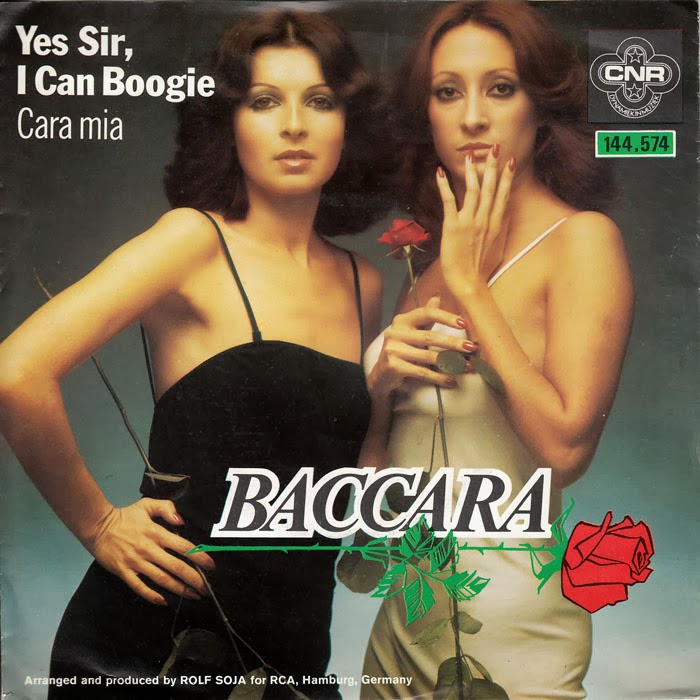
The theme, as the title indicates, is kitsch en el estilo Espanol. I start out with a female singing/dancing duo who were gigantic across Europe in the late Seventies but were barely (never?) heard of over here. The ladies were Mayte Mateos and María Mendiola, and their name as a duo was “Baccara.” They were dancers who began as flamenco/disco specialists (that's already two talents) and were converted into a successful musical act by a German record mogul and a Dutch producer-composer.

Baccara sold millions of records all across Europe, and Russia, and Japan, and the U.K. (similar to the kitsch-overload that was Boney M), starting with their wonderfully – and respectfully! – titled debut single, “Yes Sir, I Can Boogie”:


That song became a “summer song” all across Europe in '77, so of course there needed to be a follow-up. In this case the English lyrics are even riper (“They don't make men like you in our city!”). Again, a comma in the direct address:


And because there is no better way to prove your “international” cred than by singing a song about the Old West, I present Baccara's Western saga “The Devil Sent You to Laredo.” The songwriter rhymes “Laredo” with “desperado” (des-peray-do) – what more can you ask for?


A few other Baccara tunes deserve honorable mention, particularly their covers of “Yummy, Yummy, Yummy” and “Light My Fire” with a new opening (that includes the line “oh lover baby, why don't you reach out for love?”). Baccara in fact participated in the Eurovision Song Contest (after having had hit singles and somehow representing Luxembourg – don't ask).

Online biographies of the Baccara ladies emphasize the fact that they had an acrimonious break and have since formed singing duos with other women, both laying claim to being the “real” Baccara. In the meantime let's remember the ladies as they were, an elegant pair of Spanish dancers who happened to score major success singing odd songs in English. Like their tribute to men of the sea, “Ay, Ay Sailor”:


*****


Staying in the Spanish groove, I shift the spotlight from music to television with an extremely unique clip from the Spanish TV game show Un, dos, tres... responda otra vez. Politically correct it ain't.


First, some details about the show: Un, dos, tres... was on for 10 seasons broadcast over a 32-year span (1972 to 2004). I won't even try to elaborate its three-part construction, but it seems that the single best feature of the show (at least in its initial incarnation) is that there were a group of people cheering for the contestants to win (the host and his “secretaries,” cute babes wearing glasses) and another group haranguing them to lose (this should be tried on American shows). 

The clip below comes from the ninth season, which aired from 1993 to 1994. In that season two new twists were introduced to this already complicated show (in which contestants answered questions, did physical stunts, and then had an “auction,” consisting of “luck and psychological games” – !). The first change was in the rules – contestants now had to “buy” their way into later rounds.


The second alteration was that Paloma Hurtado, one of the well-loved women in the show's cast, to cite Wikipedia, “could not join the cast on the first months because she had been accidentally shot in the face weeks before the launch of the season and was recovering from the surgery.” Happily, Paloma returned to the show only a few months later.

But onto the clip. Here the show's theme is “The old Mississippi,” and actress Luisa Martin leads the contestants in a fun game that involves a bunch of white women “blacking” themselves up (UPDATE: a previous episode from 1982 contained a single "blacked-up" actor). I don't think this particular game will ever be played on American television:


I thank fellow kitsch aficionado (and game show expert) Rich Brown for leading the way to this strange gem.

Friday, September 13, 2013

The “invisible” auteur — "the Complete Howard Hawks” festival at the Museum of the Moving Image, now through November 10

Of all the master directors in Hollywood’s “golden age,” Howard Hawks remains the most enigmatic. Welles, Hitchcock, Ford, Lang, Von Sternberg — all had readily discernible visual styles, while Hawks avoided every kind of visual flourish and concentrated instead on pure storytelling. He also not only made films in just about every great Hollywood genre, he made seminal films in those genres, a feat that was beyond the mega-talents mentioned above.

A comprehensive festival of Hawks’ work (39 in all, spanning 44 years) — the first such in a long time in the New York area — is going on now at the Museum of the Moving Image in my old nabe of Astoria, Queens. In the past two weeks I’ve watched 10 of Hawks’ films (both at the museum and on disc in preparation for a segment on the festival for the Funhouse TV show), and Hawks’ mastery of genre remains breathtaking. The key bonus and blessing of this festival is that the features are all being shown ON FILM, which is getting increasingly rarer and rarer in this digital era.


But back to the films: In some cases Hawks reproduced genre tropes that were already around (could The Big Sleep have existed without The Maltese Falcon?) and in others he was devising the tropes himself — as with the screwball comedy, which he jumpstarted with Twentieth Century and perfected with Bringing Up Baby. But in all the films that weren’t mere “assignments” from studios (and there were few of those after the mid-Thirties) Hawks stuck true to his “codes.”

The Cahiers du Cinema critics in France (who of course later became the standard-bearers of the nouvelle vague) and Andrew Sarris in this country were the first to notice what Hawks’ seemingly dissimilar films had in common. The first tenet they deemed “the code of professionalism” — the fact that the heroes of his pictures took their professions very seriously, and that the mark of a person’s worth was how well they did their job.


This extended from Walter Huston risking his life as a steadfastly honest prison warden (The Criminal Code, 1930) to the trio of cowboys guarding a prisoner whose confederates want to bust him out of jail (Rio Bravo, 1959). One of the single best examples is the sublime Only Angels Have Wings (1939), in which Cary Grant plays a flyer in South America who is willing to lay his life (and those of his colleagues) on the line for what seem like ridiculously routine assignments.


The second tenet of a lot of Hawks’ dramas is that they concern a ragtag group of individuals who band together to accomplish something in a short span of time. This occurs frequently in his male-bonding films, which are miles away from today’s perception of machismo in the movies.

Sure, his characters were sometimes soldiers, had fistfights, raced cars, flew planes in dangerous weather, and indulged in lethal gun battles, but it’s the solemn, quiet nature of Hawks’ macho cinema that makes it so appealing. Especially when you compare it to present-day testosterone-charged, explosion-riddled Hollywood action pics. (The photo to the right shows Hawks showing Kirk Douglas how to throw a punch on the set of The Big Sky.)

And then there were the “Hawksian women.” Although he himself was a very old-fashioned gent (see the documentary below), he made numerous films featuring active, independent, wise-cracking women. His female characters frequently make the first pass at the men and are also career-minded — the perfect example being Rosalind Russell’s Hildy Johnson in His Girl Friday (1940).


The men in Hawks’ screwball comedies are not the noble figures from his male-bonding pictures. They are generally dignified gents who have their dignity slowly stripped from them as they play the comic foil to the female leads. Cary Grant became the personification of that character, but Gary Cooper and Rock Hudson (in the underrated Man’s Favorite Sport?) did wonderful jobs playing essentially the same part.

Hawks’ visual style is indeed “invisible,” except for the feverishly wild compositions in Scarface (1932), his gorgeously-lit images of some of his female stars (most notably Bacall in To Have and Have Not), and "artsy" camera movements of his silent feature Paid to Love (1927). Sarris noted that he crafted “good, clean, direct, functional cinema, perhaps the most distinctively American cinema of all.” Hawks favored medium shots of his characters — to further Sarris' point, the composition is called the plan américain by the French.


The modernity of his characters certainly makes his films age well, but what about the lengths of his films? Both Hawks’ action pictures and his comedies are much longer than those by his contemporaries (for example, Rio Bravo is 141 minutes, and the very light-hearted Man’s Favorite Sport? (1964) is a full 120 mins).

There are two elements that make his films so breezy despite their somewhat daunting running times. The first, of course, is the casts — he flitted from actress to actress (although he did use Marilyn twice, both brilliantly), but he made five films with both Cary Grant and John Wayne (that fact alone says a lot about his disparate output), and worked more than once with Cooper, Cagney, Robinson, and Bogart. He also used memorable supporting actors, the uncommonly mom-like (or wife-like, if you please — see Mark Rappaport’s 1997 video-essay The Silver Screen: Color Me Lavender) Walter Brennan being a favorite.


But the central reason Hawks’ films are so compulsively watchable despite their length is the roster of first-rank screenwriters he used. In addition to the great Ben Hecht, Jules Furthman, and Leigh Brackett (whom he worked with a lot), he filmed scripts by Billy Wilder, I.A.L. Diamond, Charles MacArthur, Dudley Nichols, Charles Lederer, W.R. Burnett, and John Huston. He also had the distinction of being the only director who had a sterling relationship with William Faulkner — he filmed several Faulkner scripts, including the seemingly unlikely Land of the Pharaohs (1955). One of the singular joys of seeing a bunch of Hawks films in a row is hearing the same lines of dialogue (and, in some cases, seeing entire physical bits of business) crop up in different films.


To conclude this overview, there is no substitute for clips. I urge those in the NYC area to check out the festival at the Museum of the Moving Image. MoMI had one of the best retrospectives of the last decade with its comprehensive Jacques Rivette fest (which I count as one of the most enlightening and important repertory festivals I’ve been to in my life). Most of the films in the Hawks-fest are not as rarely shown as those in the Rivette retro were, but the experience of seeing a number of them in a row, in pristine film prints projected on a screen in an auditorium, is one that can’t be beat.

*****


There are a few documentaries about Hawks available online (here is one in Spanish; here is one in French), but the best filmed interview with him took place in the 1970s when Richard Schickel was assembling the Men Who Made the Movies series. The episode about Hawks finds him open and honest about his opinions (and decidedly unimpressed by the Westerns of that era):

His first silent is lost, but the second one has survived and is quite charming. It starts out in the stone age and jumps to the present-day (and then back to the stone age!), telling the tale of a wife who has “nothing to wear.” There’s a lot of late Twenties fashion on display, and some pre-screwball sitcom-like comedy, in Fig Leaves (1926):


A scene from The Criminal Code (1930) that might seem laughable today — I would be willing to bet Lenny Bruce got his “yadda yadda, warden” (later appropriated by Seinfeld) from his scene — but which is still tense as hell. New warden Walter Huston decides to walk among his inmates unprotected:


Hawks loved the world of racing, but he only made two films about it. Here is a short segment from the Cagney classic The Crowd Roars (1932):


I am not a war movie fan and have yet to catch up to Hawks’ war pics (I will, I will), but I absolutely love Hawks’ aviator pics (in real life, Hawks had been a flyer and you can feel it in the films). The best of the bunch, and probably the film not already deemed a classic that I would *heavily* recommend in the MoMI festival, is Only Angels Have Wings (1939). Director Allan Arkush (Rock ‘n’ Roll High School) apparently feels the same way:


Hawks’ Scarface (1932) has been eclipsed by De Palma’s over-the-top ridiculous remake (one thing I will admit: both Paul Muni and Pacino give terrible performances). Here is a clip of directors Walter Hill and Michael Mann talking about the original:


The Big Sleep (1946) is one of the great detective films of all time. It’s not a comprehensible mystery (the pre-release 1944 version of the film makes more sense — but who really needs a noir-era mystery to make sense?). Here’s the great scene in which Bogart charms a book store clerk, played by a young Dorothy Malone (“you begin to interest me…”):


To show that Hawks truly did work in just about every classic Hollywood genre, here are scenes from a film he produced and supposedly co-directed, Christian Nyby’s The Thing From Another World (1951). It’s a classic Fifties paranoid sci-fi picture that concentrates on plot and characterization — the monster (played by James Arness) doesn’t appear until the very end of the film:


And speaking of classic H’wood genres, here’s the trailer for his big, brassy, Technicolor Fifties musical Gentlemen Prefer Blondes (1952). There are many feminist studies of the film (it is Hawks’ one and only female bonding pic):


He made only five Westerns, but those qualify him in the first rank of Hollywood Western directors. His first was Red River (1948), a fascinating inter-generational saga that pits the old Hollywood (John Wayne) vs. the new (Montgomery Clift). The very notion of using the subtle, “sensitive” Clift in a Western is a radical one, and he is excellent facing off against “the Duke.” Here he discusses guns with John Ireland (hey, no one ever said these films weren’t highly Freudian):


One of the best-ever Hollywood major studio Westerns is Rio Bravo (1959). It doesn’t have the psychological complexity and gorgeous location-shoot visuals of the films of Budd Boetticher and Anthony Mann, but is a hands-down masterpiece as both a Western and a male-bonding picture:


Hawks’ movies will continue to be watched by generations to come, but it is perhaps his screwball comedies that are best loved by old movie fans of the current era. There are no good clips online from his first great screwball opus, Twentieth Century (1934), so we jump straight to the masterwork. Could there have been I Love Lucy or any of the sillier, broader TV comedies of the Fifties and Sixties without the superb Bringing up Baby (1938)? Here’s a short scene (sans Katie Hepburn) that shows again what a modern director Hawks really was:


His Girl Friday (1940) is another Hawks comedy that was a wellspring of a lot of modern situation comedy. This remake of The Front Page proceeds at a frantic pace and is one of the greatest “battle of the sexes” comedies. It fell into public domain some years ago, so copies of it can be found everywhere (it is available in its entirety online, but is, again, best seen on a movie screen).

Here is a sequence that clearly inspired the overlapping dialogue found in the work of Funhouse favorite Robert Altman (when asked about his use of many characters speaking at once, Altman would point to screwball comedies as having done it years before he did).


Ball of Fire (1941) is Hawks directing a script co-written by the inimitable Billy Wilder. Here is a little segment in which the professors are exposed to modern slang:


I Was a Male War Bride (1949) is a miraculously odd creation – a film that is half “sexual tension” battle-of-the-sexes, and half gender-bending comedy in which Cary Grant is the “wife” of his U.S. WAC wife (the fact that he’s supposed to be a Frenchman makes no sense whatsoever, but hey…). Here’s the scene at the midpoint of the film where the plot switches gears:


Hawks’ last movie with Grant was the high-energy farce Monkey Business (1952). Here’s the trailer:


The final Hawks screwball comedy is Man’s Favorite Sport? (1964). Rock Hudson stars as a fishing “expert” who has never actually fished in his life (he’s just absorbed info from customers in the store he works in). The film finds Hudson playing yet another character who is hiding something — we return to Mark Rappaport, this time to Rock Hudson’s Home Movies.

The film was not a major success, but has acquired a cult in the half century since it came out. It clearly was “out of time,” appearing only a few month before A Hard Day’s Night changed the tone of screen comedy, but it holds up surprisingly well, thanks to its clever scripting and solid lead performances (it’s got to be Paula Prentiss’ finest moment in film). Here’s the trailer:


And it’s always best to close off with a song. One of the most unlikely scenes in Rio Bravo — but one which comes off perfectly — is the odd moment where Dean Martin and Ricky Nelson duet on “My Rifle, My Pony and Me.” Walter Brennan then joins them (!) for “Cindy,” a song I mentioned in my Dolores Fuller obit, as she re-wrote it for Elvis. Dean, Ricky, and Walter are doing the traditional North Carolina folk tune version, discovered by John Lomax: