Wednesday, December 11, 2019

Cinema in the time of computer graphics: De Niro’s “jaundice face” and other side-effects of The Irishman

Two young actors not
seen in The Irishman.
I spent a good part of my adolescence and 20s worshipping Martin Scorsese as a filmmaker. I still admire and respect him as an archivist, a curator, a funder of restorations, a writer of film texts, and above all else, a brilliant cinephile. As a filmmaker, his output became a matter of small surprises after Goodfellas, with the best, most interesting titles being the odder items that didn’t fit his persona — Age of Innocence, Kundun, Hugo.

The items that pertained to his former strong suits — from Cape Fear to the current Irishman — and his attempts at massive-budgeted pageantry — from Gangs of New York to Silence — were bloated, directionless, bloodless works that, while gorgeously directed, didn’t  *need* to exist in the way that his earlier, rough-edged, eternally watchable films were, and are.

And thus The Irishman, a Faustian bargain made with the endless financing of Netflix, which has as its core a character study of a nasty fucker and is blown up to epic length (the book it’s based on was 384 pages in hardback; the film is 210 minutes in length). It also contains Scorsese’s deepest-dive into CGI technology. He started using computer-tech in his films most noticeably in Kundun (one gorgeous, unforgettable image was a “computer fake” that was made with that year’s state of the art technology). Here, he lets the CGI blight the acting and create strange creatures onscreen that are at once actors we know all too well but are “touched-up” versions of them, an attempt to provide youth in the guise of “cleansed” digital imagery.

There are lovely things to be found in the film. Firstly, the visuals are gorgeous. All of Scorsese’s films, even those bereft of any palpable human feeling (Bringing Out the Dead, The Departed), have been miracles of craftsmanship. The soundtrack is a beautifully arranged melange of unobtrusive music by Robbie Robertson and some vintage orchestral music that conjures up the times in which the film takes place (and then doesn’t move on chronologically — meaning that either the characters are stuck in the Fifties/Sixties, or the filmmaker is). One of the nicest inclusions in that regard is the theme from Jacques Becker's Touchez pas au Grisbi (1954), the great masterpiece about aging gangsters, which clocks in at a lean, tough 83 minutes. (My in-depth tribute to Becker can be found here.)

There is the cast, which is a short list of Scorsese’s most important actors — Harvey Keitel, the one I wanted to see most, gets the short end of the stick and has seemingly been permanently supplanted by Joe Pesci as the “actor allowed to work in the most scenes with producer Robert De Niro under the direction of Mr. Scorsese.”
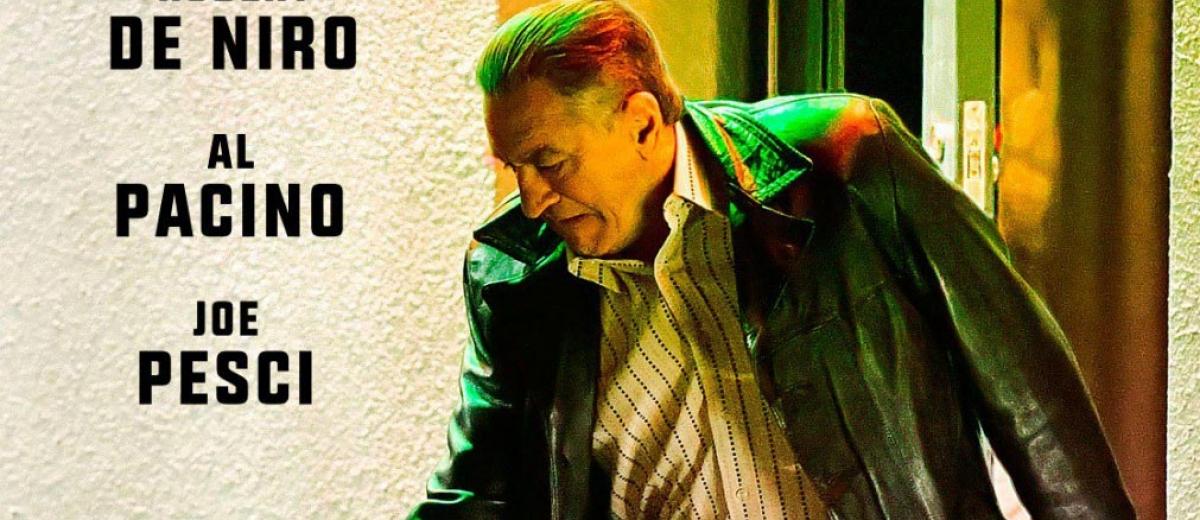
"I killed everyone worth killing!" -- Frank Sheeran
There is also the matter of cross-talk. The film’s script by Steve Zaillian is way too long and should’ve been sliced and diced down to a two-hour length, but Scorsese CANNOT bring himself to edit his films down below two hours (even the soulless music docs run for eternities). The script contains some amusing cross-talk moments, which used to be the finest moments in Scorsese’s films. The back-room discussion between Keitel and De Niro in Mean Streets will always be a high-water mark of this kind of humor.


Here, the cross-talk scenes are enjoyable — but, like everything in the picture, there are lots and lots of them. And they go on for long periods of time. And they don’t have the spontaneity of that great scene in Mean Streets — like the film as a whole, these cross-talk comedy bits are older gents revisiting something they did to perfection as younger men but now “telegraph” (and keep on telegraphing).

In 1995, shooting Casino.
The matter of length also is reflected in the fact that Scorsese is revisiting familiar turf here, turf which he covered beautifully at first in masterful movies with running times in the vicinity of two hours. In this period of his career, where *everything* he signs as a director must run to an epic length (be it a period piece, a gangster drama, or just a regular old rock-doc), The Irishman is the natural result of this beached-whale running time (which I thought he had hit the wall with, in the least-interesting pic he ever made, The Departed). 

So, The Irishman at 210 minutes is a remake of a remake (Casino, at an unwieldy 178 mins) of a remake (Goodfellas, at 146 mins) of a sublime rough-edged, lower-budgeted crime drama (the 112-minute Mean Streets). As a point of comparison, this reviewer loves Rivette and Tarkovsky, saw and enjoyed Satantango, and has happily watched Berlin Alexanderplatz and Out 1 twice. But man, oh man, Marty's "pictures" became endless as of the 2000s. (New York, New York, on the other hand, is incredibly rewatchable, because its schizo-cocaine construction is amazing to behold; it's fascinating when it's working and fascinating when it's failing... big time!)

He'd spit on CGI fx for his actors.
Scorsese seems to have a Howard Hawks fetish (I first noted this here), but with Hawks his final film was a shorter remake (Rio Lobo, 114 mins) of a shorter remake (El Dorado, 126 minutes) of a masterpiece (Rio Bravo, 141 mins). Only the most diehard Hawks fan would make an argument that El Dorado and Rio Lobo are utterly essential viewing. They’re both better than Casino, though….

25-year-old De Niro, Greetings.
But let’s set aside the beached-whale aspect of the film and get to its most conspicuous aspect, the “de-aging” digital makeover that Scorsese is so excited about (and audiences and critics say “melts away” as the film moves on). This gigantic aspect of making the film cost an amount that is not less than 15 million dollars (quite the Faustian bargain, that!) and perhaps several million more. The budget breakdowns online got murkier when Scorsese started this costly process — all because he couldn’t emulate his cinematic heroes and cast younger actors as the younger characters. De Niro rrrrreally wanted a tour de force Oscar bid!

This de-aging business was clearly the result of De Niro’s ego, and so he plays a character who ages from his mid-20s to his 80s, while he himself was 73-74 (the film was shot from 2017 to ’18). He produced the film and it is clearly intended as a “return to form” (since he now makes many, many, MANY wretchedly bad movies just for the money). Oddly enough, it’s not a return to his actual form, but instead he is a kind of a CGI creature onscreen, a hitman variant of the “Gollum” syndrome (where a live actor plays a computer-created creature).

Computer-masked De Niro at 25. The computer
was mistakenly on the "young Anthony LaPaglia" setting. 
So much for those who claim that the yellow-ish, blemish- and wrinkle-free face that was painted on De Niro’s own by CGI technology “melts away” as the film moves on. It really doesn’t, and simply can’t for those who have watched De Niro over the years and remember quite clearly what his face looked like when he was young (before the persistent wince-face that grew on him in the Eighties). Since he started working in film, he has rarely taken time off, and so we’ve seen him age from 25 (when he appeared in Brian De Palma’s Greetings) to 76 (his current age). He has never looked anything like the yellow-faced guy who appears in The Irishman.

A younger person can be made up to look old, but an older person playing a much younger person is fighting the laws of nature — and gravity. One only need to see the scene where “young” Frank Sheeran (De Niro), who is supposed to be under 40, beats up a guy who shoved his daughter, to see the gait of an old man who is trying to behave like a young one. It’s been noted online that there was a “posture coach” on the set of The Irishman to aid De Niro, Pacino, and Pesci to behave like younger men. Does it work? Well, kinda, but that’s mostly because they are seen sitting and talking for much of the film’s running time, so the matter of their old-man bodies adhering to the laws of gravity isn't as troublesome as it could've been. Of course, there's another logical problem  as they get older, most men get fatter; "young" de-aged De Niro has the un-toned, chubbier physique of a 74-year-old man.

This CGI de-aging business is akin to two things. First, a bad facelift, since the computer-enhanced expressions inhibit the emotions seen on the performer’s face. One need only think of the last few movies Cher appeared in, where her kabuki mask of plastic surgery inhibited her from any complicated expression on her face (and she was quite a good actress before she started revamping her head).

Fred Travalena wearing
a prosthetic face as De Niro.
The second are those amazingly scary full-head prosthetic masks that Fred Travalena wore in his later years — leaving nothing to chance, Travalena had masks crafted that looked like cartoon nightmares. Here, 77- to 78-year-old Al Pacino is wearing a digital version of that — as Jimmy Hoffa, his hair is stunningly phony-looking and his de-aged face looks around 60 when he’s supposed to be Hoffa at 44 and remains 60 when Hoffa is 62.

For his part, De Niro was surely one of the best actors in the world in the 1970s and ’80s – perhaps the best film actor working at that time. However, as of the early ’90s he fell into self-parody (by This Boy’s Life, he was an actor doing a De Niro impression). The de-aging process “erases” his wince-face look, but it adds nothing in its place. The smaller range of emotion he’s had for the last 25 years-plus is made even smaller by this state-of-the-art tech that produces a digitized Kabuki mask.

And this technology truly is state of the art. Although those of us who do acknowledge the movement of time realize that there’s nothing that ages faster than “state of the art” tech. One imagines that in 20 years (perhaps 10 or even 5?), audiences will look at the yellow-ish “jaundice-face” that De Niro has in his “youngest” scenes here and smile (if not laugh), recognizing that what was cutting edge in 2019 is quaint (if not downright primitive) in their own time. [UPDATE, 1/7/20: I was wrong. The costly CGI de-aging technology is already out of date! A "deepfake" expert found a way to do a "clearer" approach to de-aging De Niro's senior mug (and it does look much better than what you see in the film). It took him seven days and he used *free* software! Here's the Esquire piece that links to a video clip showing the improved approach.]

De-aged old guys. De Niro in
his Robin Williams mode. (The drawn-on
eyebrows don't help matters any.)
To deflect one from focusing on how inappropriate (and egomaniacal) it was for this digital “erasing” to have been used, one can play a little game while watching The Irishman: try to figure out who De Niro looks like in any given scene. In the “youngest” scenes, his digital face has some of the young Alec Baldwin about it. As he grows older and “age” (but not much!) was added to his face, his digital mug looks like his old costar (and Belushi-visiting buddy) Robin Williams. At one point, I thought he resembled Glenn Ford; at another, his face is so round he looks like W.C. Fields. When he’s super-old (read: older than his current age), his snowy white hair and old-guy demeanor made him the spitting image of the latter-day Robert Loggia. One thing is certain throughout most of the film: the digital face of De Niro doesn’t look anything like the younger Robert De Niro that we saw in all those films.

And yes, the de-aging was used on Pesci and Pacino as well. Of the two, I’m fascinated by the critical praise lavished on Pesci. The de-aging in his case (as with De Niro in some scenes) changes the shape of his head, to the point where Joe’s noggin looks like a walnut. Setting that aside, he seems very tired — not only in his character’s old-guy moments but also when the gent is a younger, influential gangster. Pesci has opted to stay out of film for many years now, and his return here is welcome on a general level, but he seems at points to not want to be in front of the camera, especially compared to the super-wired performer he was back in the Eighties and Nineties.

Pacino, as can always be expected, is the exact opposite. He’s super-wired and doing his “AL PACINO!” hyper-acting, to the point that Jimmy Hoffa is the comic relief in the film. At times he’s the only character you’d actually want to meet. De Niro’s Frank Sheeran is an odd, mostly quiet cipher and Pesci’s Russell Bufalino is some Pennsylvania Mafioso whose purpose in life seems to be cautioning Sheeran that he (or Hoffa) is getting out of line.

As for the plot, it seems to be about, as critics and criminologists have dubbed the real-life Frank Sheeran, “the Forrest Gump of organized crime.” The validity of Sheeran’s claims has been debated via articles that say he was confessing to things he had no part in. The addition of him being the sole killer of Joey Gallo seems ridiculous on the face of it, and the bizarrely circuitous way in which Sheeran is asked to kill his friend Hoffa is mind-boggling (as if only HE can do it — the Shakespearean aspect is melodramatic and the very definition of “incredible”). And, of course, like everything else here, it is time-consuming.

De Niro and Pacino in Rightous Kill (2008).
De Niro is 65; Pacino is 68. Both were in the thick of
their "we will play in anything we're offered" period (which has yet to end).
In closing, I’ll just return to a notion that I wrote about in 2010 when noting the fact that Scorsese’s work was very definitely different (and lesser) than it used to be. I quoted from a piece he wrote for a book on the immortal Robert Bresson. In that book he said:  “Once Elvis Costello said that whenever he’s writing a song he asks himself: is it as tough as Hank Williams? Meaning: is it as ruthlessly pared down, as direct, as unflinching in its gaze at aspects of life I might feel more comfortable ignoring? Young filmmakers might ask themselves: is it as tough as Bresson?” (Robert Bresson, editor: James Quandt, The Toronto Film Festival International Group, 1998, p. 579)

Bresson's Diary of a Country Priest (1951),
a film that influenced Taxi Driver.
Cinema that is much "tougher"
than the present-day Scorsese....
In that 2010 entry I noted: ... perhaps he’s just not making films “as tough as Bresson” anymore, or perhaps it all comes down to his having said several years ago that it rankled him when he was considered merely a “New York filmmaker” — he wanted to be considered a “Hollywood filmmaker.” He also said in an interview with Bob Costas that he envied Steven Spielberg for the way that Spielberg was able to direct crowds, a la David Lean. The fact that Scorsese’s strong suit has never been and never will be pageantry, and the bigger and more Hollywoood-like that his films have become the less soul they’ve had, has apparently escaped the man himself.

I still firmly believe what I wrote then, and it’s become obvious as the years have gone by since then that Scorsese doesn’t want to make a “small movie” (Godard’s worshipful term) EVER again. He made “news” when he commented about Marvel movies not being “cinema.” He is 100 percent right (my thoughts about this are here). But is it “cinematic” to use computer tech to disguise an actor who is too insanely old for a part? It can easily be viewed (third metaphor!) as the CGI equivalent of hiding the visage of an aging glamour queen with soft focus or Vaseline on the lens. If you’re making a serious drama, using tech to de-age an egotistical performer-producer is about as cinematic as, well, the technicians who work on Marvel movies having to insert an apocalyptic landscape behind actors dressed in capes and tights.

Scorsese also utilizes computer-tech that has been put to exquisite use by foreign filmmakers. (And the saddest thing of all is that the majority of the present-day Netflix viewers – and even the bulk of those who saw The Irishman in a theater – haven’t seen a foreign film in eons.) Just one example: the super-slow-mo used for a pointless wedding scene. The technique was used by von Trier in his brilliant Antichrist and Melancholia. Here, it’s used to slow down a wedding sequence, in order to show us how mobbed up the affair is. von Trier’s use of the effect was evocative, emotional, and moving. Scorsese’s is ornamental and pointless. The Irishman is “arthouse lite.”

An actual arthouse film. "That you should see...!"
Possibly Scorsese can’t make small films anymore — he has become addicted to the gargantuan budgets he’s been allotted, and unlike Coppola, he’s not going to move backward and make a character study or a “short story” (in the manner of Youth Without Youth). More’s the pity, since his two-hour and under films are marvels of concision and rough-edged brilliance. And right about the time that I endured the fourth or fifth cross-talk conversation in The Irishman, the bristling-with-energy (and, let’s be honest, cocaine) brilliance of King of Comedy and After Hours (both under 110 mins) seemed just about right for a palate-cleanser….

Thursday, December 5, 2019

Some Notes on Pre-code Horror: the end approaches… (Part 2 of three)

I rejoin this piece where we left off, at the end of 1932. The pre-code period chronologically ended on July 1, 1934, but, as we shall see in this installment (and the next), the deviant behavior and lurid storylines continued for several months after that date.

The Vampire Bat, 1933, Majestic Pictures, Frank R. Strayer (released Jan '33) Lionel Atwill and Fay Wray proved a good (and economical) team, so they appeared in two more horror films together in the year following Doctor X (see Part 1 of this piece).
Mystery of the Wax Museum was the prestige item, made by Warner Bros. But the “poverty row” studios were keen to steal the luster of the majors, and so The Vampire Bat was produced and rushed out by Majestic Pictures before Museum. It stars Atwill, Wray, and Universal’s mad scientist sidekick supreme, Dwight Frye.

The film is meager stuff, with only Frye’s unhinged performance as a mentally disabled villager qualifying as memorable. The plot involves a series of “vampiric” murders that are pinned on bat-hoarder Frye, who is, as could be expected, a red herring.

Atwill gets some good freakout moments in the third act, but this is the one pre-code horror movie that I do not recommend (unless you’re a Frye fanatic).

Mystery of the Wax Museum, 1933, Warner Bros, Michael Curtiz (Feb '33) The second and last pre-code color horror picture isn’t as well-known as its 3-D 1953 remake, House of Wax, but it should be. It’s a delightfully schizo affair that is both a cool and creepy horror thriller and a newspaper picture with scenes modelled after the ultimate newspaper comedy, The Front Page (although the closing scene foreshadows the famous remake of that film, His Girl Friday).


Glenda Farrell plays a “girl reporter” who lives in the Warner Bros world where everyone speaks a mile a minute — which is a great way to frame these horror movies, since it speeds up the always untenable “young lovers” plot line. Farrell is a “hard-berled” dame who greets one cop at the police station with the query, “How’s yer sex life?” (The pre-code world includes elements you wouldn’t hear/see onscreen again until the late Sixties.)

Farrell’s sequences and those that feature the young lovers — the girl in the couple (Fay Wray) is Farrell’s roommate and the boy is a sculptor in wax — proceed at one pace, and the scenes that focus on crazed wax sculptor Lionel Atwill are slower and menacing, creating a wonderfully weird counterpoint between the two “moods.”

The women in the film are fascinating — in addition to fast-talking, take-no-guff Farrell, there is Fay Wray as her roommate, a young lovely whom Atwill wants to “sculpt” for his wax museum. The other haunting face in the film belongs to Monica Bannister (see image up top), who worked most prominently in Busby Berkeley musicals as a chorine. She plays a murder victim whose corpse is dressed as Joan of Arc by Atwill.

If that last statement made no sense, you obviously have never seen House of Wax (or its several remakes and ripoffs). Atwill’s character (later played by Vincent Price) is a sculptor whose initial wax museum is destroyed in a fire. He then creates a second one but, due to his hands having been injured, he takes the easy way out and simply uses wax-covered corpses in his tableaux. He is a Phantom of the Opera-like disfigured murderer who also has a public “face” (a mask) that allows him to appear normal (or a decent simulacrum of same).


Director Curtiz might not have been Howard Hawks — who made a masterpiece in nearly every genre — but he was indeed an eclectic director who made vastly different, memorable pictures. Curtiz and company hit on a brilliant solution for the problem of wax sculptures melting under the hot lights required to shoot in two-color Technicolor. Actors played the wax statues, and so Atwill’s museum is extremely creepy, since we can see that the figures are indeed real people. Sometimes convenience supplies the best solutions.

The Invisible Man, 1933, Universal, James Whale (Nov '33) One of the more unusual horror movies of the pre-code era, this H.G. Wells adaptation blended fantasy, suspense, and humor while also giving the screen the last new monster of the pre-code era (the next new monster was the Wolf Man, who debuted in The Werewolf of London in 1935 but was refined in the 1941 The Wolf Man).

James Whale, who was allowed to go as far as he wanted by Universal Pictures given the enormous success of Frankenstein, crafted a horror picture that is by turns suspenseful and ridiculous. Invisible Man in fact offers a rough draft for the masterpiece Bride of Frankenstein, which he served up two years later (and which also featured the tiring character actress Una O’Connor as another shouty lady).

In his first movie role in the U.S., Claude Rains gave a consummately deranged performance, while wrapped up in bandages and sunglasses (and black velvet, for his undressing scenes). Rains excelled in every role he was given (from taut dramas to mawkish tearjerkers), but scientist Dr. Jack Griffin is an early high point, as the part allowed him to run a gamut of emotions, from stolid, Nietzschean frenzy to prankish glee.

Rains’ craggy, smoky voice was a beautiful instrument, matched in our era only by the late John Hurt’s equally smoky tones. Here he gets ample time to intone the “mad scientist as rival to God” dialogue with a great deal of relish. He declares to his colleague/rival: “We’ll begin with a reign of terror. A few murders here and there — murders of great men, murders of little men, just to show we make no distinction.”

He later boasts he has the “power to make multitudes run squealing in terror, at the touch of my little invisible finger…. Even the moon’s frightened of me, frightened to death!”


Mad Love, 1935, MGM, Karl Freund (July '35) American horror films of the Thirties had a sizeable number of German and British emigres both in front of and behind the camera. Mad Love was the second and last horror film directed by master cameraman Freund, and it starred Peter Lorre in his first role in the U.S. (his second in English, after Hitchcock’s original The Man Who Knew Too Much). Lorre had already given his career-making performance in Lang’s M (1931), but here he becomes the “American Lorre” — devious, contemptuous, and on the verge of a nervous breakdown.

The film was released after the Production Code had already gone into effect (in mid-1934) but, as we shall see in the third part of this piece, certain horror films got away with deviant plot elements until 1935-’36. 

Mad Love contains fetishism (as Mrs. Orlac, Frances Drake stars in a “Theatre des horreurs” show in which she is tortured onstage), medical aberrations (a hand transplant), and just plain weirdness (a scene where Lorre disguises himself as a “headless” dead man, replete with metallic hands).

The plot of the silent 1924 film Hands of Orlac — directed by Robert Wiene and based on Maurice Renard’s novel of the same title — was flipped here, so that the doctor is the one having the freak-out, rather than the recipient of the hand transplant. 

The reason the film is so impressively menacing (and wonderfully crazy) is because of the talent assembled: Lorre, Colin Clive (as Orlac), John Balderston (who scripted Dracula and a number of other pre-code monster classics), and up-and-coming cinematographer Gregg Toland (whom Pauline Kael maintained reused shots from Mad Love in Citizen Kane; this is not exactly true, but Welles did often say that Kane was as good as it was because of Toland).

Proving that best movies are always part of a continuum, it should be noted that Freund uses a trick from Mystery of the Wax Museum, namely using a live actor to play a wax statue. Lorre’s character purchases a wax mannequin of Mrs. Orlac. When the mannequin is seen in a long shot, it is a dummy, but when it is viewed from the front in a medium shot, it’s played by Frances Drake. This blending of the real and artificial anticipates a creepy moment in Bava’s Lisa and the Devil (1973), where Telly Savalas is holding a mannequin that is replaced by a live actor in the countershots.


Note: I left The Mask of Fu Manchu and The Most Dangerous Game out of this piece because they are essentially thrillers and not horror films (although both are incredibly entertaining). The Ghoul with Karloff was left out because it was made in England (and is incredibly derivative of both The Mummy and The Old Dark House). King Kong, to me, is a fantasy film, not a horror movie. The final part of this piece will deal with the three masterpieces from this era….

Wednesday, November 27, 2019

Now More Than Ever!

When discussing American politics over the last three years I’ve often simply framed things this way: “America is a fictional country.” But the U.S. of A. didn’t just turn into a big ol’ Grand Fenwick in 2016. I’d say we took a turn for the fictional when Ronald Reagan became Pres in 1980. The period before that had some resounding reality to it — after the star of Bedtime for Bonzo became president (hear him say it was a great comedy here), all bets on the country being a serious real-world, present-day entity were off.

The year he was elected was considered the last year of the “Me Decade” — but we all know that Tom Wolfe got it wrong, and that the Seventies were only the beginning of the self-involvement, which further made the country an even more bizarre place where basically anything could happen (but what always did happen made for scenarios that would’ve been thrown out in any good Creative Writing class as being “unrealistic”). Every decade since has been the “Me Decade,” and there is no prospect of the crazed introspection and leisure-time fascinations ever turning back now that the Internet and handheld devices rule us all.

So, why *isn’t* it more than likely that the encounter below will happen again, albeit this time at a political rally, a convention, or a debate? At some point, it should’ve become evident to those of us who watch this clip on an annual basis — nay, who LIVE this clip on an annual basis  that we are all of us Robert Vaughns, and the clowns are ruling the roost. It wasn’t for nothing that this particular event occurred during Reagan’s second term in the White House (the one where he more than likely had the beginnings of Alzheimer’s and the country was indeed run by the VP, a creepy former head of the CIA)?

Remember that the oft-quoted statement by George Carlin was not two lines long  it was three. The third line is often lost on the Internet (which is oddly, completely appropriate).

“When you’re born in this world, you’re given a ticket to the freak show.

When you’re born in America, you’re given a front-row seat.

And some of us get to sit there with notebooks….”

Wednesday, November 13, 2019

Some Notes on Pre-code Horror (Part 1 of three)

Halloween is the single finest holiday in the calendar, mostly because it has no hard-and-fast rules. You can celebrate it any want you want. It’s a DIY holiday that encompasses any behavior that you like — what better time to binge on vintage horror movies, from the era when talkies were a new art form and basically anything could happen onscreen? Herewith, the results of a very, very entertaining binge.

The best-remembered, most-revived monster movies made during the pre-code era were made by Universal. Those titles appear in this piece — in fact, two of the best-ever titles I will list at the end of the second part of this piece were produced by Universal. But I wanted to also tout the horror movies made by other studios, from the prestigious (Paramount, MGM) to “poverty row” productions (Majestic, Halperin Productions).

The three best of the bunch will be preceded by an honor roll of the best from that short period of time when sound was new and sublimely talented craftspeople were working in front of and behind the camera. And the only way to begin is with:

Dracula, 1931, Universal, Tod Browning (released Feb '31) The film that jumpstarted the genre. The German Expressionist films are the undisputed masterpieces of the silent era, and the films starring Lon Chaney offered a portrait gallery of amazingly nasty-looking (yet often terribly misunderstood) monsters and villains. But it was Browning’s Dracula that began the horror craze in earnest and, as such, is the one of the most imitated pictures of all time.


Browning’s film is derided these days for alternating between scenes that are way too talky and way too silent. It has its slow moments, with the dialogue-heavy sequences being a reflection of the debt that early talking cinema had to the stage. The film did, however, introduce the idea of an aristocratic monster — a figure who moves freely in high society while he harbors a deadly secret….

Lugosi is magnetic onscreen, with Browning framing him in truly iconic images that were copied endlessly in later monster movies and dramas concerning human predators.

Frankenstein, 1931, Universal, James Whale (Nov '31) The other seminal horror film of the early Thirties introduced two staples of the genre: the mad scientist (yes, Dr. Caligari and Rotwang came first, but their adventures were, by turns, dreamlike and allegorical) and the misunderstood, misfit monster.

Whale’s monster movie was remade and reworked over the next four decades. Although the stagey, dialogue-heavy scenes here are clunky as hell, the scenes in the laboratory and the ones featuring Karloff’s monster are as exciting today as they were in ’31.

The two essential elements that distinguished the film have been written about endlessly, but they can’t go unmentioned here. First, the German Expressionist influence found in the lighting, set design (by Charles Hall), camera angles, and editing — outside the brightly lit drawing rooms, all is darkness and menace. The other element that still “sells” the film is the starmaking, mute performance by Boris Karloff, who played the monster as both a clueless child and a vengeful force of nature.

After the box-office success of Dracula and Frankenstein, every studio tried to develop horror/monster pictures. The results were often mixed (or just downright weird), but there were three things that were repeated over and over:

—moody lighting and striking imagery. A decade before film noir, the darkest films in American cinema were horror movies with plots that allowed for all sorts of bizarre and deviant behavior.

—old supernatural tales, alternating or infused with completely manufactured mythologies and science (often in the same package). Yes, Shelley, Stevenson, and Stoker’s novels were written in 1818, 1886, and 1898, and the figures of werewolves, zombies, and mummies had previously existed, but the masterstroke of the Thirties monster movie was to cherry-pick items from ancient myths while also making things up from whole cloth.

—“young lovers” storylines that were included to counteract the abnormality of the films as a whole. As was the case in Golden Age talkie comedies (think of the features starring Laurel and Hardy, and the Marx Brothers), the single most annoying thing about a lot of Hollywood horror movies were the scenes featuring happy young lovers. Even when the male in the couple was a mad scientist, these half-baked romantic scenes are a slog.

Below are capsules about the most notable pre-code horror pics. After a chronological listing of those titles, I will discuss the three best Golden Age horror films (by a wide margin).

Dr. Jekyll and Mr. Hyde, 1932, Paramount, Rouben Mamoulian (Jan ’32). Jekyll is a prestige, A-budget production that has a lot of beautifully executed moving camera shots and tight closeups. Frederick March enacts great (much copied) transformations from the urbane and good-willed Dr. Jekyll to the savage and simian Mr. Hyde. March was so good he won the Best Actor Oscar, a feat not repeated for a performer in a horror movie until Kathy Bates won in 1991 for Misery and Anthony Hopkins and Jodie Foster won in ’92 for The Silence of the Lambs.

March’s performance is stylized and at first seems dated, but it is positively modernist when compared to Spencer Tracy’s “naturalistic” performance in the 1941 MGM remake of Jekyll — which finds him as a stray American identified as a British doctor. Ingrid Bergman is more memorable in the remake as the “flirtatious girl” — no longer a hooker — who is Hyde’s victim, beginning a long run of Bergman-as-victim performances. (And, as my father attested, the single meanest Hyde of all time was Jack Palance in the 1968 telefilm remake. Jack didn’t even need that much makeup!)

The plot element that most clearly reflects pre-code permissiveness here involved Miriam Hopkins’ hooker character. She is both the victim of a number of beatings from Hyde and also supplies a timeless piece of leg-art fixation, in which she lazily moves her leg back and forth to hypnotize the “innocent,” uptight Dr. Jekyll. Busby Berkeley was allowed to indulge in post-code gam-fetish imagery in later years (Busby got away with a lot), but it was deemed too “lewd” in other contexts.


1932 was the banner year for pre-code horror in Hollywood. Mad scientists, crazed killers (who may or may not have been motivated by supernatural urges) and, yes, smarmy young lovers appeared in profusion. When watched over a short period of time, one gets the impression that Hollywood was in the mood to shock and disturb the American public….

Murders in the Rue Morgue, 1932, Universal, Robert Florey (Feb '32) A schizophrenic piece that combines the “young lover” tedium with astonishingly dark (in tone and hue) scenes involving a mad scientist named “Doctor Mirakle” (played by the great Lugosi) who is looking to mate his gorilla with some lucky Parisian woman. Bela is wonderfully creepy playing the first of his portrait gallery of sadistic scientists. (The American public’s fear of science is clearly reflected in these villainous experimenters with deviant agendas.)


If the film’s surprisingly grim tone and theme of intended bestiality wasn’t enough to make Rue Morgue one of the most intriguing films from the banner year of ’32, then surely the appearance of a “mystery guest star” is. For one of Dr. Mirakle’s victims is a comely “woman of the streets” (that’s her i.d. in the credits), played by later “What’s My Line?” regular Arlene Francis! (above)

White Zombie, 1932, Halperin Productions, Victor Halperin (Aug ’32) Less than two years after his triumph in Dracula, Lugosi had declared bankruptcy (reportedly for overspending on clothing!) and was already starring in “poverty row” features made by smaller producers.

This is one of the most notable of those titles, because Lugosi is in high dudgeon as the voodoo master who holds a group of zombies in thrall, and the film is a decent potboiler, with director-producer Victor Halperin doing a fine job of using his limited budget to up the scare factor.

The zombie rule book (pre-Romero) was written here. This is a vision of shambling slave-creations that can be redeemed — but only if they are the kewpie-doll heroine (part of the picture’s pesky young lover combo).

Halperin used techniques from the preceding horror/monster pics, including mesmerizing close-ups of Lugosi staring straight into the camera, and even tighter close-ups of his eyes (borrowed from Browning’s Dracula). The most impressive steal was the split screen used by Mamoulian, in which a wipe effect stops midway and we see two different images in each half of the frame.


Doctor X, 1932, First National, Michael Curtiz (Aug '32) Lionel Atwill was an all-purpose authority figure in the later Universal monster movies, but first he was a star in his own horror features. The first of these is notable for its combination of mad scientist horror and the standard murder mystery. It also is one of the two earliest color films in the genre (the other one also starred Atwill and will be featured in the second part of this piece).

The two-strip Technicolor process in which the film was shot winds up making it look oddly menacing; it emphasizes the shadows in the street scenes and the electrical sparks in the laboratory scenes. It thus offers a look at what Frankenstein might’ve looked like, had it been shot in color (which it thankfully wasn’t).


The plot is pure pre-code sleaze: A killer who is cannibalizing his victims is sought by the police, who have narrowed down the list of suspects to a group of eccentric scientists, led by Dr. Jerry Xavier (Atwill). He in turn decides to reveal the killer by conducting a group experiment that will heighten the guilty man’s homicidal tendencies while the participants are handcuffed — the thought that the culprit is one of the few un-handcuffed people in the room occurs to the quirky eggheads a bit too late.

The Old Dark House, 1932, Universal, James Whale (Oct '32) Is one of the most curious and wonderfully deranged creations of the ’32 horror onslaught. James Whale gave us a glimpse of the over-the-top sensibility that permeated Bride of Frankenstein (see below) in this picture, which is both a legitimate horror movie and a bona fide spoof of the “dark and stormy night/old dark house” horror pics (which were affectionately spoofed in Curt McDowell’s amazing Thundercrack!, and the biggest cult movie of all time, The Rocky Horror Picture Show).

Whale had been a stage director, so he knew the importance of a great ensemble to sell the material. In this case he gave us two sets of young lovers (although Melvyn Douglas always seemed quite older than the average “boy lead”), but also a solid assortment of character people, including one of the greatest camp archetypes in movie history, Ernest Thesiger (here playing a character named “Femm”). Also a “monster” in the form of the family servant, a grunting gent with a misshapen face played by Karloff.


Even Whale couldn’t enliven the young lover sequences, but he included many inspired touches — a Manchester braggart, played by Charles Laughton (in his first American film), an old family patriarch played by an old woman (playing an old man), and the real homicidal menace in the house, a relative named “Saul” (Brember Wills), who is the oddest individual in the whole film.


The Mummy, 1932, Universal, Karl Freund (Dec '32) Like Dracula and Frankenstein, this is a beautifully crafted film that, unlike those films, shows the “monster” only briefly at the beginning. Karloff carries the entire enterprise as an ancient Egyptian variant on the Dracula character. He incarnates a wholly sympathetic monster, who has lived centuries simply to be reunited with his princess soulmate.

Screenwriters John Balderston (who wrote the play Dracula and worked on nearly all of the key Universal monster pics in the early Thirties), Nina Wilcox Putnam (who wrote children’s books and comics, and helped create the 1040 tax form when she was an accountant!) and veteran scripter Richard Schayer concocted a series of plot elements that became “mummy lore,” assembled out of bits of older tales.


Director Karl Freund, one of the greatest cameramen ever (from German Expressionist silents to the “I Love Lucy” three-camera shoot), did a superb job of mixing suspense and melodrama. It’s a shame Freund directed only two horror movies (this one and Mad Love), as both are testaments to his talent for the macabre and menacing. He preceded these two films with camerawork on Dracula and Rue Morgue, and then, after Mad Love in 1935, never worked on another horror film.

Island of Lost Souls, 1932, Paramount, Erle C. Kenton (Dec '32) Arguably the best, and definitely most disturbing, of the ’32 horrors was this adaptation of H.G. Welles, which is one of the most warped films to emerge from Golden Age Hollywood. The primitive nature of the makeup jobs done to create the film’s “manimals” and the sheer sadism contained in the plot put this on a par with the best of Universal’s monster movies.

First of all, there is the plot — Dr. Moreau (the wonderful Charles Laughton) is a scientist creating half-human, half-animal creatures in a remote jungle area on an uncharted island. His “experiments” become citizens of the island, or (if their “fusion” went awry) they are put to work doing manual slave labor. Actors of various ethnicities play some of these creatures, so an unspoken subtext about Anglo imperialism appears throughout.


Two of the manimals are unforgettable. The first is the “Sayer of the Law,” played by the very busy Lugosi. He delivers the “law” in the film and speaks the line that gave Devo their lyric and first album title, “Are we not men?”


The other creation is the only female in the bunch, the Panther Woman. She looks Asian but was played by an Irish-American actress, Kathleen Burke. Her small, thin body is an unusual sight in a Hollywood film (when glamour was all). Even more jarring is the fact that Dr. Moreau is trying to pimp her off on the film’s hero (Richard Arlen) to see if she can have sex and give birth.

Laughton’s sublimely wicked performance as Moreau combines two of the elements that appeared in most of the pre-code horror pictures. First, there is self-proclaimed godhood. From Drs. Frankenstein and Jekyll onward, the mad scientists in horror movies proclaim their divinity and equal status to God himself. Lost Souls was banned in England until the late Fifties (when it had to edited to get a release certificate; the cut scenes were restored in this decade!). This was based on a few items in the film, not the least of which was Moreau’s line “Do you know what it means to feel like God?”


The other common element of the mad scientist characters was a sadism little seen in cinema outside of domestic abuse dramas, addiction sagas, and, yes, s&m movies. The sadists in monster movies express sheer delight when another character is in pain, presumably because it is within their purview as gods-on-Earth to deliver punishment.

The grimmest and most memorable aspect of Laughton’s performance is this delight, reflected in the broad smiles he sports when discussing  his “house of pain” (the laboratory where he creates his manimals) and his plans for breeding new races of creatures.

The films discussed above can be found on DVD/Blu-ray (the Universal "Legacy" series of collections is exemplary) and often for free on YouTube, Daily Motion, Archive, and Ok.ru. To be continued...

Friday, October 25, 2019

Simplified and Painless: Deceased Artiste Marshall Efron

You never quite forget the things that blew your mind as a kid. It could be real-life experiences or things in the media that seem not to follow the rules and speak directly to you. As a Catholic school student who was losing the faith pretty quickly in my grammar school years, one such experience was the oddball children’s show Marshall Efron’s Illustrated, Simplified and Painless Sunday School. It was a wonderfully off-kilter comedy show that retold stories from the Bible, but in a gloriously threadbare, gag-filled manner.

The show was the brainchild of two great comedy writers: Alfa-Betty Olsen and her partner, the late, great Marshall Efron, who died at 81 three weeks ago. Efron seemed to be everywhere in the early Seventies — or maybe it was just that he inhabited “the cool places” on television and in the movies. In the Sixties, he had come to the attention of comedy fans in NYC on a radio station that VERY sadly left the airwaves around the time that Marshall died, WBAI-FM, which was part of the fabric of our lives here in town. (I can personally list several important life-changing moments I heard on WBAI, and the importance of its shows to friends and my father; the station's local programming has been supplanted for the present by national Pacifica shows.)

BAI mixologist Peter Bochan included two clips of Marshall in his “All Mixed Up” mix for Oct. 7, found here. The first is at 35:05; the second at 36:45.

Once Marshall jumped into the movies (after appearing in a NYC-shot short with a then equally-unknown Charles Durning, found here), he played a number of small roles in memorable pictures that were part of the “maverick” movement of the early ‘70s. The first of these titles was Robert Downey’s wonderful absurdist comedy Pound, in which every character is a breed of dog in human form. It’s one of those films that could only have been made in that time (1970) in that place (NYC) with a killer cast of character people and a truly deviant theme song.

Check out the theme music at 48:56 and one of Marshall’s best scenes at 9:12:


The most celebrated film Marshall was in at that time was George Lucas’ feature debut, THX:1138 (1971). He also had a supporting role in the well-remembered drama, starring Robert De Niro and Michael Moriarty, Bang the Drum Slowly (1973).

While he was playing supporting parts in films, Marshall was also doing regular segments for the legendary (and still terrific to this day) PBS series The Great American Dream Machine. Although the show lasted only two seasons (1971-73), it was a phenomenal creation that mixed short documentaries with smart comedy sketches, song and dance segments, animation, and short comedy films — all created by top talent in their respective fields: Albert Brooks, R.O. Blechman, the Alvin Ailey dance company, Kurt Vonnegut, and… Marshall, in segments co-written by himself and Alfa-Betty Olsen.

Marshall’s segments on the show are priceless. Some were more generic “lectures” on absurd topics:


But most of Efron’s contributions were “consumer guide” segments, in which he would compare similar products — usually to show how awful some (or most) of them were. Or he would prepare a meal:


After he was involved in the ‘70s comedy “boom,” Marshall remained busy and duly employed by doing a number of cartoon voices in the Eighties. He participated in several high-profile cartoon shows as a voice talent, and thus his friendly, bizarre range of voices is probably rattling around in the heads of those who were kids during that era.

I’m a bit older than that generation, so I have strong and very affectionate memories of Marshall’s Seventies Sunday School series, about which there is little info on the Net. I’d like to rectify that by making available two episodes on the bottomless pit that is YouTube and providing brief quotes from one of the more prominent articles that was written when the show was on the air (which is cited in various places as ’73-’77, but a complete list of episodes is available nowhere online).


Marshall's only comedy LP,
"Neutrino News Network."
The Sunday School was a national show, produced by (oddly enough) CBS News. It was an odd amalgam of a children’s educational show (a playful one — along the lines of the recently formed Children’s Television Workshop) and the great no-budget cult shows like Soupy Sales’ many programs and Uncle Floyd’s local NJ/NY show. Efron performed stories from the Old and New Testaments as a one-man cast, playing all the roles. He used costumes, makeup, props, mannequins, illustrations, odd backdrops, stock music and footage, and state of the art special effects (which were top of the line for a low-budget show in the mid-Seventies).

The show was generally intended for younger viewers, but it also was a lot of fun for adults. I originally saw the series when I was a kid in the Seventies but was lucky enough to catch it again in the Eighties, at the time I had (finally) scored a VCR. It was then I realized why I remembered the show so fondly — firstly, because it was so charming, and secondly, because it was indeed filled with oddball references that Efron would toss into otherwise pretty faithful retellings of Biblical tales. For instance, the moment in the video below where he has the Jews in Exodus declaring “Oh, show us the way to the next waterhole, oh don’t ask why...”

The tie-in book by Marshall
and Alfa-Betty
The show is beloved by those who remember it, but it apparently didn’t gather all that much attention when it first appeared. By 1975, though, it had acquired enough of a viewership to be written up in an article in TV Guide where veteran writer Neil Hickey made note of how sporadically the show was appearing on the air:

“The show is a sometime thing, airing with no fanfare at all on occasional Sunday mornings when channel-hopping children might encounter it and become enmeshed in its zaniness. (It will be visible for the remaining Sundays of April on CBS at 10:30 A.M. ET.) Although it was created as entertainment cum uplift for kids, Painless Sunday School has a hard-core following of adults with a yen for sketch comedy and a taste for the mildly irreverent.” (“Marshall Efron’s Painless Sunday School,” TV Guide, April 12, pp. 15-16).

Hickey discusses the show’s audience, saying that “Some of the most enthusiastic responses have come from the Bible belt. A number of orthodox Sunday schools time their own classes so that the children can watch the show as a group and then discuss the Bible stories afterward. Other church groups ask CBS for tapes of the show.” (ibid)

Marshall and Alfa-Betty
Hickey punctuates the piece with quotes from Alfa-Betty Olsen (apparently he spoke to her but not to Efron). “Says Alfa-Betty, ‘We have no ax to grind as regards doctrine. We treat the stories as stories without trying to make any doctrinal point. And we’re very careful not to alter the substance of the stories. We try to find new, fresh ways of telling them.’ Olsen and Efron admit that neither of them is a church-goer, nor even noticeably pious. But both are fascinated by the Bible’s art, lore and drama.” (ibid)

I’m very happy to share these two episodes of the Sunday School with fellow fans. I recorded a scant few of these shows, and these are two that work on their own (at one point, Efron did the story of Joseph and the Coat of Many Colors for something like three shows). It may or may not work for today’s youngsters, but for those looking for even more evidence that the early Seventies were a very wild time in the media, this show fits the bill.

The first episode features the story of the Exodus and Zacchaeus the tax collector. The second contains the story of King Solomon’s wisdom (you know, the bit about cutting the kid in half) and the “parable of two debtors” (with a film piece about the twelve apostles that is definitely the most normal thing on the shows).


Fare thee well, Marshall. You were a better religion teacher than I had in 12 years of Catholic education….