Monday, July 18, 2011

"This Old Man": Deceased Artiste Peter Falk

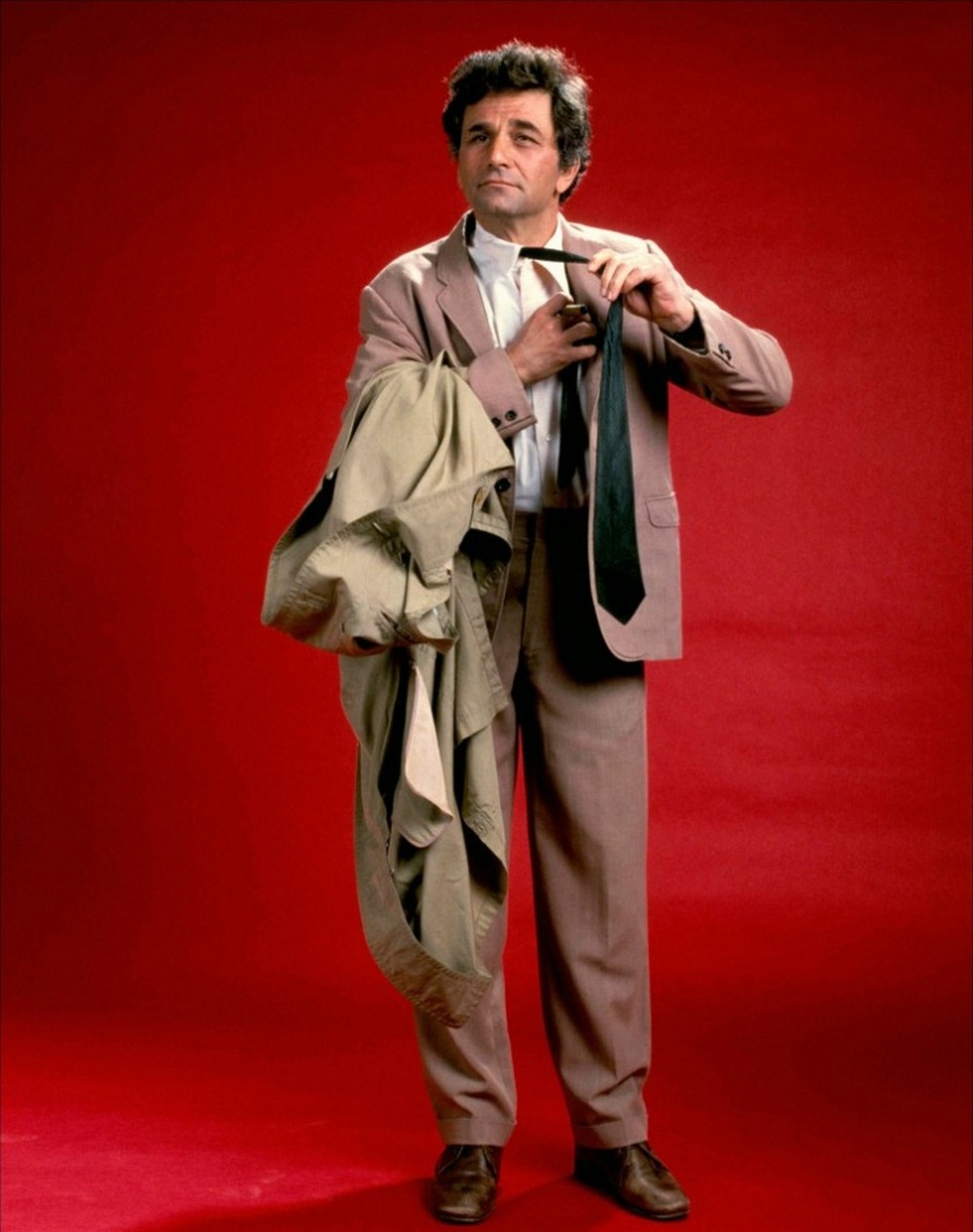
It is an extremely trite cliché that a TV star can “feel like one of the family” to members of the viewing public. If the expression has to be used at all, it might as well be used for Peter Falk, the inimitable Lieutenant Columbo, who died a few weeks back at 83. Falk was both a larger-than-life TV personality and an extremely talented movie and theater actor who did indeed occupy a sort of imaginary space in my growing up, as both my mother and father really loved his work (like Nicholson, Falk was the kind of a performer who was enjoyed equally by both men and women). As I became a diehard movie buff I discovered the depth of his work, and his ability to both “play large” and give the most nuanced and moving performances.

Columbo is, of course, the linchpin of devotion to Falk. The incredibly touching outpouring of affection for the gent across the Internet is pretty daunting: not only is he considered a kind of “member of the family” by most Americans over a certain age, he was genuinely loved the world over, as the Columbo TV movies were dubbed and shown throughout Europe and Asia (Falk also maintained that he was recognized on the streets of an African town when he went there to shoot a film).

The Columbo concept was indeed “something new under the sun” in the mystery world (the formula had no doubt been used before, but never so deftly and so often): a thriller wherein we the audience know from the very beginning who the murderer is, and the only true mystery is how will the police entrap him/her.

In the meantime nearly every one of the telefilms (minus a few of the final ones and two directed in the Seventies by Patrick McGoohan, who crafted a grimmer view of the character) offered a beautifully nuanced comic portrayal by Falk as Columbo: the shambling walk, the rumpled raincoat, the cigar, the dilapidated car, the dog named “Dog,” and of course that brilliant way of luring in the overstuffed pompous murder suspects and then lowering the boom with a simple, “…just one more thing…” The Columbo movies were TV at it best, with a comfortable, familiar lead character, exemplary writing, excellent (and, yes, often hammy) acting, and a plotline that could indeed be tied up in 90 minutes of TV time (minus commercials).

My mother adored the show from its first appearance in ’71 as part of the NBC Mystery Movie and became a diehard fan over the years, watching and rewatching the episodes, and contributing to a fan newsletter that covered everything related to both the series and Falk’s career.

The movies were indeed ideal family TV viewing: not as sickly sweet as a children’s movie (there was a cold-blooded murder taking place — right at the beginning!), not as simple-minded as a sitcom, not as tied up in scientific and legal procedure as today’s TV cop dramas. The running joke in places like Mad was that no court could convict one of Columbo’s murderers, because he built his cases against them on flimsy, circumstantial evidence — thus, the Thin Man-style outbursts or open admissions from the killers that they were indeed the culprit.

Watching the show as a kid was as invigorating as one’s first exposure to Conan Doyle: a steady accumulation of detail and character quirks, and a detective who was putting the pieces together quite handily as the program moved on. The Columbo movies have their wonderfully dated Seventies and Nineties hallmarks (hairstyles, wardrobe, plot twists involving “new” technologies like cellphones), but the storylines and, most importantly, the character of Columbo make for timeless TV. I’m happy to have experienced watching and discussing so many of the shows with my mother, and will keep those memories close to me as time goes on.

My dad enjoyed the Columbo series, but he opened me up to the “other side” of Falk’s work at an early age, when he praised John Cassavetes' incredible (and also, incredibly timeless) Husbands to me as a kid. There was no way I was going to “get” Cassavetes’ work at a young age (in fact, his work, like all perfect art, grows with you as you get older), but the bits of the film I saw on local Channel 11 were fun to me as a kid because the movie seemed to be about grown men acting in a silly, childike manner (but indulging in adult things, like drinking, smoking, and flying to London).

Years later I saw the sublime and as-near-to-perfect-as-cinema-gets A Woman Under the Influence, and realized that not only was Falk a terrific television personality, he was an incredibly nuanced actor who could play a part that at first glimpse seemed like the “villain” of the piece (a husband who can’t understand his wife’s breakdown at all) but was in fact an incredibly difficult part to play — the two things that always hit the hardest about that film are Rowlands’ delirious devotion to her kids, and Falk’s beautiful desire to help his wife and his common-Joe inclination to just ask her to please snap out of it.

The film is a difficult one, that remains as difficult and rewardingly beautiful to watch as the years go by. I think it was the critic Raymond Durgnat who said that, no matter how many times you watch the beginning of Un Chien Andalou, that razor cutting the eye never gets any duller. Similarly the almost endless scene where Rowlands tries to hurt herself in the family home and Falk tries to “wake” her up and keep his kids from witnessing what’s going on never becomes any easier to watch.

It is the trauma of both the person breaking down mentally and emotionally (Rowlands) and the person who cannot accept what is happening and wants it to stop immediately (Falk) that makes the scene so extremely powerful. The scene is a testament both to Cassavetes’ willingness to subject his audience to emotional discomfort and to the unbelievable talent of both Rowlands and Falk (the other actors in the scene respond thoroughly authentically because they are Cassavetes’ mother playing Falk’s mother and a trio of child actors who honestly don’t seem to understand what the adults are doing).

So Falk’s work has a resonance on several levels, both with the most comfortable material imaginable and the most blissfully uncomfortable. And staying in the realm of the uncomfortable (and integrally connected to Falk's final years), let me just put in a word here about how utterly disgusting the self-congratulatory crew over at the TMZ website are (while the website is bilge in cyber form, that godawful TV show is beyond noxious).

I’m a self-admitted fan of trash TV and will read gossip items by the yard, but there’s something REALLY ugly about the TMZ “ambushes” on celebrities, which have in some cases made me feel sorry for celebs I have absolutely no pity for (the only time I can feel bad for the Paris Hiltons of the world is when I fall across a TMZ link or the heinous TV show — the constant screaming of the name; the handheld camera racing to keep up with the person; the annoying, stupid questioning).

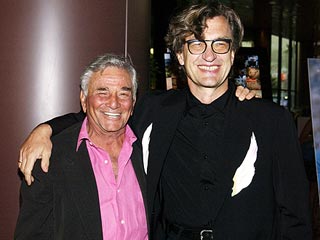
Falk was the victim of this kind of really ugly tabloid shittiness around the time that it was coming to light that he was suffering from dementia. It was reported that he was found “wandering in Beverly Hills” one afternoon in a sweater looking out of it. The photos reproduced on the Web seemed to show him talking to himself and screaming (the one to the right is not from that "news" story; I'm not going to reprint their pics). Then I actually saw the clip — yes, I succumb every so often, and as happens when you watch the infamous Bud Dwyer suicide video, I do feel really dirty afterwards. Porn makes you feel a lot (and I do mean a lot) cleaner.

What was clearly going on was that, yes, Peter was addled and was walking down the street and might indeed have been talking to himself (now how many of us have ever done the same thing?). The screaming he did and the “wild” look in his eyes and his tousled hair were due to the appearance of a camera; he begins to tell the cameraman “turn that off” and appears angry that they’re shooting video of him at that moment. Falk might’ve been having problems in the later part of his life, but I have no doubt whatsoever that the consummate pro in him immediately knew that the camera should not be there, he was not “on,” he was not in character. This was, need I add, a private moment for the guy.
The only victory I saw in this horrible moment (which was echoed, again, in the beautiful verbal tributes when he died the other week) was that commenters on the Net were as one saying “leave the old guy alone!” There is no way any of us couldn’t sympathize with this situation, either as a person whose mind wanders, or as the child of a senior who might someday have a problem similar to Falk’s.

All I can remind you of, happily, was the fact that when sleazy guys with eyes for a buck broke into Marlene Dietrich’s apartment when she was ailing and housebound, the European press did not purchase the photos they took of her looking terrible (yes, they have shown up in later biographies and on the Net). Marlene wanted her audience to remember her as she was (as did Stan Laurel, who declined to be seen in public after he had a debilitating stroke), and somehow the usually incredibly sleazy major tabloids in Europe took a stand and did not purchase the pictures. All TMZ is made of are such pictures.

But enough with the final years of Falk’s life (and yes, there are several less-than-compelling movies at the end of his filmography, including one in which he played second fiddle to SNL drone Chris Kattan), and let me celebrate the guy as he was and will ALWAYS be remembered. He spoke in interviews as if he came very late in life to acting, but in fact he began doing it in his late 20s in an amateur theater group. To that point he had been a cook in the Merchant Marine, had gotten a political science degree in college, and had worked as an efficiency expert in an office (the fact that Columbo once had that job title was one of the many wonders in Falk’s life).

When he finally devoted his life to acting in the late Fifties, he broke through in mainstream theater with a small but steady part as the bartender in the Circle in the Square production of The Iceman Cometh (this was the mind-blowing Jason Robards production preserved thankfully for TV by Sidney Lumet, without Falk). He played roles at the tail end of the “Golden Age of Television” on shows like Studio One and Kraft Television Theater, and distinguished himself in starring roles in episodes of sublime anthology series like The Twilight Zone and Naked City.

Around this same time (1960), The Chevy Mystery Show presented a teleplay by Richard Levinson and William Link called “Enough Rope,” with a shrewd detective who was smarter than he looked, based on the character of Porfiry in Crime and Punishment. The character had been played by Thomas Mitchell in the theatrical version of the show, while Bert Freed played him on the TV anthology series. His name was “Lieutenant Columbo.”

In the meantime, Falk established himself in the movies playing gangsters in Murder, Inc. (1960) and Capra’s last movie, A Pocketful of Miracles (1961). He tried to shake his “mob boss” image by playing a broad variety of roles on TV and in the movies in the decade that followed (although he met Cassavetes for the first time working on Machine Gun McCain in 1969). He shook that image forever in 1968 when he played Columbo for the first time in the somewhat dour Prescription: Murder, and then when the show began in earnest with the 1971 pilot film Ransom for a Dead Man.

As the years went by, he did vary between earnestly brilliant dramas, like the two Cassavetes milestones already mentioned (he also has a worldless cameo at the end of Opening Night), and broad farces, the best being those written by talented scripters like Neil Simon (Murder by Death) and Andrew Bergman (The In-Laws). He kept working until his final health troubles emerged, and although he never did do that long-promised “final Columbo movie,” he appeared as the character in 67 telefilms from 1971-2003 (with ten years off, from ’78-’88) and left us many happy memories.

*****
His first movie role was a small part in Nicholas Ray’s Wind Across the Everglades as one of Burl Ives’ band of mangy-lookin' rogues. He appeared in countless TV dramas, including this 1959 Omnibus episode. His first starring role was in this low-budget Beatnik potboiler, The Bloody Brood (1959).


The first role that got him major attention was his picture-stealing turn as Abe “Kid Twist” Reles in Murder, Inc. (1960). This segment from the film contains my favorite scene, him urging Stuart Whitman and May Britt to “TAKE!”:


This is the special reason that YouTube exists: upon Falk’s death, a collector uploaded an episode of the obscure 1960 TV series The Witness in which Falk reprised the role of “Kid Twist.” This is extremely rare stuff:


Falk’s theatrical roots are in evidence in this film adaptation of Jean Genet’s The Balcony (1963). A bit overdone, but still very strong:


And, showing that the guy loved to broaden his range early on, here he is singing in the Rat Pack musical Robin and the Seven Hoods (1964):


Another role in a musical, this time a 1966 TV adaptation of Brigadoon, starring Robert Goulet:


Falk’s first starring role in a TV series came with this one-season 1965 NYC lawyer show, The Trials of O’Brien. This episode begins with a great go-go club scene featuring Vincent Gardenia (!):


The sublime Murray Schisgal play Luv was adapted into an uneven but still very funny movie in 1967. In the parts played by Alan Arkin, Eli Wallach, and Anne Jackson on stage, there was Jack Lemmon, Peter Falk, and Elaine May (whatta cast!):


Falk also appeared regularly on variety shows. Here he is on The Dean Martin Show playing (what else) a gangster:


We arrive at Columbo with the advent of the 1970s. There are literally a few hundred Columbo clips on YT, but I’ll have to let the next few suffice. First, the Lieutenant annoying the hell out of a stuffy old lady. Then Columbo getting sidetracked by a book on erotic art:


A fan-created vid done in the style of Jack Haley, Jr’s “here’s the same phrase as it appeared in several different movies” montages:


The Columbo TV movies had a spectacular range of guest-star murderers. Of course Falk had to have on his friend Johnny C. (as an orchestra conductor):


The guest star who Falk seemed to enjoy having on the most was Patrick (“I am not a number — I am a free man!!!”) McGoohan, who wound up directing episodes of the series (as noted above, they are not exactly fan favorites, due to presenting a far grimmer Columbo). Here is a fan-created tribute video to the two actors. And here is a marvelous duo on one episode (who never met): William Shatner and the always overwhelming Timothy Carey:


A perfect example of the wonderfully scripted Columbo conclusions. This time the Lieutenant accuses the always-awesome Rip Torn of the crime:


If I haven’t already stressed the fact that viewers LOVED Columbo, here’s a fan-created vid illustrating Harry Nilsson’s strange but fun song “Kojak Columbo” with images from… well, take a guess…:


Falk was fine with reprising the role of Columbo in other venues if the offer was entertaining, or lucrative, enough. Here’s the entertainment — the Lieutenant shows up at a Dean Martin roast for Sinatra (and does a full ten-minute bit, a very long segment for a Dino roast):


And, yes, the filthy lucre. Falk did a series of ads for Japanese TV in the early Nineties. He promoted the Toyota Corolla dressed as Columbo. He also did ads for Suntory whisky relaxing at “home” and in pajamas and a halo with a chick in a bonnet (I have no idea). Here is a Suntory ad shot in English where Falk plays a bartender:


The trailer for Cassavetes’ Husbands (1970), narrated by NYC radio personality William B. Williams. This contains my favorite Falk scene in the picture, his singing “Good Morning, Mr. Zip-zip-zip,” a WWI-era tune out of a clear blue sky to seduce a young Chinese woman:


The opening scene from A Woman Under the Influence (1974):


The trailer for the film:


The most Cassavetes-like film that Falk was in that wasn’t directed by John himself was Elaine May’s Mikey and Nicky (1976), which costarred Falk and Cassavetes. This sequence is a gorgeous riff on death set in a graveyard that is, by turns, funny, touching, annoying, ridiculous, and profound. May encouraged the actors to improv on camera, which is what made her approach completely different from Cassavetes, whom was she presumably mimicking (John tried to limit all improvs to the rehearsal period):


A Falk interview segment from the French documentary Trois Camarades, about the friendship of Cassavetes, Falk, and Gazzarra:


Falk and Jill Clayburgh in a meet-cute scene from the TV-movie Griffin and Phoenix: A Love Story (1976):


In certain roles, Falk sounded like Humphrey Bogart. Here he is doing a delightful sendup of Bogey in Neil Simon’s Murder by Death (1976):


Falk formed a sublime comedy team with Alan Arkin in The In-Laws (1979). Here is the “serpentine!” scene:


While The In-Laws is well-remembered by fan of Seventies comedy, the other film that Falk and Arkin made in tandem, Big Trouble (1986), is completely forgotten. It is uneven but features a very good spoof of Double Indemnity, offers more of the two acting as a good comedy team, and was in fact the last film directed by John Cassavetes, who took over when scripter Andrew Bergman left the project. Here is a plum bit of business:


A film with Falk that is well-remembered by gentlemen “of a certain age” is the women’s wrestling picture …All the Marbles (1981). The last film made by director Robert Aldrich, Marbles finds Falk managing a sexy female tag team as they move up the circuit to the big time. The film is one of those cult items that actually satisfies its “mandate” — namely, devoting a large amount of the running time to the matches. Falk is the colorful, devoted manager and, yes, this is one of the many pro-wrestling films that posits that the sport is entirely real. My favorite line in the picture (Burt Young’s crack about the Brontes) is in this trailer:


From a sexy sports pic to one of Falk’s best-loved supporting roles: as himself, the former angel, in Wim Wenders’ beautiful Wings of Desire (1987). One of the many fans who loved the guy wrote in the comments field for this clip, “I can’t see you, Peter… but I know that you’re there…”:


And, similar to Big Trouble, there was a sequel to Wings of Desire that was wholly unnecessary but was nonetheless pleasant. Here’s an outtake from the film, called Faraway, So Close! (1993), featuring Falk:


Falk did indeed work steadily in the last years of his life before the health troubles emerged. Here is the trailer for one of those films (usually comedies and family fare) that went straight to DVD, an “old guy” farce featuring Peter, George Segal, Rip Torn, and Bill Cobbs called Three Days to Vegas (2007):


In closing I offer my personal fave online offerings. First the absolutely wonderful appearance made by the stars of Husbands on The Dick Cavett Show. The episode was taped on 9/18/70, and the boys put on Cavett, refusing to submit to a conventional interview (one easily assumes they visited a local “establishment” before the taping began — their playfulness seems fueled by something…). An online commenter noted that “These guys were the Rat Pack of independent film!” And this interview pretty much proves that they were:


And finally two clips that play on the same theme, in fact the same song: when Columbo had to wait for something in the series, he began to whistle or hum “This Old Man.” The song thus became a sort of in-joke for diehard fans of the show, and inspired one devoted fan to create this very touching tribute to Falk as the Lieutenant:


There is no better way to close out than with the finish of the last show in the 1976 season. The producers of the Columbo movies were not getting along with NBC, and it was assumed that the series might’ve reached its end (they were only 27 years off!). As a result they closed out the season with this nice bit of business where Columbo leaves in a rowboat, going to meet the all-important but never-seen Mrs. Columbo, as his favorite tune plays on the soundtrack:

Saturday, July 9, 2011

The comedy of discomfort: Albert Brooks

First the book review, then the career retrospective. By way of explanation: I’ve been following Albert Brooks’ career since I was a kid in the Seventies and saw him do standup on The Flip Wilson Show. That show also served as my intro at that couldn’t-stay-up-late age to Pryor, Carlin, and Robert Klein, among others. I’ve followed Albert from his TV standup work through his two utterly perfect LPs (only one of which was ever reissued on CD — and now it’s out of print), through his short films on SNL to his acting work and his filmmaking career.

Albert is a difficult figure to explain, if only because, much like two other favorites of mine (Martin Mull and Chris Elliott) his comic persona has always been difficult to summarize in a few words. Incidentally, I will refer to Mr. Brooks (as The New York Times calls him) throughout this piece as “Albert,” not to claim any personal acquaintance with the gent, but because using his last name might conjure up the more famous (and overwhelming) Brooks, namely Mel (no relation; Albert’s family name is actually Einstein). Or Richard Brooks. Or Broadcast News director James L. Brooks.

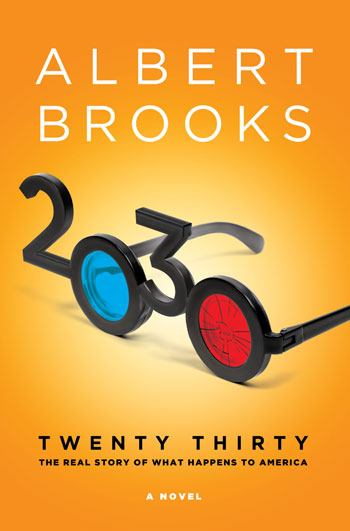
There was, and is, sort of an enigma to Albert. He currently holds the status of “comedian’s comedian,” which was demonstrated in the late-night interviews he did during a recent blitz of publicity for his new novel, 2030: The Real Story of What Happens to America. The publicity tour, which included what seemed to be his first lengthy stints at the mic since the Seventies (bookstore Q&As), was very successful, in that it helped the book crack The New York Times bestseller list and got it reviewed in countless outlets. Most of the reviews were exceptionally kind; the only dissenter was the reviewer for the NYT Book Review, whose piece was unfortunately the nearest to accurate.

2030 contains some terrific ideas about where America is headed, and by extension is an interesting reflection of where we’re at. Albert spoke at length in interviews about how he didn’t want the book to be labeled “dystopian” because he’s “hopeful” about the future. However, the best scenes in the book occur in the first third, and all of them offer a deeply grim (but realistically grim) look into the near future. Thus, at its best, the book is indeed dystopian, no matter Albert’s intentions, and winds up becoming a lot less interesting when the characters’ personal melodramas take centerstage.

The plot element that has been discussed at length in reviews and interviews is the notion that, by 2030, seniors will live longer and thus use up more of the country’s financial resources. This leads to the “olds,” as they are called, being loathed by younger Americans, who hate paying into the endless extension of the seniors’ lives.

It may sound like a variant on Clockwork Orange, but Albert is too reasonable a gent to explore the darker side of his premise — in fact, one scene where teens are menacing the hell out of some “olds” just winds down and ends with our principal senior protagonist musing on how lucky he was not to get beaten up (not very realistic…). The violence in the book is “offscreen,” to the point that even the terrorist event that is the book’s anticlimax seems like a fait accompli where nothing truly tragic will occur.

The first third of the book, though, is literally teeming with valid ideas. The one that hit hardest for me is Brooks’ take on American healthcare: 19 years from now the country still has no plan in place for uninsured folk, so patients and their relatives will take out the equivalent of high-interest, college aid-type loans to pay for operations. Needless to say, this “health loan” business has a resonance and makes one wish Albert had just explored the notions of young-versus-old and America’s lamentable healthcare status in the novel.

Instead, there is a profusion of ideas and events, each of which is fascinating on first introduction and becomes less so as the book moves on. Close to the book’s beginning comes the first trauma: a massive earthquake devastates Los Angeles. Hot on the heels of that disaster comes an event that affects every American, as China refuses to lend the U.S. any more money and opts instead for a “greater stake” in the functioning of the country.

The loan-refusal scenario is the stuff of a true “nightmare comedy” (the label that was used to hype Dr. Strangelove), but somehow Albert reconfigures it to be oddly reassuring and even heartwarming. The idea that China is, and has been for more than half a century, an authoritarian government is never dealt with because, as the case is presented in the book, the Chinese are an orderly, clean race — and besides (this joke appears at least once, possibly twice) we already like their food!

The young/”olds” war and the China-as-America’s-savior premises are big enough concepts that one could hang an entire novel on either one, but Albert — seemingly intoxicated with the prospect of creating his own universe — betrays an epic vision in the book, while still wanting to keep it down to a reasonable length. A commendable notion — and given his inexperience as a novelist, a wise one — but 2030 loses a lot of steam as it goes on, and sinks its fascinating premises in melodramatic two-character confrontations.

Running nearly 400 pages, 2030 is in fact three books in one:
—A “shape of things to come” prognostication (entertaining and thought-provoking)
—A political thriller in the book’s final chapters (where we should be in Richard Condon territory, but never are)
—A Dickensian or Altman-esque “tapestry” about disparate characters whose lives are going to intersect because of a special event

A tapestry narrative is a HELL of an ambitious endeavor for a first-time novelist to carry off, since it requires hundreds and hundreds of pages to follow each character (unless you’re a master miniaturist like Raymond Carver — who, of course, never wrote a novel — or a master satirist like Thomas Pynchon). In terms of length, 2030 isn’t an epic, but it begins to feel like one as it reaches its midpoint. (By comparison, a genuinely dystopian pulp fiction like Stephen King’s The Stand glides along.)

Perhaps this is because Albert avoids any sort of modernist techniques and instead writes in simple, declarative sentences. The book is comprised of third-person descriptions of the character’s actions, thoughts, and emotions — one gets the impression while reading it that Albert is aware of both modernist sci-fi/fantasy (Vonnegut, Philip K. Dick) and the turgid, oversimplified (but sporadically suspenseful) writing found in potboilers of the DaVinci Code variety, and he opted to go for neither.

The page count is somewhat evenly split between the many protagonists, but the most fully developed characters are sadly also the dullest. They are America’s first half-Jewish president (presumably the role that Albert would play if 2030 were ever to become a film), his Treasury Secretary (an all-too-wise and far-too-noble individual who, as the NYT reviewer noted, seems like a character custom-built for Meryl Streep), and a Chinese healthcare expert, brought in to help the ailing city of L.A., who is nothing less than an Asian variant of a Frank Capra hero.

There are no real villains or even solid antiheroes in 2030, since Albert oddly envisions a social landscape where everything is wrong… and then things start to go “right.” It’s sort of a fluffy, politically naïve tack to take, and it mirrors the “lovable” period of Albert’s movies, when he tried to make his scripts simpler and cuter, but still proved unable to make a film that would wow the public, and in the process lost all but the hardliners (yes, I paid to see The Muse in a theater — yes, it was cute, and yes, I can barely remember a moment of it).

The opposite has happened with 2030: its reviews haven’t just been positive, they’ve been near to raves — making me wonder, “did they read the same book I did?” I know it doesn’t seem like it from the above, but I am genuinely happy to see Albert back in the national spotlight and am glad that his first book was such an ambitious endeavor. The best I can say for 2030, though, is that he wrote at least one-third of a great book, and put the spotlight on some very important topics.

******
Now on to the happier portion of the program, intended to show that the above came not as a drubbing of Albert, but merely as the thoughts of a weary reader. Let me now celebrate the career that led up to the book:

Despite his having worked simultaneously as an actor, most of us who were around in the Seventies became aware of Albert as a standup. His act was always conceptual (although not as aggressively or as experimentally weird as that of Andy Kaufman), and his subsequent screen persona was that of a bothered/harassed guy (one critic used the helpful term “worrywart”) who boasted a sense of urgency mixed with panic and righteous indignation.

An important component of his comedy throughout the Seventies and Eighties was that “Albert Brooks” the character was both abrasive and blithely unaware (or uncaring) of the havoc he caused. The latter is a classic comic conceit and was brilliantly carved out by the man. His standup routines were airtight bits like this gem:


He hasn’t been one who is given to “explaining” his comedy, but in the recent spate of interviews he’s done he has commented, apropos of his new, wonderfully funny Twitter account, that he has “spent years deconstructing Bob Hope,” meaning he did acts that dissected and mocked the old show-biz models, like this extremely rare clip of him doing an “and then I wrote…” songwriter act. And, of course, this ventriloquist act from… The Flip Wilson Show:


Perhaps his finest conceptual moment is this Tonight Show moment where he does slapstick comedy while commenting on the fact that he doesn’t do slapstick comedy:


His standup career is also unusual in that he gave it up entirely after a half-dozen or so years, but would return to the form sporadically, but only for The Tonight Show. Carson was such a powerful force in show business at the time, and he was such a fan of certain acts that they would do things for him they did for no one else. Thus, Steve Martin and Albert both would return to their standup roots when appearing with Johnny. Two great examples of this are thankfully available on YT:


I mentioned his two excellent LPs above, and they are both must-listens; they exist as downloads at various places online, and you should indeed take advantage, since they are both currently way out of print. The second LP, A Star is Bought (1974), is a brilliant concept piece created by Albert and Harry Shearer in which Albert devises several ways to get his record played “on every radio station in the country.”

One of those gimmicks is this incredibly esoteric but spot-on abuse of Dickie Goodman’s “flying saucer” records, which sampled hits of the day. Albert explains before the track that he couldn’t afford the rights to popular songs (neither could Goodman — he was frequently sued), so he just had some made up. What is notable about the track is that two of the singers are the late, GREAT Harry Nilsson and Albert’s girlfriend in the early Seventies, a certain Linda Ronstadt:


This is the Albert bit that I’ve listened to the the most over the years, his six-minute evisceration of talk radio that is as absolutely perfect now as when it was released back in '74:


And the rarest piece of Albert vinyl, his Xmas single (also co-written by Shearer):


Albert left standup comedy behind for filmmaking in the mid-Seventies and unfortunately has often been thought of as working “in the shadow of Woody Allen.” Plainly put, Woody’s schlemiel character was lovable; Albert’s brash character was not. Woody made wonderful, conventionally structured films, while Albert’s films were conventionally structured but also commented on the ugly, manipulative side of show business (Real Life) and the destructive side of relationships (Modern Romance). Most importantly, Woody developed a solid following in Europe and the UK, while Albert has remained a well-known supporting actor and cult filmmaker solely in America.

Additionally, Woody started making serious films as early as the late Seventies and has made films in which he didn’t appear, while Albert has always remained an onscreen comic figure in his films. With his fourth film as a writer-director, Defending Your Life (1991), he softened his onscreen persona, making him a harassed but lovable figure — presumably because he wanted to get more features made and was not of a mind to make indie films (many filmmakers who have worked in Hollywood stay infatuated, like Orson Welles, with the “greatest train a boy could ever have” and can’t conceive of working with a smaller palette on a far lower budget).

His first three films — Real Life (1979), Modern Romance (1981), and Lost in America (1985) — remain hysterical today, not only because his comic instincts are razor-sharp (he was hailed as the “funniest white man alive” in the Seventies — because Pryor was assumed to be the single funniest person), but also because he was willing to play an abrasive protagonist in his own films, an antihero who had a bit more backbone than Woody’s screen persona, but just as many neuroses.

In my opinion the really brave, truly interesting artists are willing to be disliked by the audience if it benefits the work they’ve made (not to evoke Woody too many times in this piece, but even he adopted an abrasive variation on his comic persona in both Stardust Memories and Deconstructing Harry). The works may fail commercially, but they definitely acquire the right audience as time passes.

But first, the aspiration. Albert broke into filmmaking with a series of shorts in which he appeared that aired on the first season of Saturday Night Live (all of which are worth your time and attention). His first-ever short, though, was called “The Famous Comedians School” and aired on the PBS series The Great American Dream Machine. The abbreviated version that is available on YT is a weird edit made for a Milton Berle-hosted special on comedy; the producers unwisely added a laugh track — had Albert emerged in the Eighties or Nineties, one can easily see him starring in an HBO, laugh track-less sitcom of the Curb Your Enthusiasm variety:


His first feature is indeed a marvel. Real Life is a brilliant (and brilliantly abrasive) satire on the PBS documentary series An American Family (the forerunner of today’s “reality TV”), cinema verite, pretentious filmmakers, and money-hungry studio execs. Co-written with Harry Shearer, it remains a pungent piece of nasty comedy. There are no clips from the film available online, but the fucking wonderful trailer, in which Albert uses 3D effects when it’s certain the audience won’t have the glasses, is right here:


His second feature, Modern Romance, is a fascinating artifact of the Eighties zeitgeist that finds Albert and his costar Kathryn Harrold playing characters who are hard to warm up to, involved in a relationship that is difficult to care about. And yet the film is extremely funny and very perceptive about the screwed-up patterns people manifest in their love relationships. One of my favorite bits from the film is online thankfully. It consists of Albert rambling around his apartment after taking a quaalude:


A memorable bit from the film set in an editing suite:


And the only onscreen meeting of Albert and his brother Bob Einstein (aka “Super Dave Obsorne” and “Officer Judy”):


Of the seven films he’s made, I believe Lost in America was the biggest hit at the box office. It’s easy to see why — his “Easy Rider for yuppies” is filled with great dialogue and situations (and is oddly in synch with everything that has happened in this last decade). At this point Albert’s character was still abrasive and capable of having a world-class freakout:


An amazing bit of uncomfortable comedy, with Garry Marshall as the casino owner:


The infamous “nest egg” speech:


With Defending Your Life (1991) Albert and his writing partner Monica Johnson “softened” the character he played, a change that stayed in place until recently. I enjoyed the films that ensued, but they were clearly attempts at a “family friendly” Albert Brooks. Here is a great moment with the one and only Rip Torn from Defending:


His seventh and most recent film as a writer/director/star, Looking for Comedy in the Muslim World (2005), was a major flop, but it represented a return to the Brooks character of the Seventies and Eighties. His rendition of himself in Muslim World is again an abrasive and blithely unaware individual who constantly questions his own behavior and that of others. The film failed at the box office due to political events, Americans’ disinterest in really solid comedy (as opposed to crap SNL- and Apatow-related farces), and the criminally unwieldy title. But I thought it brought us full circle, back to the Albert I’ve been a fan of since the early Seventies:


This clip from Muslim World encapsulates what Albert does at his best: crafting a *thoroughly* uncomfortable situation, putting his brusque character in the middle of it, and lampooning the way we communicate with each other. In this scene he also quite deftly decimates the improv comedy process. We’ve all encountered this situation in comedy clubs: a performer asks for suggestions, and then proceeds to simply go with whatever he/she feels confident doing:


*****
The oddest thing about this whole “resurgence” in Albert’s career is that, as a major fan, I’ve actually been more enthused to read Albert’s wonderful Twitter feed, which is funny and caustic as hell, than I was reading the last half of 2030. His career as an actor has been fertile for more than two decades now (I guess I’ll take the very sentimental My First Mister over the please-WHY-are-you-guys-doing-this? remake of The In-Laws), but I do hope that he gets the opportunity to make more films.

If he continues to write fiction, I’d hope he takes a slightly less ambitious tack, and (please!) avoids the personal melodrama. I’d also earnestly, amiably suggest that he avoid EVER AGAIN ending a piece of writing with a speech that earnestly, amiably makes suggestions about how something could be changed for the better. I, for one, would never conceive of… whoops!

Wednesday, June 29, 2011

The Passing Tide 5: Deceased Artiste Wild Man Fischer

Larry “Wild Man” Fischer was a true original for whom the unwieldy and imprecise term “outsider music” is just too tiny in its implications. And let’s be honest: the “outsider” label is a term that cares less about the artist and more about the "expert" — thus the inclusion of insiders with major-label music careers in the “outsider” category.

Fischer was the real deal, though: a street singer who had an awful singing voice but who thought up and performed songs that were bizarre, oddly (sometimes scarily) honest, and, most important of all, catchy as hell. He was also was lucky enough to be “rediscovered” over the years by different groups of odd-music fans.

His obits sketched his tenure as (The New York Times) “a mentally ill street musician” and (The L.A. Times, being far more kind) “a disheveled troubadour.” His mental troubles were of course what made his music so compelling (or really irritating) to listen to. He was given the nickname “Wild Man” by Solomon Burke, but is best known for his short association with Frank Zappa, who produced the amazing two-record set An Evening with Wild Man Fischer. Fischer’s highs and lows were recounted in the documentary Derailroaded, where the reason for the break with Zappa is revealed — Larry throwing a bottle in anger, nearly hitting baby Moon Unit in the head.

After the Zappa connection had died out and everyone forgot his sole appearance on Laugh-In (presumably booked in order to find “another Tiny Tim”), Larry went back to roaming the streets of L.A. singing for dimes and quarters. His recording of a promotional song for the Rhino Records store provided him with a “second act,” as he became a favorite on The Dr. Demento Show with “My Name is Larry” and went on to release three LPs for the newly created Rhino label. Those albums didn’t sell very well, and he went back to being a street singer. He was reclaimed from obscurity by the “outsider” business, and then made a final appearance in public on The Jimmy Kimmel Show, thanks to a very smart producer on the show being a fan of his work.

Derailroaded is essential viewing for those who know Fischer’s songs and others who just like strange music. It is thorough and very moving, but sadly left out the Kimmel appearance and thus ends on a down note, with Larry entering an assisted-living facility, in which he lived until his death two weeks ago of heart failure at the age of 66. Unlike the Roky Erickson and Daniel Johnston documentaries, Derailroaded leaves us with the sad notion that the thing that made Larry special, the “pep” that he claimed was his impetus to write and sing songs on the street, was gone when he went back on medication for bipolar disorder and schizophrenia.

Let’s remember the Wild Man at his creative, utterly bizarre best, first with the song he was hoping would be a hit single, for which Zappa provided a full production:


His most anthemic song, which you WILL NOT be able to get out of your head, is the one he performed on Laugh-In, “Merry-Go-Round.” Here is the album version, with Larry lapsing into a British accent on one of the verses — again, he wrote this hoping for a hit single, but instead crafted a tune that is all hook and nothing more, which seems to be the product of both his obviously voracious AM-radio listening and his childlike ear for sound:


As an example of Fischer’s influence on later generations, I offer Alexei Sayle’s cover of “Merry-Go-Round,” which seems just a bit more menacing than Fischer’s version:


A true rarity: Wild Man performing with the Mothers of Invention in late ’68. Here he performs “I’m a Meany,” his song about Yellow Submarine:


Even stranger, one of the creepier and more revealing songs from the Zappa-produced double abum, “The Wild Man Fischer Story,” performed live with the Mothers at the same show:


The song that ushered in the second phase of “Wildmania,” his promotional 45 for the Rhino store, “Go to Rhino Records”:


An invaluable little intro to Larry on the street, courtesy of an early Eighties “news magazine” show:


A rare concert appearance by Wild Man, with one of my fave bizarro musical acts, Barnes and Barnes:


Fischer recorded a duet with Rosemary Clooney (yes, you read that right) called “It’s a Hard Business.” That isn’t on YT, but you can hear similar sentiments in the sad and cynical “Don’t Be A Singer”:


The trailer for Derailroaded offers a capsule view of his life:


And the film’s creepiest scene offers animation for what is surely Larry’s scariest tune, “The Bouillabaisse”:


Larry’s last public performance, to my knowledge, his stint on the “Future Talent Showcase” on the Kimmel show:


Why not end with a sigh? Wild Man, with the help of Mark Mothersbaugh, covers “The Way We Were”:

Saturday, June 25, 2011

In Pod We Trust: five podcasts to which I am addicted (entries 4 & 5)

4. As It Occurs to Me: Richard Herring remains one of Britain’s busiest standups and also one of its most prolific podcasters. In my profile post on Herring, I discussed his other endeavors, but in this “short list” of recommended podcasts I had to include his sketch comedy show As It Occurs to Me, since it is, by turns, the most ambitious, the silliest, and, yes, the most imaginatively vulgar program I’ve heard in the decades since one could actually hear “the seven dirty words” on listener-sponsored Pacifica radio in NYC.

The show grew out of Herring’s twisted-history BBC program That Was Then, This Is Now, but it is a vast improvement on that show, in that AIOTM (as its title indicates) has no hard-and-fast concept behind it and is subject to no censorship whatsoever. It’s an exploration of the ideas and events that have occurred to Herring (and his cast) in the week prior to the program.

One warning: it might be quite puzzling to listen to the later episodes in any given series of the show before the earlier ones, so it might be best to start with the earliest shows. Herring is a master at crafting utterly absurd in-jokes and taglines that range from the sublime (I still salute him for referring to people’s children as their “sexcrement”) to the ridiculous (one season later, AIOTM still contains gag references to a skit that fell very flat a year ago, a goofy motorcycle-clothing store sketch).

Herring is ably abetted by his small cast of two actors (Emma Kennedy, Dan Tetsell) and a musician (Christian Reilly), but the show does seem to rise and fall on the twists and turns of his own fertile and warped imagination, and his ability to toss off lines and concepts that are better than some lesser standups’ entire acts. He also does this on the much more informal and quite often directionless podcast he does with TV/film critic Andrew Collins called Collings and Herrin.

As for the “dirty” side of the show: I have a pretty low tolerance for comedy that is obscene for the sheer sake of being obscene, but I do revere “dirty” humor that is surreal (as with Frank Zappa) or fucking brilliant (as with Cook and Moore’s inspired “Derek and Clive” LPs). Herring regularly plays with the notion of being puerile in his humor, but somehow keeps AIOTM and his standup from ever descending to the Howard Stern/Opie & Anthony level of unimaginative scatological humor.

Herring’s stage persona in his standup is often that of a chubby schlemiel, but in his podcasts and in certain of his themed standup shows, he is an agent provocateur who takes things just one step too far — and then muses about why he’s never on “the telly” anymore….

UPDATE: The only trouble with trying to chronicle any part of Richard Herring’s career is that the guy moves so damned fast. In the time that it took me to write and upload this blog entry, I found that he had recorded what he claims is definitely the very last AIOTM episode. He said that twice before, so perhaps we will see a return of the show, but he already has another short-term podcast he’s developing for this year’s Edinburgh Fringe, and he continues the sometimes hysterical, sometimes not-so-much, Collings and Herrin ’cast.

Available: Here
Price: free

Frequency of podcast: a “season” of six episodes annually

5.) Atoms, Motion and the Void: The preceding five podcasts in this survey are all rather easy to discuss, but the last one is such a special case that I’ll first refer you to a piece I wrote on it back in 2008, then I’ll describe it again briefly and talk about its latest “cycle” of programs.

AMV offers superlative storytelling in a literary vein — wait, stop, don’t mentally tune out! By “literary,” I mean entertaining and exceptionally well-constructed, not dry and over-intellectualized. The podcast is the creation of writer-performer Sean Hurley, who plays the lead character, one Sherwin Sleeves. Sleeves is an unflappable old gent living in the woods of New Hampshire who inhabits a universe that is by turns extremely realistic and magical.

The show is in fact a unique fusion of disparate elements, the main one being modern lit and old-time radio. The clever plot twists and self-awareness of the former mingle with cliffhangers and subtle “reveals” of the latter in the best AMV episodes. The stories are so well-written that I frequently scratch my head and wonder why Hurley hasn’t had a short-story collection or novel published yet. Besides the fact that the publishing world is bleeding to death on a gurney in the corner of the emergency ward, I think it is because Sean has unwittingly staked out his own terrain, and his work needs to be performed more than it needs to be read.

Making AMV even more a “one-man band” effort is the fact that Sean scores the show himself. In the earliest episodes, he played songs by other artists that perfectly fit the mood of the piece — in this capacity he actually got me to enjoy Rammstein and perfectly accomplished a Funhouse-like leap of culture with an episode that featured songs by both the Velvet Underground and Eddie Cantor. In recent years the songs in the shows have all been Sean’s own, thus fully integrating Sleeves as the sole “voice” of the universe he inhabits.

After a layoff of several months, Hurley has returned with a new series of episodes that he is offering by subscription — the original 35 shows are all still available for free. So far the new tale is engrossing and properly trippy, as Sherwin moves through a landscape of woods and water that is the mirror image of the one he normally lives in. Again, AMV functions with the homespun charm of A Prairie Home Companion, but as if written by a writing staff composed of Borges, Hesse, and Vonnegut (and perhaps, for good measure, my all-time fave Richard Brautigan).

No one is going to subscribe to something they’re not familiar with, so I hereby reproduce from my last blog post the list of episodes that supply the best introduction to the show.

The fact that there are well over two dozen episodes [now there are 35 – ED] may seem daunting to newcomers, but I suggest these shows: episode 2 as an amusing intro to the character and his ramblings, episodes 4 or 6 as door-openers to the larger tapestry that Sleeves winds up telling; 5 or 7 for uniquely touching tales (and I am not into the sloppy sentiment that ordinarily surrounds the telling of stories involving kids), and episode 18 if you just want to jump the gun, and experience Hurley’s mindwarpingly good writing.

AMV was the first podcast I got hooked on, and it remains a personal object of addiction.

Available: Here
Price: The older episodes are all free online. The new cycle of shows is available in the form of a subscription, with the episodes coming in the mail as limited-edition CDs, plus membership to the “Stalwarts” site, which celebrates all things AMV and features related downloads. Subscriptions are $12.96 a month, three months for $38.88, or six months for $77.76. I chose the download-only option (with Stalwarts membership), which is $45.00 for the series of six eps as MP3s.
Frequency of podcast: the show appears at intervals and has always been well worth the wait between eps.

I’m glad to share my recommendations for the preceding quintet; please feel free to add your own nominations in the comments field below. The five shows I included in this post are all very different, but they all share two things: they relate to audio genres that were formerly a staple of commercial radio (no more!), and it’s evident that their host-producers all put in a helluva lot of hard work to create them. I close out with two instructions: download and listen!

Friday, June 24, 2011

In Pod We Trust: five podcasts to which I am addicted (entries 1-3)

Commercial radio is deader than Marconi, and so those of us who listened to the medium all our lives have three options: listener-sponsored stations, satellite radio, and podcasts. In NYC, the first option has never come in on portable radios (“college radio” signals have never had enough strength; NPR is informative, but more often than not makes me doze). The second is a manifestation of the “niche” factor in American culture (hide the good stuff in niches that cost dough, while the mainstream garbage is free). And thus a few years ago I moved to the third option, which is thoroughly dependent on you knowing that the show exists.

Like trees in the forest, a veritable swarm of podcasts compete for your time and attention (and in some cases, for your dollars), but you could easily overlook the best ones on the journey to read another bite-sized piece of text on the Net. Since this past weekend I turned “another year older and deeper in debt,” I figured my gift to you, the reader of this blog, would be a short discussion of the five podcasts I most eagerly await. Four of them I’ve written about before on this blog; only two charge a subscription fee, and both of those have ample archives of older material available for free. Four of the five hosts began on radio, and all of the programs have their own individual charms and addictive qualities. I would've linked to the downloadable version of one of my favorite remaining radio programs, Idiot's Delight with Vin Scelsa, but that is available only as .asx files, which can't be carried around on an MP3 player.

1.) Lionel Media: Lionel, whom I wrote about here, is a former radio talk-show host who was on both liberal and conservative stations, and always seemed to stake out his own turf. His only book to date labeled him a “contrarian,” but I’d prefer calling him a skeptic, which, given the extremely bored yet dogmatic way in which Americans view both politics and religion, is a valuable thing.

If you want to sample what Lionel is like when he’s in his hyper-kinetic mode, check out his wonderful three-minute commentaries on local WPIX news. On his website, he currently offers an audio podcast on which he goes into depth on the same issues as the PIX commentaries, and also ponders a host of others.

Although I disagree with him on some issues, and there have been a few times when I’ve felt that 30-45 minutes would’ve sufficed on certain topics (his podcast usually runs an hour), the best episodes have found him carefully deconstructing some statement or action made by the government. That is when he is at his best as a “decoder” (his own term) of the mainstream media’s coverage (and blind acceptance) of the government’s pronouncements. My personal favorite episodes of the ’cast have been more personal ones, where Lionel (in perfect Henry Morgan mode) tells us about people who annoy the hell out of him. Examples of this from his WPIX commentaries are here and here.

Sometimes I do sense a slight “disconnect” between the high-energy commentator on TV and the soft-spoken podcaster, but in both roles Lionel is a talker who always forces his viewers/listeners to think about what’s going on around them. Plus, he’s extremely funny, especially when in an exasperated or annoyed mode.

Check out his WPIX commentaries on YouTube for an intro as to how the man’s mind works. I’m still surprised that a local news show is airing his radical (read: logical and well-argued) messages. He is well worth your time:


Available: Here
Price: $5.99 a month, but free “sample” episodes every few weeks
Frequency of podcast: 3-5 times a week.

2.) WTF With Marc Maron: Marc is the only podcaster on this list lucky enough to have commercial sponsors and to seemingly be making a profit from his Net-show. Ostensibly an interview show concerned with the world of comedy, I detailed in my last post about WTF how, pretty early on, the show started offering odd and fascinating “therapy sessions” for the comic figures interviewed.

I’m still not sure why the guests consent to talk in detail with Marc about their biggest fears, grimmest memories, and most tangled familial relationships, but it most definitely makes for a riveting listen. A few guests have indeed moved away from discussing anything too personal, and still others have acknowledged the fact that the show frequently goes in that direction (“I’m not gonna cry for you, Dr. Maron,” declared “the pitbull of comedy” Bobby Slayton).

As I mentioned last time, I have little to no interest in some of the people Marc has on (how many members of “The State” or “The UCB” can one honestly care about?). But it is a testament to his unique method of “sharing neuroses” and getting his guests to open up that I often wind up listening to these episodes anyway — developing a sympathy or simpatico for the individual, even though I still don’t find them funny or ever want to watch their work.

There are exceptions, though. While, for example, I already enjoyed the work of Dave Foley (Kids in the Hall) and standup Maria Bamford, and just wound up loving ’em a whole lot more after they opened up to Marc about their private lives (in minute detail), I found recent episodes (one posted today) with two major “name” comic personalities, Jimmy Fallon and Amy Poehler, to be shows one could avoid entirely. But I listened — yes, I listened, and have learned my lesson; I will spend no more time hearing reminiscences of SNL or UCB alumni. (Both institutions have crafted startling amounts of unfunny, unwatchable sketch comedy.)

Marc will frequently refer to the ghosts of Comedy Giants Past — Lenny, Pryor, Carlin, Hicks — and people who influenced the current generation of standups like Mitch Hedberg and Dave Attell (all of whom I enjoy very much). But one need only hear Fallon talk on WTF about Will Ferrell being the funniest man he’s ever met “in my entire life” and understand in a flash the “mediocritization” of American comedy. Steve Allen used to say Groucho was the most naturally funny man he’d ever met; Fallon points to Ferrell — why say more? (I've seen Fallon gush over top-notch British humorists like Chris Morris, the Pythons, and the Mighty Boosh elsewhere, but his taste in the American comedy of his own generation is as piss-poor as the "stupid human tricks" performed on his program.)

But I come to praise Marc, not to bury him with one of his more famous guests’ sadder statements. The single best example of what Maron is capable of with WTF was a recent episode in which he interviewed a comic legend who still dwells among us, Jonathan Winters. The last time I saw Winters being interviewed it was on Jimmy Kimmel, where he did a rather dazzling bit of improvisational material as a deranged scoutmaster for boys who dressed his charges in little dresses and bonnets. As Winters went on, the routine was alternately hysterical and then not funny at all (the sign of true improv). Around the time he reached a wonderfully Faulkner-ian image that wasn’t funny at all but was still wonderfully haunting (a flood that sent all the little boys’ dresses downstream…), Kimmel stopped him cold and asked, “Can I speak to Jonathan?” thereby ending the routine for good, and proving that however friendly and nice Jimmy K. is, he hasn’t the foggiest when it comes to playing straight man to the comic Force of Nature that is Jon W.

By comparison, Maron let the now-85-year-old Jonathan simply wail at points during their interview. Winters talks much slower now, but his mind still fires on all cylinders, and around the 1:05 mark of the interview — after having discussed his stays in mental institutions and his grim relations with his parents — Jonathan started riffing. What came out was a dark piece in which he played both a wimpering patient and his stern psychologist. The latter is so fed up with their sessions and his patient’s spinelessness that he begins to urge him to commit suicide, in graphic detail. The bit has no punchline, but it is Winters at his best, and it is incredibly dark (bringing to mind the much-circulated “Hee-Hee-Larious” unsigned party record that “JW” made made many years ago).

I would definitely love to hear Marc meet up in the future with more of the “old lions” of comedy who dwell on the West Coast, and continue to hold “therapy sessions” with his extremely tortured and very funny contemporaries. The talks with friendly but anemic (and boringly non-neurotic) sketch-comics aside, WTF remains a show for comedy fans to keep an eye on, if only to hear Marc “trauma-bond” with funny standups whose secrets and memories make for fascinating listening.

Available: Here
Price: Free, but a “premium membership” (with access to the older episodes) is available for $.99 for 1 month, $4.99 for 6 months, and $8.99 for a year.
Frequency of podcast: twice a week

3.) The Bitslap with KBC The NJ-based free-form radio station WFMU is a bastion of eclecticism that is listener-sponsored and, sadly, unable to be heard on any portable radio in NYC. Thus, the station’s podcasts provide a portable way to listen to the station, and the show I’m about to discuss can be heard only as a podcast.

Though he’s never been one of their “celebrity” DJs, a gent who simply goes by his initials has been on my short list of favorite air personalities since the dim, dark late Eighties. He left his regular berth on the station back in the 1990s (early? mid? I’m reaching the point where memories start to blend together….), but has been producing a weekly music podcast for the last two years for the WFMU website. It is mind-warpingly weird, and by that I mean wonderful.

KBC’s stated heroes on the program are Spike Jones, Stan Freberg, and the Firesign Theater, but there’s a lot more to his show than novelty tunes and “headphone comedy.” He cleverly blends rare singles with 78s and what are now called “deep album tracks” to create a mind-altering effect (without chemicals!) that calls to mind the best aspects of Sixties and Seventies free-form radio, as well as the strange vibe that permeated Seventies radio comedy (the best example being The National Lampoon Radio Hour).

He arranges most of the shows thematically and does a superb job of venturing down the “rabbit hole” of recorded comedy music to discover the catchiest, silliest, most hypnotic, and yes, at times even abrasive, music and vintage comedy sketches. The show is clearly a labor of love and, as an access producer, I can well understand KBC wanting to “give it all away.” (Remember, before YouTube, there were zines, public access and, most definitely, FM free-form radio.)

Check out KBC’s playlists to see the breadth of material he covers — and be sure that no one on the planet has a wider collection of rare, unique, and downright strange Xmas music than he does!

Available: Here
Price: absolutely free
Frequency of podcast: once a week

COMING UP: Two shows that have lengthier intervals between their episodes, but are well worth the wait!