Friday, July 2, 2010

“Playing with gentle glass things”: An appreciation of Richard Brautigan

I first became aware of Richard Brautigan in books I read about the Beatles, as his sole spoken-word LP was at one time intended to be a release on the “Zapple” label. My first encounter with Brautigan’s writing was again Beatle-related: he wrote a very haunting intro to the mass-market paperback The Beatles Lyrics Illustrated called “The Silence of Flooded Houses.” Then I read his short story collection, The Revenge of the Lawn, and my lifelong love of his work began. 

Brautigan is typically described as a “Sixties cult figure,” sometimes as a Beat writer, sometimes as a hippie icon. He was actually neither — he was younger than the Beats and not thought by them to be serious enough; though he clearly loved hippie chicks, he stayed far away from drugs and the communal lifestyle of the Haight-Ashbury district he lived in during the “Summer of Love." 

He is also often defined by the fact that he committed suicide at the age of 49 in 1984. I will leave behind those aspects for a bit and talk about what he really was: a poet and novelist who blended a gently surreal prose style with a wry, deadpan sense of humor and a view of nature as both constant and sheltering, and eternally subject to change. 

His writing style is deceptively simple, as was Vonnegut’s (in fact Vonnegut recommended Brautigan to his first mainstream publisher) and, although he can’t be duplicated, his influence is felt today in more whimsical, less poetic writers like Tom Robbins. The easy-to-read aspect of Brautigan’s prose caused him to be vastly underrated by American critics and academics and, true to form, has made him a cult hero in parts of Europe and Asia (the best American writers, musicians, and filmmakers tend to have more fervent cult followings in other countries than they do over here). 

For me, Brautigan’s work has been a touchstone since my teen years. Although capsule biographies of the man seem to dote on his last few depressed years, the sense I get from his Sixties work is that of a visionary optimist, and his Seventies/early Eighties work conveys a melancholic whose curiosity and wonder at bizarre insights and juxtapositions sustained him. For me, his writing is “magical,” perhaps in the sense of magical realism, since fantastic events are recounted in a comically deadpan fashion. Whatever the case may be, his writing never fails to lift my spirits when I’m feeling down, and as a writer I wish I could view life through the very special lens he was blessed with.

In the fall of last year, I came across discounted copies of the three collections of Brautigan’s work that have thankfully remained in print. I own the original paperbacks of all of his books (setting aside the limited-edition chapbooks and early broadsides), but the idea of revisiting the works between new covers intrigued me (my fascination with his work had found me haunting bookstores during the final years of his life hoping to find any new material by him). And it had indeed been decades since I had read most of the books — I used to gulp them down in single sittings back in the late Seventies, which had left me with vivid memories of some images and plot points, but a hazy recall of the particulars of most of the later titles. 

So I’ve spent the last eight months or so spacing out my reading of his work, just so I could make it last longer — there were only ten novels, two short story collections and five slim volumes of poetry. I found that the books I thought were “minor” (Sombrero Fallout) or “a little too long” (A Confederate General From Big Sur) were the right length, and several shades deeper than I’d been able to perceive as a grammar-/high-schooler. Brautigan’s poetry is a vivid and inventive, late 20th-century blend of his two influences, William Carlos Williams and the Japanese haiku poets. 

The poems, which are thankfully all available online (!) at the indispensable The Richard Brautigan Bibliography and Archive, run the gamut from quick gags, to surreal daydreams, to gorgeous love poems written for the women in his life (who were often seen on the covers of the books). A definitive volume of his collected poetry is long overdue, but in the meantime, I urge you to check the work out on the Brautigan Archive.

I had briefly wondered why Brautigan’s daughter Ianthe has allowed all of his verse to remain online on one “above-ground” site, but the reasons are apparent: all but one of his books of poetry are out of print, and the man himself used to stand on the street in Haight-Ashbury handing out his work. Brautigan wanted people to read his poems, and in this era of instant Net gratification, I’m sure he’d be glad they are all right there, out in public view. (He also was miles ahead of the curve when he wrote a poetic paean to the merging of the natural and the cybernetic, "All Watched Over by Machines of Loving Grace," right.)

Of particular interest to fans like myself who only have his books from mainstream publishers is a digital recreation of his totally, utterly, completely out of print “book” (consisting of seed packets in a folder with poems on them) called Please Plant This Book

Brautigan’s novels break down neatly into three periods. The first is the absolutely magical Sixties work, which is best sampled in Revenge of the Lawn (in print in one of the three-in-one collections) and the three-in-one volume that appeared during Brautigan’s lifetime and has remained in print all these years. It contains his best-known work, Trout Fishing in America, the poetry collection The Pill Versus the Springhill Mine Disaster, and what is definitely his most “perfect” novel in my view, In Watermelon Sugar. Extremely low-key, IWS creates a world all its own, offering a bizarrely prescient allegory for the hippie era that was most likely intended as a simple comment about the joys and perils of communal living (he wrote the book in 1964, but it was published in 1968). 

The Abortion also seems to “sum up” the Sixties in a unique way. Written in 1966 but not published until 1971, it contains one of Brautigan’s most indelible creations, the Library of Unpublished Works. (A real-life equivalent to this exquisite dream-creation existed for a while in Burlington, Vermont.)

The second period of Brautigan’s fiction found him tackling a different genre every year, producing four very original books. His “gothic western” The Hawkline Monster and comic private-eye novel Dreaming of Babylon are still in print, but sadly the two more oddly personal and darkly humorous titles are completely gone from sight. 

Willard and his Bowling Trophies tells the story of a couple experimenting with mild S&M while three dumb-ass brothers search for their precious bowling trophies, which have been stolen from them but just happen to be sitting in the apartment right below the awkward S&M couple. I read the book as a teen and found it extremely funny and imaginative. As I reread it now, I still find it humorous, but realize the deep vein of sadness in the S&M couple’s interaction (details in Brautigan bios would seem to indicate that both the couple’s play and their unease are based on his own relationships with women in the Seventies). The book still has its wonderfully funny moments, but it’s quite something else when you come to it as a middle-aged person.

His novels were all “strange” in one delightful way or another, but the other out-of-print “genre” novel (which is the most playfully un-genre-fied work from this period), Sombrero Fallout, is perhaps his strangest narrative ever. A heartbroken “humorist” who seems to be Brautigan himself pines for the Japanese girl who broke up with him, while a page of a story he threw away starts to “live” in his garbage pail. Like Willard…, the book is an absolute revelation, as it mixes a blissful level of oddball humor with a sense of romantic loss that jumps right off the page. 

The third period of RB’s fiction is comprised of only three books. The Tokyo-Montana Express is a sort of diary of his journeys between a ranch in Paradise Valley, Montana, his adopted home, and Tokyo, a city that adopted him (he became a cult writer in Japan in the late Seventies, due to the haiku-like nature of his work). I delayed re-reading Brautigan’s last two novels, as they both exhibit the sadness that enveloped the end of his life. 
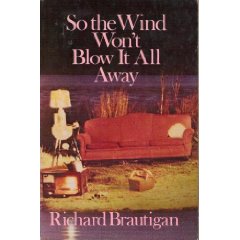
So the Wind Won’t Blow It All Away is a terrific, characteristically low-key tale of adolescence that shares with the final novel, An Unfortunate Woman, a roundabout, Tristram Shandy-like approach to storytelling (although Brautigan does tie up his loose ends very neatly). Also, both books are most definitely about the proximity of death in everyday life. 

The emotional ties I have to Brautigan’s work have grown stronger as I have gotten older, and so I was very glad to find a few kindred spirits online who have done beautiful tributes to the man and his work. There are several interesting articles on him here, and Dennis Cooper did a terrific blog entry that includes good samples of Brautigan’s prose. 

The two most invaluable references, though, are Jen Leibhart’s e-mail list, housed on her site The Brautigan Pages, and the already mentioned “deep” resource that is The Richard Brautigan Bibliography and Archive, run by Brautigan scholar John F. Barber. 

Brautigan video clips are very scarce, since he wasn’t a Mailer or Capote-like self-promoter and thus seemingly never appeared on TV(if he did, the appearance is buried in some archive or was disposed of years ago). He did, appear, however in an informal fishing documentary called Tarpon with his Montana writer friends Jim Harrison and Tom McGuane. Here is a scene from Tarpon that shows Brautigan simply hanging out and animatedly chatting with his pals: 


Brautigan walking in San Francisco in something called “Nowsreal”:


There are a number of people reciting Brautigan’s poetry on YouTube, but here is one soul’s “visualization” of a poem which features a sexy woman seen from the back. Methinks Richard would approve…


Another super-rarity: Brautigan “interviews” a little girl for a friend’s film project:


I find it every heartening to see that younger readers are taking Brautigan’s work to heart. Here are scenes from an event called “XXI Century Brautiganism” that took place on the WSU Vancouver Canvas late last year:


His spoken-word LP, Listening to Richard Brautigan, can be heard here, and it can be downloaded here.

In closing, I’ll just note that I had an incredibly brief encounter with Brautigan at a signing for Tokyo-Montana at the Greenwich Village Brentano’s (which, if I remember correctly, was on 8th St. and Fifth Avenue). He was sick on that day, but showed up anyway and signed books. For some unknownable fanboy reason, when my turn came, I said, “I never thought I’d see you in a situation like this!” He answered with a deep hoarse voice, “I never thought I’d see myself in a situation like this….” and dutifully signed the old paperbacks I handed him in his trademark tiny handwriting. I then told him, “You’re my favorite author,” and he got very quiet and handed the now-autographed books back. 

Perhaps he thought I was just being kind, that I had felt obliged to say what I did, or perhaps he was so sick he didn’t even care, but I’ve always been glad that I got to say those words to him. I meant them, and still do.

Thursday, July 1, 2010

Ken Russell's masterpiece The Devils now on iTunes

I’ve already professed my love for the work of Ken Russell in these pages, and still have more of my interview with “Unkle Ken” to come in this format and on the Funhouse TV show. In the meantime however, it has been brought to my attention that his masterpiece The Devils has finally been made available in this country in a sorta, kinda, near-to-complete version.

The film is owned by Warner Brothers, which is still, to this very day, scared of putting it out in its complete form, for fear that it will outrage Catholics and other dogma-loving Xtians. The truth is that the film is one of the finest explorations of religious hypocrisy ever, in any art form, and if someone is bothered by it, then they need to double-check their own religious beliefs. The documentary made for British television about the controversy surrounding the film constituted the first time that the censored “Rape of the Christ” sequence had been shown publicly (the same night the docu was shown the film was aired in its entirety). In that documentary a Jesuit notes that that scene is about blasphemy taken to the very limit, but the sequence that Russell intercut it with — in which Oliver Reed performs the ceremony of the mass with his lover and offers her the sacrament of communion — redeems the “Rape” sequence, showing what constitutes real faith as opposed to hypocrisy.

So the good news in this instance for U.S. viewers is that The Devils is finally available to be seen in its restored version. The bad news is that it is missing part of the “Rape of the Christ” sequence (which is what I assume takes it down three minutes from 111 to 108 minutes), and is only being made available by the oh-so-skittish Warner folks as a digital download on iTunes. No DVD, no Blu-Ray, none expected.

It’s very interesting to consider that of all the films that caused moral outrage at the turn of the Seventies, the rest of the pack — A Clockwork Orange, The Wild Bunch, Straw Dogs, Deep Throat — have all been perennially available on American home media on VHS and then DVD. The Devils thus validates itself by being so hard to locate (the best complete copy that has thus been circulated is of that single airing on British cable TV). It obviously has as much to say to our own era as it did back in 1971. Religious hypocrites will never go away, and they hate to be called out on their utterly ridiculous, offensive, and dangerous behavior (some might hit the nail through the palm with “un-Christ-like”). So check out the Russell film through the download, or through the bootlegs (I’m sure it’s circulating on Bit Torrent and Rapidshare, as the British cable TV version was up on YouTube in its entirety for a few months at one point), or when it appears at a local repertory theater. It’s a dynamic work that continues to say a lot about the publicly pious.

Here is where I found out about the iTunes download. Thanks to the great “Movie Irv” for passing this on. UPDATE: As of today, 7/8/10, the film has been pulled, and according to online sources, was up for less than a week. It was indeed missing the entire "Rape of the Christ" sequence, but supposedly was a crystal-clear restoration of the film. C'mon, Warner Brothers, what are you so scared of?

NYC's MTA has slowed down service until soon nothing will be running at all….

No, the title doesn't refer to New York becoming a Warriors or Streets of Fire-type landscape in an "alternate future" (although I often speculate on how easily that could happen). I just feel compelled to return to the topic of NYC's dreadful little tin-cans of horror, although I can’t really add much to what I’ve said in past blog entries.

Except, of course, to note that the MTA is crying poverty once again, as they always are. Now we know they lie on a regular basis, so it’s lovely to find that, just this week, as they took a whole bunch of completely necessary bus lines out of commission (stranding many riders in the outer boroughs — the lands the MTA is most apathetic about) and discontinued two subway lines, that the service has been absolutely awful. Worse than ever, and that’s saying something.

Perhaps the goal here is to re-establish that the citizens of NYC are dependent on them. Creating the wonderful fictions (which do indeed occur in real-life, but several of them in one day on the same two or three train lines — wow, what a coincidence!) of “police actions,” “track fires,” signal problems,” etc, etc, ad nauseum, must be exhausting, but they’re surely wanting to raise the fare, since none of the people who run the MTA take the damned trains and buses in the first place.

It's often been noted that cops should be forced to live in the communities they serve, just so they would know exactly what life in that neighborhood is like, and so they can’t escape to the suburbs at day’s end and think of the people who live in their precinct as “the Other.” I think the same should be true of the MTA. And while we’re at it, why not stick the tiny billionaire who bought himself a third term onto a subway running from Brooklyn to Queens, or the Bronx to Manhattan, or an outer borough to fucking anywhere. Have them ride the Frankenstein creations they’re responsible for on days like the past few, when a really sprightly tortoise could outrun a subway train in this town. Just an idea.

The movie/TV/music stuff continues above, but I must give complete credit to the source for the images seen above. They came from the the Remixed Metre blog, who says he got them from the Gothamist website, but I could only retrieve them from his site. So there.

Friday, June 18, 2010

Reasons to be Cheerful, Part Four

Since this is officially the day I turn “another year old and deeper in debt,” I’m going to just slip backwards in time (which comes easily most of the year, even easier on birthdays). I’ve talked before on this blog about Sixties and Seventies “easy listening” music (aka elevator music) that was burnt into my brain at a young age, and continues to conjure sensations of that era when I hear it.

You can find entries about punk artists and psychedelic artists and bubble-gum artists elsewhere on this blog, but for this entry, there are no lyrics, and it’s just “MOR” easy listening tracks that were hits and became the wallpaper to our daily activities back then. (And remain a sorta “comfort music” for those who had this piped into their consciousness.)

Most of the songs I’ll be linking to are in the Herb Alpert/Burt Bacharach/bouncy pop number category (I’ve already paid tribute to numbers like ”Classical Gas”), but I thought I’d start off with one that predates those songs and instead has a nice little depressing edge to it. It’s an evocative little number called “Last Date” by Floyd Cramer, the master of the “slide piano” who was a legendary session player in Nashvile. On its own the song has a sort of downbeat, last-call-at-the-bar feel, but when you find out the title, you sorta get the drift:


And since I don’t want to slide into a “saloon song” coma with these tunes, I’ll offer another Cramer number, this time incredibly fuckin’ bouncy and catchy. This was recently used in the soundtrack of the movie An Education (which I still haven’t seen; I found this on, where else, YT). It’s called “On the Rebound” and although “jaunty” is a word you’re supposed to use to describe people and not music, it’s pretty damned jaunty:


I’m going to skip past two of the most obvious songs that belong in the category of cheerful instrumental, “Java” and “Alley Cat,” and proceed onto one that most people of a certain age (what a remarkably diplomatic phrase, that) know, but don’t know the title of, Dave Baby Cortez’s “The Happy Organ” (all genitalia jokes will be happily skipped past too):


And one of the other songs that seeped into the brainpan back then was this sucker, which was recorded and became a hit by Billy Vaughn and Bert Kaempfert. This version has a jungle girl-themed video, so it seemed to be the one that needed linking:


Continuing on with Kaempfert, there is only one pop tune I know of to have a chart status (in the U.S. at least) that had the word “Afrikaan” in the title. That was “Afrikaan Beat,” and Kaempfert definitely led the way to the style of Herb Alpert and the Tijuana Brass, although Herb “Latin-ized” the sound.


Most of these songs are best-remembered in their single versions, but here’s a live rendition by Kaempfert of “That Happy Feeling.” The word “bouncy” doesn’t even convey the damned thing, but it must also be noted the tune has a special resonance for those in the NYC area in the early Sixties, as it was used as the theme to the afternoon children’s show The Sandy Becker Show. And what makes the vid special? You get to see the handclaps, a key part in any mercilessly hooky Sixties tune:


There's a bottomless pit of instrumentals you may know the tune of but can’t name, like “Wheels” by the String-a-longs. Then there are the songs that AM-radio listeners knew all too well, but are still as pleasant to re-hear decades on, like “Grazin’ in the Grass” by Hugh Masekela. The hit with vocals (and the insane “Icandigityoucandigithecandigitshecandigit”) was done
by the Friends of Distinction. But the Masekela original is the instrumental great:


Months ago when I did a little Deceased Artiste tribute to
Raymond, Lefèvre, the man who gave us the infectious instrumental “Soul Coaxing,” I was of course reminded of the best-known French instrumental of the Sixties “Love is Blue” by Paul Mauriat. Since I am fixated by the unnecessary vocal versions of these songs, I offer you the vocal version by Al Martino, but here is the Mauriat originaL:


On an album-cover associative level (painted womyn), here is the indelible Burt Bacharach-penned Casino Royale theme by Herb Alpert. I’m not a soundtrack aficionado per se, but this is one of the OST LPs I will dig out and spin every few months. It definitely buoys the spirits:


Since we’re on the infectious route, here’s “No Matter What Shape (Your Stomach’s In)” by the T-Bones, which was used in a TV commercial about heartburn which is here:


And if we’re going to go deep-Sixties, you’d have to resurrect
Andy Williams’ “Music to Watch Girls By” clip which is endearingly corny as fuck. Andy sang many, many of the instrumental songs that they wrote ridiculously impromptu lyrics for. One YouTube uploader maintains that the Andy song was the original in this case, but the Bob Crewe Generation (nobody calls their band the “Generation” anymore, more’s the pity) had the hook-ridden instrumental hit:


And I’ll close out with two tunes whose titles I didn’t know until recently. The first is the insanely infectious “Soulful Strut” by Young Holt Unlimited. This is supreme stuff:


Since we must move leave the Sixties behind, let’s do that to enter the Seventies, with the 1972 hit “Joy” by Apollo 100, which was sort of the 45 RPM super-pop version of the more pretentious art-rock stuff Emerson Lake & Palmer were carrying out in that era. Alternately brilliant and immaculately cheesy, it won’t exit your noggin anytime soon:


If anyone has any infectious instrumentals they want to leave links to, drop 'em in the comments! UPDATE: The comments contain a bunch of suggestions from M. Faust that include at least two songs I know had (natch) unnecessary lyrics sung at one point by Andy Williams! (The "Romeo and Juliet theme" and "Love's Theme") The Midnight Cowboy theme is almost too sublimely movie-related to have fit in here (but musically it does), and Hot Butter's "Popcorn" is infectious as hell (and well utilized in a party scene in Shriek of the Mutilated; the sequence is not on YT).

Monday, June 14, 2010

"I'm a little man, I'm a little man -- he's a big man": Deceased Artiste Dennis Hopper

Back when Dennis Hopper was a hippie wildman, Kris Kristofferson wrote the song “The Pilgrim, Chapter 33 (Hang In, Hopper)” for Dennis, whom he had worked with on The Last Movie (the song was also supposed to reflect Kris’ other friends, like Johnny Cash and Jerry Jeff Walker, but his title betrays the main subject). Kristofferson’s lyrics, which can be found here, talk about the schizo nature of Hopper’s talent, how he was a “walking contradiction” (a line quoted by Paul Schrader in Taxi Driver, with a direct reference to Kristofferson, and yet another later in the film to Hopper).

Hopper definitely was a conflicted character when he was at his best — once the conflicts died down, so did the factors that made him an extremely watchable performer, and he made the conscious decision to appear in anything and everything (using accents he wasn’t very good at, and even playing Sinatra in one particularly odd pic that showed up on DVD). Perhaps to support his habit of buying art, perhaps to keep up with his upscale lifestyle, perhaps merely because he wanted to die “with his boots on” on a movie set. As a longtime fan of his, I’ve been cringing for the past 15 years plus, as he’s appeared in bad TV series, godawful “DVD premieres” (and their forefather, the “straight to video” movie), and stinking cable films; pretty much anything they offered him, he took. He completely ceased being a filmmaker after producing a few really interesting films, and became a character performer who would star in just about anything.

I say the preceding with regret, since I thought that, at his best, Hopper had a helluva lot to offer as an actor and as a filmmaker. Since the man has left us now, after a very public battle with prostate cancer (and his most recent younger wife), I’ll leave out the bad and just focus here on the good and the weird in Hopper’s work. He grew tremendously as a performer over the years, most likely due to his life experience and prolonged period indulging in drugs and really, really wild behavior (as with the sitting-in-the-middle-of-a-dynamite-circle story). Like his friend Jack Nicholson, he grew from being a really flat actor into a true multi-dimensional character on-screen, stealing some films outright and dominating others with scarily intense performances.

Hopper cultivated his “hipster” cred early on, from basking in the reflected glow of James Dean and starting a feud on a movie set with journeyman director Henry Hathaway. After the incident with Hathaway blacklisted him, he moved to New York, and tried for a “legit” reputation in theater and television. He gave some great performances in TV series, but also appeared in some compulsively watchable kitsch, like this episode of Petticoat Junction:


Even while appearing on fun crap like the above, he also kept moving in art circles, as is indicated by the fact he was in a “Screen Test” for Andy Warhol:


While researching this piece, I found that the clearest example of how Hopper grew as an actor could be found in his recitation of an all-too-familiar poem he’d memorized. He performed Rudyard Kipling’s “If” (which, btw, he had to remind us, was the middle word in “life”… man…) on The Johnny Cash Show (there was also a singing duet, which is wonderfully bad and can be found here). It’s pure corn, seeing Dennis recite the piece at this point in his career, kinda like him doing something “straight” for once, even as he is a hippie film star (with oddly groomed hair — what was it with that “pilgrim” look?):


He then performed the poem at a Dylan "Rolling Thunder" tour show, and of course inserted it out of the blue (plus the "middle word in life" bit) into Apocalypse Now. The most impressive clip I came across is him reciting the poem again as an older man, and a far, far better actor, giving it a genuinely emotional tinge that was missing in his earlier performances. Dammit if he didn’t get better as he got older (the reason why I was saddened by his descent into awful moviemaking for his final 15 years).


For a dose of pure hippie-visionary Dennis, the single best source is the documentary American Dreamer (1971), directed by L.M. Kit Carson and Lawrence Schiller. When the docu was made, he was one of the hottest filmmakers in the world thanks to the success of Easy Rider, and he was about to shoot himself in the foot big-time with The Last Movie. Here he’s driving and rambling:


Here he centers in on Orson Welles as a model filmmaker, but also as the kind of person the studios simply would *not* trust with a film budget:


One of the docu’s finest moments, Dennis’s admission that he is a male lesbian:


The Last Movie (1971) is available in its entirety on YT. I have very mixed feelings about the film, since I think it is bold and daring and extremely crazy (always to be encouraged), but it actually winds up being only half a good movie, due to Hopper’s inability to actually carry off Godardian disjunctive techniques — plus the fact that he’s set up such a conventionally good storyline his working with alienation techniques wasn’t necessary:


He gave some great performances even while he was “indulging” in a major way. One of those was Henry Jaglom’s terrific Tracks (1977). The incredibly high-strung conclusion of the film finds Hopper going to that place he went to again in films like Blue Velvet:


He was also just perfectly cast in Wim Wenders’ brilliant crime-and-character picture The American Friend (1977). This trailer doesn’t have English subs, but Dennis’ scenes are in English:


Shortly after he gave the disciplined performance above, he went full-tilt gonzo for Coppola’s cameras in Apocalypse Now. It’s interesting that he was such a “type” when he gave this kind of performance, yet no one ever did an impression of him (although everyone I know wound up quoting his more batfuck crazy dialogue after seeing him give performances like this). He serves as the "doorway" to Brando, which is interesting in light of the fact that Marlon was forever going to be the paramount actor of Hopper's generation, given that Dean took an early exit and Monty Clift dissolved in the mid-Sixties:


Now we come to what I feel was the most underrated part of Hopper’s career, and the part he sadly abandoned when he started getting blockbuster salaries in the early Nineties: his filmmaking. Again, while he was still a dedicated “user,” he made an excellent low-budget independent feature in Canada that found him emulating the Cassavetes style to very good effect. Out of the Blue (1980) is hippie Dennis reflecting on the new punk culture, and the way in which people of his generation might not have been the most… attentive parents. It’s an excellently acted pic that is disturbing as hell and showed he was a very talented filmmaker who shoulda kept making movies. Here the lead character, Hopper’s fucked-up teen (Linda Manz), registers her complaints on a CB radio:


Here’s a little slice of the pic’s “atmosphere,” as the underage Manz wanders into a punk club:


And here Daddy Dennis comments on punk:


Hopper didn’t make another movie as a director until 1988, when he helmed Catchfire, which was released as Backtrack on video in 1990. It’s a bizarrely cast movie that is a helluva lot of fun, despite the fact that Dennis’s urban tough-guy accent is about as unconvincing as Nicholson’s in Prizzi’s Honor. The film was pretty much buried by its studio Vestron, just before Vestron itself was buried by bankruptcy. It exists on YT only as a pseudo-bondage clip uploaded for its fetish-y aspect, and for its Bob Dylan cameo, recorded here off of a TV set (I guess whomever holds the right to the title is demanding the clips come down?):


Hopper also made one of the best ever films about L.A. street gangs, Colors (1988). Superbly acted by Robert Duvall and Sean Penn, and as tense as all hell, the film is definitely one to be seen. It has been uploaded in its entirety on YT:


Hopper’s last film as a director was Chasers in 1994, which can be best described as “The Last Detail with Randy Quaid replaced by a hot blonde from Baywatch" (yes, it’s that high-concept). He had spoken in interviews about creating a film school for directors, but he completely abandoned that part of his career after Chasers (with the exception of one short in 2000). A definite shame, considering the talent he did display as a director — and the fact that he stopped being interested in filmmaking around the time he started earning *giant* salaries in big-budget crapo blockbusters like Speed and Waterworld (which may have failed at the b.o., but Dennis made quite a lot doing it).

Since I don’t really want to draw too much attention to Chasers, I’ll close with the trailer to his last good pic as a director, The Hot Spot (1990), which is based on an old hardboiled novel, found Don Johnson actually giving an excellent performance, and costarred the dynamic duo of Virginia Madsen and Jennifer Connelly, both unquestionably pleasing to the eye: