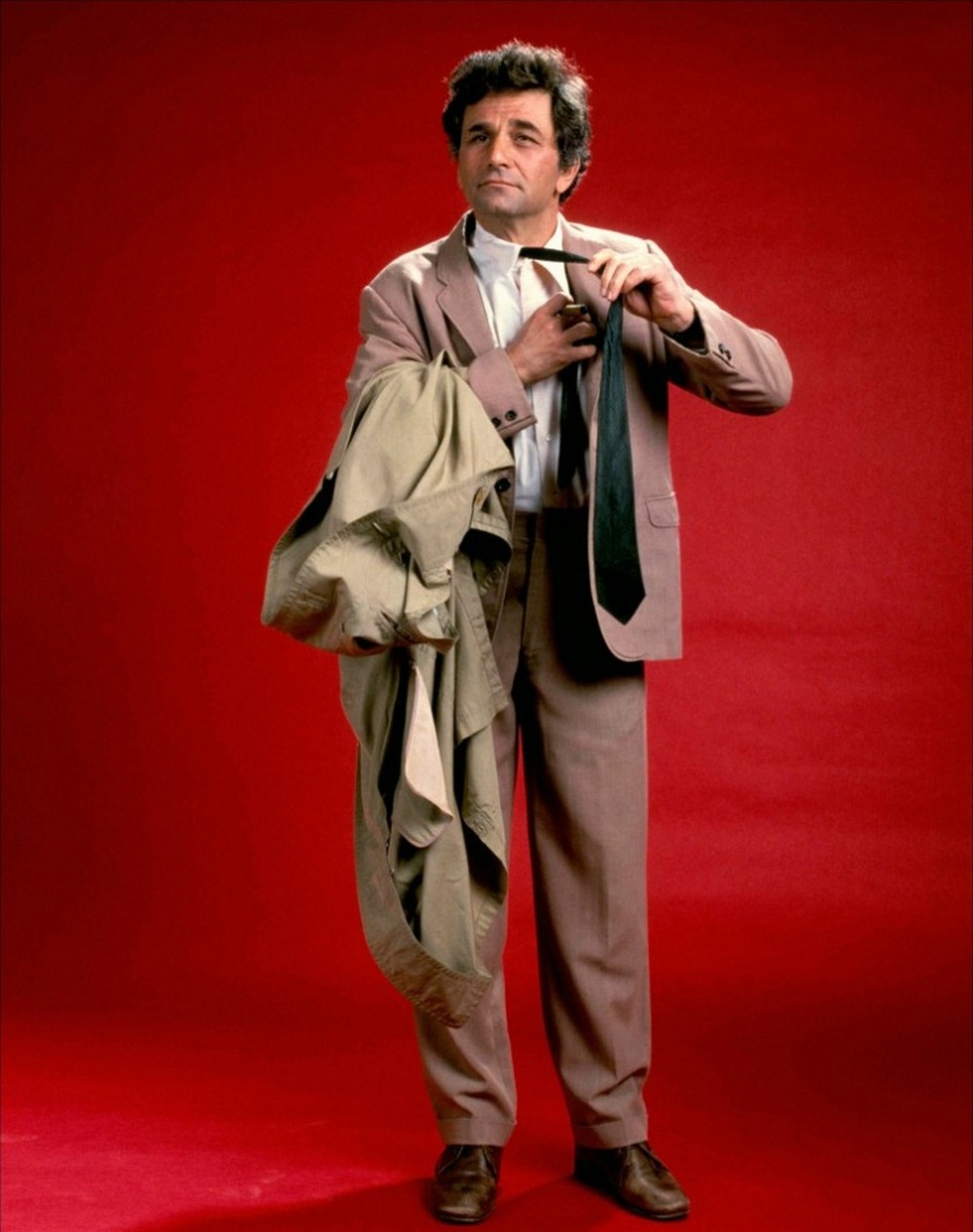
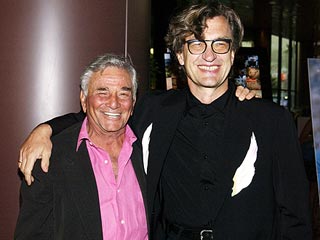
It is an extremely trite cliché that a TV star can “feel like one of the family” to members of the viewing public. If the expression has to be used at all, it might as well be used for Peter Falk, the inimitable Lieutenant Columbo, who died a few weeks back at 83. Falk was both a larger-than-life TV personality and an extremely talented movie and theater actor who did indeed occupy a sort of imaginary space in my growing up, as both my mother and father really loved his work (like Nicholson, Falk was the kind of a performer who was enjoyed equally by both men and women). As I became a diehard movie buff I discovered the depth of his work, and his ability to both “play large” and give the most nuanced and moving performances.
Columbo is, of course, the linchpin of devotion to Falk. The incredibly touching outpouring of affection for the gent across the Internet is pretty daunting: not only is he considered a kind of “member of the family” by most Americans over a certain age, he was genuinely loved the world over, as the Columbo TV movies were dubbed and shown throughout Europe and Asia (Falk also maintained that he was recognized on the streets of an African town when he went there to shoot a film).
The Columbo concept was indeed “something new under the sun” in the mystery world (the formula had no doubt been used before, but never so deftly and so often): a thriller wherein we the audience know from the very beginning who the murderer is, and the only true mystery is how will the police entrap him/her.

In the meantime nearly every one of the telefilms (minus a few of the final ones and two directed in the Seventies by Patrick McGoohan, who crafted a grimmer view of the character) offered a beautifully nuanced comic portrayal by Falk as Columbo: the shambling walk, the rumpled raincoat, the cigar, the dilapidated car, the dog named “Dog,” and of course that brilliant way of luring in the overstuffed pompous murder suspects and then lowering the boom with a simple, “…just one more thing…” The Columbo movies were TV at it best, with a comfortable, familiar lead character, exemplary writing, excellent (and, yes, often hammy) acting, and a plotline that could indeed be tied up in 90 minutes of TV time (minus commercials).
My mother adored the show from its first appearance in ’71 as part of the
NBC Mystery Movie and became a diehard fan over the years, watching and rewatching the episodes, and contributing to a fan newsletter that covered everything related to both the series and Falk’s career.
The movies were indeed ideal family TV viewing: not as sickly sweet as a children’s movie (there was a cold-blooded murder taking place — right at the beginning!), not as simple-minded as a sitcom, not as tied up in scientific and legal procedure as today’s TV cop dramas. The running joke in places like
Mad was that no court could convict one of Columbo’s murderers, because he built his cases against them on flimsy, circumstantial evidence — thus, the
Thin Man-style outbursts or open admissions from the killers that they were indeed the culprit.

Watching the show as a kid was as invigorating as one’s first exposure to Conan Doyle: a steady accumulation of detail and character quirks, and a detective who was putting the pieces together quite handily as the program moved on. The Columbo movies have their wonderfully dated Seventies and Nineties hallmarks (hairstyles, wardrobe, plot twists involving “new” technologies like cellphones), but the storylines and, most importantly, the character of Columbo make for timeless TV. I’m happy to have experienced watching and discussing so many of the shows with my mother, and will keep those memories close to me as time goes on.

My dad enjoyed the Columbo series, but he opened me up to the “other side” of Falk’s work at an early age, when he praised John Cassavetes' incredible (and also, incredibly timeless)
Husbands to me as a kid. There was no way I was going to “get” Cassavetes’ work at a young age (in fact, his work, like all perfect art, grows with you as you get older), but the bits of the film I saw on local Channel 11 were fun to me as a kid because the movie seemed to be about grown men acting in a silly, childike manner (but indulging in adult things, like drinking, smoking, and flying to London).

Years later I saw the sublime and as-near-to-perfect-as-cinema-gets
A Woman Under the Influence, and realized that not only was Falk a terrific television personality, he was an incredibly nuanced actor who could play a part that at first glimpse seemed like the “villain” of the piece (a husband who can’t understand his wife’s breakdown at all) but was in fact an incredibly difficult part to play — the two things that always hit the hardest about that film are Rowlands’ delirious devotion to her kids, and Falk’s beautiful desire to help his wife and his common-Joe inclination to just ask her to please snap out of it.
The film is a difficult one, that remains as difficult and rewardingly beautiful to watch as the years go by. I think it was the critic Raymond Durgnat who said that, no matter how many times you watch the beginning of
Un Chien Andalou, that razor cutting the eye never gets
any duller. Similarly the almost endless scene where Rowlands tries to hurt herself in the family home and Falk tries to “wake” her up and keep his kids from witnessing what’s going on never becomes any easier to watch.

It is the trauma of both the person breaking down mentally and emotionally (Rowlands) and the person who cannot accept what is happening and wants it to stop immediately (Falk) that makes the scene so extremely powerful. The scene is a testament both to Cassavetes’ willingness to subject his audience to emotional discomfort and to the unbelievable talent of both Rowlands and Falk (the other actors in the scene respond thoroughly authentically because they are Cassavetes’ mother playing Falk’s mother and a trio of child actors who honestly don’t seem to understand what the adults are doing).
So Falk’s work has a resonance on several levels, both with the most comfortable material imaginable and the most blissfully uncomfortable. And staying in the realm of the uncomfortable (and integrally connected to Falk's final years), let me just put in a word here about how utterly disgusting the self-congratulatory crew over at the TMZ website are (while the website is bilge in cyber form, that godawful TV show is beyond noxious).
I’m a self-admitted fan of trash TV and will read gossip items by the yard, but there’s something REALLY ugly about the TMZ “ambushes” on celebrities, which have in some cases made me feel sorry for celebs I have absolutely no pity for (the only time I can feel bad for the Paris Hiltons of the world is when I fall across a TMZ link or the heinous TV show — the constant screaming of the name; the handheld camera racing to keep up with the person; the annoying, stupid questioning).

Falk was the victim of this kind of really ugly tabloid shittiness around the time that it was coming to light that he was suffering from dementia. It was reported that he was found “wandering in Beverly Hills” one afternoon in a sweater looking out of it. The photos reproduced on the Web seemed to show him talking to himself and screaming (the one to the right is not from that "news" story; I'm not going to reprint their pics). Then I actually saw the clip — yes, I succumb every so often, and as happens when you watch the infamous Bud Dwyer suicide video, I do feel really dirty afterwards. Porn makes you feel a lot (and I do mean a lot) cleaner.
What was clearly going on was that, yes, Peter was addled and was walking down the street and might indeed have been talking to himself (now how many of us have ever done the same thing?). The screaming he did and the “wild” look in his eyes and his tousled hair were due to the appearance of a camera; he begins to tell the cameraman “turn that off” and appears angry that they’re shooting video of him at that moment. Falk might’ve been having problems in the later part of his life, but I have no doubt whatsoever that the consummate pro in him immediately knew that the camera should not be there, he was not “on,” he was not in character. This was, need I add, a private moment for the guy.

The only victory I saw in this horrible moment (which was echoed, again, in the beautiful verbal tributes when he died the other week) was that commenters on the Net were as one saying “leave the old guy alone!” There is no way any of us couldn’t sympathize with this situation, either as a person whose mind wanders, or as the child of a senior who might someday have a problem similar to Falk’s.
All I can remind you of, happily, was the fact that when sleazy guys with eyes for a buck broke into Marlene Dietrich’s apartment when she was ailing and housebound, the European press did not purchase the photos they took of her looking terrible (yes, they have shown up in later biographies and on the Net). Marlene wanted her audience to remember her as she was (as did Stan Laurel, who declined to be seen in public after he had a debilitating stroke), and somehow the usually incredibly sleazy major tabloids in Europe took a stand and did not purchase the pictures. All TMZ is made of are such pictures.
But enough with the final years of Falk’s life (and yes, there are several less-than-compelling movies at the end of his filmography, including one in which he played second fiddle to
SNL drone Chris Kattan), and let me celebrate the guy as he was and will ALWAYS be remembered. He spoke in interviews as if he came very late in life to acting, but in fact he began doing it in his late 20s in an amateur theater group. To that point he had been a cook in the Merchant Marine, had gotten a political science degree in college, and had worked as an efficiency expert in an office (the fact that Columbo once had that job title was one of the many wonders in Falk’s life).

When he finally devoted his life to acting in the late Fifties, he broke through in mainstream theater with a small but steady part as the bartender in the Circle in the Square production of
The Iceman Cometh (this was the mind-blowing Jason Robards production preserved thankfully for TV by
Sidney Lumet, without Falk). He played roles at the tail end of the “Golden Age of Television” on shows like
Studio One and
Kraft Television Theater, and distinguished himself in starring roles in episodes of sublime anthology series like
The Twilight Zone and
Naked City.
Around this same time (1960),
The Chevy Mystery Show presented a teleplay by Richard Levinson and William Link called “Enough Rope,” with a shrewd detective who was smarter than he looked, based on the character of Porfiry in
Crime and Punishment. The character had been played by Thomas Mitchell in the theatrical version of the show, while Bert Freed played him on the TV anthology series. His name was “Lieutenant Columbo.”

In the meantime, Falk established himself in the movies playing gangsters in
Murder, Inc. (1960) and Capra’s last movie,
A Pocketful of Miracles (1961). He tried to shake his “mob boss” image by playing a broad variety of roles on TV and in the movies in the decade that followed (although he met Cassavetes for the first time working on
Machine Gun McCain in 1969). He shook that image forever in 1968 when he played Columbo for the first time in the somewhat dour
Prescription: Murder, and then when the show began in earnest with the 1971 pilot film
Ransom for a Dead Man.

As the years went by, he did vary between earnestly brilliant dramas, like the two Cassavetes milestones already mentioned (he also has a worldless cameo at the end of
Opening Night), and broad farces, the best being those written by talented scripters like Neil Simon (
Murder by Death) and Andrew Bergman (
The In-Laws). He kept working until his final health troubles emerged, and although he never did do that long-promised “final Columbo movie,” he appeared as the character in 67 telefilms from 1971-2003 (with ten years off, from ’78-’88) and left us many happy memories.
*****
His first movie role was a small part in Nicholas Ray’s
Wind Across the Everglades as one of
Burl Ives’ band of mangy-lookin' rogues. He appeared in countless TV dramas, including
this 1959 Omnibus episode. His first starring role was in this low-budget Beatnik potboiler,
The Bloody Brood (1959).
The first role that got him major attention was his picture-stealing turn as Abe “Kid Twist” Reles in
Murder, Inc. (1960). This segment from the film contains my favorite scene, him urging Stuart Whitman and May Britt to “TAKE!”:
This is the special reason that YouTube exists: upon Falk’s death, a collector uploaded an episode of the obscure 1960 TV series
The Witness in which Falk reprised the role of “Kid Twist.” This is extremely rare stuff:
Falk’s theatrical roots are in evidence in this film adaptation of Jean Genet’s
The Balcony (1963). A bit overdone, but still very strong:
And, showing that the guy loved to broaden his range early on, here he is singing in the Rat Pack musical
Robin and the Seven Hoods (1964):
Another role in a musical, this time a 1966 TV adaptation of
Brigadoon, starring Robert Goulet:
Falk’s first starring role in a TV series came with this one-season 1965 NYC lawyer show,
The Trials of O’Brien. This episode begins with a great go-go club scene featuring Vincent Gardenia (!):
The sublime Murray Schisgal play
Luv was adapted into an uneven but still very funny movie in 1967. In the parts played by Alan Arkin, Eli Wallach, and Anne Jackson on stage, there was Jack Lemmon, Peter Falk, and Elaine May (whatta cast!):
Falk also appeared regularly on variety shows. Here he is on
The Dean Martin Show playing (what else) a gangster:
We arrive at Columbo with the advent of the 1970s. There are literally a few hundred Columbo clips on YT, but I’ll have to let the next few suffice. First, the Lieutenant
annoying the hell out of a stuffy old lady. Then Columbo getting sidetracked by a book on erotic art:
A fan-created vid done in the style of Jack Haley, Jr’s “here’s the same phrase as it appeared in several different movies” montages:
The Columbo TV movies had a spectacular range of guest-star murderers. Of course Falk had to have on his friend Johnny C. (as an orchestra conductor):
The guest star who Falk seemed to enjoy having on the most was Patrick (“I am not a number — I am a free man!!!”) McGoohan, who wound up directing episodes of the series (as noted above, they are not exactly fan favorites, due to presenting a far grimmer Columbo). Here is a
fan-created tribute video to the two actors. And here is a marvelous duo on one episode (who never met): William Shatner and the always overwhelming Timothy Carey:
A perfect example of the wonderfully scripted Columbo conclusions. This time the Lieutenant accuses the always-awesome Rip Torn of the crime:
If I haven’t already stressed the fact that viewers LOVED Columbo, here’s a fan-created vid illustrating Harry Nilsson’s strange but fun song “Kojak Columbo” with images from… well, take a guess…:
Falk was fine with reprising the role of Columbo in other venues if the offer was entertaining, or lucrative, enough. Here’s the entertainment — the Lieutenant shows up at a Dean Martin roast for Sinatra (and does a full ten-minute bit, a very long segment for a Dino roast):
And, yes, the filthy lucre. Falk did a series of ads for Japanese TV in the early Nineties. He promoted
the Toyota Corolla dressed as Columbo. He also did ads for Suntory whisky
relaxing at “home” and
in pajamas and a halo with a chick in a bonnet (I have no idea). Here is a Suntory ad shot in English where Falk plays a bartender:
The trailer for Cassavetes’
Husbands (1970), narrated by NYC radio personality William B. Williams. This contains my favorite Falk scene in the picture, his singing “Good Morning, Mr. Zip-zip-zip,” a WWI-era tune out of a clear blue sky to seduce a young Chinese woman:
The opening scene from
A Woman Under the Influence (1974):
The trailer for the film:
The most Cassavetes-like film that Falk was in that wasn’t directed by John himself was Elaine May’s
Mikey and Nicky (1976), which costarred Falk and Cassavetes. This sequence is a gorgeous riff on death set in a graveyard that is, by turns, funny, touching, annoying, ridiculous, and profound. May encouraged the actors to improv on camera, which is what made her approach completely different from Cassavetes, whom was she presumably mimicking (John tried to limit all improvs to the rehearsal period):
A Falk interview segment from the French documentary
Trois Camarades, about the friendship of Cassavetes, Falk, and Gazzarra:
Falk and
Jill Clayburgh in a meet-cute scene from the TV-movie
Griffin and Phoenix: A Love Story (1976):
In certain roles, Falk sounded like Humphrey Bogart. Here he is doing a delightful sendup of Bogey in Neil Simon’s
Murder by Death (1976):
Falk formed a sublime comedy team with Alan Arkin in
The In-Laws (1979). Here is the “serpentine!” scene:
While
The In-Laws is well-remembered by fan of Seventies comedy, the other film that Falk and Arkin made in tandem,
Big Trouble (1986), is completely forgotten. It is uneven but features a very good spoof of
Double Indemnity, offers more of the two acting as a good comedy team, and was in fact the last film directed by John Cassavetes, who took over when scripter Andrew Bergman left the project. Here is a plum bit of business:

A film with Falk that is well-remembered by gentlemen “of a certain age” is the women’s wrestling picture
…All the Marbles (1981). The last film made by director Robert Aldrich,
Marbles finds Falk managing a sexy female tag team as they move up the circuit to the big time. The film is one of those cult items that actually satisfies its “mandate” — namely, devoting a large amount of the running time to the matches. Falk is the colorful, devoted manager and, yes, this is one of the many pro-wrestling films that posits that the sport is entirely real. My favorite line in the picture (Burt Young’s crack about the Brontes) is in this trailer:
From a sexy sports pic to one of Falk’s best-loved supporting roles: as himself, the former angel, in Wim Wenders’ beautiful
Wings of Desire (1987). One of the many fans who loved the guy wrote in the comments field for this clip, “I can’t see you, Peter… but I know that you’re there…”:
And, similar to
Big Trouble, there was a sequel to
Wings of Desire that was wholly unnecessary but was nonetheless pleasant. Here’s an outtake from the film, called
Faraway, So Close! (1993), featuring Falk:
Falk did indeed work steadily in the last years of his life before the health troubles emerged. Here is the trailer for one of those films (usually comedies and family fare) that went straight to DVD, an “old guy” farce featuring Peter, George Segal, Rip Torn, and Bill Cobbs called
Three Days to Vegas (2007):
In closing I offer my personal fave online offerings. First the absolutely wonderful appearance made by the stars of
Husbands on
The Dick Cavett Show. The episode was taped on 9/18/70, and the boys put on Cavett, refusing to submit to a conventional interview (one easily assumes they visited a local “establishment” before the taping began — their playfulness seems fueled by
something…). An online commenter noted that “These guys were the Rat Pack of independent film!” And this interview pretty much proves that they were:
And finally two clips that play on the same theme, in fact the same song: when Columbo had to wait for something in the series, he began to whistle or hum “This Old Man.” The song thus became a sort of in-joke for diehard fans of the show, and inspired one devoted fan to create this very touching tribute to Falk as the Lieutenant:
There is no better way to close out than with the finish of the last show in the 1976 season. The producers of the Columbo movies were not getting along with NBC, and it was assumed that the series might’ve reached its end (they were only 27 years off!). As a result they closed out the season with this nice bit of business where Columbo leaves in a rowboat, going to meet the all-important but never-seen Mrs. Columbo, as his favorite tune plays on the soundtrack:
 While I always enjoy celebrating the careers of performers and artists who’ve left this mortal coil, I also do want to salute those who are still with us. And this week, on the occasion of a very nice discovery (two very nice discoveries) on YouTube, and apropos of nothing at all (fortunately not a demise), I am happy to salute the work of an actress who has been forgotten by most folks, but who gave us a handful of wonderfully indelible performances.
 At various points in the Sixties and Seventies, Harris was perched on the brink of superstardom, but didn’t have much interest in it (in that regard, she is a “legit” theater, less sex-kittenish version of the wonderfully hesitant Tuesday Weld). The only trace of a recent interview with her on the Net, from 2002, finds her saying she didn’t have an impulse to keep acting, and she has in fact been an acting teacher for the past few decades — before, during, and after the final flourish in the Eighties and Nineties where she played a few moms onscreen.


 Since A Thousand Clowns, Nashville, Family Plot, and Freaky Friday are all imminently available, let me just direct you to the nicest rarities that appear online. First, audio tracks of an ill-fated, off-B’way revival of Brecht’s Mahagonny starring Harris and Estelle Parsons. Then the underrated (okay, forgotten) Herb Gardner character masterwork Who is Harry Kellerman and Why Is He Saying Those Terrible Things About Me? (1971). Harris has a bravura scene that earned her an Oscar nomination. She is utterly sublime.