Thursday, December 16, 2021

The pitchman as scene-stealer: an interview with Robert Staats

The absolute joy of scene-stealing performers is that they redirect our attention even when we’re enjoying the film in question. It’s easy to be a scene-stealer in a bad movie (in that case there isn’t very much to be stolen), but in a great movie the character person has achieved something wonderful when we still remember their small turn after the movie is over.

Robert Staats served just that purpose in a number of cult films that are great to begin with; he also walked away with some great moments in films that are not quite up to snuff. And the most intriguing thing about this is that Staats has never considered himself to be an actor, didn’t want to be an actor, and firmly maintains to this day that his parts in movies came about because he was fine with “doing a favor for a friend.” What goes unsaid here is the filmmakers in question — Harry Hurwitz, Jonathan Kaplan, Robert Downey Sr., and others — knew that Staats could give a memorable performance and they wanted him to brighten up their movie with his cinematic alter-ego: a carny pitchman who is both your best friend and a guy whose hand is reaching in your pocket.

I had the rare pleasure of interviewing Mr. Staats a few weeks ago and am very happy to share some of his history, his wonderful anecdotes, and his not-too-positive view of major-studio Hollywood (countered by his friendly devotion to Hurwitz and the filmmakers who knew how to use him as a “secret weapon” to keep their films moving along perfectly). He’s a no-nonsense sort of guy who, at 89, is happy that he has fans who enjoyed his movie work, but he’s far prouder of his military service and his work as a seaman over the years. 

“I have no interest in any aspect of show business,” he says now. “I was not interested in soliciting any acting work. I had no agent, although I got a lot of offers from agencies. I wanted no part of it. I would answer the phone and someone would introduce themselves, ‘Could you do this or that?’ ” That was the extent of his work in show business, although he clearly got a number of those phone calls from 1969 through the early Eighties. 

Winning over a rube in
Fairy Tales (1978).
He “backed into” work as a comic actor because of his experience as a “front-talker” at state fairs and other events. This began after his first stint in the Army (1952-55). Staats still speaks the language of the “carny,” discussing how important it is not to “blow the tip” (lose your audience). “You gotta work them and work them,” Staats says of the “tip.” “I was pretty good at layin’ it down.” 

One of his initial forays into show-biz was investing in a traveling show that would honor James Dean, who had recently died. The show contained a facsimile of Dean’s “death car” and was to feature a lifelike wax figure of the movie idol. When the figure arrived, however, it was a dummy of Elvis Presley — the man who made the figure thought that Presley was Dean and had no idea what the real Dean looked like. 

Despite that screw-up, the attraction did fairly well and Staats ended up selling it (and the giant semi-trailer the car was kept in). He was then asked by a producer of tent shows if he could step in as a front-talker. “I did very well — stayed there and made quite a bit of money.” He did spiels at large events. “Some of these state fairs had 100,000 people on the midway in one day. These were huge things, the Calgary Stampede, the Texas State Fair.” He would entice the public to see attractions like “the Alligator Boy.” He admits that being a front talker is certainly an art, but not a nice one — “painting is a nice art. I was screwing people out of their money.” 

“By the way, every game in the carnival is rigged. Every one. I know how they’re all rigged. I know so many ways...” 

In the off-season, he started pitching merchandise, but he felt that he “didn’t have a very good resume” at the age of 30, so he and his wife both re-enlisted in the service so he could get a commission. When his second stint (1959-62) in the Army was over, he made a crucial connection that propelled him into the advertising business and ultimately into a film career he never asked for, but that he excelled at.

A photographer named Ray Porter that Staats knew from the Army was then working for
Seventeen magazine. He had gone to art school with an animator named Len Glasser. Porter introduced Glasser to Staats without knowing he was introducing future business partners who would change the face of advertising with their unconventional approach to industrial films and TV commercials. 

Animation from "Safety Shoes."
Glasser recruited Staats for his advertising firm, Stars and Stripes Forever. Staats, an independently minded guy no matter what the situation, agreed to work for him on commission, became a partner in the firm, and ultimately stayed with the company from 1962 to 1971. The first important thing the two made together is a short film that is considered a classic in advertising circles. “Safety Shoes” (1965) was made for the Lehigh Safety Shoe Company and plays like a spoof of TV commercials. It is only in the last three minutes (of 18) when you find that you’ve been pranked in an unusual way — the comedy film you’ve been watching is indeed an industrial film for a very real product. 

Staats “backed into” the film for an interesting reason — it simply wasn’t long enough. The sponsor wanted a 20-minute short and the film was running under. Glasser had hired doubletalk expert Al Kelly to provide a very funny and incomprehensible intro, and had created a cartoon about safety shoes (which features, among others, the [uncredited] voice of future Hurwitz star and Staats cohort Chuck McCann). 

He needed to fill out the spoof section of the film, and so Robert Staats became a film actor, playing his alter ego, later named “E. Eddie Edwards.” Staats says he chose that name for a specific reason: “It just struck me. There are a lot of shitty guys who always try to make themselves look good with a nice name. So E. Eddie is this shitty pitchman, this dishonest carny who wants to be something else. He was like a number of guys that I knew that were that way.” 

Staats wrote his own lines and both sold the product and made fun of hard-sell con men whom every consumer has come in contact with. The character blossomed later, especially in the films of Harry Hurwitz, but here he comes on strong and is a memorable creation. In other words, Staats stole his very first film. 

“Safety Shoes" was up online on Vimeo, posted by a noted advertising filmmaker. And it's now gone! All we have left is this screengrab of Bob as E. Eddie.


and this credit for Staats:


and this production credit for the Big RS:


Glasser’s company ended up having ancillary offices in Chicago and Toronto, and doing films for big clients like the Ford Motor company, General Mills, and Hostess. Staats appeared as a TV-friendly version of his E. Eddie character in a string of TV commercials for New England Telephone. (Staats notes his pitchman character was family-friendly in these spots — “I would clean it up.”)

The first great independent filmmaker that Staats worked as an actor for (albeit briefly) was Robert Downey Sr. (My recent tribute to Downey Sr. can be found here.) Again, happenstance and blind luck took a hand — “Downey and I lived in the same building in Forest Hills. My son and Robert Downey Jr., and my wife and Downey’s wife, would meet all the time. [Downey Sr] wanted to be in the film business and I was in the film business. I told him about this crazy filmmaker in the same office building as Stars and Stripes, a millionaire who was pumping a lot of money to build up a commercial film business called Filmex.”

The man who ran Filmex was an heir to a very profitable business, American Home Products. His family was wealthy and he was “wiping them out financially” since nothing was coming of the film projects he invested in (which included commercials). He hired Robert Downey Sr, who wound up sitting around and writing his own films, including a spoof of advertising that was to become Putney Swope (1969). 

Downey’s ideas came to nothing at Filmex, but his experience working at the firm did inform part of Putney Swope, and so the man who connected him with the film biz, none other than Staats, was hired to play a small part in the film. (An executive, called “Mr. War Toys” in the credits, who is told he has bad breath by Arnold Johnson as Putney; the scene can be found here.) Staats remembers the shoot well, as it took place in an office building at night.

Staats in Putney Swope.
The film became a major hit for Downey Sr and propelled him out of the “underground,” but it did nothing for Staats. Around the same time, however, he made friends with filmmaker Jonathan Kaplan, who introduced him to the man that used Staats to best advantage as E. Eddie, Harry Hurwitz.

But before we get around to Staats’ awesome scene-stealing in Hurwitz’s best known (and best in general) film, let’s turn to a different medium. Staats’ work in Len Glassman’s advertising films attracted the attention TV producer George Schlatter, who was cresting in 1968-69 on the incredible success of “Laugh-In.” After a nice luncheon at the Russian Tea Room, Schlatter hired Staats to appear in and write for his new series, “Turn-on.”

"Turn-on"
Photo by S. Kaufman.
Over the years “Turn-on” has become famous as “the show that was cancelled while it was airing.” This is indeed true — the first episode of the series aired on Feb. 5, 1969, and was cancelled by the network after it played on the East Coast and was making its way to the West Coast. A station manager in Cleveland pulled the show as it was airing and went to a live presentation of organ music (!).


Staats is very frank about the experience of working on “Turn-on.” He was hired for 14 shows and claims that many of his segments for that season were shot. (One other complete episode, in addition to the infamous first show, is in the library of The Paley Center.) He says he performed as three characters: his pitchman alter-ego E. Eddie, a “Modren Bride” [spelling correct] who gave advice to the lovelorn, and “the Magic Housewife” who dispensed cooking tips. He wrote his own material and maintains that at no time was it said by anyone associated with the series (including reps from the network, ABC, or the sponsor, Colgate Palmolive, who were on the set) that the show was objectionable. 

"Turn-on"
Photo by S. Kaufman.
He admits to having had fun creating those characters and acting them out, but he is very honest about the experience, noting that he wasn’t quite aligned with Schlatter’s Liberal politics. He also notes that the producer (who still had a massive hit running at the time, with “Laugh-In” killing in the ratings) “came to me, crying poor mouth, ‘oh, woe is me,’ I’m takin’ some bath on this. Do you mind if I don’t pay you the rest of the contract?' I had a contract for quite a few thousand dollars, you know! I said, ‘Don’t worry about it, George, I’m paid in full.’ So I just waived it off. That’s Hollywood….” 


He admits his sketches were “slightly smutty” for 1969, but he was encouraged in that by Schlatter. He also looks back on it as a lessons of sorts, since he came out of the experience feeling that “Hollywood is a dishonest sewer” that he was happy to be away from. (And, aside from one very well-budgeted film he appeared in as a favor to director Jonathan Kaplan, Staats never worked in mainstream show biz again.)

Staats also notes that, after the first “Turn-on” episode aired, he was more than surprised to see the “Art Fern” character on Carson’s “Tonight Show.” The character had many aspects of the E. Eddie Edwards character and Carson worked with Carol Wayne, who had played Staats' sidekick on Schlatter’s show.
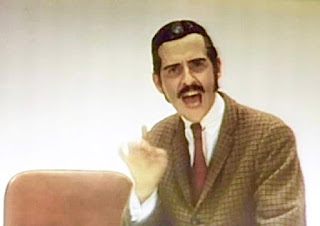
"Turn-on"
Photo by S. Kaufman.
When I asked Staats about writing his own dialogue in most of his film appearances, he replied with a saying he’s fond of — that he “was in it, but not of it.” He used the phrase in our interview more than once to describe both himself and the filmmakers he liked the most (Hurwitz, Kaplan). That carny phrase means that these people could work within the system but never were corrupted by it; they retained their personality in their work, made films according to certain rules set by producers, but never succumbed to the general greed and backstabbing that runs the movie industry. 

We move on to the point where Staats first worked with the filmmaker he is most identified with, the late and very great Harry Hurwitz. Staats has nothing but praise for Hurwitz, declaring that Harry “was a wonderful guy — there was no artifice about him.” As Staats remembers it, he was introduced to Hurwitz by Kaplan (who studied at NYU in the 1960s, with Scorsese as his tutor). Other directors might’ve used Staats to good advantage in bit parts, but Hurwitz constructed entire scenes around the E. Eddie Edwards character and cast Staats in his only starring role (in The Comeback Trail). 

McCann and Hurwitz.
One of the reasons that Hurwitz’s great film The Projectionist (1970) is so memorable is that he threw the kitchen sink into it. It has a central plot — in which projectionist Chuck McCann fantasizes about being a superhero — but it also veers off the rails wonderfully with scenes that find Chuck interacting with old movie clips (in a way that was later done in many features, including Dead Men Don’t Wear Plaid), moments of the projectionist’s daily life (which show the Deuce off to good advantage), and random elements, like a late-night commercial the projectionist watches on his TV, featuring none other than E. Eddie Edwards. 

Hurwitz realized that to get the best out of Staats he should give him an outline and let him create his own dialogue. But, Staats emphasizes, this was within “parameters” — “I made it a pitch, but I made it his pitch. Some of the key lines were Harry’s. You can’t write a pitch. I can write a pitch because I was a talker. There’s a singsong rhythm to it — if you don’t do that, it doesn’t come across. All that stuff I did [in movies], I had to be the writer completely or rewrite it, so that it fit E. Eddie’s pitch.” 

Demonstrating proper behavior in
The Projectionist.
“As a front talker, I was used to talking for prolonged amounts of time. The mob in front of you at the carnival, which could be a couple of hundred people, they’re called ‘the tip.’ You gotta work them and work them, until you get where you know you can turn it — until you get there you have to keep going. So I was pretty good at layin’ it down real fast, and getting it in one take or two at the most. Carnival talkers are good at that. You don’t have a script, you’re winging it.” 

The result in Projectionist is a sequence that is very well-remembered, not only for its un-p.c. jokes and spot-on spoof of late-night scam-product commercials but because it stands as a little mini-film within the larger film. In her review of the film, Judith Christ singled out Staats for praise. This short segment showcases the full-tilt version of E. Eddie, and while The Projectionist is a modern comedy classic (and nostalgia-fan’s wet dream), the film is indeed stolen by Staats for the mere three minutes that he’s onscreen:


Staats next appeared in Jonathan Kaplan’s Night Call Nurses (1972) at Kaplan’s request. Staats had no agent and, again, appeared in films simply because the filmmakers (Downey Sr, Hurwitz, Kaplan, Alan Abel) would call him up. Here again Staats ad-libs for a few minutes as E. Eddie, lending some verbal humor to a “soft” T&A drama-comedy (and stealing the film in the process). His bit in the film begins at 18:54; the film is here.

In Night Call Nurses.
I wrote about Harry Hurwitz’s The Comeback Trail back in 2017 — you can find that piece here. In that blog entry, I outlined how the film was remade and changed by Hurwitz. There was one complete initial version of the film, but he felt it needed more work, so he continued to work on it for several years, adding additional scenes shot in New York and L.A.

This means that there are two different versions floating around the “underside” of the Internet (there has never been a DVD or even a VHS release of the picture). The first one contains more of the main plotline, while the second ends up exploring the fictional film company that is at the center of the plot. 

I actually “found” Mr. Staats because of that piece. I had asked the public for any info regarding his status — who was he? Where had he come from? Was he still with us? This lead to the interview I’m writing about here. In the meantime, a remake of the Hurwitz film has been finished and awaits a major release — it stars Robert De Niro in the Chuck McCann role (I’m not making this up; check out the trailer), Tommy Lee Jones in the Buster Crabbe role, Morgan Freeman in newly created gangster role, and Zach Braff of TV’s “Scrubs” in the role played by Staats (this time as “E. Eddie Eastman”). 

McCann and Staats in
The Comeback Trail.
The Hurwitz film was shot from 1971 to 1979 (!) and got its first theatrical showings at the Thalia in Manhattan in 1982. Staats clarified that, again, he did the role at Hurwitz’s request and there was indeed an initial shoot in New Mexico for a few weeks in 1971 and then the shoots for the additional material took place in NYC and L.A. over the next eight years. 

He also noted about the film’s plot — about two low-rent producers trying to kill the senior-citizen star of their latest film (Crabbe) in order to get his life insurance — that “anybody who saw The Producers would recognize it in Harry’s outline.” He noted that McCann and he ad-libbed their own dialogue throughout the shoots. “Harry gave us a few minutes of direction,” he emphasizes, with “no time estimation” given for the scenes but with the caution “don’t run away with it. You could say we were script writers,” he clarifies. “We wrote dialogue — we were dialogue writers.”

He denies the story that was in my original blog entry (courtesy of an associate producer on the film) concerning Buster Crabbe getting drunk and beating someone up on the set. Staats does confirm that Buster was fond of “beverages.” (“I’m fond of beverages myself,” adds Staats.) But he didn’t beat anyone up on the set. 

Crabbe in
The Comeback Trail.
Staats remembers instead what they did do together. As for the ripe language, remember that Bob Staats considers himself first and foremost as a seaman. “We would have drinks — not excessively. Believe it or not, down the road from where we were shooting in New Mexico, there was a tent show. It was a striptease artist, a sex show, in a tent on the highway. The star, a stripper — you could imagine what the strippers would look like in this fuckin’ joint – had one leg. She had an artificial leg. So Buster and I went down here a couple of times. Of all the people I hung out with on that set, it was Buster I hung out with the most. 

“A couple of years later Buster was giving a talk to a bunch of film students at a college. He called me and asked me to come and help him out with the talk. He liked me and I liked him.” As for Crabbe beating people up, Staats declares it never happened on the Hurwitz film. He says, “I knew him well — not quite well – enough to judge his character. I mean one of the things carnies do is figure out people… so we can take their money. ” 

I was surprised to see that Hurwitz’s film is back “in public view.” This is the original edit of the material, with more of the plot than the later version:


A 1976 film that Staats appeared in has disappeared over the years. Alan Abel’s The Faking of the President is present only on the Net as a listing of a handful of cast members, including Staats as G. Gordon Liddy and the infamous “Richard M. Dixon” as Nixon. The info we can go on is Staats’ vague memory of the picture: His character name was “G. Gordon. He was a pitchman; he sold a line of weaponry.” 

The next filmic adventure for Staats was a bit part in Jonathan Kapan’s first mainstream production, Mr. Billion (1977), made as an American vehicle for Italian star Terence Hill. Staats appears in the film as railway train conductor who is (of course) running a side hustle in cheap watches.

In Mr. Billion.
Staats remembers the shoot well, because he wound up hanging out with the film’s American “name,” Jackie Gleason. The Great One liked his “beverages,” and since Staats was by no means an abstainer when it came to said beverages, he joined him for a few. Among other things they talked about their youth — Gleason was raised in Bushwick, while Staats grew up in the adjoining Queens nabe of Ridgewood.

Staats’ memory of the film extends to the fact that it was the only film he was in that had a big premiere — the film played as the Easter show at the Radio City Music Hall. “Jesus, that stunk!” Staats reflects on his friend Kaplan’s first big-budgeted film. (Kaplan did better with later items like Heart Like a Wheel and The Accused.) His scene in Mr. Billion can be found here at 18:45. 

In Fairy Tales.
Harry Hurwitz gave Staats a lovely supporting part in the softcore feature Fairy Tales (1978), which he made under the nom du erotica “Harry Tampa.” There’s no question that Staats is the best thing in the film (and this in a feature that gave Linnea Quigley her debut role). He steals the show as “Tommy Tucker,” who is given the job of persuading rubes to go into the (not so) Old Lady Who Lives in a Shoe’s house of ill repute. 

He got the part in the usual way — Hurwitz called him up and offered it to him. Staats was once again “doing whatever Harry wanted me to” and he made the role his own by ad-libbing carny pitches to rubes who wander by the shoe. His tagline from his previous E. Eddie appearances comes in early on. (“Isn’t that wonderful? Say yes, it makes me feel good. I couldn’t help but notice... ”) 

He returns throughout the film to instigate the vignettes, with wonderfully worded enticements. (“20 dollars for sex, 30 if you want to touch the sides.”) At the end, he closes things out with an exhortation to see the film again, with your family: “It’s a family picture, friends. Mom and the kids can come for the music and dancing, and Dad will enjoy the meat.” 

In Fairy Tales.
“I winged that whole thing,” says Staats. “Harry didn’t have any input in that…. I would tell the different guy to ask me this or say that, to give me a feed line…. That was all my smut. Harry wasn’t smutty at all.” 

One can only be grateful to the YouTube poster who boiled down Staats’ scenes in the film to one glorious 10-minute edit. The man himself notes that he doesn’t keep copies of his acting work around, but he was amused when a relative stumbled onto Fairy Tales and was surprised that he had been in a “porn” movie. (It's actually a softcore picture.) Staats’ take on the movie? “I thought it was funny — I love that kinda crap!” 


Hurwitz’s second softcore film as “Harry Tampa” was Auditions (1978). The premise for this one is tissue-thin: We watch people audition for the sequel to Fairy Tales. The participants are mostly porn stars who perform for the camera solo or in groups. There is comic relief every so often — Staats wanders through, of course, and gets two really good scenes (and a bit toward the end). This time his E. Eddie Edwards character is a sleazy agent (for “ASU — the Agency for the Strange and Unusual”), but that’s sort of like being a pitchman anyway, isn’t it? 

In Auditions.
This incarnation of E. Eddie is not as high-energy as before, but he’s still a master bullshit artist. Staats scenes in the film can be found at 14:30, 20:20, 102:00, and 114:00. The film is viewable here with the proviso that this is, most certainly, an NSFW video. 

The last sequence that Staats appeared in for Hurwitz that was released appears in That’s Adequate (1989). The first 45 minutes or so of this pic is an absolute joy, as Tony Randall hosts a journey through the productions of “Adequate Pictures,” the same firm that was responsible for the ridiculous films in Comeback Trail. The cast of this part of the movie is a rogues’ gallery of great NYC talent: James Coco, Stiller and Meara, Professor Irwin Corey, Lenny Schultz, Brother Theodore, and Joe Franklin. 

The second part of the film was shot in L.A. and it’s very different in tone. (And much less funny.) The latter-day productions of Adequate Pictures includes a “where did this come from?” charity-single music video sketch that is clearly a riff on “We Are the World.” In this part of the film the cast includes a young Bruce Willis, Robert Downey Jr, Richard Lewis, and many other L.A. standup comics. 

Staats’ turn as E. Eddie finds him as the MC of a movie premiere where he sings the praises of the studio’s output, including “Singin’ in the Synagogue.” His bit is at 10:29.


One of Staats oddest credits was a very mainstream cartoon assignment — doing a voice for the syndicated show “Drawing Power” in 1980, which was half-live and half-animation, and was a spinoff of the popular “Schoolhouse Rock” series. “George Newall and Tom Yohe worked for executives at an ad agency called McCaffrey & McCall (which I wrote two live trade shows for, and I appeared in the shows). They were potential clients I called on. So I got to know George very well, and they had this very successful show they owned called ‘Schoolhouse Rock.’ Periodically they would call me up to do voiceovers.”
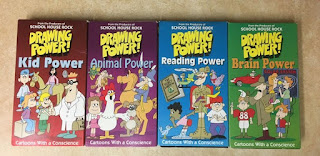

I must, again, bless the fans on YouTube who upload everything they love. A VHS video of “Drawing Power” has been uploaded and looks to be shot off a TV set. Staats does the voice of “Professor Rutabaga” who is, you guessed it, a carny pitchman! The character appears at 10:49 and 39:01, as the Professor lectures us on the joys of vegetables and our imagination. He even says “Say yes — it makes me feel good...”


The last time we were lucky enough to see Staats steal a picture was in Kenny Hotz and Spencer Rice’s mockumentary Pitch (1997). As Staats tells it, “Two young guys up in Toronto wanted me to do the film. I didn’t know them. I agreed to do it, if they had refreshing beverages on the set… and some sandwiches.” (Mr. Staats never specified which beverages he was looking for, but one can sure it wasn’t a seltzer or a Coke.)

Staats appears at 11:06, 28:30, and 51:34:

For those who are Hurwitz completists (tell me, where is his own Nixon film, Richard?), Staats brought up another collaboration he had with Harry and Chuck McCann, which evidently was never edited together (or sits in a vault somewhere). “Chuck was in the film; he had the lead. He plays a homeless guy who gets a credit card and uses it to buy food or something. He’s a very simple guy. He then gets a second credit card — you know, how they mail them out to people? So when he gets the bill for the first one, he pays it off with the second one, and back and forth. It was shot on Long Island; Harry was a hired hand directing it.” 

Another Hurwitz fragment with Staats sounds like it would’ve possibly been woven into another Hurwitz “omnibus” pic like That’s Adequate: “Harry asked me to do a pitch in an amusement park in Long Beach, California. And it had to do, I think, with politics. I don’t know what became of it. It was dark — it was like an evil pitchman luring you into a tunnel ride. This was near the end of Harry’s life.” 
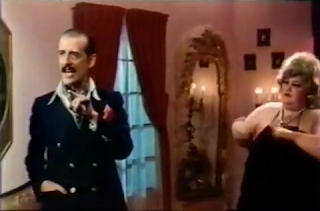
Making a point in Auditions.
One of the most touching moments in my talk with Mr. Staats was the moment where he talked about how he thinks of himself. “The American merchant navy is known as ‘the hooligan navy’ — hard-drinking guys, terrific guys. I identify with them forever. To this day, many people know me only as a merchant seaman. I’ve had neighbors in this building for years — they only know me as a merchant seaman. I tell people I’m a seaman. I don’t talk about anything else. At heart I’m a seaman. Those were the happiest days of my life. 

“Merchant seamen are roughnecks, hard-drinking guys. But they’re also very intellectual, believe it or not. They’re readers. I knew two millionaires who went to sea — they had a million dollars and they’re shipping out as seamen, not just once, that was their life. It has its appeal… 

“It isn’t romantic — they love the life! The sea wants to kill you, every fucking day. And it does, frequently. Seamen have a very high rate of dying or getting injured. That goes with the territory. Ships blow up, collide, shoal up, burn out at a rapid rate. It’s the nature of the thing. Nature is a powerhouse.” 

At different points in our interview, Staats pointed out that he was only an actor because “people called me up.” He did note, more than once, that he had the best working relationship with Hurwitz: “Harry was very gentle, but also very strong. He knew what he wanted, and he got it out of us.” 
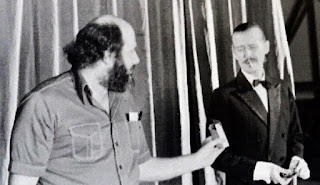
Hurwitz and Staats, working on
The Comeback Trail.
(Photo by S. Kaufman.)
Toward the end of or interview I asked Mr. Staats if Hurwitz paid his airfare to come out to L.A. and do small scenes for him. He replied that sometimes that was the case, but there was a time or two that Bob paid for his own air fare and charged it to whatever agency he was working for at the time. 

“I really liked Harry,” he reflects. “All of the directors I met through Harry, they were genuinely nice people — they weren’t the Hollywood types. They were like Harry, that’s why they liked Harry. They were followers of Harry because they were like him. *I* was a follower of Harry, in a sense. He was with it, but not of it.”

Friday, December 3, 2021

‘Get Back’: The Beatles smile and make faces, while Peter Jackson suffers from 'Scorsese syndrome'

The eight-hour monolith of rock docs, Peter Jackson’s Get Back has been dissected from so many angles by Beatle super-fans that this is simply one more “opinion piece” on this all-too-weighty documentary. On the whole, I think Get Back has a bunch of golden moments and is also very much a beached whale-like creation, incredibly similar to Scorsese’s films of recent years (rock-docs and his fiction films), in that it is *way* too long and desperately needed to be edited down. It is only for fans of the Beatles, and as such, can’t be labelled “an all-time great rock doc” — because the all-time great music films draw in new fans to the musician(s) being profiled; they don’t just appeal to the diehard, as Get Back does, from its very inception back at the end of 1968 until today. 

As it sits, the experience of watching all eight hours of the film is like seeing an already-long movie (say, three to four hours) but with countless moments that are DVD supplements (at best) plunked down in the “body” of the feature. Nothing could be set aside, everything is given equal importance.

One can only imagine how extremely repetitive the other 52 hours of footage from these sessions are — although there are probably many more sour faces and verbal jousts in that footage that couldn’t/wouldn’t be included here, because this film is, at base level, Paul McCartney’s much-hoped-for rejoinder to Michael Lindsay-Hogg’s original Let It Be (1970) assemblage of the footage that did indeed show “the unhappy Beatles” and shocked many people wanting the “quirky moptops” back. Lindsay-Hogg’s film also left us wanting more at 80 minutes; Jackson’s film is an overdose. 

So, in order to move more quickly through the elements, I hereby submit the very bad and very good elements of the film. I loathe “top ten lists” (even worse, “every song/movie/book, ranked”!), but since Jackson produced a beached whale of a work, I felt I had to take an approach that was counter to that. 


The bad elements of the film:

The ridiculously forced frivolity and giddiness. To counteract the “downbeat” mood of the original film, Jackson seems to have mined the 60 hours of footage for deliriously happy moments. Any Beatle smiling, making a silly face, doing a silly dance. It’s adorable, yes, in small doses. In very large doses — as when Jackson knows we’ve now seen them sing a particularly sub-par song (“Dig a Pony,” anyone?) upwards of five times, so he offers us a “music video” of them bein’ goofy lads — it’s sheer performance and no longer a documentary. 

It’s insane how much happy-go-lucky footage there is; some sad moments are present, but they are heavily counterbalanced by what seem like hours and hours of the Beatles being ridiculously happy. Certainly, they must’ve had some carefree moments during this project and they also did partake of some *wonderful* chemicals, but their forced giddiness seems to also be the result of seasoned on-camera performers turning on the charm for Lindsay-Hogg’s omnipresent filming. “Fly on the wall” films have occasional glances by the subjects into the camera. Get Back is four gentlemen and their crew performing directly for the camera. 

Why exactly did George Harrison leave the band? Jackson had a mandate to clearly make a happy version of Let It Be, but he also noted he didn’t want to diminish the preceding film, so he used alternate takes of certain scenes. Thus, the most famous interpersonal moment in the original film — when a frayed George Harrison does not want to be instructed by McCartney anymore, so he tells him “I’ll play whatever you want me to play. Or I won’t play at all, if you don’t want me to play. Whatever it is that will please you, I’ll do it.” — is here shown from a different, more distant angle where George is out of focus and the scene goes on longer in order to establish, “Look, look – these guys weren’t mad!”

Jackson noted in interviews that he used different takes of the material than were used by Lindsay-Hogg in order to "respect" the original film. This is admirable, but someone in the Beatles organization (with the initials PM?) pulled Let It Be many years ago. (It never was issued on DVD and is absent from the repertory circuit.) It's all over the Internet, in versions gotten from the VHS and LaserDisc releases, but has been MIA from legal distribution for a good two decades now.

Jackson's editing is smooth as silk (and the picture quality is such that we can be sure the original film elements NEVER looked that good, even when they were just back from processing at the lab; digital restoration of film makes it look as it never, ever looked before). It's disingenuous to "paint over" the George-Paul argument, though, since Harrison left the band at one point during the shooting. What was he so pissed about? 

It’s entirely possible that Lindsay-Hogg got absolutely no footage relating to this during the 60 hours he kept cameras rolling, but it's more likely that Jackson just wanted to entirely obscure it. And so he does, with George’s departure seeming to come out of a clear blue sky. Especially because the "angry George" moment was softened in this edit, and the "Silent Beatle" kept rehearsing for the rest of that day.

Bored Yoko, in the center of things Yoko did not break up the Beatles — but John demanding she had to sit right next to him during these sessions must’ve driven the other guys nuts. (No matter how many times we have inclusions of McCartney saying she’s great... because he’s in front of a camera!) 

Yoko often noted she didn’t know anything about the Beatles, that pop/rock held no interest for her. Here she sits in the middle of the four collaborators and reads magazines, files her nails, and definitely communicates that she has no interest in what is going on around her. 

Yes, Jackson found some footage from the later days where she is actually rocking back and forth enjoying the music, but even he couldn’t disguise her evident boredom. She was born to a wealthy family and clearly disdained popular culture. Here we see her display that boredom, and we also see John making her “equal” in their relationship — by having her sit by his side and do nothing? (An odd form of feminism for the new-model couple.) 

Third-person talk about the Beatles’ past, by the lads themselves. In the “wow, this seems awkwardly made up for the cameras” department, there are incredibly “formal” discussions by the Fabs about the death of “Mr. Epstein” and the trip to study under the Maharishi that was productive songwriting-wise, but not spiritually (well, perhaps for George, who was the only one following that form of spiritualism anyway). These sequences come off, again, as performers speaking to the audience, not each other. 

Arguments are more compelling than old friends smiling at each other. The scenes in which actual tensions are in evidence are fascinating — when McCartney is indeed lecturing the other three (while saying he doesn’t want to lecture them); also when Harrison is indicating he doesn’t want to do a live concert or anything beyond albums (and when he notes to Lennon that he wants to do a solo album). 

Look at George's face.
Since the band did break up after the recording of Abbey Road (a far superior album to any grouping of the Let It Be/Get Back songs), there has to be some explanation for what went wrong. Jackson’s film includes some hints toward the simmering tension, but the forced-giddiness factor undercuts it entirely. Thereby making Get Back a pretty bad chronicle of a band’s break-up. (There are several books that cover this period in detail and explain beautifully what happened; Jackson conceals it with sleight-of-hand-like misdirection to the many moments when smiles or funny faces erupted.) 

Nobody’s happy on the Apple rooftop. One of the most jarring things about the original Lindsay-Hogg doc is that no one is seen smiling on the Apple rooftop during the final concert, in which the Beatles performed nine songs (four of which were retakes). Lindsay-Hogg cut the retakes in the original film, and here they’re notable only because Lennon had big trouble remembering his own lyrics, since these were songs he didn’t seem to really care about at all. (Anytime the Beatles left “placeholder” lyrics in their songs, you could tell they were just trying to fill out an album.) 

In the happy-go-lucky Jackson assemblage of Lindsay-Hogg’s footage, the same is true. Yes, Billy Preston is smiling throughout, but he was barely on-camera. One older woman in a green sweater and a younger woman in a green dress are seen in brief shots smiling. Three girls on an adjacent roof are seen being happy. Otherwise, absolutely no one, most importantly the Beatles, is seen smiling on the Apple rooftop as they play. (I’m discounting John’s post-song jokes — those are part of a performance.) Compare this with the Rutles mock-doc All You Need Is Cash, and you’ll see that the fake version (“Get Up and Go Back Home”) is the happy rooftop concert as it exists in the imagination of Beatle fans. 

The real thing was historic indeed, but was also a stunt (to give the film something outside of the studio) in which the group were never seen by their audience, unless they worked across from Apple and had roof access. The sequence rises and falls in both the ML-H and Jackson versions on the viewer’s reaction to the on-the-street footage of Londoners hearing unfamiliar Beatle tunes without being able to see them. The lack of smiles at this key moment — which was 100% genuine — underscores the forced nature of the smiles in the studio. (Of course, Jackson trumps that by having a Beatle “listening party” back in the studio after London bobbies shut the rooftop concert down; everyone is grinning ear to ear and “larkin’ about” yet again. And yet they all broke up nonetheless….) 

The Let It Be/Get Back set of songs are the weakest in the second half of the Beatles songbook. Sure, “Get Back” is a great rocker, “Let it Be” is a great serious number, and “Two of Us” is a quite poignant “looking back” song for two friends. (“One After 909” and “Across the Universe” are also very good, but both were older compositions and are not shown being rehearsed much at all in Jackson’s assemblage of Lindsay-Hogg’s footage.) 


“Dig a Pony,” “I’ve Got a Feeling,” and “Don’t Let Me Down,” three very minor Beatles tracks (and three *truly* uninspired lyrics) are seen to distraction in Jackson’s film. They are driven into the ground — we see them rehearsed over and over and over AND OVER. George’s three songs are pleasant (including “Old Brown Shoe”), but they’re nowhere near the quality of the two he had on Abbey Road and the trove of stuff he put on All Things Must Pass. If there is any one reason one would want to fast-forward through parts of Get Back (which I didn’t do, because, again, I love these guys!), it would be the incessant repetition of a very meager group of songs. 

The good parts of the film: 

The moments of genuine emotion. Much has been made of McCartney noting “And then there were two” when George has left the band and John is arriving late one day; that is a genuinely authentic-seeming moment. The same for Lennon’s sarcasm about the Rolling Stones (always a sore point with him, despite his palling around with Mick and Keith during this period) and his calling Glyn Johns “Glynis” repeatedly (am sure Glyn had to take that in stride, but it must’ve conjured up the schoolyard for him; even during his peace-and-love days, John could be a really acidic person, and yet (or because of that) he's my favorite Beatle!). 

The all-too-brief moments where George’s feelings about wanting to leave the band do seep through Jackson’s slap-happy montage also resound. And, of course, Ringo’s “I’ll do whatever you guys want to do” attitude is the leveler, since one assumes he rode on the very erratic waves of the other three gents’ egos. And that odd but truly genuine bit of surreptitiously recorded talk between John and Paul about how to get George to come back (after John brusquely had volunteered that they should just get Clapton). 

 —The insane jam with Yoko. George (whom they knew since he was 14) has left the band, so what better time to play a cacophonous jam with John’s omnipresent partner who clearly looked down her nose at their music and wanted to do some squalling instead? It’s an odd reaction to what has just taken place, but they do seem so taken aback by George’s leaving that IF the Beatles were going to have a jam with Yoko, that would be when it took place, and it did. 

 — Seeing George break out. Yes, we’re stuck hearing his Let it Be album contributions and “Old Brown Shoe,” but we can see that his composition of “For You Blue” had an interesting source-point, and we also see him having a silent but steady hand over “Octopus’ Garden.” And then there’s the small bit of him working out a new song called “Something.” That was the point where the future was certainly an open book for him. “Silent Beatle” no more. (And he was known to have as cutting a sense of sarcasm as Lennon.) 


Seeing George Martin guide them through every mini-crisis. It always seemed rather weird to fans that the Beatles didn’t have George Martin produce the LIB album. The fascinating thing in Jackson’s assemblage of the footage is the constant presence of the stolid Mr. Martin, who was the only “adult” (he was 43, fourteen years older than Lennon) to guide the group after the death of the aforementioned “Mr. Epstein.” After the crisis is averted (read: Harrison returns), Martin appears to have been in the studio nearly every day of rehearsal and recording, troubleshooting tech problems and tamping down the egos of the four “boys,” as he called them. 

Billy Preston gets his due. The only non-Beatle to be credited on one of their 45s and an invaluable contributor to the LIB sessions, it’s very good to see him come in and melt instantly with the band. His electric piano parts of these songs stand out, and in a few cases make the song re-listenable. Clearly the presence of a fifth musician (not someone reading a magazine) diffused some of the tension in the room. (You know, the tension that Jackson spent a lot of time erasing by his choice of happy smiling faces and little dance moves….) 

The songs that are NOT part of the LIB album. The single best thing in Get Back is the footage of the Beatles playing songs that were not in that small group of songs they finally put into the LIB hopper (which were then remixed and ornamented by Phil Spector; I might be one of the only people who feels that his “messing” with McCartney’s songs was exactly in synch with McCartney’s highfalutin corniness, esp. on “Long and Winding Road”). 

If there is any “gift” that Lindsay-Hogg did give us by filming the group non-stop through the month of the LIB project, it was this aspect. If I could view any amount of the 60 hours of LIB footage, this stuff is what I’d want to see. As it stands, Jackson does include the Beatles doing various other songs, but either they close the song off in a chorus or two, or Jackson cuts it off — to get back to “Don’t Let Me Down,” “I’ve Got a Feeling,” and “Dig a Pony.” Fuck! 

The five categories of songs-you-wanna-hear that are played by the band to pass the time in the studio are: 

—Rock oldies. This is the stuff they loved. Lennon always wanted to be playing the early rock ’n’ roll tunes, and hearing the Beatles do classics by Berry, the Everlys, Little Richard, Eddie Cochran, Ray Charles, and, of course, Elvis (among many others) is wonderful. One of Jackson’s best editing moments is a montage contrasting the shaggy older Beatles singing Chuck Berry's “Rock ’n’ Roll Music” with them as younger moptops singing it live to a choir of screaming girls. Most unusual and welcome cover, hands down: "The Third Man Theme," played by John on guitar. 


—Early shards. Lennon/McCartney compositions from their early days. Some are truly crappy, but others probably could’ve been reworked into something memorable. Further evidence that these guys were insanely productive from the moment they became friends until they broke out into solo careers. (And of course they were all under 30 for that whole journey.) 

— Their own earlier records. To pass the time, either John or Paul would break out into often satirical versions of songs from their earlier albums. Hits like “Love Me Do” and “Help!” are spoofed, but two of my faves come up out of the blue and sadly go back there: “Every Little Thing” (an album track that is catchy as can be) and “Woman” (a McCartney song written pseudonymously for Peter and Gordon; back at the time when even the Beatles’ “gifts for friends” compositions were terrific). 

— Songs that wound up on Abbey Road. A far superior set of song to those on LIB, these songs just crackle compared to… well, “Dig a Pony.” It’s also fascinating to contemplate that all the shards on the second side of the Beatles' actual “farewell album” were initially going to be full songs, but they were put to better use as part of that complex whole. (But, really, how long could “Polythene Pam” or “Carry That Weight” have lasted?) 

— Songs that appeared on the Beatles solo albums from 1970 on. Besides the great tunes that were left over from the “White Album” (“Teddy Boy,” “Child of Nature”), we hear here different configurations of Beatles doing John’s “Gimme Some Truth” (with input from… McCartney?), Paul’s hooky “Another Day,” and “All Things Must Pass” from George’s startling debut album. (Which, like the Beatles albums, seemed like a weight George carried around over the years — could he ever put out an album as good as that one? The answer was no, but he continued to write great singles.) 

I hereby suggest that you follow my lead — if you were worn down by the giant whale titled Get Back, the best way to get it out of your head (or to simply remember the good moments) is to play the Beatles songs you like a whole lot better than the ones that made up the official LIB line-up. You’ll probably want to avoid “Dig a Pony,” “I’ve Got a Feeling,” and “Don’t Let Me Down” for the next few decades….

Thursday, November 25, 2021

WWRVD? Thoughts on a second pandemic Thanksgiving

Every year without fail I present the clip at the bottom of this entry. It’s one of those seasonal displays of joy that only gets better with age  like receiving a fruitcake for Xmas and making endless jokes about it. 

As time moves on, though, I wonder: What Would Robert Vaughn Do? Where would he fall in the current culture war? Would he get the Pfizer or Moderna jab, or would he argue instead for natural immunity? Would he comment on the issues of the day, the murder trials and other controversies, or would he remain silent and simply watch them unfold, waiting to speak about them when they are fully resolved? 


It’s hard to say since, sadly Mr. Vaughn passed on. He is no more, has ceased to be, gone to meet his maker, is bereft of life, rests in peace and joined the choir invisible. He is, in short, now an ex-Robert Vaughn, and we can’t pretend to know what he would make of the complications of the 21st century. We can only marvel at his many performances, and even (dare I say it?) the times when he was doing material that was actually meant to be funny.


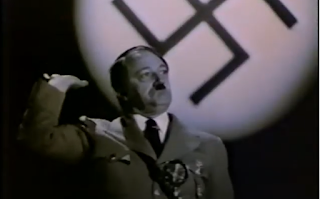
I’m prepping an interview to run on these pages, and in doing so I wound up rewatching parts of Harry Hurwitz’s That’s Adequate(1989), a piecemeal creation that is wonderfully funny for about 45 minutes and then slides into not-as-funny time-fillers for the remaining 30 minutes. Coincidentally one of the MANY guest stars featured in the film is our own Vaughn playing Hitler. 


Hurwitz was a very funny scripter, and so Vaughn’s dialogue as Der Fuhrer is predictably silly and amusing. (Hitler loves the Z-budget studio Adequate Pictures because he enjoyed their films “Slut of the South” and “Singin’ in the Synagogue.”) Vaughn of course had plenty of campy sequences in the “Man from U.N.C.L.E.” and he appeared in several big-screen comedies (from S.O.B. to C.H.U.D. II: Bud the Chud and from BASEketball to Pootie Tang). 


But seeing him as Hitler is oddly satisfying, as he enjoyed hamming it up – ’cause he often had no other level on which to deliver the material. Watch at 19:00: 


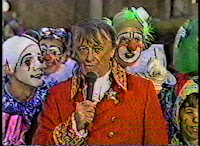
But you didn’t come here to see Vaughn as Hitler. You came here to see him mocked by clowns at the Macy’s Thanksgiving Parade in 1986.This year it was announced that children under 12 would not be allowed in the parade proper  I think this is a horrible stricture and would've certainly dulled this magic moment, had that rule been in place in '86. 


And please, before watching once, twice, or a dozen times, just ask yourself: What Would Robert Vaughn Do?

Sunday, November 14, 2021

Marcello, Depardieu, and a baby monkey: When ‘The Stanley Siegel Show’ celebrated Ferreri's ‘Bye Bye Monkey’

From the 1950s through the ’70s, foreign films weren’t so “foreign” at all. Average city-dwelling Americans had ready theatrical access to the most notable foreign titles, went to see them on “date nights,” and thus foreign movie stars were interviewed on American TV. Now, seeing foreign movies is considered a “niche” interest, a “boutique” kind of cult pursuit that does have its cadre of followers but is of absolutely no interest (the fascination with Parasite aside) to the “Netflix and chill” American viewer.

Thus, imagine a time when a local talk show in one of the country’s key markets would invite on the cast of a film being made by an Italian director. Yes, the film was being shot in English on the streets of NYC, but it starred a Frenchman (who was, by chance, the biggest up-and-comer in France and had already been in a bunch of top-notch European features) and an Italian superstar, who was known over here in a way then that no European star is now. 

Imagine, too, that the show in question is hosted not by Dick Cavett, who was the premier interviewer of foreign stars and filmmakers, but instead one of the most notorious of all Seventies talk-show hosts — pretty much the living embodiment of Wolfe’s “Me Generation.” And the film that is being shot is an art film that pretty much flopped (this, again, when foreign films did indeed have a ready viewership) and has received only cursory recognition since — despite the efforts of yours truly on this blog and the Funhouse TV show to draw attention to its writer-director, Marco Ferreri. (Why? Because it’s very odd and wonderfully crazy.)


The talk show host in question was Stanley Siegel, a brash interviewer who liked to do attention-grabbing stunts on the air but who also did embody the self-absorbed Seventies ethos (which hasn’t disappeared — basically Wolfe was only wrong in that ALL generations that appeared after the Sixties have been “Me Generations”). For Siegel’s most famous stunt of all was to bring his therapist onto his morning talk show in NYC and do a “session” with her on the air. No full record of this is available on YouTube, but it remains in the memories of all who saw it back then. 

And the film in question? Well, it’s none other than a Funhouse favorite, a bizarre sci-fi dystopian view of NYC that deserves a cult but is too downbeat to get one, Bye Bye Monkey (1978). The film is a study in strangeness, as it seems to anyone who lived through the Seventies to be virtually a documentary on what the lower part of Manhattan looked like in the late Seventies; to its maker, though, it was a fantasy about a world that is “constructing and deconstructing itself” (per the interview I did with Ferreri in the mid-Nineties). 

Herewith, a brief bit of an intro: a snippet of star stars Gerard Depardieu and Mimsy Farmer in the presence of a giant dead ape (supplied to Ferreri by, you guessed it, Dino De Laurentiis). Then, the scene that took on a whole different meaning in 2001 — the nursery rhyme about the baby falling (“cradle and all”) being sung by supporting star Geraldine Fitzgerald with the newly completed World Trade Center looming in the background. Finally, one of the most bizarre moments, Gerard noting his “baby” monkey (the child of the big, dead one) is dead, to his boss at a wax museum depicting scenes of ancient Rome (played by James Coco).


The Italian superstar who is seen briefly in that montage is, of course, Marcello Mastroianni. Who, it seems, is the person Siegel really wanted to have on this talk show, since he devotes the lion’s share of time to him — one assumes the publicist made a deal that, if Siegel promoted the film as it was being shot, he could have Marcello.

Many fascinating things are said. Firstly, that Marcello hadn’t read Ferreri’s script by the point he stepped off the plane from Italy to the U.S. to appear in the film. (He was very good friends with Ferreri; the two lived near each other in France.) He then notes the film is about obsession — which is amazing (and certainly accurate), since when I conducted my interview with Ferreri I started with that notion (that the majority of his protagonists, and certainly all his male protagonists, have a singular obsession of some kind), and he denied it entirely. 

Here are Ferreri’s comments on the film in question:


Siegel clearly was in search of some personal revelations and so he keeps digging with Marcello, and ends up asking him questions of the sort that Marcello would *never* answer for European journalists. One can see in the four-hour-long feature doc Marcello Mastroianni: I Remember (1997) that MM did NOT want to talk about the ladies in his life. 

Here, Siegel launches right into the affair Mastroianni (who remained married to his Italian wife — his only wife — until his death, although he had Deneuve and his daughter by her at his bedside when he died) had with Faye Dunaway. Marcello directly answers Siegel’s question, saying that Catholicism made life “difficult” for Italians. 

Marcello notes he doesn’t “believe [any] more” in marriage — although he’s still married to his wife of 27 years. (He says his wife is “a good friend.”) Siegel continues by bringing up Deneuve. Marcello is quite open that he finds marriage to be “a prison.” Siegel keeps digging, but Marcello is laidback in his attitude and doesn’t want to focus on any specific woman — although, again, the fact that he answered these questions, ones he forbade in later interviews, is what’s both bizarre and fascinating about the episode. 

The funniest bits throughout this are Siegel’s intros to different topics (as in “Frank Sinatra — he’s Italian, like you – once said...”). He also ignores the other three cast members until the second half of his one-hour show. He notes that Marcello is the one man he’d most like to be, besides photographer Robert Capa — since the show was, no matter who the guest was, primarily about Stanley and no one else. 


When he does finally get around to the other cast members, it’s more of Stanley’s truly eccentric mode of in-your-face (but off-kilter) interviewing. He wants to find out about the “real” side of the panel, so he probes their attitudes (and the work itself, their acting, is never discussed; the film they’re making is of virtually no interest to Siegel). The main topic is guilt in different cultures — and the most refreshing answer comes from Gerard Depardieu, who says he doesn’t feel the French have a lot of guilt. 

Depardieu then reveals that, like Mastroianni, the script of a given film isn’t important to him if he wants to work with a director. He will lose it (as he has done on Bye Bye Monkey and on Bertolucci’s 1900). Siegel ignores that revelation entirely and then asks him to recite dialogue from the film, which does confuse the hell out of Depardieu. James Coco has to note that what Siegel has asked is “very difficult for an actor…” 


Siegel, in one of his blunt-to-the-point-of-openly-rude moments, veers off into asking Depardieu and Marcello about France and Italy “losing wars.” Then, because Stanley was Stanley and NOT Dick Cavett, he asks Marcello and Gerard to play on-air with the baby monkey seen in the film. 

My brain exploded watching this.


NOTE: Thanks to Donica O’Bradovich for this senses-shaking discovery.

Thursday, October 14, 2021

What’s in the Boxes? A livestream performance by Alan Arkin and Robert Klein

Little heads in little boxes — I’ve been driven nuts by Zoom visuals, which have reduced discussion, entertainment, art, and just plain silliness into the home game of “The Hollywood Squares.” But when this pandemic finally ends (probably in 2024, just in time for the next pandemic and a surely chaotic Presidential race, in which the Duopoly will play its preordained game once again), I will remember fondly some of the cultural events that were done over the bizarro Zoom platform, a place where two people can’t properly talk at the same time. (But the second person’s “box” will indeed light up like crazy if he/she does want to interject.) 

An example of a one-time only event: a livestream I caught this past weekend starring two of my faves of long-standing, Alan Arkin and Robert Klein. The duo (who are both grads of early Second City companies but have never worked together before this) performed an un-staged (at their respective homes) reading of two one-acts written by Arkin, to benefit The Schoolhouse Theater and Arts Center in Westchester County, New York.

The first play, a somewhat preachy jaunt in which the Amazing Randi (Klein, playing the real-life magician and skeptic) meets a very welcoming Jesus (Arkin), was very obvious in its writing and allowed for no great characterizations. Arkin and Klein were joined for this and the second play by Jon Richards as the narrator (and necessary stage-direction reader).


The impetus for the play was apparently that Arkin is a spiritual person and wasn’t fond of Randi’s debunking not only magicians, but all kinds of spiritual schools of thought. The idea of Randi being seated next to the big JC on an airplane — and then being reduced to tears at the play’s end (when he arrives at his hotel room) did not make for a really resounding statement on either faith or disbelief.

On the other hand, the second one-act, “Virtual Reality,” was a great blend of comedy-team crosstalk and Theater of the Absurd (a NYC Jewish “Godot” with shady workers as the two-man cast — or are they crooks?). Klein did a great Bronx accent as a guy whose job is to unload three crates that are to arrive from an unnamed source. (Are they filled with stolen goods? Will the contents be sold or exchanged for something even stranger?)


Arkin wrote a terrific “Alan Arkin” role for himself — one where (true to form) his “new recruit” character doesn’t understand what he’s supposed to do in helping Klein, and eventually ends up yelling (in Alan’s classic fashion) about him not knowing what the hell is going on. The play begins with Arkin’s character showing up to his new “job” (or is it a caper?) and being told by Klein that the crates haven’t arrived, and they will prepare for their job by pretending the crates are there and making note of the contents. The piece supplied perfect roles for both of them and was a well-crafted absurdist one-act. (That ends, of course, just where the actual action in a traditional play would begin.)

The livestream was followed by a “talk back” segment in which both actors were willing to answer questions about the plays, or basically anything. The always-terrific Arkin seemed pleased with the whole event, but Klein lamented that he kept looking down at the text (because he saw that Arkin was interacting with the camera). Arkin was far more adept in his performance — this is true. But the odd nature of the second play made it okay that Klein wasn’t fully “engaging” on a visual level. (Plus his tough-guy Bronx accent sounded pretty damned authentic.)


I asked two questions in chat that were answered on the “Talk Back” afterward. The first was about Arkin’s influences for the second play — he honestly admitted “Virtual Reality” came out of him playing around with a playwriting app a friend of his couldn’t get to work. (Turns out I missed him performing it with his son Tony off-B’way in 1998; it was produced at the Manhattan Theater Club with what he said was a one-act starring Elaine May and Jeannie Berlin — then one with Arkin, May, and their children! Jeezis...)

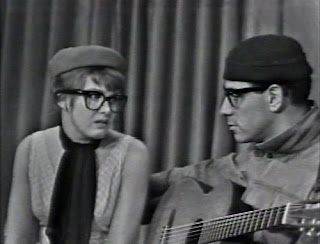
Barbara Harris and Alan Arkin.

The second question was about the late, very great Barbara Harris, whom both men worked with. (Arkin in the initial Second City cast; Klein in the B’way play The Apple Tree.) Arkin responded instantly by saying, “She was brilliant and she had emotional problems. She had difficulty with staying in something [theatrical]. She would have problems and have to leave. But she was unquestionably a brilliant performer.”

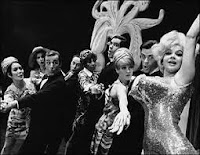
The Apple Tree
(Harris on right;
Klein in cast)
Klein noted he had a big crush on her and (some of this is in his memoir) he befriended her and brought her to see his old neighborhood in the Bronx and the Bronx Botanical Gardens. He remembered that, at the time, Harris was lamenting that "Warren Beatty won't leave me alone!" (Post-Second City, she had made a big splash with both her theatrical work and her first film, A Thousand Clowns.)

He was there the night when she “went up” onstage in The Apple Tree: “Alan [Alda] was standing there dumbfounded and Barbara starts addressing the audience. ‘Hello, how are you?’ and she’s not making sense. She’s not crying but she’s not ‘in it’….” Her understudy took over for the rest of the first act and the second act, and an emergency call went in to Phyllis Newman, who took over for the third act and filled Harris' three roles afterward. Klein calls it one of the most “extraordinary” things he had ever seen onstage. (Barbara returned to the show two and a half months later; she stayed with it until after Alda had gone and Hal Holbrook took his place.)

All in all, it was wonderful to see Arkin functioning on all cylinders at 87 and Klein doing some comic bits during the talk back. (He’s a kid of 79.) When the pandemic really does end someday, I won’t bemoan the loss of its jerry-rigged entertainment — but I will indeed have some pleasant memories of these one-time-only livestreams. And yes, some screenshots to prove the damned things really took place.