Friday, January 26, 2024

Raise the Candles High: Deceased Artiste Melanie

Melanie was a best-selling folk-pop performer who became a cult musical figure. She is remembered very fondly by those who were her contemporaries in the hippie age group and by younger people who latched onto her music later on (like myself) when she was releasing a slew of albums that found her toying around with the idea of reinvention but also always staying true to her singer-songwriter roots. 

The best-known facts about her were that she played at Woodstock when the audience lit up candles (and matches and lighters) in the rain (thereby inspiring her Top Ten hit “Lay Down (Candles in the Rain”) with the Edwin Hawkins Singers) and that she wrote and sang the novelty-sounding hit “Brand New Key.” What was really remarkable about her, though, was that she was a very accomplished songwriter and had a killer voice — she was indeed a “belter” in the classic sense. She also recorded a broad array of covers, some of which are instantly forgettable, but others (including her epic take on “Ruby Tuesday”) are better than the original versions. 

My own fascination with her music began in the late ’70s when she had come back from a hiatus where she continued to record but didn’t tour, as she was raising her children. By the time she returned to full-fledged activity as an artist, the recording industry had moved on. 

There were also difficulties with record labels (this after she had run her own indie record label, Neighborhood Records, with her producer-husband Peter Schekeryk) — the oddest notes one finds online about her recording career are that two full albums were recorded in ’75 and ’79 and were kept by the studios they were recorded in because the bill for the recording time hadn’t been paid. This coincides with accounts of difficulties (not, I must stress, in any way with Melanie herself — there are no bad stories I’ve ever heard about her) that were relayed to me by a person who collaborated with her at one point.

One major obstacle was chronicled in an article sadly called "Look What They Did to Her Songs" that appeared in The Australian on June 5, 2014 (article behind a paywall). It turned out that Schekeryk sold the publishing rights to every single song Melanie wrote before 2004 without telling her. The story is reprinted here and it's a rather stunning betrayal but, since she was not aware of what he had done, their marriage was seemingly a happy one, as it lasted from 1968 until his death in 2010.

I got into her music at the point where she was no longer having hits but was a steady presence on the concert scene and on television. One of the two times I saw her perform was when I cut some classes in HS to see her receive the “skate key” to Manhattan from borough president Andrew Stein. (She performed a solo concert after the rather dubious ceremony.) 

I then saw her again, several lives later, at the B.B. King Blues Club on 42nd Street in the early 2010s. Her voice was pitch perfect as she belted out her best-known hits, as well as a bunch of new songs and covers.

*****

In honor of her really underrated body of work — there are indeed a few dozen albums with hidden gems hidden everywhere — I thought I would offer a dozen videos as a “survey” of her work. 

A little note here about which videos were chosen: I haven’t done a blog entry on a musical figure in many a year, but now I prob rarely (if ever) will, as way too many music clips on YT can’t be embedded in a blog. Thus, in some instances I had to pick videos that had nothing going on visually because I wanted to include the song and the better video for the song is verboten as far as embedding. I’ll list a few interesting Melanie YT channels at the end, but I wound up not using videos from two of the best because they turned the embedding feature off.

I’ll start out with the first song I heard from her on record. The two-record set “The Best… Melanie” from Buddah was a collection of the most notable songs from her time with the label (1968 to ’71).
From Steve
Hoffman's 
music board.

What is most impressive about the set, and any subsequent of “best of” that Buddah put out, was that they included non-hit album tracks that showed the raw, folkie side of Melanie and also her initial forays into pop tunes with orchestral backing. (Count me as a sucker for strings and horns on a pop tune.)

The Buddah comp was later released with a rather ridiculous cover concept — you could fold over the cover and make a cube with color drawings of Melanie! Rather bizarre, but perhaps this was thought of by the same person who included the famous line “Rub gently to release the magic of Melanie’s garden” on the cover of the U.K. release of her later Buddah collection Garden in the City

The first track on the collection was this somber, emotional cover of George Gershwin’s “Somebody Loves Me.” Quite a note to start off a greatest hits package!


A YT poster who has put up some dazzlingly rare tracks by Melanie (anyone want to hear her singing at four? Or the single for a girl band she wrote before her own recording career began? Or her mom Polly singing?) put up this collection of 1968 demos. Two of these songs became fan-faves, and there’s also an early version of her earthy cover of “Ruby Tuesday.”


There is no way in hell I can embed the very entertaining video versions of her doing “I’m Back in Town” (a very Broadway-esque tune, done with proper B’way-pit orchestra backing), so I’ll opt for this item instead, which finds her performing a song that was a hit in France before she’d had a hit in the U.S.! French TV had certain ways of framing female artists, and here she visually resembles nothing less than a ye-ye girl, albeit a seriously folkie ye-ye.


A great half-hour concert that aired on U.K. TV. I wish the poster had not “stretched” it to fit a rectangular screen (TV images look dreadful when stretched), but the live performances here of six of her best songs are great.


Her biggest hit was this tune, which appears in various permutations on YT, including a version where the vocal is isolated (that shows how she did sing the hell out of this little ditty). There was also a cartoon made of it, but that features the Sonny and Cher cover of the song. (As it was made for their CBS show.) Here’s the version that became Melanie’s biggest hit.


Most of the videos on Melanie’s own YT channel are forbidden to be embedded, but here’s one that can be properly placed on a blog, and it’s an amazing one. Melanie guests on the Everly Brothers’ own variety show (!) in 1970. The other guest stars, with whom she and the Everlys sing “This Little Light of Mine,” are (culture shock 101) Tina Turner on her own and Bobby Sherman!


Here’s footage of one of her several appearances on the laidback Mike Douglas Show. She performs “The Nickel Song,” an incredibly catchy reflection on the music business (in the guise of a human jukebox, namely the performer). This is the medley version of the song, where she starts out with an older nickel song, Teresa Brewer's "Music, Music, Music," and then moves into her own composition (which is another one of the many Melanie fan-faves). I’ve always been very fond of the line “They’re only putting in a nickel, and they want a dollar song...” 


And speaking of covers, Melanie did two perfect covers of Phil Ochs songs. She performed both at the concert that was held at the Felt Forum to commemorate his life. The first, more serious one (which is definitely worth a quick search on your fave music platform) is “Chords of Fame.” Here is the lighter of the two, the cryptic, bouncy, and absolutely blissful “Miranda” given a great “reading” (as they used to say) by Melanie here. 


 A really great video featuring Melanie post-“comeback” (no, she never really did go away, but this is when she was touring again) in ’77 singing her rousing and very emotional cover of “Ruby Tuesday” with a full band. Whoever edited the clip uses that footage as the base but then flashes back to the Sixties with various images, including the younger Melanie.


During the height of her pop stardom, Melanie was on Johnny Carson and Ed Sullivan a few times each (clips from some of those appearances are on her YT channel). When she came back she needed to appeal to a younger demographic so somehow she was booked on… the Brady Bunch variety show? Well, at least the song, “Cyclone,” is a very solid one that she also promoted on American Bandstand. NOTE: Every single video that contains the longer version of this song, or is visually interesting (or is jarring, like the Brady Bunch one), is un-embeddable. So it’s not included here. 

Three last videos to highlight Melanie’s influence on others. First, one of the songs she sang with Miley Cyrus in a backyard concert that is up on YT as individual songs. Here, Melanie and Miley duet on a hard-driving version of one of Melanie’s greatest and most timeless songs, “Look What They Done to My Song, Ma.” It was nice to see Miley introducing her fans to Melanie with some of her best-remembered songs.


Here's a perfect matching of composer and singer: Melanie doing vocals for a project by Stephen Merritt, he of the Magnetic Fields. Merritt writes beautifully heart-wrenching little numbers and Melanie had just the right voice to sing one of them. And so she did for "The 6ths" (a Merritt project) on this number in the year 2000. Here definitely is Melanie in a new milieu, being perfectly suited to the material (although the plunking behind her is a bit maddening). Thanks to friend Steve for this one.


And for the closer, an album track that wasn’t a hit when it came out, but it was fondly remembered by Melanie fans. Melanie’s version recently popped up on an episode of the brilliant “Black Mirror” series, which was a really nice surprise. It’s an incredibly catchy tune, with a flute-and-strings backing. 

It turns out that Charlie Brooker and his “Mirror” compadres didn’t actually dig this one up completely out of the blue — the original recording was heavily sampled by an Australian group called the Hilltop Hoods for their 2003 song, “The Nosebleed Section.” As with a lot of songs that use *incredibly* catchy hooks from elsewhere, it’s obvious this tune wouldn’t’ve existed without the Melanie original. 

Single nicest sight in the Hoods'  video? The band’s younger female fans singing along with the part of the song that contains Melanie’s original vocals. (Processed with filters to sound like a 78.)


Some last links: 

 —Melanie’s own YT channel, featuring a lot of great footage. 

The gent who put up the super-rarities from Melanie’s mom’s stash (!).

A super fan's collection of rare concert videos and tunes on TV.

Another fan's Melanie video-trove.

—And… a “missing” album recorded in 1979. (As noted above, the studio was never paid so the tapes were kept by the owners!) Some very nice mellow vocalizing here; this shows Melanie going down a different path that she didn’t pursue. Thankfully, the album is now in the hands of the public.

Wednesday, December 20, 2023

A Christmas gift from the Funhouse: a rare interview with Orson Welles, with English subtitles

As the year comes to a close, I present for your delectation an online present: the entirety of my episode showcasing a filmed interview with Orson Welles, from a never-seen-in-the-U.S. French TV doc.

The year was 1972 and Orson was at work on his Don Quixote film, but he was also prepping The Other Side of the Wind as well. A very famous French actress was recruited to host this pilot for a TV series directed by a New Wave filmmaker (one of the least-known members of that movement, but a member nonetheless, thanks to the period in which he started making films and the fact that both Truffaut and Godard raved about his first feature). It appears that only two other episodes were ever shot.

This particular actress had worked with Orson four times already (although I’m not sure why the unfinished The Deep and the finished Immortal Story never comes up in this chat). She clearly had a deep affection for the Big Man, and that is evident throughout this chat.

I’m not sure if all the stories told here are 100% (or even a lesser percent) true, but that doesn't matter at all. They are told in a grand style, with plenty of cigar-stained laughter, and remind us of what a tremendously engaging storyteller Welles was. (His laugh was always killer.) If any researcher has turned up any of the crime thrillers or science fiction that Welles claims he wrote here under a pseudonym for the pulps, I'd love to hear about it.


I translated this interview myself, so any errors in the English subs are entirely mine. I found Orson’s French to be charming and he is fully understood by his friend the hostess, but when you “map” out his French he did indeed throw in some incomplete sentences that trailed off and used some Americanisms in the language. 

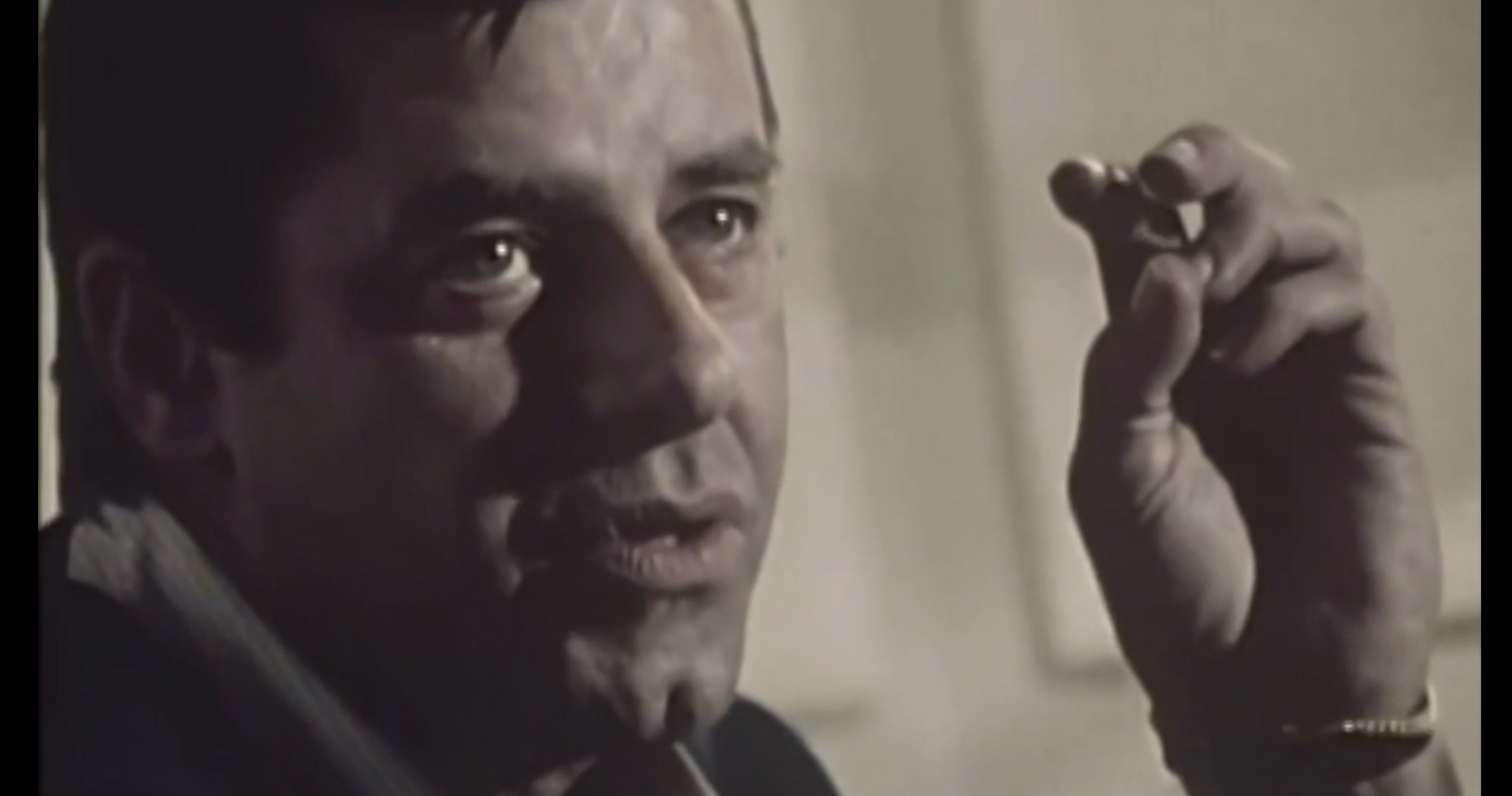
This documentary also included the interview with Jerry Lewis that I posted a few months back (see this entry URL); that one was a lot easier to tackle, since I only had to translate the overdubbing in French, as one could still hear a lot of the English in between the French voices on the dub. With Orson’s interview, I had to make it seem readable and comprehensible and yet still convey in English his, again, very charming but not entirely grammatically pristine French. 


One note, to prevent inquiries of “gimme everything” school of Net correspondence and commentary: This interview runs approximately 27 minutes. Episodes of the Funhouse run 28 minutes. To properly contextualize this interview I needed a few minutes at the outset (also to give all the names and i.d. the production co./distributor who has long held it from being shown internationally), so I removed less than 2–3 minutes of the chat (containing a story he told many times — about the reason he had a scene set in a Turkish bath in his Othello). 

I also had to put another short part of the interview — where he talks about the protagonist of the Other Side of the Wind, who was to be eventually played by John Huston — over my intro to the footage. Thus, you can see the latter (with the subs onscreen) but can’t hear it. This is the best I could do, given the timeslot I have and the time constraints I work under. I could not make a separate “cut” of the episode for the “gimme everything” folks on the Net. 


I do the show as an intense labor of love (for a full 30 years now) and give of my time freely to make it the best it can be. I can work no longer on this particular project — it took hours to convert it into this comprehensible condition. (I literally typed in many of the English subs; others I altered from a very wonky computer translation.) 

Enjoy the episode, and please feel free to share it anywhere you like.

Merry Happy Holidaze from the Funhouse!


Thanks much to my friend, superior cineaste Paul Gallagher, for his help in finding this film and also the translation process.

Thursday, November 23, 2023

An annual moment of reflection (or, Send in the Clowns)

Every year around the holiday season, we take stock of where we’re at. Currently the U.S. is in an absolute mess — the economy sucks, we are funding one side each in two foreign wars that were absolute disasters from the word go, the divide between fellow citizens only get deeper and deeper, and mainstream culture is pretty much lowest-common-denominator garbage.

But it is Thanksgiving, and one must count one’s blessings on this commercial holiday (with the biggest, most commercial holiday coming up fast — start that Xmas music in October, boys, we want those suckers to start buying!). I surely was blessed to capture the moment where Robert Vaughn was mocked by clowns as he tried to read the U.S. Constitution at the Macy’s Thanksgiving Day Parade.

In the past year, the only Robert Vaughn-related news happened when his one-time costar (and the guy whose fame and following of young women eclipsed that of Vaughn, whose show The Man From UNCLE originally was), David McCallum (aka “Illya Kuryakin”), died at age 90. (Vaughn only reached 83.) Perhaps Vaughn is being eclipsed in the afterlife as well — but one thing will always be certain: David McCallum was never mocked by a group of makeshift clowns (whom I believe were Macy’s employees; perhaps someday someone can confirm or deny that). And if he was, we have no video proof of it. 

I should also note that yesterday (Nov. 22) was not only the 60th anniversary of the Kennedy assassination but also the anniversary of Robert Vaughn's birthday. (If he had lived, he would've been 90.)

Enjoy Mr. Vaughn, soldering through a minor show-biz disaster.

Monday, November 6, 2023

An Amicus horror-movie binge: notes (plus three non-horror Amicus reviews)

These blog posts were posted in sequence (well, sometimes out of sequence) on my Facebook profile as I watched the films in question. The binge began the week before Halloween and ended three days after the holiday. I’ve added three bonus reviews at the end of films that are not horror but were indeed produced by the two men who were Amicus itself, Max J. Rosenberg and Milton Subotsky. 

To celebrate Halloween, I’m in the midst of an Amicus binge. (I did Hammer last year for several weeks and ended up seeing dozens of films.) They had far less films and were much less productive than Hammer, because it was basically two (American) producers, not even a mini-studio. Their first outing together was City of the Dead (U.S. title: Horror Hotel). Milton Subotsky (producer No. 2) provided the screenplay, which in this case was really good (some of Subotsky’s work as a scripter was really corny, but sometimes it worked perfectly). 

With the always hoped-for Chris Lee as a teacher who is also a member of a coven, Hotel has a bunch of surprising elements, among them the fact that that female lead is captured by the coven at one point and is never seen again — we don’t see her die, but otherwise she is Janet Leigh in Psycho, a lead character whose disappearance becomes the guiding force in the plot (yes, that also was the case in L’Aventura; all three films were released in 1960). Nice atmospheric shots (with plenty o’ fog) created with a nothing budget, Hotel had the advantage of being in black and white — some of the budget problems were later visible in Amicus productions because the films were in color. 

The official start of the company (which was, again, really just two American producers, operating in England) was Dr. Terror’s House of Horrors (1965). Producer-scripter Milton Subotsky copied one of his favorite films, Dead of Night, and created this collection of tales, which are hit and miss, but are put across by the actors with much sincerity. The set-up was much copied in the years that followed: a psychic (Peter Cushing) enters a railroad compartment and tells the fortunes (all of which are tragic and supernatural) of the five men sitting there. 

Some of the "threats," as rendered by the great horror director Freddie Francis, are low-budget fun (a vine that takes over a house), but thankfully the menaces get better as the film goes on (with the Chris Lee section about an artist's disembodied hand being the best). The ending is very predictable but that is because, again, it was copied in the years after '65. 

The big success of Dr. Terror spawned the singularly scary/silly The Skull (1965), courtesy of horror masters Freddie Francis and Robert Bloch. It's put over at points by the cast, headed by the great British horror team, Cushing and Lee. Cushing is a collector of supernatural items who wants to buy the skull of the Marquis de Sade. Lee, who has already been "enslaved" by the skull, tells him to forget it, but that... well, you can figure out the rest. 

The most impressive thing about the picture is that the last quarter is nearly entirely dialogue-less (except for a few stray lines from Lee), with Cushing effectively becoming a silent-movie actor as he's menaced by the skull. The least-effective thing about the scene is the skull itself (you can see the strings vividly at one point — hi-def restorations reveal embarrassing details). The most effective elements are Cushing's acting (he always took his work seriously, even if it was the silliest stuff imaginable), and the bombastic and wonderful score by Elisabeth Lutyens. 


Robert Bloch revamps his Psycho formula with The Psychopath (1966), wherein the most memorable character is an old toy maker who lives amongst her dolls as her "children." Her son is clearly a Norman Bates type, and thus it isn't surprising that the film kinda falls into a "son of Psycho" mode. (Bloch blamed Freddie Francis and the producers for doing a shoddy job with his script, but it's definitely Robert in writer's-Bloch mode, redoing something he'd already done.) The dolls-found-next-to-murder-victims is a nice touch (at least the dolls made for the film look like the actors), but this one is a minor Amicus pic. 

The Deadly Bees (1967): So far, the lowest point in the binge in terms of actual artistry, but damn, it is dopey fun. Scripter Robert Bloch again blamed Freddie Francis and the producers for being cheap and working too fast, but this is not by any means a very, um... intelligent plot about the feud between two beekeepers in a remote town. The biggest problem is the cast — no horror stars (Bloch was hoping for Karloff and Lee) and one of the leads is "aged" to look older. 

The bee attack scenes are threadbare — images of the actors are overlaid with "bees go crazy!" footage and little fake bees were taped to their clothing. To show how Amicus hadn't picked up on the sexy-horror-star phenom (which made the female leads nearly as important as Lee and Cushing in the Hammer pics), the big sexy moment here is on the poster: one potential bee victim, Suzanna Leigh, is seen in her bra. 

Torture Garden (1967) solidified the Amicus approach to the horror anthology. This time the Freddie Francis-Robert Bloch combination turned in some very good thrills — and others in the "this is ridiculous, and we're going to play it that way" vein (when Bloch's ideas — like a living piano that wants to kill a grand pianist's girlfriend — got really nutsy). Burgess Meredith hams it up well as "Dr. Diablo," a sideshow emcee who promises a bunch of attendees that he will show them their future, all of which are tragic. 


The two stories that stand out are one where an actress finds out how a veteran movie star has remained in such good shape (he's robotic), and another where an Edgar Allan Poe collector (Jack Palance, in scary intellectual mode; Palance was always scary) is taunted by another (Cushing, indispensable in British horror) Poe devotee who has an even more complete collection. This format (which began in Dr. Terror) became the blueprint for Amicus' greatest successes. 

The 1970 poster for Scream and Scream Again freaked me out as a kid (when it was on the cover of Famous Monsters mag); the film itself is one of the weirdest things Amicus ever made. It's a combination sci-fi tale, a horror movie, and political paranoia fable. It was the first "union" of the big three (Price, Cushing, Lee), but there is only short scene at the end that contains two of them together. The plot oddly reflects Amicus' main strength, anthologies, by having different plot strands moving forward simultaneously. The one about a military-ruled nation (a seemingly Soviet country that has Nazi-like uniforms for its soldiers and cops) never quite gels, but the notion of a vampiric killer who is actually the product of a project the British government paid for does make it a memorably strange movie. 

In the end, we find that Vinnie Price is the surgeon who has masterminded the manufacture of supermen and women, but he makes clear when the hero tells him he's creating a super race, "... but not an *evil* super-race!" He also refers to the hero as "pointlessly savage." (Like Cushing and Lee, Price always played his roles to the utmost, committing his very self to even the oddest moments in these pictures.)

The House That Dripped Blood (1971) and the following Amicus film were a formative part of my experience growing up. My father, who had a broad mind about many things, knew I *loved* them friggin' monster movies. Famous Monsters duly promoted House That Dripped Blood and Tales from the Crypt, so, despite their being "adult" horror, he brought me as a lad of a scant few years to the double bill. (He told me not to inform my mother and made me assure him that I wouldn't have nightmares -- I did have nightmares subsequently, but they were gone within a day or two, and I had a moviegoing experience I still regard fondly.) Dripped Blood is from the period where Amicus really had hit its low-budget stride. 

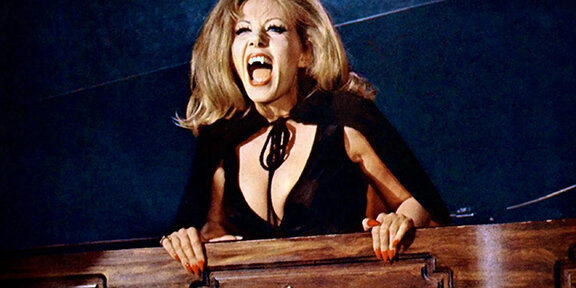
The lovely Ingrid Pitt in
The House That Dripped Blood (1971).
Directed by Peter Duffell (Freddie Francis was apparently busy) and scripted by Robert Bloch, the film had an excellent balance of straightforward horror and tongue-in-cheek bits. This time, Bloch didn't just dash off any old crap — he did provide some solid stories. Denholm Elliott (a master at going crazy slowly) plays a horror author haunted by his serial killer creation starts things off with a bang. Then it's Peter Cushing in sad, forlorn mode as a retiree who discovers that the local horror house has a wax figure of his ex, dressed as Salome! On from that shocker to Christopher Lee (as essential as Cushing to any British horror pic) as a dad who is trying to shelter his daughter from her heritage of witchery. And, for the finale, a spoof of egomaniacal actors with Jon Pertwee as a horror-movie vet who takes himself seriously (with the always welcome Ingrid Pitt as his glamorous female counterpart). Dripped Blood is up in the must-see category of Amicus productions. 

Though better than Hammer's Two Faces of Dr. Jekyll (1960), I, Monster (1971) is notable for having Christopher Lee playing the dear doctor and Cushing playing one of his close friends. Unfortunately, the film contained a low-budget make-up job for Lee as the Hyde character (a bulbous nose, enhanced eyebrows, and a bad set of fake teeth). I, Monster is mercifully short, though, and does mostly stick to the events of the novel. The character names are changed from Jekyll and Hyde — presumably so as not to clash with Hammer's Dr. Jekyll and Sister Hyde, which opened the same year. (And, though not as perfect as it could be, Sister has some memorably camp moments.) A lesser Amicus necessary only for Lee and Cushing completists. 

Tales from the Crypt (1972) was part of the double bill that marked my childhood (along with House That Dripped Blood). Still at the peak of creepiness-mixed-with-dark-humor, Amicus was the perfect company to adapt E.C. Comics scripts by Gaines, Feldstein, and the superbly noirish Johnny Craig. Here producer-scripter Milton Subotsky gets the pacing right (which wasn't the case in Dr. Terror) and each story is a gem. 

It works from beginning to end, starting with the perfect Christmas horror story starring Joan Collins, to the tale of a car accident (that's doomed to happen — an E.C. special), to one of Peter Cushing's greatest turns as a sympathetic old toymaker who is hounded to suicide by his evil wealthy neighbor, to the finale in which Patrick Magee triumphs as the leader of a band of old blind men who have a colorful, classically E.C., revenge in mind for the man who has been mistreating them. Made for only 3 million dollars and featuring a terrific cast and stylish direction by horror master Freddie Francis, Tales was a strong part of Amicus' heyday in the early 1970s. 

A thriller that visually evokes the kitchen sink films at points, What Became of Jack and Jill? (1972) is an odd little number that seems to be a "youth culture" movie but has two utterly unlikeable characters at its center. Jack (Paul Nicholas) and Jill (Vanessa Howard) want to live together in his grandmother's house, but first they must kill off the old lady (Mona Washbourne). Thus, the film is comprised of two good-looking performers acting bitchy to a nice old lady (who may be a pain in the ass, but doesn't seem as much of a shrew as she should be to make us identify at all with the plans of the leads to scare her to death). 

There are some good twists at the end — there would have to be, otherwise you'd wonder why they made the picture at all. Amicus purportedly was embarrassed to have made this sucker and thus kept it on the shelf for two years. (Totally understandable.) The only Amicus "horror" flick to not be available in good condition "above ground" on the Web. (But that's okay...) 

Asylum (1972) has hands down the best frame device of any of the "portmanteau" anthology horror pics from Amicus, and its top-notch cast put over the material beautifully. A young doctor (Robert Powell) would like to be the head administrator of a mental asylum, so the warden (the always amazing, always seething Patrick Magee) proposes a game — if the doctor can tell him which of four inmates used to run the hospital, he can have the job. Robert Bloch's scripting here is the best of any of his work for Amicus, and movie/TV genre specialist Roy Ward Baker presents it in classic deadpan fashion. 


This time half of the stories are told by women — Barbara Parkins (in a classic kill-the-wife scenario) and the great Charlotte Rampling (as a woman who still has an "invisible friend") get that honor. Barry Morse and Peter Cushing (him again!) are in an excellent tale of a tailor's terror, and the pic ends with a small Herbert Lom robot doll (I want one of them!) and the resolution of the "game" Magee is playing with Powell. One of the must-sees among the Amicus horrors. 

Not as good as Tales From the Crypt, The Vault of Horror (1973) focuses on a few of the more gimmicky E.C. plotlines — some seem chosen for their final twist, while others were picked because they are set in an exotic locale. One story signals "comedy" as it stars Terry-Thomas and Glynis Johns — the blackly humorous ending is a classic E.C. conclusion, but the segment isn't scary at all. 

Real-life sibs Anna and Daniel Massey get a better tale (about a town of vampires), while one-time Dr. Who Tom Baker gets to play a painter crazed by vengeance (who doesn't need voodoo dolls, since his paintings are his "weapons"). Pleasant fun, but one can see why we never got a "Haunt of Fear" third film from the lightness in this one — and why Roy Ward Baker is better known for the Hammer films he made (Quatermass and the Pit, The Vampire Lovers) than the ones for Amicus. 

Another minor Amicus production, And Now the Screaming Starts (1973), feels for the first two-thirds of its running time like an early '70s TV movie. (The scripter, Roger Marshall, was best known for his work on British TV.) Stephanie Beacham plays a new bride brought back to the family mansion who immediately suffers weird apparitions and then gets to ponder the eternal question: Will my baby be a devil baby? The last third is a bit better and less like a telefilm — especially a nasty flashback sequence where a sadistic Herbert Lom shows up. The two other guest stars — Patrick Magee and the always-sincere-but-sometimes-he-just-couldn't-save-the-picture Peter Cushing — are pretty much wasted. Hammer did period pieces better than Amicus. 

The end of the road for Amicus anthologies, From Beyond the Grave (1974) thankfully has some good twist endings, a solid cast, and this guy right here (below) in the frame device. (He owns an antique store that bonuses with each item bought — and even nastier ones with the items that are stolen...) Thus, we wind up where the Amicus anthologies began (with Cushing wearing equally crazy eyebrows on the train in Dr. Terror). Here the stories are all by British horror writer Robert Chetwynd-Hayes, and we start out with a bang with David Warner acquiring a mirror that has a Ripper-like killer inside it. 

Cushing in From Beyond the Grave (1974).
The second story has a terrific twist — it involves businessman and henpecked husband (but also kind of an asshole himself) Ian Bannen, his nasty wife Diana Dors, and a veteran who sells items for pence on the sidewalk (the always-sublime Donald Pleasance, with an onscreen-daughter, creepily played by his real-life daughter Angela). The third episode is very silly but Margaret Leighton steals it as a psychic who is initially thought to be fake but then opinions change.... The last story involves a door that brings along its own scary drawing room to a house that it is installed in. Amicus went on for five more films (two horror, three fantasy based on Edgar Rice Burroughs), but this was the end of its great run of anthology horror pics. 

The first and only time Vincent Price starred in an Amicus film, Madhouse (1974; he's essentially a guest star in Scream and Scream Again). It's a good vehicle for Price, yet nowhere near as crazily perfect as the first Phibes and Theatre of Blood. He plays a horror actor who went insane years ago and is making a comeback to play his movie monster role "Dr. Death" in a new British TV series. More murders continue to occur and everyone believes it's Vinnie — until we find out exactly who has been doing it in the film's last few minutes. Peter Cushing and Robert Quarry costar (and both appear in vampire outfits in a costume party scene). 

The film is decently paced, but it's pretty much a standard-issue murder mystery with horror trappings — although it is great to see VP watching himself torturing people in Corman pics from the '60s in the mid-Seventies. (The film was a coproduction of AIP and Amicus, so these clips cost nothing for the filmmakers.) And yes, a similar plot to this one is in the 1978 horror pic Hallucinations of a Deranged Mind by Jose Mojica Marins -- although red herrings are dispensed with in that film. 

The hybrid horror pic The Beast Must Die (1974) is basically both: one of MANY remakes of The Most Dangerous Game (the first one with an African American in the "hunter" role) and a "gimmick movie" of the kind William Castle specialized in. Here we have the millionaire hunter (Calvin Lockhart) throwing a several-day vacation at his mansion — because he knows (how? never explained) that one of his guests is a werewolf and he will kill him/her. Anton Diffring plays his security man, the mighty Cushing is a Scandinavian expert on werewolves, and Charles Gray and young Michael Gambon unofficially compete for who has the most impressive voice. (Answer: both.) 


The film actually does stop 15 minutes before the end to have a "werewolf break" where the viewer can choose who is the wolf (which is depicted in this el cheapo outing by a dog wearing extra fur). The answer is not all that surprising. This wasn't the last Amicus production — the two producers went on to make three medium-budgeted Edgar Rice Burroughs adaptations and then, sadly, Amicus was kaput.

The above 17 films were all watched on ok.ru site. As noted, the only middling copy up there was What Became of Jack and Jill? And now the bonus reviews, written specifically for this blog post: 

It’s Trad, Dad (1962) is a curious relic of a curious period: the pre-Beatles era in England when “trad” jazz (think: Dixieland) was a popular youth phenomenon. Thus, in the manner of certain B-pictures based on radio variety or music-oriented programs, the film is composed of wall-to-wall musical numbers punctuated by a comedy plot. That plot is pretty formulaic stuff: the teens in a small town (who all look 20-something) are bothered by the town fathers who hate their rowdy music (which consists of “trad” and American pop), so two of them (real-life pop stars themselves; the girl is the well-charted-in-the-U.K. Helen Shapiro) try to assemble a concert to show the old fuddy-duddies that their music is the best. 

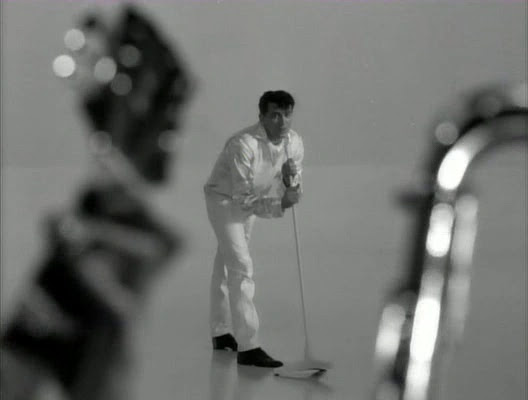
Gene Vincent in It's Trad, Dad!
The only reason this film should matter to anyone outside of those studying the music charts of early Sixties Britain is that it is the feature debut of director Richard Lester. I’ve already discussed on this blog how some of Lester’s style emanated from the brilliantly warped mind of Spike Milligan (with whom Lester made “The Running, Jumping & Standing Still Film”), but it is clear seeing his early work in Trad that Lester was also influenced by the French New Wave and, very much, silent comedy. Add to those influences a familiarity with modern technology (Lester was a TV director before he broke into film) and you have the style that became popularly known as “the Lester style” in A Hard Day’s Night.

Trad is curious, in that Lester was allowed to mess around with the visuals during the goofy little plotline and in about one out of every four musical numbers. So, you have the odd experience of seeing a pop-art “music video” that finds Lester experimenting with different styles of editing and camerawork, and then you see two or three more musical numbers in which nothing interesting happens on a visual level. Then there’s a “crazy” one, then a few more normal ones. I guess Lester considered himself lucky at this stage of the game to be able to do anything odd at all, but the combination of experimental visuals and drearily familiar camerawork and editing makes Trad even weirder for modern viewers. 

The most “prestigious” film in the Amicus canon was a film that was produced by Rosenberg and Subotsky without the Amicus name — it was released under the moniker “Palomar Pictures International,” because the producers felt they didn’t want their Harold Pinter adaptation to be released by the same entity that released The Deadly Bees. Sadly, The Birthday Party (1968), William Friedkin’s taut and disturbing film, failed at the box office and was considered a complete bomb financially, although it is one of the best Pinter films, along with Losey’s The Servant and Accident, and Peter Hall’s The Homecoming


Like The Caretaker and Homecoming, it is a filmed play, but vibrantly done so by young William Friedkin — who later showed his care with filming plays with Boys in the Band, Bug, and Killer Joe. Pinter wrote the screenplay, which, if one needs to nail it down, is about a man (Robert Shaw) hiding out from the Mob at a seaside boardinghouse, who one day is visited by two men (Sydney Tafler, Patrick Magee). This key aspect of the plot is present only in a few pieces of dialogue, as when Magee asks Shaw, “Why did you leave the organization?” (and one realizes this Pinter piece is treading on the same ground as the TV masterwork The Prisoner). 

The performances are all top-notch and Friedkin does an excellent job of adding modernist techniques to the traumatic moments (most notably, a scene where violence is occurring in the dark and we see “thermal” bits of imagery). The film was destined to be a cult affair, better regarded years on from its release, as the play itself is a disturbing piece of material that, like many of Pinter’s best works, has a claustrophobic, circuitous feel to it. 

I’ll close out with a film I’d always wanted to see, since I’m a big fan of Sandy Dennis and also of (still with us, at 85!) Eleanor Bron. The two were costars in the film that Milton Subotsky claimed was his favorite of all the films he produced, A Touch of Love (1969, released in the U.S. as Thank You All Very Much). Touch is a simple drama, a downbeat character study about a single woman (of the kind that Sandy Dennis excelled in) who ends up pregnant when she sleeps with a TV news presenter (a ridiculously young Ian McKellan, in his first movie role). 

The film is scripted by Margaret Drabble based on her novel The Millstone, and it is one of those works that reflected the late Sixties/early Seventies preference for films made for adults about adults. Dennis’s English accent is wobbly, but the film’s focus is squarely on her character’s changing emotions about being single and then pregnant (with much talk about the option of abortion, courtesy of Bron’s character outlining that it could be performed legally if it was done to preserve the sanity of the pregnant woman). 

Dennis’s performance is characteristically understated (and a bit neurotic, one of her specialties in both drama and comedy). Bron is the reliable friend who moves in with her when she is pregnant and who serves as a sounding board about the Big Decision that must be made. And, for those keeping count (and aware of SCTV’s “bun in her oven” theory of British kitchen sink cinema), this is indeed another brilliant British drama that does have a woman getting pregnant as its central dilemma.

Sandy Dennis and Ian McKellan
in A Touch of Love (1969).


Sunday, October 22, 2023

Jerry Lewis talks about his preparation for ‘The Day The Clown Cried’ (11 min. interview)

I’ve been covering Jerry Lewis on the Funhouse TV show since we began back in Sept of 1993 (yes, it was the 30th anniversary last month!). He’s definitely "the Man You Love to Hate to Love to…" Thus, I’ve tried to show the oddest artifacts of his career. In recent years these have been French texts which have praised him to the heavens, but also the trying-to-forgive-him-but-it-was-so-hard memoir by his first wife Patti and the two atrocious French farces he starred in in the 1980s (but then later claimed starred a “lookalike”).

This year I think I hit the jackpot in terms of finding a true gem (thanks goes to superior cineaste Paul Gallagher), and thus I sat at my computer one night watching the very rare doc in question and creating English subtitles for this interview, which was conducted in English but then was overdubbed in French. I won’t mention here who the interviewer is or who directed this particular unseen-outside-of-France doc, because all of that is gone through in my onscreen intro.

If you’d care to jump right to the interview with Jerry, go to 6:30. It will interest diehard fans, though, to know the background details of the documentary, who was involved in its making, and what Jerry had done the preceding day in France to promote the forthcoming filming of his never-finished, never-released masterwork of something or other, “The Day The Clown Cried.”

Thursday, August 3, 2023

The most infamously cancelled comedy show, now on YouTube!

Chuck McCann and
Mel Stewart as cops 
doing an ad for mace.
[UPDATE: This piece has been updated to now link to the official, authorized postings of these episodes by producer George Schlatter. Unfortunately, these videos are "stretched" to a rectangular image when they were shot in classic TV (1:33) "square" ratio. So they induce a bit of wincing on that level, but now they're legal....]

Back when I wrote about the great Robert Staats, I mentioned the infamous comedy series “Turn-On,” which was the only show to be cancelled as it traveled across the country, from East Coast primetime to West Coast primetime on Feb. 5, 1969. 

The show wasn’t as awful as that bit of TV history implies — it was actually way ahead of its time. A far hipper version of “Laugh-In,” it was conceived of by the same production company, Schlatter-Friendly Productions, for ABC. It had no laugh track (which was very unusual for TV comedy in 1969), contained even more complicated edits than “Laugh-In,” and was willing to lose some laughs to get across certain points.

Since both existing episodes of the series are now on YouTube — watch them before they get pulled! – it’s worthwhile to contextualize the series. First, it’s important to note that “Turn-On” showed up several months before Norman Lear’s sitcoms (starting in January 1971) and National Lampoon (starting in April 1970) opened up the floodgates to what is now considered “incorrect” humor but was then considered liberated humor, since it cast a wide net and made fun of absolutely everyone.

Secondly, the show featured plenty of ridiculous jokes, but it didn’t talk down to viewers, and assumed they could take the jumps from situation to situation, gag to gag. It was conceived of as "the first computerized TV show."


It actually resembles a sci-fi series or a live-action cartoon in its approach: a solid white background is seen behind the performers (two years before THX-1138), the credits continue to appear throughout the length of the show, and an electronic score is used throughout the first episode.

It is truly wonderful that both existing episodes are now readily available (Staats noted to me that material was prepared for a half-season of shows), as the second show (with guest host Robert Culp) is far better than the first (with guest host Tim Conway), and it never aired at all, because the series was indeed canceled as the first ep was traveling West. It is "calmer" in its approach, since, presumably, Tim Conway signaled "kooky comedy" and Culp signaled "mellow sexuality," so the latter approach is taken in the second show (down to the soundtrack having a light jazz score instead of constant electronic bleeps and blops).

One of the quick onscreen
lines that jolts a modern-day
viewer.
The take-no-prisoners approach to humor on the show meant that it ran the gamut from flagrantly silly blackout material (a la “Laugh-In” and, later on, “Hee-Haw”) to smarter humor to very quick-and-dark jokes. Two of these occur in Episode 1 when you see a series of desks at which the Paris Peace talks (“as dictated by General Ky”) took place — the desks are arranged in a swastika pattern. Also, as we see a court sketch, the phrase “Israel Uber Alles” floats by on the bottom of the screen.

“Turn-On” thus mocked hot-button issues (and “tasteless” premises) in a way that “Laugh-In” never would have and which later became the norm for later shows like “Fernwood 2-Night” and, much later, for “Adult Swim” cartoons and live-action series. 

The last element that must be mentioned about “Turn-On” is its cast. A bunch of newcomers were featured, but some of the cast were old pros. Mel Stewart and Hamilton Camp were very familiar faces on TV, while Chuck McCann was the nearest to a star “name” the show had (thus the guest hosts). Robert Staats did his “E. Eddie Edwards” pitchman character on the program (plus a more bizarre drag character called “Modren [sic] Bride”). 

Robert Staats (credited here as "Bob")
as pitchman E. Eddie Edwards.
That character is best known from The Projectionist, but that film’s release was several months off when the series was shot; Schlatter would’ve seen Staats in a very popular industrial film called “Safety Shoes” (1965). The advertising firm that Staats worked for, Stars and Stripes Productions, is in the credits for “Turn-On” as having supplied segments, most likely animated ones.

Teresa Graves.
It will be noted that the women in the cast participate in all the sketches and some serve as “dancing girls,” a la “Laugh-In.” In fact, the only cast member both shows shared was Teresa Graves, who gets to both do jokes and dance here. 

 Another familiar name flies by in the list of scripters. Albert Brooks, who at this time was just beginning in show business as a standup, is listed alphabetically among the writers. Also on the second episode, a Ban deodorant ad features a young Ms. Madeline Kahn. (The ads are quite fascinating, since some of them look like the show  white backgrounds, silly behavior  but some are "documentary-style" as in one with Mary Quant promoting AT&T).

Here is the first episode, with guest host Tim Conway. [The embeds below are for the authorized versions posted by producer George Schlatter -- I wish they weren't "stretched" into a rectangular ratio! But now they are fully legal...]


Here is the second show, never aired, with guest host Robert Culp.

Note: Thanks to YouTube poster Andrewgtv05 for their posting of the shows, and friend Jon W. for his pointing them out to me.

Monday, July 24, 2023

Proud to be a muse, talented in her own right: Deceased Artiste Jane Birkin

There is no way I could let the passing of Jane Birkin go by without doing at least a modest tribute to her on this blog. I was lucky enough to conduct an interview with her way (way) back in 2003 when she was in NYC to present her show “Arabesque” — consisting of songs by Gainsbourg with an Arabic backing band at the Alliance Francaise.

This clip, which is quite short, is one of the most popular interview clips I’ve posted on that site – you know the one, the one that doesn’t really approve of “fair use” and has a myriad of rules to keep those who uphold that practice from posting their work. In any case, this is a short little snippet, but that’s what I used to post up there.


Recently, when “Uncle Jean” (aka Jean-Luc Godard) left us, I went back to the Birkin interview to excerpt her discussion of working with him on Soigne ta droite (1987).


*****

Because of her public persona as Gainsbourg's muse (
in my talk with her she proclaimed her pride at having inspired and been given the songs by Serge), it was not noted enough by critics that she kept getting better and better as an actress. She’s charming as hell in some of her early “dollybird” incarnations, and her beauty is one of the only reasons to watch some of the films she made with Gainsbourg (unless Serge did the score, which gave you two reasons to see the film).

But, as time went on, she began appearing in more demanding roles and, once her relationship with Jacques Doillon had ended, she did indeed become a regularly busy actress who provided particularly wonderful turns in ensemble pieces (as in the two Poirot-by-Ustinov films she’s in) and the work of other New Wave directors, including Resnais, but most especially Rivette. (For whom she starred in Around a Small Mountain, his last film, a “small movie” extraordinaire concerning a very charming middle-aged romance.)

For we American fans, the documentary Jane by Charlotte (2021), made by Charlotte Gainsbourg in an effort to understand and relate to her mother, gave us a portrait of Jane that was very much down to earth. She may have been a music, movie, and fashion icon, but she was also a somewhat emotionally distant mother, who, it was revealed in the film, was having health problems.

In the film, which lacked a narration by Charlotte and was more of a fly-on-the-wall view of the family (thus requiring that you already knew who Jane, Charlotte, Lou, Kate, Serge, and others were), Jane having a bout with cancer is mentioned in the past tense. In her obits it was noted  that she had a stroke in 2021 and had cancelled various commitments in early 2023 because of a broken ankle and a break in her shoulder.

Then she cancelled an appearance at Town Hall in NYC in the summer of last year, having all the tickets refunded, which seemed to indicate something grievous had occurred. No more was heard until the death announcements started appearing online the Sunday before last.
*****


As a tribute I offer the following video clips, which relate entirely to her music career. Appraisals of her acting career are best saved for another time, as a number of her French films never appeared on these shores with English subs.

While her “Symphonique” stage show found her singing only the songs that Serge wrote directly for her (with the orchestra playing Serge’s most familiar songs with Jane offstage), it’s interesting to see that she was on French TV in April of 2021 looking in fine form, performing a Gainsbourg medley of his more, let us say, “familiar” songs.

She was seen in March of 2022 on an interview show discussing her concert performances, her “sketch” film with Agnes Varda (not a great picture — each time I see it, I want to love it, but it seems like more of a not-that-good TV comedy show transposed to film), and the documentary by Charlotte. She looks a bit bigger in this clip but is in good spirits and seems to be in good health.

And here she is on Feb 1 of this year, participating in a protest supporting the people of Myanmar. Her commitment to various causes was the least-seen but most important part of her public appearances:


Many of the TV appearances Jane made with Serge have become available on DVDs and on fan-generated “mail order” discs. This one, featuring him lip-synching to two songs from the classic Melody Nelson album while he carries Jane on his back, is one of the more playful clips that hasn’t surfaced on a compilation (yet).

Serge composed songs for seven of her solo albums (not counting songs for films and random unreleased tracks). The songs ranged from the sublime to the ridiculous. One of the latter is “Di-doo-dah,” heard here with Jane singing it live on the Russell Harty show in 1973

Another minor (but catchy) song for Jane by Serge was “Ex-fan des sixties,” wherein the decade’s biggest heroes (either dead or having broken up their band) are recited in a laundry-list fashion. It’s not a major Gainsbourg song, but it’s interesting, as it acknowledges what an incredible impact the pop and rock of the Sixties had on France. (All the artists mentioned are either American or British).


Moving from the ridiculous back to the sublime, here is one of the songs that Serge entrusted to Jane that is considered one of his best works which he never sang. It was recited by Catherine Deneuve at Serge’s funeral service and was always in Jane’s repertoire, if she was doing “both sides” of Serge.

The title, “Fuir le bonheur de peur qu'il ne se sauve,” translates loosely as “Fleeing happiness for fear it will run away.” A very helpful YouTube poster named Julia has subtitled the song in English but hasn’t made the video embed-dable for some inexplicable reason. (I always wonder why people make sure their vids are not to be embedded – will that negate the possible copyright claim? Those are either going to come or they’re not; adding the embed function serves to spread your work around more.) 


Over the years, Jane sang with a number of other performers. Perhaps because her first song was a duet with a guy (“Je t’aime, moi non plus” with Serge), she continued to work very well with male partners. One personal favorite was Bryan Ferry (with whom she sang a Roxy classic). Also, in Bertrand Tavernier’s
Daddy Nostalgie (1990), she duetted with Dirk Bogarde on the song “These Foolish Things,” which Ferry had brought back to life on his first solo LP in 1973.

“Je t’aime” was such a big hit in France and England that a follow-up was attempted twice: “69 Anee Erotique” and the “new dance” that Serge proposed (which, let’s face it, was not all that much more than syncopated groping) with this number.


Some fascinating footage appears here — Serge personally instructing Jane on how to sing one of his songs for her solo albums. (He definitely conceived of her “choir boy” voice as an instrument to be included in the orchestration of his songs.) Also, Jane talks in 1997 about his death and how he left her 25% ownership of the Melody Nelson album, in case “things went wrong” in her old age.


In 2003 when Jane was touring the world with her “Arabesque” show, featuring Gainsbourg songs with arrangements for Arabic instruments, she appeared on various programs in Europe to promote the shows she was doing. Here she performs Serge’s rousing “Elisa,” slowed down and made into a hypnotic ode.


Jane had another touring show after “Arabesque,” but her final major undertaking in terms of musical performance was a show called “Birkin Gainsbourg: The Symphonic” (which sounds much better in French as “Le Symphonique”). The show played here at Carnegie Hall on Feb. 1, 2018, and was an absolute delight. Only one guest star joined Jane onstage: Rupert Wainwright, who sang "Ces Petits Riens" and "La Chanson de Prevert." There is a video of Rufus joining Jane in a different venue here.

In Charlotte’s documentary about her mother, it is noted that the only time they sang together onstage was here in NYC at the Beacon Theater on March 6, 2020, a short time before the pandemic lockdowns began. A scan of YT reveals that, while the Beacon show might’ve been their only planned and rehearsed appearance together, they did sing onstage on another occasion. In 2013 a video was posted of them singing together at a concert in Monaco, duetting on Serge’s “La chanson de Prévert”:


Birkin stated in my interview with her that her first-ever performances in the U.S. were for the “Arabesque” tour in 2003, and thus her first-ever NYC performances were the two times she performed that show at the Alliance Francaise. (I saw the second of those two shows and it was wonderful.)

Her last performance in NYC was most definitely the Beacon Theater show, as a show that was to take place on my birthday (June 18) was announced for last year (2022) at Town Hall and was cancelled very quickly without explanation. (The mention of cancer in Charlotte’s documentary and the stroke she suffered in September 2021 were alerts that she perhaps was having health problems.)


Oddly enough, the first hit you get on Google when searching to find when it was that Jane played her last concert is the thoroughly unreliable Concert Archives site, which lists the cancelled June 18, 2022 gig as if it actually took place. One wonders how many other cancelled performances are on the pages of this website….

In any case, the reason to re-see the Symphonique show at the Beacon was that, this around, Jane had invited guest stars to join her onstage. So I attended the show and was very glad to see Jane duetting with both Iggy Pop (!) and Charlotte G. 

Jane chose to sing “Ballade de Johnny-Jane,” from the soundtrack of Serge’s film Je t’aime, moi non plus (1976), with Charlotte. This was an interesting choice, as it first appeared on the soundtrack to the film and is an odd song that refers to the film in its lyrics. 


It also, oddly enough, was a song that Jane duetted on with Vanessa Paradis. The latter is a surprise, since Vanessa had Serge write the lyrics for her second album about a year before his death. She was the only artist who requested he do rewrites on some of the lyrics, and he wound up wisecracking, “Paradis, c’est l’enfer” (“Paradis, it was hell”). Here are Jane and Vanessa singing “Johnny-Jane.”

And here is some lovely YT poster’s very good recording of mother and daughter singing father’s movie theme song:


Now further down the rabbit hole, we can thank YT poster “secularus” for posting not only the preceding video, but also videos of the two songs that Jane did with Iggy at the Beacon. 

The first was “Elisa,” which they had also done the preceding evening on “The Tonight Show” with that grinning, chuckling idiot as host. The “Tonight Show” people made sure that there is no post of that performance on YT. All the better to watch this dynamic duo perform it onstage:


Iggy first tackled Gainsbourg’s lyrics with a tuneful cover of “La Javanaise” in 2012 (on his album Apres). Far closer to the spirit of his own songs is Serge’s “Requiem pour un con,” which taunts the listener and calls them an “ass” (or twat, in one online translation that I think is a bit too loose and a bit too British). Here Iggy does the song with Jane:

The song that Jane ended all of her Gainsbourg shows with was the aforementioned “La Javanaise.” It was written by Serge for Juliette Greco, who had the initial hit with it. Serge also recorded it himself and sang it in some of his live shows, later in his career.

Jane’s performances of it were always especially moving, as her voice cracked throughout it, and it always seemed like the song’s simplicity made it the perfect way to end a tribute to Serge. Especially because this most romantic of tunes, set in a waltz tempo, actually says that the couple dancing will be in love “for the length of a song.”


In one particular rendition she did on a Gainsbourg tribute on French TV, the audience sang the song along with her, which made it perhaps the most stirring tribute to Serge ever (with the French public so familiar with his signature song that they took over from the onstage singer). That version doesn’t appear to be on YT (or is tucked away somewhere), so I’ll end with a different version, in which Jane sings the whole song alone.

This is from a charity benefit show she participated in back in 2017. She is wearing sneakers and an old-looking pullover, and is sporting a cast on her left arm. This makes the performance even more endearing, as if she was going to keep singing Serge’s music no matter what happened to her health-wise. And she did, for which we can only be intensely grateful.


Note: Thanks to Despina Veneti her excellent sampling of Jane B. photos.