Wednesday, March 28, 2018

More wave than particle: Deceased Artiste Chris Rush (part two of 2)

When we left our “cosmic comedian,” he was a steady draw at night clubs, had recorded two comedy LPs that sold well, and was opening for major music artists, from rock to jazz and soul. In this part of my tribute to Chris Rush, I’ll be discussing his comedic ventures in venues other than nightclubs.

But since it’s so hard to come by clips of Chris in his Eighties prime, here he is (from :55 to 1:20) on a local WNBC “Live at Five” news story about “young comedians." By this point Chris had been onstage for about a decade (and was 36). Other familiar faces in the piece include Bill Maher and Rita Rudner. (Plus vets Professor Irwin Corey and the late, great Sid Caesar and Imogene Coca, and Robin Williams, who was already famous.)


Chris never stopped working as a comedian, but it was easy for fans to lose track of what he was doing in the pre-Internet era. I rediscovered him, after seeing him open at the Bottom Line for Flo and Eddie a few years in a row (in the late Eighties), on the now sadly forgotten but truly mighty medium of radio.

Chris was a regular guest on Joey Reynolds’ all-night (midnight to 5:00 a.m.!) talk show on WOR-AM in the late 2000s. He was, as ever, a killer — he brought a burst of energy to Joey’s show and demonstrated his sharp comic instincts every time he guested, riffing on timely topics and basically any other item that came up in conversation. He had clearly gotten better with age.

Chris’s appearances on the Reynolds show were so good because, by that time, he had become a radio veteran through his guesting on different radio shows (like John DeBella in Philly and Opie and Anthony – on the latter he seemed very out of place, and one asshole thought it was funny to play a cricket noise when Chris spoke) and his stint as a steady sidekick from 1997-’99 on the Wakin' Up with the Wolf morning zoo show on WPYX-FM in Albany.

There are a few good shards online of Chris on the Wolf Show.


This one is particularly frenzied — perhaps attributable to the fact that this was one of the few times that Chris was getting up extremely early in the morning for a comedy gig. It wound up on the radio station’s promo CD for the Wolf show called “Chris’s Head.” (Chris quickly became more popular than the actual host of the show….)


On Joey Reynolds’ show, though, Chris was in his element. Joey’s show could go in several different directions at once, and Chris was able to converse on several different levels, letting his imagination run wild at some points and seriously contributing to the discussion at others.
*****

The other medium in which Chris excelled is one that he wasn’t very active in, namely humor writing. In part one of this piece, I mentioned his onstage debut in 1972 at the Gaslight Cafe (his first time ever as a standup comic, at which he got a standing ovation).

Two years before that, though, he began writing articles for National Lampoon. Starting with issue number 5 in Aug. 1970, there were seven articles by Chris that appeared in the mag. A later issue, number 40 in July 1973, contained a flexi-disc with bits from his first LP, First Rush.

Chris was brought to the Lampoon by Bill Skurski, the graphic designer (he and another designer are referenced in the recent abysmal Doug Kenney biopic as the guys “who know Robert Crumb”). From the Rush articles that NatLamp published, we can see that Chris’s cartoonlike sense of imagery was already in full flower.

First, a word about the un-p.c. side of Chris’s comedy. I’ve spoken about this many times on the Funhouse TV show, but one of the best products of the cultural rupture that was the Sixties was the appearance in the early Seventies of extremely funny un-p.c. humor (of course, no such phrase existed then) that manifested itself most vividly in the sitcoms of Norman Lear (from All in the Family to Fernwood 2-Night) and the brilliantly nasty, at times surreal, whimsy of NatLamp (as diehard fans refer to it).

Chris fit right in with this revolution in comedy because his strong suit was always cartoonlike images of an unfiltered, un-p.c. bent. He was part of a generation of comedians who were unafraid to do “ethnic humor” — wherein all races were open to be mocked, most especially one’s own. Much like his friend George Carlin, Chris also loved to speculate about bizarre modes of death.

A "photo novel" with Chris as Hercule Poirot.
Today’s audiences are freaked out by ethnic humor and dark jokes about dying — with the deaths of Don Rickles and Carlin, those topics now appear only in the comedy of “unfiltered” cult comics like Doug Stanhope, who have a solid following but decidedly do not get high-profile comedy specials on HBO or Showtime. (Sadly, two of the latter-day, truly puerile, legacies of ’70s unfiltered comedy are gross-out movie comedies and the “shock radio” of Stern and O&A, which punches down [mocking homeless people, for instance] and affects a cynical, you’re-all-scum perspective.)

So Chris was indeed a product of his times — the post-Lenny Bruce, post-’68 “opening up” of American comedy that found the best standups regularly going into dark and intentionally awkward places for laughs. (Check out Pryor telling an audience of white people how he doesn’t want to have his cock sucked by men anymore, because the guys who do it are such blabbermouths — incredible stuff….) The Lampoon was a bulwark of that nothing-is-sacred mindset and Chris’s articles for the magazine were both pure Rush and pure NatLamp.

The pieces were of two types: lists of sick, weird jokes and themed essays (the editors encouraged Chris to submit more “literary” humor, meaning comedy in a linear context). The former are totally straightforward and the latter show a path that Chris never took, but could’ve mastered: humor writing in the classic sense (albeit with a larger, more “streetwise” vocabulary).

The sick jokes have a number of dated references, but these six from one piece give an indication of the “no-limits” places that both NatLamp and Chris were going at the time:

Q: What's black and white and red all over? A: The graduating class of Kent State!

Q: What's the difference between mother's milk and Raid? A: There's no DDT in Raid!

Q: What do you call a twelve-year-old junkie in Harlem? A: "Old-timer!"

Q: What has three arms, six legs, and purple polka-dots? A: Any Vietnamese baby born where we used a defoliant!

Q: What do you call twenty-five Mixmasters and a jar of Novocain? A: An abortion clinic!

Q: Did you hear about the battered-child doll? A: Wind it up and it cringes!

[from “Sick Jokes of the Seventies,” National Lampoon, Vol. 1, No. 20, Nov. 1971, p. 53]

The essays cover a variety of topics. In one Chris remembers awkward moments of seduction from his teen years (the early Sixties). In another he discusses “the myth of the Mafia” (offering situation after situation that makes it clear the Mafia was no myth). He tackles the lifestyles of freaks — way-out hippies, not denizens of the sideshow — in another piece, and in the final essay he presents a mock-anthropological study of the extinct race of “the Dolts.”

Of the five pieces, the first is the most remarkable — first because it’s written as a bizarre, Terry Southern-like encounter with a con man; secondly because it is based on Chris’s real-life experience as an insurance salesman in Harlem.
I had grown tired of stealing Cracker Jacks from pigeons and was absolutely depressed at the thought of my coming Thanksgiving feast consisting of a bouillon cube with all the trimmings. It was at this desperate point that temptation crossed my path. I was loitering in my usual hang-out, Filthy Phil's Coffee House and Orthodox Pagoda. A group of fellow artists and myself were discussing the lighter side of malnutrition when we were interrupted by a conservatively dressed stranger, who asked to see the proprietor. It was quite obvious he was some sort of salesman, and we were amused at his misfortune in picking Filthy Phil as a prospect. In general, Polish Buddhists are a thrifty lot and Filthy Phil was no exception. In fact, Phil was legendary in his cheapness. It seemed that one day, Phil discovered that a saltshaker was missing and he locked the door and submitted 15 customers to a rectal search. So we held little hope for the salesman, no matter what he was pushing. What followed was astonishing.... [from “Confessions of an Insurance Man,” National Lampoon, Vol. 1, No. 5, Aug. 1970, p. 18]


Once Chris became a standup he left humor writing behind. His friend Bill Skurski brought him back to it twice, though, with two projects he (Bill) worked on that were clearly inspired by the Lampoon. The first was a short-lived humor mag called Harpoon.

I have been informed by one of the contributors to the mag that it was “sued out of existence by Matty Simmons,” but before that happened Chris contributed a suitably oddball piece in the first issue (September 1974) that found him making up fake beauty queen promotional copy for cheesecake photos that one presumes had fallen into public domain. (Fans of Hugo Haas’ films will recognize the mag’s cover girl as being Cleo Moore.)


Another publication Bill Skurski supervised to which Chris contributed was an underground comic called Drool that lasted all of one issue, in 1972. Chris produced another collection of sick jokes for Drool. Again, Chris’s cartoonlike imagery is the best part and well-suited to the comic medium, despite the lack of specific gag illustrations.

And yes, no matter which way I turned the comic while scanning, Chris's article was printed in a lopsided manner....


One of the first places I first encountered a routine written by Chris, years before seeing him open at the Bottom Line, was in the 1975 paperback Breaking it Up, a selection of standup routines printed as if they were blank-verse poetry. 

It was the perfect kind of book to appear in an era that produced several books in which rock lyrics were presented as poetry. Chris’s routine, “Cannabis Capers,” was unique to the book, as it didn’t appear on his first album.

While he concentrated entirely on standup in the Eighties and Nineties, there was one fascinating piece of writing he did that appeared in a best-selling book. In researching this piece I was reminded that Chris had spoken at different points about having contributed to a book by Tim Allen (at the point when Allen was a star on Home Improvement). Oddly enough, his contribution was a piece of private correspondence that Allen chose to include in his 1996 book I’m Not Really Here.

Before I discuss this rather odd “guest appearance” in a book, let me embark on a short tangent. In the first part of this piece, I mentioned Chris’s initial work as a molecular biologist. He always did material concerning weird nature facts, odd science-related phenomena (from strange experimentation to UFO sightings), and popular sci-fi concepts from TV shows and novels.

In the early Nineties he became fascinated by quantum physics and read book after book on the subject, becoming a self-taught expert on the topic. Among his favorite authors in the field, according to his longtime companion Megan, were Rupert Sheldrake, David Bohm, Michael Talbot, Gregg Braden, Dean Radin, Ken Wilbur, and Russell Targ.

Chris loved to share his knowledge, and so when he found out that Tim Allen was doing the same autodidact thing about “quantum” (as Chris referred to it), he sent a book, Dancing Wu Li Masters: An Overview of the New Physics by Gary Zukav, to Tim via his manager. Tim wrote a letter to Chris asking questions about various topics having to do with quantum physics.

Chris’s response beautifully summarizes some quantum principles and offers references for everything Chris was saying — plus added humor, of course. It’s quite strange, though, to read a book by a comedian that stops on a dime about two-thirds in and then includes a lengthy segment written in correspondence form by another comedian (with attribution to that second comedian; Allen bought the rights to the letter from Chris).

If one reads the rest of the book, one suspects that Chris wrote a few other parts of it, since there are other incredibly smart yet simplified encapsulations of complicated quantum phenomena, containing cartoonlike images Chris used in his later one-man show Bliss. Here are two versions of the eight “ways in which the world works” explained by Chris in the letter:


Quantum Reality #6: Neorealism. (The world is made of ordinary objects.) An ordinary object is an entity which possesses attributes of its own, whether observed or not. This is heresy in the eyes of establishment physics. The main neorealist rebel was Einstein, who said of Heisenberg and Bohr’s quantum theory: “[Their] tranquilizing philosophy — or religion — is so delicately contrived that, for the time being, it provides a gentle pillow for the true believer from which he cannot very easily be aroused.” That’s a classy put-down from the Big E. The weird thing is that the small group of neorealist rebels with their primitive notions include many of the founding fathers of quantum theory. Besides Einstein, there’s Max Planck, whose discovery of the constant of action sparked the quantum revolution; Erwin Schrodinger, who devised the famous “cat in the box” experiment to illustrate the uncertainty principle; Prince Louis de Broglie, who predicted the wave nature of matter; and more recently my main man, David Bohm. Even this quantum reality, closest to the old-fashioned idea of a “normal” world, contains the fantastic requirement that some objects move faster than light, which entails time travel and reverse causality. [Tim Allen, I’m Not Really Here, 1996, Hyperion mass market edition, pp. 255-56]
And, because there’s always a place for a joke in an explanation of quantum principles:

Quantum Reality #8: The Bisected World of Heisenberg (The world consists of potentials and actualities). The key here is the probability wave, which means a tendency for something. (You wondered in your letter to me why you only had a “tendency” to exist.) This notion introduces something between the idea of an event and the actual event, a bizarre kind of physical reality where possibility and reality meet. Everything that happens in our world comes out of probabilities set up in the world of quantum potential. The magic act of measurement creates an actuality. There is no deep reality as we know it, only tendencies and urges. This is also known as the Shrinks and Hookers Corollary. [ibid, p. 257]

The last piece of humor writing that Chris did was a small book of “dangerously funny lists” called, in true Rush style, Milking the Rhino (2007). The book is a virtual cascade of absurdist imagery, with Chris’s bizarro language overflowing in some of the lists.

At one point Rhino was offered for free as an e-Book by Amazon. This provoked some rave reviews from satisfied readers and a surprisingly big number of people didn’t like the book — they said they didn’t find it funny (fine, everyone has their own comic sensibility — thus the popularity of Adam Sandler and Will Ferrell movies, which I respond to like bamboo under a fingernail) but also seemed thoroughly *offended* by the book.

I kept reading the reviews until I found several individuals who expounded upon their “Not funny!!!” verdict. The people who were most bothered by Chris’s writing were disturbed by his dark humor (especially his oddball method-of-dying jokes) and were not fond of his being so un-p.c. Chris continued to do ethnic humor over as the years went on, but he used it in passing and the main “victims” of this kind of humor were his own tribe, the Italians.

I find Rhino very funny, but do wish there had been an audiobook, since no one did Chris’s material better than Chris himself.

Two lists, first of oddball accidents. [Milking the Rhino, Chris Rush, Andrews McMeel, 2007, pp. 21-26; pp. 41-45]


and "amusing suicides and freakish deaths":


Before Chris became obsessed with quantum physics, he had accumulated a lot of great material — the kind of context-less stuff he used to do as an opener for bands and as a “middle” on comedy bills (I still would pay a good price to see any part of Chris and Larry Storch supporting Dick Shawn at the Bottom Line.)

Thankfully, he recorded this material and it became his third album, There’s No Bones in Ice Cream (1997), released on the great retro/reissue label Sundazed. The CD is out of print but is currently up on YT in its entirety. These are a few exceptional tracks:

Chris’s great opener for uptight crowds (esp. in NYC). Includes talk of King Kong, traveling in the South, and newcomers to NYC:


Having grown up Italian, Chris knew the macho culture all too well. Here he talks about the notion of machismo, and the fact that men have a hard time getting over failed relationships:


A great bit, that moves from a fave Rush topic (aliens) to capital punishment and gays in the military:


*****

In the early Nineties the bottom fell out of the comedy club market; this coincided with Chris’s growing discomfort with working the club circuit, where one encounters people who come seeking some amorphous thing called “comedy,” which they’re not looking to have to think about. (A few years back I sat through a night of five standups at one well-known NYC comedy club and saw five performers play directly to a Friday night audience by doing an incredibly repetitive amount of “battle between the sexes” material — it was mind-numbing.)

Chris in Westbury. Photo
by
John Blenn.
In 1994 Chris started in earnest to craft a one-man show that wove together his love for (and great knowledge of) quantum physics, his deep trove of oddball animal trivia, and a theme he was in the process of developing — namely how science interacts with the spiritual. He considered calling the show "The Tao of Laughter," but took George Carlin’s advice and retitled it after a line in the show, “Laughter Is the Sound of Bliss.”

He worked on Bliss (the show’s final title) for the next 15 years, initially developing it in comedy clubs (including the Gotham Comedy Club and the venues he dearly loved on Long Island). During this period, he had two celebrity friends fund the show: Tim Allen invested in it in 1997 and 2000, and Carlin backed it in 2001 (see info on the latter in the first part of this piece).

The show debuted in a “legit” off-Broadway theater, 45 Bleecker, in April of 2009; it ran until August of the same year. During this time I had the chance to interview Chris about the show (again, see part one of this piece for the whole interview, as aired on the Funhouse TV show). Chris maintained a cordial relationship with the theater until, sadly, it closed due to financial troubles.

He performed Bliss a few additional times in 2010. ( I was in the audience at his final performance, held at the KGB Bar in May 2016, as part of a show entitled “Spaghetti Eastern.”) Chris’s preferred version of Bliss exists in both audio and video formats — one hopes that either is released someday, so we have a record of the last stage in his work (and the long-awaited fourth Chris Rush comedy album).

Chris in Valley Stream, Long Island. Photo by John Blenn.
Chris was not the type to nostalgize — he liked to focus on the present and the future, not the past. The one time we talked where he did rhapsodize about the past found him talking about what I presume was his favorite-ever gig. I didn’t stop to ask him where and when this occurred, but given his rich record of opening for rock bands (documented in part one of this piece), it could’ve been anytime in the ’70s when open-air rock festivals flourished. His friend Bill Kates says the festival in question was the Summer Jam at Watkins Glen in 1973, which had a world-record attendance record of *600,000* (!).

He remembered winning over an incredibly large crowd, numbering in the tens of thousands, and proceeding to make them all laugh at once. It was, he said, the most beautiful sound he’d ever heard – echoes of Chris as a child making his family laugh all at once — and clearly his proudest moment as a performer.

Although Chris sometimes bristled at being labelled a “comedian’s comedian” (since that didn’t generate a steady standard of living), I think often about the effortless way he made me laugh, whether he was standing on a stage or simply offering random observations on the phone (often about what was going on on his TV).

The term “comedian’s comedian,” accurate as it was, was too small a description to fit what Chris did onstage and off. He made us all laugh, in a broad range of situations. I can think of no greater legacy than that. 
*****

Chris was one of those rare standup comedians who had no desire to act. He did do so, however, in a George Carlin pilot (which he contributed to as a writer, and had a supporting role in) and a series of shorts shot in NYC for a Comedy Central series called Small Doses in 1996. The shorts were called “Food for Thought” and were about two goofy young men working at a supermarket. Blaine Capatch and (an amazingly young-looking) Patton Oswalt starred, and Chris played their agitated boss:


The videos on YT that best offer the flavor of seeing Chris live are a series of bits from Bliss. Shot by Bill Kates, this is my favorite:


Two of Chris’s friends, Chris Sippel and Sal Cataldi, shot some great footage of Chris just riffing, using some of his Bliss material, along with things he came upon in the moment. These clips were shot in 2010 for a proposed vlog project.

Chris on one of his favorite subjects, aliens:


And more of his great bits, including the personification of god, chemicals in our water, and weird animal trivia:


Thanks much to those who helped with this piece: Paul Gallagher, Bill Kates, and Chris’s longtime companion, Megan De Caro.

Monday, February 12, 2018

The mad scientist as 'black belt comedian': Deceased Artiste Chris Rush (part 1 of two)

Photo by John Blenn
Chris Rush was the neighborhood wiseacre gone absurdist science professor. An engaging conversationalist who would listen and then respond with the funniest insights and deft turns of phrase. He was a “comedian's comedian” who, according to his friend George Carlin, was prone to “ad-lib five careers worth of material backstage.” He died at the age of 71 on January 28, 2018, in Forest Hills, Queens (although he lived in Manhattan at one point for several years, he remained a boroughs guy, having grown up in Williamsburg, Brooklyn), after a number of ailments took their toll on his system.

Chris certainly had the ability to make anyone he met laugh — he was one of the only people I've met who could “tune in” to your personal sense of humor and begin to make you laugh out of the blue, even while discussing the grimmest topics.

Chris's first LP, First Rush.
Art direction: Thomas Hachtman
Chris put in several decades on the standup circuit. His beginning was auspicious — after only a year as a standup, he scored a record contract with Atlantic Records.

The resulting album, First Rush, moves through the subjects that had made up his life to that point (in his mid-20s): a strict Catholic upbringing and, stricter yet, a Catholic education; a fascination with science (he had been a molecular biologist prior to becoming a comedian); fantasies, delusions, and mindfucks sparked by the use of drugs, from pot to hallucinogenics; and a love of television. The last-mentioned remained a lifelong fascination — Chris was an inveterate nature-channel viewer and a collector of details about the strange behavior of animals and insects.

Back cover of First Rush. Photo by Michael Sullivan.

The album is not the best introduction to Chris’s comedy, since his later material was far funnier and didn’t rely as much on drug humor. Some of the shorter bits are still wonderful, though, particularly the ones about religion:

Judeo:


Christian:


As I’ve been preparing this piece I’ve been speaking to Chris’s partner Megan, who has been receiving very nice messages from his friends that have been supplying pieces of the jigsaw puzzle that was his life. When I asked Chris about past events, he often dodged the subject or said he didn’t remember — he clearly was a man of the present and future, who didn’t want to dwell in the past. He told Megan about his childhood and his strict Italian father (he was born Christopher Mistretta).

He remembered the first time he made the family laugh, as a tiny kid aged one and a half, by standing on a chair and impersonating opera. The kid liked the reaction he got, so he continued to be the family clown as he got older (what better way to stave off a strict parent?).

A bearded Chris (left, with hair!) in the early Seventies.
Photo by Michael Sullivan.
A posting on Facebook by Chris’s ex-wife Michele adds a bit more to his biography: She noted that the two were married for a decade (1968 to ’78) and were “hippies” who wore the fashions of the time. Both were Brooklynites (she an 18-year-old from Bensonhurst, he a 21-year-old from Williamsburg).

Michele and an early science teacher encouraged Chris to be a professional comedian. The most interesting detail in Michele's touching reminiscence was this nugget: “The first time he dared to perform was at the Gaslight in Greenwich Village. He got a standing ovation, and knew he wanted to be a comedian.” She paid tribute to his ability to make people laugh until they hurt, and added, “He was the kind of husband that would help me find important things when I lost them. My smile, my hope, my courage.”

An ad for Chris's debut album,
which ran in National Lampoon.
A humor break from the biographical info — Rush on food. As quoted in Allentown's Morning Call newspaper, “Nightclubbing” column: “In almost no other place in the world besides America, Rush noted, do the words 'unfavorite food' have any meaning. His 'unfavorites' include liver, tongue sandwich ('How can you enjoy something that tastes you back?') and sushi ('My family calls it bait').”

Back to the bio: Chris’s fascination with science manifested itself early on. Megan recounts his wild and reckless (well yeah, crazy) early years as an amateur “scientist”: “As a youth, probably a teen, Chris got his hands on a CIA manual and/or an army manual and regularly used the 'recipes' in it around the neighborhood. He stopped traffic on his street with smoke camouflage. He severed a toilet from a park bathroom wall with one explosion. He threw a jar of nitroglycerin gel down the sewer near his home. A minute later all the doors along his street swung open. Sewage had shot into the homes. Sewage splattered one guy while he was shaving.

“In high school Chris read a recipe in a newspaper article for a laxative weapon the military was using. He formulated it in class. It went airborne and the entire class, including the teacher, shit their pants. Chris was like a mad scientist and he frequently created drama around the neighborhood with his antics.”

Chris's love of science was more serious by the time he reached college. He never did complete his undergraduate degree, but he became the head of surgical research at Brooklyn Jewish Hospital supervising staff with doctoral degrees. His study of molecular biology — his favorite scientific topic at that moment – soured when he became deeply disturbed by what they were doing to animals in the course of the surgical research.

Michele encouraged him to go onstage. As he put it to Heavy Metal magazine in an interview in the January 2012 issue [p. 14.]: 

“I went to Catholic school, see? There was a lot of stress and tension. We had SS nuns and the humor would come as a source of tension relief. I was always the funny guy in grammar school and later in high school…. I used to be a chemist, a research biologist, actually, so I started, instead of working with chemicals, I started eating some of these chemicals, and I would just start to rap comedy for hours on end. I didn’t know where it came from. I still don’t. The news, universal consciousness, whatever the hell it is that takes you over, and I would just hook with another human being and laughs would be produced. It was my greatest high and my greatest love. Now, I lucked out. I was doing it in a loft building for free, I never thought of becoming a professional comedian…”

A great bit from his second album, encompassing evolution, animals, deaths, sex, and flirting at a bar:


On First Rush he sounds a lot like Lenny Bruce — the nasal intonation, the NYC accent, the use of street slang and hipster argot – but he noted to me in the interview for the Funhouse TV show that his appreciation of Lenny came as the Seventies wore on (in the form of “books and movies” as he put it). He grew up idolizing free-wheeling comedians, the people he referred to as “black belt comedians,” like Jonathan Winters, and more sedate standups like Bob Newhart and Funhouse interview subject Shelley Berman.

Due to his hip credentials, Chris worked a lot as an opening act for rock bands from the Seventies through the Nineties. I first encountered his work in print, in the book Breaking It Up, edited by Ross Firestone, but it took another decade before I saw him live, opening several times for Flo and Eddie at the much-missed Bottom Line nightclub. (To illustrate what company Chris was in, other opening acts for Mark Volman [Flo] and Funhouse interview subject Howard Kaylan [Eddie] included Bill Hicks and a very young Chris Rock.)

At the Bottom Line you often didn’t know who the opening act was until you arrived at the club. Having done countless gigs before rock audiences waiting (im)patiently for their favorite band, he was used to having to win over the crowd — so his first topic was, thus, impatience, especially at his NYC gigs, where he could go straight into a dissection of the New York personality and the *complete* lack of patience contained therein. 

Megan informs me that, when he saw a big line waiting to get into the club, he would sometimes go over and start chatting up and performing for the folks on the line, seeing that they were bored and unhappy (a brilliant strategy to make sure they enjoyed his opening set, it also reflected Chris's love of shooting the shit).

One of my fave Rush lines about NYC living – the real reaction to King Kong. “Lookit that big gorilla – hope he don't shit or fuck up traffic. [honks car horn]”


***** 

By discussing Chris’s interactions with other comedians and the bands he opened for, we get a clearer picture of his energy and invention (through his riffing with and relating to other comics), and also his dogged determination and innate understanding of how to handle disparate audiences (through the sets he did to open for various musical acts).

Chris maintained long-lasting friendships with comedians on every level of the business, with the most notable friend and cheerleader being George Carlin. Chris admitted in the Funhouse interview that he got his contract with Atlantic because they viewed him as another Carlin. Chris and George maintained a connection for a few decades, mostly through phone calls and correspondence.

In 1985, George included Chris as a cast member in a pilot that never went to series called “Apt 2C” (the cast also included co-writer Pat McCormick, Blake Clark, and Bobcat Goldthwait!). He also recommended Chris for various things he didn’t want to take on himself, like hosting a Sirius talk show (this was after Chris had been a regular on two different “morning zoo” AM radio shows).

The executives at Sirius didn’t opt for him, but that didn’t stop George from helping out his old friend a second time — Chris’s first investor in his dream project, a one-man show to tour theaters and not nightclubs, was Tim Allen (for whom he ghostwrote a best-selling book; more on that in part two of this piece). When Allen was no longer onboard, Carlin stepped in to finance and produce the show.

The title of the show at that time was a line of Chris’s that George thought served as the best introduction to the material: “Laughter is the sound of bliss.” When 9/11 came along and the project floundered, George stepped away from Bliss (as it was later known) because he felt that he should be actively ready as a sounding board for Chris, and he (George) was having heart trouble and other issues that didn’t permit him that investment of time.

Chris had the utmost admiration for George — whom he called a “bloody genius” in the Funhouse interview” and a “black belt comedian” in our talks on the phone — and he was particularly touched, according to Megan, by the fact that George used to send him newspaper reviews of his (Chris’s) shows he found in local publications as he traveled around the U.S, in case Chris hadn’t seen them.

Upon hearing that story, I was reminded of my own mother and the many older ladies who are prone to saving up articles, reviews, and coupons to give to their loved ones. (Carlin was raised by a single mom, so one wonders if he picked up that habit from her.)

Another humor break from the biographical info — Rush on cockroaches. “In New York, the adult cockroaches are into method acting. And they train their young. I won't use Raid on them. It's a nerve-blocking agent and it takes three minutes for them to die. I can't take the guilt when the cockroach tells me: 'I've got three kids and a wife under the fridge.'”

Other comedians whose work Chris loved, loved him back. He spoke often about what a privilege it was to meet Sid Caesar, who presented him with the Best Male Comic award by the Association of Comedy Artists. Dick Shawn enjoyed Chris's work as well and the two worked together on at least one occasion at the Bottom Line. On Aug 2-3, 1985, the club presented “Together again for the first time: An evening of standup comedy” with Shawn, Chris, and Larry Storch (!). The amount of energy on that stage must've been overwhelming.

Chris with Dick Shawn and Stiller & Meara.
Photo by BL Howard of the Brooklyn Roads site.
One of the many other comedians who enjoyed Chris's company was a young Robin Williams. Chris recalled an evening in L.A. when the two matched wits for a while, trying their best to crack each other up. He and Robin were riffing on each other's style of comedy; they went at it for at least an hour, to the point where the deli owner locked the door and let them keep going while the place was closed. Robin tried to persuade him to stay in LA, suggesting that he could get a sitcom. Chris said the only way he would do that would be if he got to play an alien. Two weeks later, Robin started Mork and Mindy, Chris said.

Chris didn't like to nostalgize when I spoke to him — again, he was an “onwards and upwards” kind of guy. He did recount, however, how he enjoyed talking with Andy Kaufman after their sets at comedy clubs in the Seventies, with Andy staying in character as “Foreign Man” all the while. A few years later, when Andy was a TV star, he spotted Chris in the street and ran to talk to him, nearly getting hit by a car in the process. The two old acquaintances were happy to catch up – and Andy never once spoke in his normal voice. (Foreign Man Kaufman referred strictly to Rush as “Mr. Chris” every time the two met each other.)

At the Bottom Line. Photo by BL Howard
of the Brooklyn Roads site.
Chris played every known venue that presented comedy performers. When he was beginning his standup career while in college, he performed in loft spaces. As he became established, he played nightclubs and eventually the comedy clubs that began to dot the American landscape (he was the debut act in several clubs that opened down in the South during the “comedy boom” of the Eighties).

Chris at an in-store appearance for Beaming In.
Photo by BL Howard
The biggest challenge, however, was one that he tackled with ease for more than a decade and a half — opening for rock bands in concert halls, college auditoriums, and even arenas. The line-up of acts Chris opened for reads like a short list of “thinking man’s rockers”: Tom Waits, Steely Dan, Electric Light Orchestra, Talking Heads, etc.

He certainly had a home at the Bottom Line. The BL“timeline” website has many entries for Chris. The acts he opened for at the club included Dr. Hook and the Medicine Show (with special guest Shel Silverstein!), Ray Barretto, George Duke, John Mayall, Taj Mahal, Larry Coryell, Warren Zevon, Ginger Baker, Tower of Power, Al Stewart, Fairport Convention, David Bromberg, and Buddy Rich (!).

Outside of the Bottom Line, he opened for several other jazz and blues acts – Wes Montgomery, Sarah Vaughan, B.B. King — and even world music legends (Hugh Masekela). Chris’s friend Bill Kates notes that he first saw Chris live as the MC and opening act for the Alice Cooper group on their “Billion Dollar Babies” tour at Madison Square Garden.

Chris didn't discuss these gigs at any length in later years, but he did volunteer when questioned that he loved winning over the musicians' audiences and got along famously with the musicians themselves, from the jazz gods to the “art rockers” (Talking Heads).

He had specific memories about specific acts — like the time that he was picked up in the air by the mighty Meat Loaf, and his ride in a car driven by none other than Tom Waits. (His verdict: never ride in a car driven by Tom Waits, but that might have changed since the two played together at Stonybrook university on Nov. 6, 1976.)

Chris's second LP, Beaming In.
Design by Michael Sullivan.
During this period Chris honed a set of material that was released as Beaming In, his second LP. A friend remembers Chris playing an NYC Star Trek convention, which follows, given the sci-fi bent of his material at this point and the fact that he was a diehard Trekker himself.


The best thing on the album: Chris talks about cohabiting with one's beloved, then admits being tired and decides to keep going with his set, and accepts topics from the audience to keep moving. He goes all over the map, and the result is exactly like it was talking to him one on one — delightful and lightning-fast thinking:


*****

Jumping ahead in time (we’ll jump back in the second part), I wanted to close out this part of my tribute to Chris with the episode of the Funhouse TV show that I made from my interview with him in 2009. He was doing his one-man show Bliss down at the 45 Bleecker theater and was in rare form.

I am extremely proud of having played straight man to him, and count this among the most delightfully “fast” interviews I’ve ever done. When we spoke on the phone, Chris would make a point of saying he liked my fast way of talking (he called me “caffeine in human form”), but I gotta say Chris was a veteran fast-talking New Yorker, whose mind functioned very quickly, retained an endless amount of knowledge and trivia, and instantly clicked in to what the listener found funny (in my case, you can make me laugh endlessly by mocking the Catholic church) and exploring that topic.


In part two of the episode we discuss Lenny Bruce, Carlin, and quantum physics, which Chris taught in a simplified and highly understandable manner:


In the third and last part, we talk more about quantum physics (he in a very funny way), compulsive TV watching, and his development of Bliss.


Coming soon to a blog near you! Part two of this piece, which will explore Chris's writing, his time on the radio at various stations as a guest and sidekick, and his latter days as a performer, including his one-man show Bliss. 

Thanks much to Megan De Caro, Chris's longtime partner and “angel,” and the various photographers who allowed me to use their work in this piece.

Wednesday, January 10, 2018

When ‘Eraserhead’ spanked Jerry Van Dyke’s daughter

In researching a piece of footage that relates to recent Deceased Artiste Jerry Van Dyke, I found the mind-boggling piece of video found below. Why and how this has been up online since the end of 2016 with very little being made of it (esp. in David Lynch fan circles) is a major surprise, but it definitely serves as a wonderful substitute for the footage I *was* looking for and couldn’t find.

That footage would be a segment from a nighttime syndicated tabloid show — I think it was A Current Affair — reporting on the very tragic death of Kelly Van Dyke, the daughter of Jerry Van Dyke and the niece of Dick. The segment included interviews with Nance, who openly cried while talking about Kelly, his wife (there was an age difference of 15 years between them but, due to Jack’s prematurely old looks and cranky manner, it looked as if he was a few decades older than her).
 
The two had met while in rehab — Kelly was addicted to both drugs and alcohol at different times in her life, while Nance was an alcoholic. In the heartbreaking interview on the tabloid show, he discussed how he had loved her and how she had tormented him, calling him when she was sleeping with another man.

There were also interviews with Lisa Loring from The Addams Family, who claimed to have found Kelly’s body after she hanged herself (this has been disputed by Nance’s brother), and a Native American gent who had protected Kelly by getting her out of a bachelor party that was getting out of hand.

Kelly’s work as a porn star had slid down to the level of appearing as a stripper at bachelor parties, and at this particular one the men were responding so positively to her teasing behavior that this gent felt he had to get her out of the party. He drove her home and she demanded he come into her house with her (the presumption being that she would sleep with him) or she’d kill herself. That, sadly, was the night she hanged herself.

The most eye-opening piece of footage in the segment was not any of the interviews, as harrowing and sad as they were. It was an outtake from one of Kelly’s porn films (made under the name “Nancee Kellee”) in which she and another woman were about to do a lesbian scene but were sitting on a bed in lingerie between takes. I’m recalling this from memory, but their conversation centered around the fact that Kelly said she had had a bad dream the night before, one with her father in it. Her actress friend then asks something to the effect of “…again?”

Now, this could mean a number of things. The mind immediately jumps to the most damning reasons for such a nightmare: that she was recalling being abused or beaten by her father. It’s entirely possible that she was just having sad dreams about him because the two had had a bad rift and hadn’t seen each other in a long time (the accounts of her funeral mention how shattered Jerry was by her death). It’s not my place to try to analyze what she said in this outtake – I was just rather stunned that the tabloid show had gotten this piece of footage (you don’t often see porn outtakes on mainstream commercial television) and that it related to something that was bothering her, which involved her celebrity father.


So the lives of both Kelly Van Dyke and Jack Nance were both sadly strewn with tragedy — Nance, of course, died in 1996 after he was severely injured in some kind of fight that occurred at a donut shop near his house. Thus, I shouldn’t be surprised that anything odd occurred in their relationship and yet I was taken aback seeing Jack acting in one of Kelly’s fetish-video appearances.

The title of the tape was “Old Fashioned Spankings,” and it was shot in 1991, presumably during the few months that Jack and Kelly were a married couple (as is recounted in the documentary You Don’t Know Jack, Nance was on the set of Meatballs 4 when he received the final phone calls from Kelly, threatening suicide).

The eight-minute spanking segment that Jack appeared in with Kelly is par for the course in terms of pre-Internet fetish videos (ruled by rules created with the Postmaster General in mind --   no mixing of actual sex and fetish activity!). It’s actually quite innocent, except for the very NSFW images of Kelly’s vag when Jack is tenderly touching her behind before he spanks it.

The scenario, such as it is, involves Jack as an angry “old” husband who finds that his “child bride” (again, he’s 48, she’s 33) has been going out and drinking when she’s supposed to be doing her homework. 

These kinds of vignettes don’t have scripts, so Jack has to outline the premise in his dialogue, which clearly seems improvised. At one point, he notes while spanking her that he didn’t get the veal cordon bleu he was expecting for dinner and had to have cornbread instead. At another point he decries the “heavy metal hippies” she’s hanging around with in the evenings. 

Jack is well-remembered by Lynch cultists for his delivery of peculiar lines (so many of them in Eraserhead, including one personal fave, “Why are you asking me this question?”; in Twin Peaks both the much-beloved “She’s dead… wrapped in plastic!” as well as the surreal, “There’s a fish… in the perc-ulator!”). Here he just has to sketch out that he’s mad at Kelly and she has to deny what he’s saying.

By the end she’s confessing that she really enjoyed the spanking and he’s telling her “Give me a kiss and let me tell you that I love you… I couldn’t live without you,” which is a pretty sweet endearment for a spanking video. (Kelly responds, "I couldn’t live without you either.”). In the documentary You Don’t Know Jack, it is noted that Jack really did love her, but her addictions and depression got the better of her in the end (as he get the better of her end here).

Their real lives were irredeemably sad in their last few years: Nance kept trying to beat his drinking habit, but seemed unable to, and Kelly’s drug habit was causing her to slide down the porn ladder to the point where, again, she was dancing at local bachelor parties. One of her few porn features was titled The Coach’s Daughter, to capitalize on her dad’s role on the sitcom Coach.

This odd little video puts Nance in an obscure category – he is hailed as “the only mainstream actor to appear in a fetish video.” It also offers a weird little window into a relationship that was doomed and the lives of two people who died well before their time. Not a good recommendation to watch something “erotic,” but this fairly tame (except, again, for the full view of Kelly) video is not exactly an erotic masterwork in the first place. I’m going to take an educated guess, though, and say that sitting through this eight minutes of no-budget, almost-wholesome sleaze is more fascinating than watching all of Meatballs 4….

Sunday, January 7, 2018

Monster kid for life: Guillermo del Toro’s ‘Bleak House’ Exhibit

While I was in Toronto to see the Bat Out of Hell musical, I was able to attend the exhibit of Guillermo del Toro's horror/supernatural/Victoriana collectibles at the Art Gallery of Ontario museum (closed today, unfortunately). I will readily confess that I am woefully deficient on del Toro's films, something I want to correct now that I've seen the gent's “soul,” as mirrored in his insane collection of “monster kid” dream artifacts.

I was utterly overwhelmed by the collection and did take photos – something I never, ever do in a museum, nor would I want to. At this exhibit, though, photography was encouraged and it seemed part of del Toro's sharing of his collection – that others could photograph and even pose with (at a reasonable distance, natch) the memorabilia and lifesize figures.

If you need background on the exhibit you can find it any number of places online. Suffice it to say that, since del Toro's film work has taken off and he has been hailed as one of the best horror/thriller directors working today (including a Best Director Golden Globe he won for The Shape of Water shortly after this blog entry was posted), he has invested his money in things that remind of the stuff that has comforted him over the years.


There has always been a kind of “club” feeling among those who love horror, sci-fi, and monster movies – from the earliest American fans who organized (whose ranks included the “unholy three”: Ray Harryhausen, Ray Bradbury, and Forrest J. Ackerman) to goth kids and well beyond. There will be no end to this phenomenon (as witnessed by the “creepypasta” fans online and the endless flow of near anonymous horror flicks that still make it into theaters in this era of streaming and downloads).

At the outset I will mention that there were two points in the exhibit in which I was emotionally touched by del Toro's fan boy-ishness. The first was right at the beginning, in which a video greeting by del Toro acknowledged the person who inspired his collecting hobby. That person was, of course, Funhouse interview subject Forry Ackerman, perhaps the greatest “monster kid” of all (and certainly one of the first to be proudly recognized as such). del Toro notes in the opening video that hearing about Forry's “Ackermansion” made him want to have the same kind of crazy collection. And while he lacks Forry's connection to the great men of yesteryear (Karloff, Lugosi, Price, Lang, and Willis O'Brien), he has compensated beautifully by having incredibly realistic-looking mannequins made of his favorite artists and “monsters.”


When it is not being lent to a museum for an exhibit, the collection resides in del Toro's “Bleak House” in L.A. (He's also a big Dickens fan.) Perhaps the most important thing about the exhibit was that he was emphasizing not just film but reading matter throughout – kids were brought there by their parents (who were most likely into this stuff growing up) and they saw that books (and, naturally, comics) are a seminal “path” that leads to a thorough exploration of the enjoyably eerie part of our pop culture.

The mannequins in the exhibit are incredibly life-like. They resemble the beautifully rendered pieces at Madame Tussaud's (although I believe no wax was involved in the creation of these figures/statues/models/mannequins they are referred to by all these names online). The one that first reinforced the literary connection to weirdness is the figure of Poe that was seated and seemed ready to converse with visitors to the museum.


Seeing this wildly life-like version of an extremely long-dead author made one realize how deeply del Toro is devoted to his passions – a lot of these figures would completely creep out even the most dedicated horror buff (the ruminations about waking up and stumbling toward the bathroom and walking into a creepy-looking statue began among the attendees when inside the “rain room” that housed the Poe figure).

Poe is the pathway, Lovecraft is the uncut drug. The figure of Lovecraft is uncannily real-looking. He was situated in a room that had the covers of every book found in Lovecraft's library pasted on the wall and several busts and smaller statues of Lovecraft's trawlers “from beyond” displayed across from the figure himself (to complete the creepiness, the AGO hired a pianist to play suitably “Phantom”-esque music in the room).


But much of the exhibit was naturally tied up with movies, del Toro's own and the ones he clearly lived and thrived upon throughout his youth. The range was from the silent era to the much-loved cult pics of the Seventies (both the films that were more successful when they went to midnight shows, like The Phantom of the Paradise, and those that made money when they were initially released, like Alien).


The devotion to childhood and adolescent heroes was apparent throughout the exhibit. Like many of us, del Toro grew up worshipping the inimitable Boris Karloff, and his rogues' gallery of immortal horror characters. del Toro has noted in interviews that he found a sense of belonging when he discovered Uncle Forry's Famous Monsters of Filmland magazine, and there was no better person to salute the glories of Karloff than the late pun-master, Mr. Ackerman. Karloff will always remain to many of us the “king of monsters.”


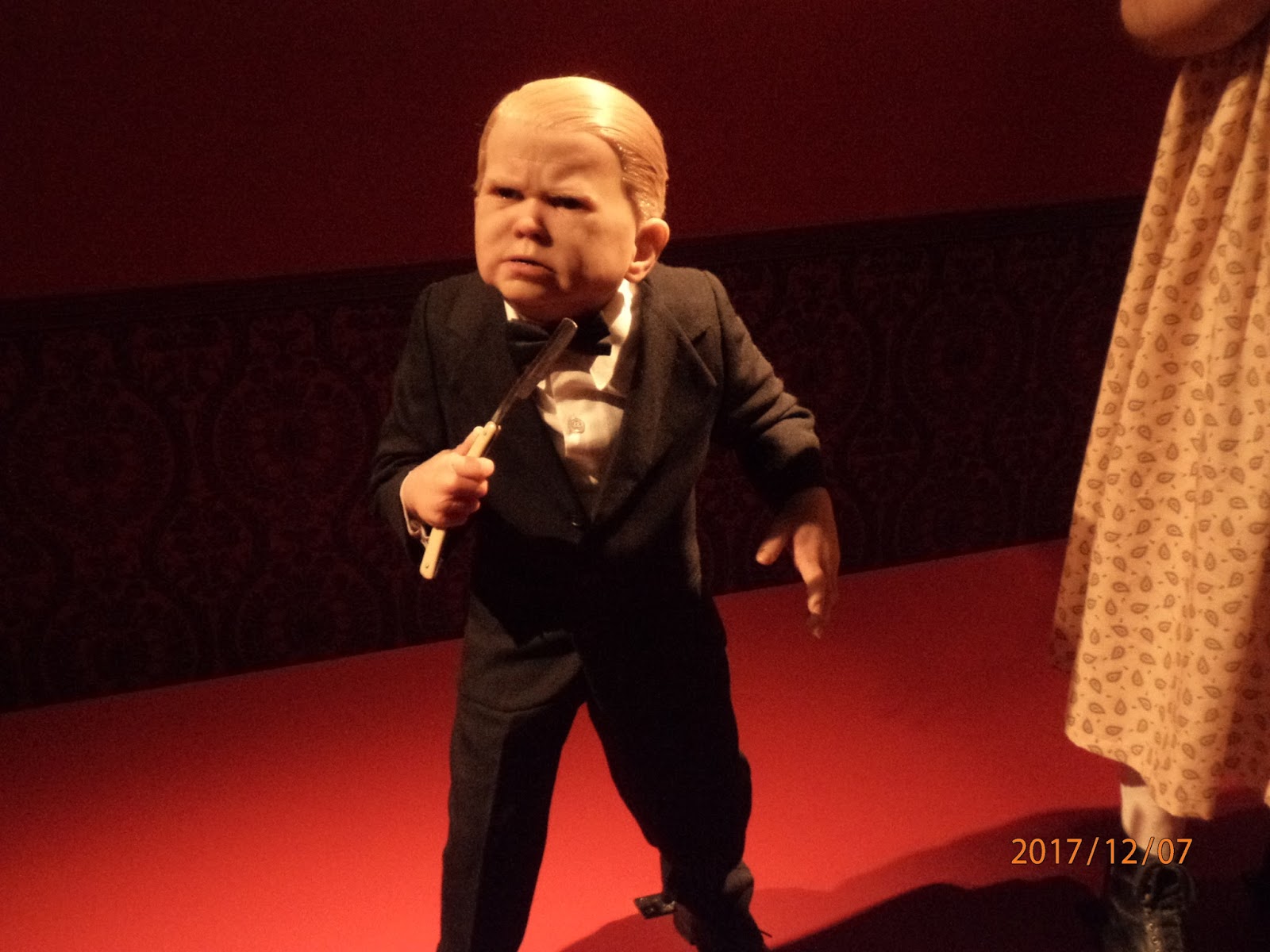
There are many disturbing life-size (and bigger!) creatures in the exhibit, many of which are scary to behold and must've taken some care in mounting, since they are (again) so goddamned big. But what was undoubtedly the scariest set-up to me were three “innocent”-looking figures lurking in the corner of one room of memorabilia. These three cast members of Freaks (1932) retain their power to both intrigue and scare the crap out of the ordinary schlub encountering them.


When I went to the exhibit, a bunch of teenage students were being taken through it by a very nice, open-minded, clearly very liberal teacher, who was explaining Todd Browning's film to the assembled young minds. Her argument was that we don't use the word “freaks” any more, but do call these people “outsiders” while we try not to discriminate against them in society. She preached the joys of diversity and inclusivity, and spoke (rightly) of the film's true message of brotherhood.


While listening to this heartening speech by the teacher, I was watching del Toro's own videotaped intro to the figures, which said, simply enough, that he loved Freaks because the “good-looking people are evil” and the scary-looking people are good and support each other in a very tight-knit community. He hit the nail on the head in 2-3 minutes, while the teacher continued to preach as the teens were simultaneously attracted and repulsed by the three figures on the platform in front of them.

While the teacher is indeed right – we should not in any way discriminate against people who look different than us – she had seemingly forgotten that Browning was a showman (he worked with fr… er, “outsiders” like the ones in the film before he started directing). He made Freaks after his Dracula had been a gigantic hit and he could do whatever he wanted. He *did* want to preach a gospel of diversity, inclusivity, and brotherhood among outcasts – but he also wanted to scare the shit out of the viewer.


The “normal” person's response to the people in the film is certainly to be both attracted and repulsed by the “different” people in the film – they mean no harm, but their appearance initially scares us. We come to love them in the film and enjoy their sense of community, but they also scare the hell out of us when they decide to “punish” the woman who has wronged their friend. 


I had a friend once tell me that the “freaks” didn't scare him because he could run away from them, and I had to remind hm that the film's alternate message was that, when you wrong these people, they will get you one way or another. Even the one gent who lacked both arms and legs would most certainly slice your throat while you were asleep as he chinned himself along the ground to get to you. (Yes, you can run now, but you can't run forever…).

Enough for the thoughts that flittered into one's mind while seeing del Toro's incredible collection. The room that produced very emotional feelings for me was “the comic room,” in which they had hung up del Toro's original comic art (with everyone from Eisner to Moebius on display) with many of the comics he owned – and Famous Monsters issues at eye-level.


The room overwhelmed me because it made me think of going to comic-cons in the early Seventies with my father and the way in which he introduced me to all of that material – from FM to Eisner to EC Comics and well beyond – and how the later items (like Neil Gaiman's Sandman) were things I was able to share with him when the time came that I was still going to comics stores and he wasn't. You may think a bunch of funny-books might not hold any emotional undercurrent but they do, believe me, they do.


The piece de resistance was in the final room: a celebration of the Frankenstein monster, most specifically the monster as played by Karloff in the first three films of the series (1931, 1935, 1939 – committed it to memory as a warped little kid).


With every book cover that featured the monster's likeness on the wall, and life-size figures in the center and on the sides, and even more Franken-art in other parts of the room, it was an overwhelming celebration of the ultimate “outsider” figure in monster-movie lore.


del Toro's collectibles are supposedly headed back to his suburban home in L.A. (the place he has dubbed “Bleak House”), but there's still a chance the exhibit may be reconstituted in another city in the U.S. or overseas. I'm glad I took these pictures, but there is something overwhelming about seeing all that stuff in one place. And, of course, coming face-to-face with one's childhood/adolescent dream and nightmare figures in a museum setting. 

Thanks to "monster kid" emeritus Kayleigh for recommending this exhibit and fellow Famous Monsters fan M. Faust for sharing it with me.