Friday, January 5, 2018

Jukebox dystopia: ‘Bat Out of Hell: the Musical’

I love Jim Steinman. I mean, I've never met the man, but I'm a diehard fan of his bombastic, excess-laden melo-dra-matic (hyphens needed) pop-rock for several decades now.

So when I heard that Steinman's long-planned Bat Out of Hell musical had finally seen the light of day and was playing in Toronto (it closes this coming Sunday), I knew I needed to see it, since there is no assurance it will ever reach Broadway. (The fact that it’s playing at the Ed Mirvish Theater, named after the owner of the much-missed “Honest Ed’s” emporium, only made the trip more essential.)

The show is a mess but a fun one. Steinman is an unrepentant master of excess, so it follows that problems with the show aren't simple miscalculations but are instead pretty sizable mistakes. The first is the book by Steinman. One must remember that Sondheim himself, the greatest living Broadway composer, has never written his own librettos — Steinman is a control freak, so he did so in Bat.

The result is a futuristic, dystopian scenario involving street kids that grow no older than 18 (one of Steinman's big dream-projects has been a Peter Pan musical), an evil yet oddly charismatic business mogul/dictator, and a star-crossed Romeo and Juliet/West Side Story romance. Add in odd supporting characters, like a “soulmate” for our hero named “Tink” (a male — and no, we didn't have to applaud to keep him alive), and you begin to see the confused, placeholder status of the storyline.

To help viewers understand the plotline, there are both mock newspapers from the city of “Obsidian” (the location of the play, a future identity for NYC) given to each audience member and introductory projected titles before the show begins. These nuggets of info are helpful but also distracting — the show inevitably boils down to “romance between rich girl and street gang leader” and “evil leader learns he'll lose his daughter if he stays evil.” The fantasy aspect — which seems to have come from two Walter Hill films (The Warriors and a film Steinman supplied songs for, Streets of Fire) is distracting and unnecessary.


The other distraction from the blissfully overwrought score is Emma Portner's choreography. She chose to go with moves that evoke the past — namely the well-remembered (but solely as kitsch) music videos of Bob Giraldi. This isn't modern dance, nor is it classical ballet or Agnes de Mille's revamp of same. It blends the moves of old MTV staples with the “hand jive” synchronized dancing from Grease, an odd choice for a harder-edged pop-rock enterprise. Here is a sample, from a person who shot scenes from the play on their phone.

And finally there is the cast. The show was first performed in London and Manchester, so the performers are primarily English. On the night I saw the show — a Wednesday in early December — stand-ins were substituting for the two main performers (the younger couple). Of these two, Georgia Carling acquitted herself nicely, but Benjamin Purkiss seemed to be struggling to stay in key during some of Steinman's extremely demanding rock anthems.

In one department, both performers did deliver (they had to — it was in the script). The lead female character, “Raven,” the 18-year-old daughter of the evil mogul, spends a good deal of the play in a teddy and other form-fitting outfits. Not to make this a sexist affair, the male lead, “Strat,” appears shirtless at every opportunity, to lend his character an Iggy/Daltrey air. This is clearly done to add a rock 'n' roll aspect to the proceedings but instead serves to distract viewers in a pleasant way during the moments of exposition.

Sharon Sexton is quite good as “Sloane,” the mogul's wife, who has to tackle the “Will you love me forever?” half of “Paradise by the Dashboard Light,” among other great songs. Her duet partner is Rob Fowler as the mogul “Falco,” a character who is supposed to be an evil prick but is in fact the most likable character in the show. Fowler's singing voice has the right combination of rock 'n' roll bravado and theatrical belting, and he is thus perfectly suited for the material.

Sexton and Fowler are involved in the one of the show's most memorable moments, a bit of stagecraft  that is memorable enough to stay with one well after the show (and needs to be “undone” by stage hands during the intermission). Falco and Sloane are at dinner when they reminisce about their first seduction — which, of course, leads to “Dashboard Light.” Their dining table slides away to reveal a car, which, as the song concludes, crashes down into the orchestra pit (which exists for this sole purpose — the rock band accompanying the singers is located backstage). Two other special effects occur later in the show, but I won't give them away here.
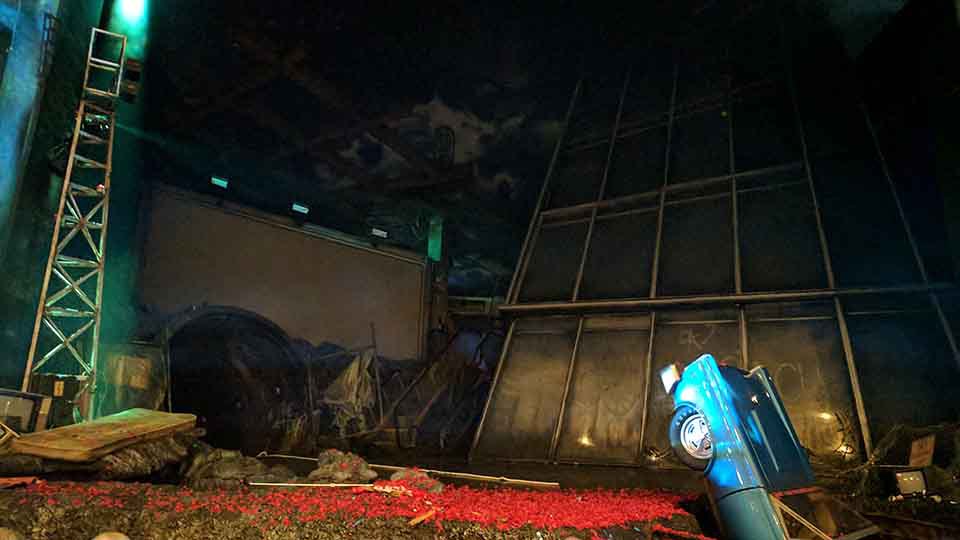

Suffice it to say that the production design is impressive enough to distract one from the simple-yet-still -too-dubiously-complicated plot line. The set is a dystopian landscape — composed of a tilted, Blade Runner-esque skyscraper, the teen gang's hideout, and Raven's bedroom, which achieves greater depth (and, yes evokes early MTV once more) through the use of a video camera that is used to project it onto monitors and screens (why the cameraman is visible isn't explained, but that's the least of the odd plot points).

This brings me to the show's strong suit, and the reason it exists in the first place, namely Steinman's sublime earworm tunes. Every one is an anthem of one sort or another, be it a full-out rocker or a power ballad, all ideal inclusions in a stage musical. When the performer's voice is right for the material and the backstage band is cookin', the plotline seems to disappear and Steinman's work shines in all its deeply-sincere-yet-slyly tongue-in-cheek glory.


The humor in Steinman's work is a factor missed by those who view the Meat Loaf/Steinman albums as kitsch. While Steinman aspires to take rock into the arena inhabited by one of his two heroic Richards, Richard Wagner (the other one is Little Richard), many times he's also kidding. 

In this interview in Billboard, Todd Rundgren presented the best analysis of Steinman’s music by exploring how the Bat Out of Hell album seemed to him (Todd) to be a spoof of Springsteen, whom he felt had brought rock back to Fifties iconography but took it all too seriously. Steinman, on other hand, “wove this sense of humor into the material in a way that Springsteen never did.”

The songs included here hail primarily from the three Bat Out of Hell albums, with the inclusion of the soft pop Air Supply hit “Making Love Out of Nothing at All” (a Steinman composition). The “epic” numbers are of course accorded the biggest set-pieces (and the attendant crazy fx), while the shorter ballads and pop-rock classics keep the evening moving right along (and, again, thankfully distract from the plot).

Steinman receives a degree from Amherst College (he's in the studded outfit).
Steinman's genius for crazed, sensational “melo” (as opposed to mellow) music comes through when the songs are at the forefront. It's indeed uncertain whether the show will ever reach Broadway — and, if so, whether it can catch the attention of the folks who made Rock of Ages such a long-running hit (nearly six years).

If the plotline is retooled or trimmed back, Bat Out of Hell could easily be a hit on Broadway, since the Meat Loaf/Steinman albums were always big, boisterous musicals waiting to happen. Perhaps if the piece can simply become a suite of Steinman's pop-rock classics with the barest hint of a West Side Story through-line for the characters, Bat could truly take off to hell and back.
*****
Steinman with the original 'Bat"
women: Karla DeVito and Ellen Foley.

As video “bonuses,” here are a few choice bits of music that relate to Steinman and the show. The first is a killer monologue that he first did on his one and only solo album, Bad for Good. It is performed by "Strat" right at the opening of Bat Out of Hell: the Musical, but this particular version is the craziest. It appeared on the electronic press kit for the Original Sin album by Pandora’s Box, a group of female studio singers (including Ellen Foley), who were intended to be Steinman’s own version of another one of his fave musical acts, the Shangri-Las.

Steinman has done one of these monologues per album since the original Bat LP. They are clearly homages to, and satires of, the poetry of Jim Morrison. This piece in particular evokes Morrison’s super-arch spoken-word interlude in “The End.”


I in no way advocate or support people bringing video devices to a theater. But, since someone did, I refer you to this song as wonderfully performed in the Toronto version of Bat. One of Steinman’s great evocations of the Phil Spector school of songwriting, “You Took the Words Right Out of My Mouth (Hot Summer Night)”:


Steinman has reworked some of his songs for different purposes. Here is the original demo version of a song that appears in the Bat musical. Intended for the never-produced Batman musical, it is a grim little number called “In the Land of the Pig (the Butcher is King).” You want “melo”? You got it.


Throughout the show, one flashes on the original versions of the songs by one Marvin Lee Aday, aka Meat Loaf. Meat is an incredible performer, a rock singer of operatic range and intensity. He will always be *the* foremost interpreter of Steinman’s work.

Here he is performing one of the “epic” Steinman compositions (and one of the biggest-ever hits for both “Mr. Loaf” and Steinman), “I'd Do Anything for Love.” This is from a concert performance where Meat was in full kick-ass mode. He is the most elegant Big Man who has ever sung a rock song (and yes, Jack Black has stolen his every move for those rock “performances” he does….).


To my mind, the song below is the Steinman's finest pop-rock classic — his epic tunes are indeed what he will always be remembered for, but there’s something about this rapid-fire attack. It truly works as a spoof of Springsteen’s heartsick Americana, per Todd Rundgren’s formulation of the album (“I was a varsity tackle/and a helluva block./When I played my guitar/I made the canyons rock…”).

Pursuing the idea that sometimes other folks can alter Steinman’s material for the better, Jim is interviewed here about how Rundgren sped this song up in the studio when Steinman was sick with the flu, trying to get a standard-length rock song into the album (the irony being that the two songs played to death by the radio at the time of the album’s success were always the epic-length “Paradise by the Dashboard Light” and the snowy ballad, “Two Out of Three Ain’t Bad”).

The insanely sincere lyrics, Edgar Winter’s sax, Meat’s incredible vocal, and the speed with which the damned thing is delivered make this, for me, the ultimate Steinman composition (and, needless to add, theatrical to the max).


And to close this out, I must showcase my all-time fave visualization of a Steinman song, a music video made for the Pandora’s Box album by none other than Funhouse interview subject “Unkle” Ken Russell. I can’t imagine a better combination of wonderful madmen than a fusion of Jim Steinman’s operatic rock and Ken Russell’s frenzied genius for dream imagery.

Here Unkle Ken is borrowing from himself, using the scenario from his moving segment for the film Aria (1987). The result, however, is the most gloriously delirious visualization of a Steinman tune ever — bikers, gods and goddesses (who might be aliens, or not), glitter, fire, studs, snakes, and a sacred ritual. It’s hard to ask for more than this.

It was noted somewhere that the initial idea was to produce a “video album” for the Pandora’s Box album, to be directed entirely by Ken Russell. The mind fairly reels at what we lost in the way of brilliant (and brilliantly sincere) excess.

Thursday, November 30, 2017

Kaurismaki’s latest film brings ‘Hope” to adult viewers

Tired of seeing movies made for children, teens, or urban hipsters? Then sink into the world of Aki Kaurismaki, where people smoke, drink, listen to old-fashioned rock ‘n’ roll, and speak only when they need to.

Kaurismaki, Finland’s finest export, is a master of subdued melodrama and wonderful deadpan humor. He’s thankfully been able to keep making “small movies” (the best kind) on a regular basis. His latest, The Other Side of Hope, opening today in NYC, fits in with his terrific preceding film, Le Havre (2011), as its plot revolves around immigration in Europe and counteracts its grim exterior with a warm heart and lovingly jaded humor.

Aki!
Not one to produce didactic works, Kaurismaki seems to have gravitated to stories about immigrants because they dwell in the same world as his working-class Finns — they are lonely yet belong to a misfit community, live for their paychecks, dream of a better life, and many are prone to smoke, drink, and listen to their favorite music in bars and restaurants. One immigrant character here sums it up when he notes that immigrants are “invisible” to the average person (as are working-class people to the upper crust). 

The Other Side of Hope offers us one such gent, Khaled (Sherwan Haji), a Syrian refugee who lands in Finland by chance, moving westward in his journey. After he flees a “reception center” (where immigrants find out whether or not they can stay in Finland or will be deported), he gets a job at a failing restaurant run by an ex-traveling salesman, Wikstrom (Sakari Kuosmanen). The restaurant workers aid Khaled in trying to find his sister, who has been missing since she left Syria.

Perhaps the most engaging thing about Hope is that Kaurismaki doesn’t ignore the real-life peril his characters face but also adds whimsical fairy tale aspects to his sagas of “marginal” people. Here Khaled is at one point nearly beaten to death by skinheads but is saved by a rather unexpected deus ex machina. Kaurismaki is one of the truly great anti-Spielbergian filmmakers who presents us with a somewhat realistic vision of the world, but then does allow his characters a hint of escape from the harrowing side of everyday life.

His films are structured like melodrama but have the tone and rhythms of comedy. The struggles of the characters in the restaurant are wonderfully limned, as they change the cuisine and décor of the place several times to see if they can attract a clientele. The best incarnation is their time as a Japanese restaurant using local products (including sushi made from herring).

The performers are all perfectly cast and balance the comedy and drama very well. They bring Kaurismaki’s bleak-seeming but very funny script to life, while we hear the characters’ favorite music, ranging from Syrian folk tunes to classic rock ‘n’ roll.

The leisurely pacing and absence of any kind of over-the-top action may turn some viewers off. But the low-key brilliance of Kaurismaki’s work proves that you don’t need CGI or unsubtle action or comedy to make a successful movie — just a tight script, great performances, and a seemingly cranky but still idealistic artist behind the camera.


Thursday, November 23, 2017

The clowns will save America

"Do you have the cards?"

It's that time, again, folks! Let us celebrate this grand country of ours with the one thing that can unite every faction -- young and old, male and female, white and black (and every other color in the spectrum), persons with "this" sexual preference (and/or gender identity) and people with "that" sexual preference (and/or gender identity).

The memory of Robert Vaughn can free us. Because it's always nice to see a man mocked by clowns as he reads this country's Constitution. Happy Turkey Day!


And if you want to "read more about it," check out my post from last Thanksgiving about Vaughn's many legal ads. It can be found here.

Monday, November 20, 2017

The Funhouse interview with cinematographer Caroline Champetier

Champetier shoots with Leos Carax.
I’m always happy to speak with someone whose work I’ve admired for a long time. In the case of Caroline Champetier, I knew the work she had done and had seen her name on the credits of many films, but had never “added up” exactly how important her contributions have been to French cinema over the last 35 years.

I interviewed her when she was in NYC for a mini-retro of her work at the Alliance Francaise (FIAF) in October. I was able to move through her career quite well in the time we were allotted but, as I am editing the shows that will come from this interview (I’m hoping to do three), I am reminded of just how many great filmmakers she has collaborated with.

She has shot film (and video) for Akerman, Straub/Huillet, Godard, Rivette, Jean Eustache, Jacques Doillon, Benoit Jacquot, Leos Carax, Anne Fontaine, and Ms. Champetier herself. Those were the individuals I discussed with her in the interview; I chose to leave out her work with Claude Lanzmann and Xavier Beauvois (you can’t fit everything in in one interview — especially not a giant work like Shoah!).

Caroline Champetier
Below are two segments from the interview that are particularly enjoyable. The first is about her time shooting Holy Motors with Carax — in particular her shooting the feature exclusively at night on high-def video, and the amazing “intermission” scene featuring a killer band playing in a church (with our hero Denis Lavant on accordion).


The second clip is about her time with Godard, doting on his “Uncle Jean” comedic alter-ego and his reputation (among many critics and filmmakers — Hal Hartley, just to throw out one name) as a “master of lighting.” Champetier takes issue with this (not disputing his mastery, but more the title — since the cinematographer lights the scenes….).


The interview will air in the coming weeks on the Funhouse. Stay tuned!

Monday, November 13, 2017

The art of the kvetch: the Funhouse interview with Deceased Artiste Shelley Berman

I've wanted to pay tribute to the late Shelley Berman since he died at the beginning of September, but I waited until I could do it right. Doing it right in this case involved digging out the Funhouse episodes in which I presented my 2002 interview with Shelley, which took place at the Hollywood Collectors Show. (The theme for that particular show was “performers who starred on The Twilight Zone.”)

I had a great time interviewing Berman and consider our chat one of the best interviews that has appeared on the Funhouse. This was because the conversation grew organically – I was there to interview him, but it became apparent after a short while that Mr. Berman was going in and out of his onstage persona. I was privileged to serve as his straight man and was especially touched by the fact that, after the camera was turned off, he leaned over to me and said, “I was just kidding. You asked some good questions.”

In any case, I should not forget the first clip I put up from the interview, which can be found here. This was the first Funhouse clip I put up on YouTube eleven years ago, and I'm very happy to see it's been watched by so many people – I was delighted that Shelley moved effortlessly into a new routine (which I'm not certain he ever recorded in any medium) about his frustration with automated phone menus.

The new clips I've uploaded to YT are other great moments from our talk. The first one finds Mr. Berman talking about how much he dislikes other drivers, ribbing me for moving the microphone away from him, ribbing me a bit more (this time about public access – he is the only guest who has actually shown interest in and acknowledged where the chat in question was going to be seen), and then onto a serious question I had asked about his wonderful “father and son” routine, which can be heard here.


The third clip was a bit of a departure. At one point in the interview, after he had moved forward chronologically he moved back to his beginnings as a performer and paid homage to his wife Sarah, who was sitting right next to him. This is a sweet segment (and there's even a punchline!), mostly because Shelley and Sarah were together their whole adult lives – they got married in 1947 and remained with each other until his death in in September.


The saddest aspect of Mr. Berman's later years was that he fell victim to Alzheimer's disease. This is always a terrible, godawful way to live one's last years, but for a man who was so eloquent and verbally  brilliant, it must've been a particularly awful and confusing situation to exist in.

I'm glad some of us were able to tell Mr. Berman how important (and really funny) his comedy was to us. As I said at the end of our interview, conjuring up a terrible metaphor but stating an undeniable truth, he was a very important link in the “chain” of modern comedy. All of the post-Fifties neurotic comedians, from Woody Allen to Larry David and onward to each new generation of onstage neurotics and kvetchers, owe a great debt to Shelley Berman.

Thursday, November 2, 2017

'Lost' films found 3: Alan Rudolph's 'Return Engagement'

I avoid promoting free streams of copyrighted movies on this blog, but do spotlight the posting of films that are “MIA” (read: no DVD [or VHS] release in the U.S, and very little chance there will be one). Such is the case with Alan Rudolph's Return Engagement (1983).

It's Rudolph's only documentary and is not essential viewing – if you're unfamiliar with his work, check out his films Choose Me, Trouble in Mind, or Afterglow first. But if you already know his work, or you're interested in the lives and public personas of Timothy Leary and G. Gordon Liddy, the film is definitely worth a look.

It was shot when Leary and Liddy became a sort of “comedy team” on the lecture circuit, cordially “debating” each other in various cities during the early Eighties. What we see of their stage encounter in Return Engagement indicates that their speeches were learned by heart and their disagreements over various issues were most likely repeated verbatim on every stop on the tour.

Rudolph is a master of the “small film” and understated emotion, so it's fascinating to see him use a similarly personal approach for a documentary. The only problem here is that Leary and Liddy had honed their personas so well by the Eighties that they were close to being cartoon characters: the kooky, mellow-as-anything, Sixties acid guru and the equally kooky, hyper-macho, right-wing extremist.


“There is no there there” with either man. During a scene where Rudolph films the men with their wives, one gets the sense that, while the scene isn't exactly staged, the couples have still worked out their “roles” to an almost unnerving degree.

The positive aspect of the film is its time capsule quality. Liddy is filmed working out at the gym, while Leary – who declares himself a “futurist” above all – is seen typing away on a word processor, extolling the virtues of computers as he works on the manuscript of his latest book. To further situate where the American public was in '83, the film's opening scene has people on the street being asked what they know about the two men. Those interviewed seem to be “remembering” two figures from a somewhat distant (but actually somewhat recent) past.

Perhaps the film would've worked better if Rudolph or his surrogate, interviewer (and event moderator) Carole Hemingway, had challenged both men more about the depth of their beliefs; as it stands, she asks Leary about his “show-biz” aspect and Liddy about his fondness for talking about murder, but little is revealed in the process. Rudolph's assignment in this case was to film the debate and add some colorful moments around the event, so one can't expect very much.
 

According to a 2013 interview with Rudolph, he looks back at the film as a “strangely satisfying experience. It took a few days to film and a long time to edit and nothing was written other than necessary information.” He refers to the debate as a “dog-and-pony show” and notes that he made the film for producer Carolyn Pfeiffer to basically work his way toward making a fiction film with “complete independence” in the shooting and editing (the result was Choose Me).

He also reveals in the same interview that “At the ‘breakfast with spouses’ segment, Mrs. Liddy showed up with a fresh black eye under her sunglasses.” You can see the bruise in the film – some makeup was applied, but it's still visible.

A few moments in the “debate” are galvanizing, as when Liddy casually discusses how murder factors into the running of the U.S. government, and when Leary is confronted by an angry blind man who claims his disability was caused by Leary's advocacy of hallucinogens (as kids on LSD shot this gentleman, blinding him). For the most part, though, one gets the impression one is watching a fairly “scripted” bit of stagecraft – Leary in particular walks back and forth on the stage, while the more stolid Liddy stays planted where he is when it's his turn to stand and talk.


Rudolph wisely includes at the end of the picture long scenes from high school classroom sessions run individually by Liddy and Leary. Both men come off far better in these sequences than they do onstage. They situate themselves historically for the students and defend themselves against some very pointed questions – by comparison, the debate comes off as the publicity stunt it most surely was.

In closing, though, I must mention the film's most jarring scene, which is a cocktail party held in honor of the two men early on in the film. The attendees at the party include Geraldo Rivera, Marjoe Gortner, Maria Shriver, Arnold Schwarzenegger, Harry Nilsson, and Cheech Marin (!). At one point, Leary wonders where “Bob” is. When asked why he cares so much, the perpetually turned-on guru replies, “Bob got the cocaine.” One wonders if Rudolph has any outtakes from this blissfully tacky gathering….

The film can be found two places online. The first is on YouTube in three parts. The first part of the film is here at 8:52. In both this posting and the one on the archive.org site, the film follows two episodes that Leary did with Bob Costas (this is apparently because these items were on the first volume of a series of VHS tapes featuring Leary movie and TV appearances).


Full disclosure: I run the Alan Rudolph fan page on Facebook. "Like" the page if you're a fan of Rudolph's work. It is located at this link.

Thursday, October 19, 2017

With and without Godard: Deceased Artiste Anne Wiazemsky

Although many of her English-language obits naturally labeled Anne Wiazemsky as the “ex-wife and muse” of Uncle Jean (aka Jean-Luc Godard), it was nice to see that her impeccable first performance in Bresson’s Au Hasard Balthazar (1966) was highlighted in the headlines of other obits. In France she was equally billed as “actress and romancier” (novelist). She did indeed have a “second act” to her career when her books (20 in total) were received warmly by both critics and the public from 1988 on.

Several of her novels were romans à clef based on her own very rich life. She came from royal Russian stock, with her father serving as a French diplomat; her mother was the daughter of Nobel laureate Francois Mauriac. The family moved frequently due to her father’s profession, but Anne became a lifelong Frenchwoman when her family moved to France in 1962.

Au Hasard Balthazar is one of Bresson’s masterpieces (so many masterpieces in such a small body of work — only 13 films). Like all of his work, it’s a quiet picture that has incredible emotional impact because it is so low-key and “observant” of its characters.

Anne was one of Bresson’s “models,” the non-actors he hired to play the lead in his films. She is also one of the few Bresson performers to subsequently become a movie star (Dominque Sanda is the most prominent example). She was a perfect performer for Bresson, as she hit the right notes of innocent and fragile curiosity for her character in Balthazar.


In one of her books she wrote that Bresson was infatuated with her and asked her to marry him. She declined the offer and instead wound up romantically involved with one of Bresson’s most talented fans, Godard. 


She did not, however, have vehicles written for her by JLG, as Anna Karina did, because her marriage to Uncle Jean occurred while he was an ardent Marxist who was making overtly political films — which, nonetheless, happen to feature some of the prettiest women seen in cinema (all lit and framed to perfection by JLG).

She made seven films with Godard, including his arthouse hits La Chinoise (1967) and Sympathy for the Devil (aka One Plus One, 1968); in the other five of the seven films she either has no character name or is uncredited. Her presence in the films is privileged, with her most often playing a “searcher” who is looking to understand politics and its effect on the average person.

This is seen to best advantage in a long scene in La Chinoise where she asks real-life philosopher Francis Jeanson (playing himself) about revolution. Her character Veronique advocates terrorism, but seems ignorant of the consequences of terrorist behavior.


The wondrous “music video” trailer Godard created for the film:


Godard continued to use her as a “searcher” in the scattered but entertaining Sympathy for the Devil.


Several filmmakers openly proclaimed their worship of Godard by emulating his framing and editing style and, most importantly, “stealing” his lead actors. These included Pier Paolo Pasolini, Alain Tanner (for one film, Le Retour d’Afrique), and a major Funhouse favorite, Marco Ferreri

Ferreri cast Wiazemsky as the “Eve” figure in his post-nuclear Garden of Eden fantasy The Seed of Man (1969, below). In true Ferreri style, the film is both fascinating and, at points, downright odd — and features a beach as one of its main settings.


Pasolini cast Wiazemsky twice, the first time in his brilliant Teorema (1968), which has a plotline that has been ripped off several dozen times (but always without the “downer” ending). She is the daughter of the family that is affected by drifter Terrence Stamp, who sleeps with each member of the clan (including the father!). It’s a strong, well-rendered scenario.


Her second and last time starring in a Pasolini film was Porcile (1969), his wildly allegorical film about capitalism, with the main capitalist here owning a pig farm (get the symbolism?). It’s such an unsubtle allegory that PPP asked his friend Marco Ferreri (no stranger to unsubtle allegories) to costar as one of the capitalists.

Most important, though, are the two stars, both Godard stalwarts. Jean-Pierre Leaud — in his high-energy, fond-of-recitations Godardian incarnation — stars as the scion of the capitalist family, while Wiazemsky plays his politically engaged girlfriend.


Wiazemsky did indeed reinvent herself in the late Eighties, as her first book was published in 1988, the same year that her last movie was released.

Only one of her books has been translated into English thus far (My Berlin Child), but many positive reviews of her novels in French can be found online. In her obit in the left-wing newspaper Liberation, it was noted that “discreetly, book after book, she forged a status as a loved and recognized, often award-winning, novelist.”

Her movie career was indeed memorable, thanks to Godard crafting several indelible images around her. But Bresson’s utilization of her inquisitive, sad-looking visage enshrined her forever in the memory of most fans of great cinema. It’s hard to forget Balthazar once one has seen it.


As a final clip, here is a beautiful moment from Teorema synched to music by Erik Satie:

Wednesday, September 27, 2017

Cynicism, emotion, and Zen: Deceased Harry Dean Stanton

The best character actors always have memorable faces. Harry Dean Stanton's visage was perfection it went from a lean, rough-hewn cowpoke's mask to the sunken, weathered mug that made him instantly recognizable in all of his roles since the mid-Eighties.

The details of his youth are scarce (he wanted it that way, if the documentary Partly Fiction is any indication), but set him up for a career playing “average American cynic” parts. A native of Kentucky, he served in the Navy in WWII he was a company chef in the Battle of Okinawa (!).

He returned from the war and pursued his interest in performing through college and into several stage roles. His regular work as a supporting player on TV and in the movies began in earnest in the late Fifties and never stopped until he died over a week ago at 91.


Through the Sixties and Seventies, he carved out a place as a supporting performer, usually in Westerns and crime movies. Although no one knew his name at the time despite his close friend Jack Nicholson including it in graffiti on the sets of his films his no-nonsense demeanor and his memorable face found him playing heavies (he was the thinnest heavy around) and characters who get killed off rather quickly.

His career changed for good thanks to one role that of “Travis Henderson” in Wim Wenders' Paris Texas (1984), scripted by Sam Shepard. Wenders and Shepard gave Harry Dean his very first starring role at the “tender “age of 58. As it turned out, it was one of the few he ever got, but the film itself was good and he was so excellent in the role that his name finally became as familiar as his face.


The same year saw the release of Repo Man, the brilliantly off-beat comedy where Harry Dean played the coke-sniffing veteran repo man Bud. The combination of that brusque, cynical character (who had a mean way with a bat) and the quiet, directionless Travis established HDS as a sturdy presence in the ever-fickle movie industry.


From heavies to good guys, the one common thread in his movie work is that, like his friend Jack, Harry Dean was an indubitably American presence. His characters had seen it all, done most of it, and were at a slight remove from the over-stimulated culture we live in. He was effortlessly cool and his characters often reflected his own craggy charm and fascination with both country and Mexican music. 

Good character actors are always impressive because they lend a back story to even the most briefly seen characters, through their physical presence. HDS did that in every film he appeared in.

I saw Harry Dean in concert at the long gone (and much lamented) Bottom Line here in NYC. I attended the show almost on a lark, since I wasn't aware of Harry Dean's commitment to his music and just figured it would be a suitably odd evening.

By the show's end I was struck by two things: his evident love for the songs he performed (which were nearly all country and Mexican), and the amazing readings Harry Dean threw in as “interludes” between his musical performances. He read from Shepard's The Motel Chronicles (the source for Shepard's script for Paris, Texas). I was bowled over by his readings, which were stirring and very emotional.

Sadly he didn't do any complete audio books, but he did narrate (as the “older” Hunter S. Thompson) this audio version of Fear and Loathing in Las Vegas. Jim Jarmusch plays Raoul Duke, Maury Chaykin is Dr. Gonzo, with Harry Shearer among the other voices.


As he aged, Harry Dean evolved into the ultimate “senior hipster” used in the sense of the real cool folk of the past, not the faux hipsters of the present. He smoked and drank to his dying day (seemingly) and was none of the worse for it, as he had always been a spindly, unhealthy-looking guy who was ready to indulge (quietly, ever so quietly).

One of the most interesting juxtapositions is to view two recent (read: made in the last decade) documentaries about him. The full-length feature is Sophie Huber's Partly Fiction (2012).


Huber was hard-pressed to get Harry Dean to answer any of her questions. In the film, she recruits his friends David Lynch and Kris Kristofferson to ask him questions and reminisce, but it is only through filming him singing that she seems to get at the “real” Harry Dean. He opens up while singing, and then (and only then) is she able to get him to comment on his family life and his very busy career as a performer. 
 

A few years earlier, though, Harry Dean was far more cooperative with an interviewer for the DVD extra “Harry Zen Stanton,” made by Peter McCarthy for the 2005 DVD release of Repo Man (which McCarthy produced). Although he didn't offer any information about his private life, he did sum up his personal beliefs, which were indeed Zen-like but also heavily cynical about the activities of the human race. They also indicated that he was very well-read for “an old cowpoke.”

“… There's no answer to that. Don't you follow what I'm trying to say? Everybody wants an answer to why I did this, why all that happened. Ultimately there's no answer to it. Everything happens the way it's going happen, nobody's in charge, it's all gonna go down Iraq war, Napoleon, serial killers, wars… you never know what's going to happen next.

“We think we're in charge. Ten seconds from now, none of us in this room know what we're going to be thinking or saying. So who the fuck is in charge?”

As he talks to McCarthy, he does at first seem like a diehard cynic. But it becomes clear that he had read up on Zen Buddhism and various sciences:

“… It's an old Eastern concept. One guy phrased it, 'To realize you're nothing is wisdom, to realize you're everything is love.' Or pure intelligence, pure awareness. Ultimately that can't be defined in words. It's beyond words, it's beyond consciousness. It's a hard sell!”

McCarthy closes out the mini-doc with Harry Dean quoting the Tao Te Ching:

“If you don't realize your source/you stumble in confusion and sorrow./ If you realize where you come from/you naturally become tolerant/disinterested or attached, kindhearted as a grandmother, dignified as a king./ Immersed in the wonder of the Tao/you can deal with whatever life brings you, and when death comes, you are ready.' Seeing everything as a meaningful whole… one connected whole.”


Perhaps that is what ultimately made Harry Dean such a cult hero in the last three decades. He was an individual who loved music and acting (in that order, it seemed) and knew “too much” about the petty squabbles and tediously predictable behavior that makes up our daily life.

For him, a good smoke, a potent drink, and some emotional music (punctuated by incarnating different characters in different films) was all that he needed.
*****

One of the best tributes to Harry Dean was posted to the Net for his 91st birthday. The David Lynch/Twin Peaks fansite Lynchland got HDS to give them a list of his 15 favorite songs, and so they assembled a little “mix tape” for The Man (with a little vocal intro he provided).

The choices range from his beloved Mexican music (a Vicente Fernandez tune, HDS singing a Mexican-tinged piece from Ry Cooder's soundtrack for Paris, Texas) to folk (Joni's “Big Yellow Taxi,” some Dylan) to country (his friend Kris' “Sunday Morning Coming Down,” Orbison's “Blue Bayou,” Robert Earl Keen's wonderful “The Road Goes On Forever,” Steve Goodman) to timeless (Fats Waller's “Gonna Sit Write Down...” and Johnny Cash singing Danny Boy”). It's quite an assortment of treasures, found here.

Harry Dean brightened up any film he was in, including “maverick” landmarks (like Two Lane Blacktop and Pat Garrett and Billy the Kid) and classic genre pics (Alien, Escape from NY). He is one of several terrific scene-stealers in John Huston’s adaptation of Flannery O’Connor’s Wise Blood (1979).

The film is slightly schizophrenic: The performances and script follow the novel very closely, but Huston decided to “rev” up certain comedy sequences by making them farcical in tone (the total opposite of O’Connor’s deadpan mode), with composer Alex North’s sporadically goofy score making those scenes feel like they’d wandered in from a Hal Needham movie. Those misguided moments aside, the film is indeed another downbeat Huston gem.


One of the most enjoyably weird projects Harry Dean starred in (yes, one more starring role!) was the 1987 “Rip Van Winkle” episode of Shelley Duvall’s Faerie Tale Theater. It was directed by Francis Ford Coppola (who had worked with HDS on One From the Heart) and the most striking aspect of the show were sets designed by Eiko Ishioka that “breathed.” Very, very trippy entertainment for a show aimed at kids.


Altman’s underrated Fool for Love (1985) found Harry Dean as an older man who had a special relationship to the lead characters, played by Kim Basinger and Sam Shepard (who also wrote the play the film was based on). He was married to Barbara Mandrell in his mind…. [The thumbnail for the embed is blank, but the link works.]


David Lynch had a special connection to Harry Dean, both as a personal friend and as a filmmaker. HDS worked for him several times, with his biggest part coming in the mostly forgotten HBO anthology film Hotel Room (1993). Harry Dean plays an average Joe who is humiliated by his colleague (Freddie Jones) as he tries to avail himself of a hooker (the late, great Glenne Headly).


Harry Dean’s big final role was the starring turn in the forthcoming Lucky, but most folks reading this blog (who are surely Twin Peaks fans) saw him in Twin Peaks: the Return reprising his role from Fire Walk With Me.

His character was one of the many who simply disappeared during the series, but the scenes he was in were quite memorable and added to the unspoken themes of the series, which were aging and death. (Which I discussed in this piece on the blog.)


As good as he was in so many films, I would vote for his short turn in The Last Temptation of Christ (1988) as being one of his finest moments. He again does what a character actor needs to do: He appears only in a single scene, plays a character that he has imbued with a back story, and then steals away the film.

The reason he’s able to do that is because the scene he’s in is, in my opinion, the best scene in the picture, and the one that most clearly outlines what Scorsese, scripter Paul Schrader, and novelist Nikos Kazantzakis were trying to say about Jesus: that, even if he was entirely human, his believers would still cherish the concept of him being a deity.

Harry Dean’s Saul (also called Paul) is a preacher who has a gimmick: He speaks about the “resurrected Jesus.” When the real Jesus (Willem Dafoe) approaches Saul (in the dream-world in which he is able to live as a regular human being) and says that he, Saul, has made up a completely fake theology, Saul tells Jesus he is wrong and the people he preaches to *need* the story of the resurrected Jesus, whether or not it actually happened.


“I created the truth out of what people needed and what they believed,” says Saul. When he is told point-blank by Jesus that he’s recounting a fake story, he replies, “My Jesus is much more important and much more powerful” than the real person, standing in front of him.

It’s a powerful and very well-written scene. For me it is the crux of the entire film, which is about the humanity of Christ, and has some beautifully rendered moments and some segments that land with a thud (as in Jesus’ 40 days of temptation in the desert).

The scene is immaculately conceived and written, and it is indeed “sold” by Harry Dean, who plays Saul with an incredible conviction, and even pride in conveying a falsehood to his followers. It’s the moment where Scorsese most fully articulated the theme of the film.


To close out, I have to end on Harry Dean singing, since that seemed to be the thing he enjoyed the most in his final years. Here is the B-side of a single he released in 1993, a Mexican-tinged tune called “Across the Borderline.”