Thursday, August 3, 2023

The most infamously cancelled comedy show, now on YouTube!

Chuck McCann and
Mel Stewart as cops 
doing an ad for mace.
[UPDATE: This piece has been updated to now link to the official, authorized postings of these episodes by producer George Schlatter. Unfortunately, these videos are "stretched" to a rectangular image when they were shot in classic TV (1:33) "square" ratio. So they induce a bit of wincing on that level, but now they're legal....]

Back when I wrote about the great Robert Staats, I mentioned the infamous comedy series “Turn-On,” which was the only show to be cancelled as it traveled across the country, from East Coast primetime to West Coast primetime on Feb. 5, 1969. 

The show wasn’t as awful as that bit of TV history implies — it was actually way ahead of its time. A far hipper version of “Laugh-In,” it was conceived of by the same production company, Schlatter-Friendly Productions, for ABC. It had no laugh track (which was very unusual for TV comedy in 1969), contained even more complicated edits than “Laugh-In,” and was willing to lose some laughs to get across certain points.

Since both existing episodes of the series are now on YouTube — watch them before they get pulled! – it’s worthwhile to contextualize the series. First, it’s important to note that “Turn-On” showed up several months before Norman Lear’s sitcoms (starting in January 1971) and National Lampoon (starting in April 1970) opened up the floodgates to what is now considered “incorrect” humor but was then considered liberated humor, since it cast a wide net and made fun of absolutely everyone.

Secondly, the show featured plenty of ridiculous jokes, but it didn’t talk down to viewers, and assumed they could take the jumps from situation to situation, gag to gag. It was conceived of as "the first computerized TV show."


It actually resembles a sci-fi series or a live-action cartoon in its approach: a solid white background is seen behind the performers (two years before THX-1138), the credits continue to appear throughout the length of the show, and an electronic score is used throughout the first episode.

It is truly wonderful that both existing episodes are now readily available (Staats noted to me that material was prepared for a half-season of shows), as the second show (with guest host Robert Culp) is far better than the first (with guest host Tim Conway), and it never aired at all, because the series was indeed canceled as the first ep was traveling West. It is "calmer" in its approach, since, presumably, Tim Conway signaled "kooky comedy" and Culp signaled "mellow sexuality," so the latter approach is taken in the second show (down to the soundtrack having a light jazz score instead of constant electronic bleeps and blops).

One of the quick onscreen
lines that jolts a modern-day
viewer.
The take-no-prisoners approach to humor on the show meant that it ran the gamut from flagrantly silly blackout material (a la “Laugh-In” and, later on, “Hee-Haw”) to smarter humor to very quick-and-dark jokes. Two of these occur in Episode 1 when you see a series of desks at which the Paris Peace talks (“as dictated by General Ky”) took place — the desks are arranged in a swastika pattern. Also, as we see a court sketch, the phrase “Israel Uber Alles” floats by on the bottom of the screen.

“Turn-On” thus mocked hot-button issues (and “tasteless” premises) in a way that “Laugh-In” never would have and which later became the norm for later shows like “Fernwood 2-Night” and, much later, for “Adult Swim” cartoons and live-action series. 

The last element that must be mentioned about “Turn-On” is its cast. A bunch of newcomers were featured, but some of the cast were old pros. Mel Stewart and Hamilton Camp were very familiar faces on TV, while Chuck McCann was the nearest to a star “name” the show had (thus the guest hosts). Robert Staats did his “E. Eddie Edwards” pitchman character on the program (plus a more bizarre drag character called “Modren [sic] Bride”). 

Robert Staats (credited here as "Bob")
as pitchman E. Eddie Edwards.
That character is best known from The Projectionist, but that film’s release was several months off when the series was shot; Schlatter would’ve seen Staats in a very popular industrial film called “Safety Shoes” (1965). The advertising firm that Staats worked for, Stars and Stripes Productions, is in the credits for “Turn-On” as having supplied segments, most likely animated ones.

Teresa Graves.
It will be noted that the women in the cast participate in all the sketches and some serve as “dancing girls,” a la “Laugh-In.” In fact, the only cast member both shows shared was Teresa Graves, who gets to both do jokes and dance here. 

 Another familiar name flies by in the list of scripters. Albert Brooks, who at this time was just beginning in show business as a standup, is listed alphabetically among the writers. Also on the second episode, a Ban deodorant ad features a young Ms. Madeline Kahn. (The ads are quite fascinating, since some of them look like the show  white backgrounds, silly behavior  but some are "documentary-style" as in one with Mary Quant promoting AT&T).

Here is the first episode, with guest host Tim Conway. [The embeds below are for the authorized versions posted by producer George Schlatter -- I wish they weren't "stretched" into a rectangular ratio! But now they are fully legal...]


Here is the second show, never aired, with guest host Robert Culp.

Note: Thanks to YouTube poster Andrewgtv05 for their posting of the shows, and friend Jon W. for his pointing them out to me.

Monday, July 24, 2023

Proud to be a muse, talented in her own right: Deceased Artiste Jane Birkin

There is no way I could let the passing of Jane Birkin go by without doing at least a modest tribute to her on this blog. I was lucky enough to conduct an interview with her way (way) back in 2003 when she was in NYC to present her show “Arabesque” — consisting of songs by Gainsbourg with an Arabic backing band at the Alliance Francaise.

This clip, which is quite short, is one of the most popular interview clips I’ve posted on that site – you know the one, the one that doesn’t really approve of “fair use” and has a myriad of rules to keep those who uphold that practice from posting their work. In any case, this is a short little snippet, but that’s what I used to post up there.


Recently, when “Uncle Jean” (aka Jean-Luc Godard) left us, I went back to the Birkin interview to excerpt her discussion of working with him on Soigne ta droite (1987).


*****

Because of her public persona as Gainsbourg's muse (
in my talk with her she proclaimed her pride at having inspired and been given the songs by Serge), it was not noted enough by critics that she kept getting better and better as an actress. She’s charming as hell in some of her early “dollybird” incarnations, and her beauty is one of the only reasons to watch some of the films she made with Gainsbourg (unless Serge did the score, which gave you two reasons to see the film).

But, as time went on, she began appearing in more demanding roles and, once her relationship with Jacques Doillon had ended, she did indeed become a regularly busy actress who provided particularly wonderful turns in ensemble pieces (as in the two Poirot-by-Ustinov films she’s in) and the work of other New Wave directors, including Resnais, but most especially Rivette. (For whom she starred in Around a Small Mountain, his last film, a “small movie” extraordinaire concerning a very charming middle-aged romance.)

For we American fans, the documentary Jane by Charlotte (2021), made by Charlotte Gainsbourg in an effort to understand and relate to her mother, gave us a portrait of Jane that was very much down to earth. She may have been a music, movie, and fashion icon, but she was also a somewhat emotionally distant mother, who, it was revealed in the film, was having health problems.

In the film, which lacked a narration by Charlotte and was more of a fly-on-the-wall view of the family (thus requiring that you already knew who Jane, Charlotte, Lou, Kate, Serge, and others were), Jane having a bout with cancer is mentioned in the past tense. In her obits it was noted  that she had a stroke in 2021 and had cancelled various commitments in early 2023 because of a broken ankle and a break in her shoulder.

Then she cancelled an appearance at Town Hall in NYC in the summer of last year, having all the tickets refunded, which seemed to indicate something grievous had occurred. No more was heard until the death announcements started appearing online the Sunday before last.
*****


As a tribute I offer the following video clips, which relate entirely to her music career. Appraisals of her acting career are best saved for another time, as a number of her French films never appeared on these shores with English subs.

While her “Symphonique” stage show found her singing only the songs that Serge wrote directly for her (with the orchestra playing Serge’s most familiar songs with Jane offstage), it’s interesting to see that she was on French TV in April of 2021 looking in fine form, performing a Gainsbourg medley of his more, let us say, “familiar” songs.

She was seen in March of 2022 on an interview show discussing her concert performances, her “sketch” film with Agnes Varda (not a great picture — each time I see it, I want to love it, but it seems like more of a not-that-good TV comedy show transposed to film), and the documentary by Charlotte. She looks a bit bigger in this clip but is in good spirits and seems to be in good health.

And here she is on Feb 1 of this year, participating in a protest supporting the people of Myanmar. Her commitment to various causes was the least-seen but most important part of her public appearances:


Many of the TV appearances Jane made with Serge have become available on DVDs and on fan-generated “mail order” discs. This one, featuring him lip-synching to two songs from the classic Melody Nelson album while he carries Jane on his back, is one of the more playful clips that hasn’t surfaced on a compilation (yet).

Serge composed songs for seven of her solo albums (not counting songs for films and random unreleased tracks). The songs ranged from the sublime to the ridiculous. One of the latter is “Di-doo-dah,” heard here with Jane singing it live on the Russell Harty show in 1973

Another minor (but catchy) song for Jane by Serge was “Ex-fan des sixties,” wherein the decade’s biggest heroes (either dead or having broken up their band) are recited in a laundry-list fashion. It’s not a major Gainsbourg song, but it’s interesting, as it acknowledges what an incredible impact the pop and rock of the Sixties had on France. (All the artists mentioned are either American or British).


Moving from the ridiculous back to the sublime, here is one of the songs that Serge entrusted to Jane that is considered one of his best works which he never sang. It was recited by Catherine Deneuve at Serge’s funeral service and was always in Jane’s repertoire, if she was doing “both sides” of Serge.

The title, “Fuir le bonheur de peur qu'il ne se sauve,” translates loosely as “Fleeing happiness for fear it will run away.” A very helpful YouTube poster named Julia has subtitled the song in English but hasn’t made the video embed-dable for some inexplicable reason. (I always wonder why people make sure their vids are not to be embedded – will that negate the possible copyright claim? Those are either going to come or they’re not; adding the embed function serves to spread your work around more.) 


Over the years, Jane sang with a number of other performers. Perhaps because her first song was a duet with a guy (“Je t’aime, moi non plus” with Serge), she continued to work very well with male partners. One personal favorite was Bryan Ferry (with whom she sang a Roxy classic). Also, in Bertrand Tavernier’s
Daddy Nostalgie (1990), she duetted with Dirk Bogarde on the song “These Foolish Things,” which Ferry had brought back to life on his first solo LP in 1973.

“Je t’aime” was such a big hit in France and England that a follow-up was attempted twice: “69 Anee Erotique” and the “new dance” that Serge proposed (which, let’s face it, was not all that much more than syncopated groping) with this number.


Some fascinating footage appears here — Serge personally instructing Jane on how to sing one of his songs for her solo albums. (He definitely conceived of her “choir boy” voice as an instrument to be included in the orchestration of his songs.) Also, Jane talks in 1997 about his death and how he left her 25% ownership of the Melody Nelson album, in case “things went wrong” in her old age.


In 2003 when Jane was touring the world with her “Arabesque” show, featuring Gainsbourg songs with arrangements for Arabic instruments, she appeared on various programs in Europe to promote the shows she was doing. Here she performs Serge’s rousing “Elisa,” slowed down and made into a hypnotic ode.


Jane had another touring show after “Arabesque,” but her final major undertaking in terms of musical performance was a show called “Birkin Gainsbourg: The Symphonic” (which sounds much better in French as “Le Symphonique”). The show played here at Carnegie Hall on Feb. 1, 2018, and was an absolute delight. Only one guest star joined Jane onstage: Rupert Wainwright, who sang "Ces Petits Riens" and "La Chanson de Prevert." There is a video of Rufus joining Jane in a different venue here.

In Charlotte’s documentary about her mother, it is noted that the only time they sang together onstage was here in NYC at the Beacon Theater on March 6, 2020, a short time before the pandemic lockdowns began. A scan of YT reveals that, while the Beacon show might’ve been their only planned and rehearsed appearance together, they did sing onstage on another occasion. In 2013 a video was posted of them singing together at a concert in Monaco, duetting on Serge’s “La chanson de Prévert”:


Birkin stated in my interview with her that her first-ever performances in the U.S. were for the “Arabesque” tour in 2003, and thus her first-ever NYC performances were the two times she performed that show at the Alliance Francaise. (I saw the second of those two shows and it was wonderful.)

Her last performance in NYC was most definitely the Beacon Theater show, as a show that was to take place on my birthday (June 18) was announced for last year (2022) at Town Hall and was cancelled very quickly without explanation. (The mention of cancer in Charlotte’s documentary and the stroke she suffered in September 2021 were alerts that she perhaps was having health problems.)


Oddly enough, the first hit you get on Google when searching to find when it was that Jane played her last concert is the thoroughly unreliable Concert Archives site, which lists the cancelled June 18, 2022 gig as if it actually took place. One wonders how many other cancelled performances are on the pages of this website….

In any case, the reason to re-see the Symphonique show at the Beacon was that, this around, Jane had invited guest stars to join her onstage. So I attended the show and was very glad to see Jane duetting with both Iggy Pop (!) and Charlotte G. 

Jane chose to sing “Ballade de Johnny-Jane,” from the soundtrack of Serge’s film Je t’aime, moi non plus (1976), with Charlotte. This was an interesting choice, as it first appeared on the soundtrack to the film and is an odd song that refers to the film in its lyrics. 


It also, oddly enough, was a song that Jane duetted on with Vanessa Paradis. The latter is a surprise, since Vanessa had Serge write the lyrics for her second album about a year before his death. She was the only artist who requested he do rewrites on some of the lyrics, and he wound up wisecracking, “Paradis, c’est l’enfer” (“Paradis, it was hell”). Here are Jane and Vanessa singing “Johnny-Jane.”

And here is some lovely YT poster’s very good recording of mother and daughter singing father’s movie theme song:


Now further down the rabbit hole, we can thank YT poster “secularus” for posting not only the preceding video, but also videos of the two songs that Jane did with Iggy at the Beacon. 

The first was “Elisa,” which they had also done the preceding evening on “The Tonight Show” with that grinning, chuckling idiot as host. The “Tonight Show” people made sure that there is no post of that performance on YT. All the better to watch this dynamic duo perform it onstage:


Iggy first tackled Gainsbourg’s lyrics with a tuneful cover of “La Javanaise” in 2012 (on his album Apres). Far closer to the spirit of his own songs is Serge’s “Requiem pour un con,” which taunts the listener and calls them an “ass” (or twat, in one online translation that I think is a bit too loose and a bit too British). Here Iggy does the song with Jane:

The song that Jane ended all of her Gainsbourg shows with was the aforementioned “La Javanaise.” It was written by Serge for Juliette Greco, who had the initial hit with it. Serge also recorded it himself and sang it in some of his live shows, later in his career.

Jane’s performances of it were always especially moving, as her voice cracked throughout it, and it always seemed like the song’s simplicity made it the perfect way to end a tribute to Serge. Especially because this most romantic of tunes, set in a waltz tempo, actually says that the couple dancing will be in love “for the length of a song.”


In one particular rendition she did on a Gainsbourg tribute on French TV, the audience sang the song along with her, which made it perhaps the most stirring tribute to Serge ever (with the French public so familiar with his signature song that they took over from the onstage singer). That version doesn’t appear to be on YT (or is tucked away somewhere), so I’ll end with a different version, in which Jane sings the whole song alone.

This is from a charity benefit show she participated in back in 2017. She is wearing sneakers and an old-looking pullover, and is sporting a cast on her left arm. This makes the performance even more endearing, as if she was going to keep singing Serge’s music no matter what happened to her health-wise. And she did, for which we can only be intensely grateful.


Note: Thanks to Despina Veneti her excellent sampling of Jane B. photos.

Thursday, June 29, 2023

Sam Fuller’s “missing” first novel: ‘Burn, Baby, Burn!’ (1935)

The book (sans dust-jacket)
Everybody’s gotta start someplace. Samuel Fuller started his writing career in journalism, moving up from paper boy to copy boy to full-fledged reporter, filing stories just as fast as he could write them. His work as a newspaperman infused his later screenplays (for other directors and himself) and most certainly his dozen novels.

I’ll try to cover his most accessible (read: not super-costly) novels in another post, but I was lucky enough to find a copy of his debut book, Burn, Baby, Burn (1935) for a reasonable price (read: more than I ordinarily pay, but this one normally goes for thousands). 

It’s a slight book but is fun as an artifact of his first period in Hollywood in the 1930s. During this period, Sam (identified that way on the cover; his later books were credited to Samuel [or Samuel Michael] Fuller) was not above sketching Hollywood by including laundry lists of movie stars and noted newspaper columnists. 

When the lead character talks to his fellow reporters about him going to Hollywood, he explains: “… I’m going to be a writer. You know, write all that high-class stuff you see credited to guys like Norman Krasna, Nat Perrin, Art Sheekman and —” (Burn, Baby, Burn, Phoenix Press, New York, 1935, [p. 23]) Fuller even puts Perrin (who he notes “resembled Chico Marx, the comedian.” [p. 140]) and Louella Parsons into the novel, talking to the protagonists. 

At a later point, the lead takes a friend to a ritzy Hollywood restaurant:

“You sap,” said Open, “this is the classiest place in town. Only the nicest people come here. Look, there’s Jean Harlow and William Powell. And over there is Mary Astor and George S. Kaufman. And right behind you is Marion Davies and Irene Dunne. And you … you lug … you order beer after a lecture on liquor like that.” [p. 181]
The plot is very simple: reporter Open Braddagher finds himself hired by a Hollywood studio after he writes about a celebrated murder case. (The reporter is nicknamed “Open” because of “his cocksure blatherskite tactics on assignments.” [p. 9]) 

Sam Fuller (left) with
Don Ameche, 1941.
On the train to Hollywood, he sits in the dining car across from an attractive woman who pays him no mind. Upon his arrival in Tinseltown he settles in for what he thinks will be a good run as a high-paid screenwriter. 

But the young woman from the train turns out to be a small-town reporter named Margot Campbell who scoops him by quickly writing a script about the same murder case he was supposed to write about. He is ruined by the success of the movie she wrote (which is produced very quickly by a “poverty row” studio) and returns to NYC. 

His big “comeback” in the news business is the “Electric Chair Baby” story, about a woman who’s set to be executed whom Braddagher finds out is pregnant. Open realizes this is his big chance to break an important story — even if he fudges the details a bit. He gets the exclusive on the story and manufactures a melodramatic tale that is syndicated to various papers around the country. 


The nationwide success of his articles brings him back to Hollywood where he becomes an actor-scripter and scores big with a movie version of the Electric Chair Baby story (called “Life Begins”). He takes revenge on Margot by hiring her to write the sequel for him. He humiliates her in public, to get even for her previously scooping him. She walks off the picture and isn’t heard from for a while, leaving all to assume she’s returned to her former papers (in Evansville and Rochester, Minn). 

Open then pitches a gigantic epic sequel (called “Life Begins Again”) in which the viewer is given various details about the birth of a baby. The film is finished and then (only then, since this is a comedy) the studio finds that the Hays Office (the famed H'wood censor of the time) is banning the film for revealing “how a baby is born.” The studio takes a giant financial hit as a result and Open is fired. 

He spends the money he had collected from his salary on various trips (and drinking — Open does a LOT of drinking in this book). He then finally ends up (no surprise) back in NYC as a reporter. 

He finally gets another plum story — a bomb has gone off in the 14th Street subway stop. (Attributed to a bunch of “Reds.”) Open immediately plans a special angle on it but gets arrested by a cop who has a grudge against him. He finds the next day that he’s a star reporter again — for Margot somehow (don’t ask) filed his story for him in time to scoop the other papers. The two reporters are reunited and admit their love for each other leading to... a happy ending.
*****

Burn is certainly not a major work by Fuller, but it does show him in a different light, tackling the screwball comedy genre — because our two reporter protagonists are both heartsick with love for each other, but are both hardboiled types who are too stubborn to admit it — and will even ruin their own lives in the process of not admitting it. Until, of course, it’s time for the “final clinch” and for them to reveal their love for each other. 

He thus plots the book so that Margot is sketched as a logical, talented writer and Open is a creature of instinct who knows how to “sell” a story. Margot’s love for Open remains no matter what he does to her and, true to the genre (one thinks of the ultimate newspaper romance, His Girl Friday), he does pile on a lot of punishment — but also secretly burns for her. (Thus, the profuse drinking and his jealousy whenever she’s seen in the company of any other man.)

The drawback is that the book is unadulterated humor and, as demonstrated by his films, Fuller’s sense of humor was sharpest when it was ironic or dark. He chose Hollywood as the setting for Burn, and mocks the town playfully — perhaps because he was still hoping to sell his stories for big bucks? The other location is one he knew intimately, a NYC newspaper.

The famous photo of young Sam
as a newspaperman.
Fuller also seeks to emulate the newspapermen who became authors of humorous short stories. Modern readers are most familiar with the names Ring Lardner and Damon Runyon. Runyon, in particular, created his own universe of crooks, gamblers, and losers, by adopting a present-tense, side-of-the-mouth type of speech to tell stories that were allegories and morality plays in gangster get-up.

Fuller didn’t write third-person Runyonese, but he does have his characters move back into newspaperman speak and street talk at some points. (In his movies, there are many examples of this kind of dialogue; one of the most famous is Gene Evans in Steel Helmet yelling at a wounded soldier, “If you die, I’ll kill you!”)
“Oh yeah,” ranted Open. “Well, listen to me, you babies. I’m through with you and the work you stand for. Work!” He spat on the floor. “You hang around and chase drowning kids, fire engines and emergency trucks. For what? I have plenty of gorgeous dolls, lots of dough, cases of Rye and a swell apartment. Why, I’ll even have —”
“Aw, shut up. Quit having a pipe dream. Hollywood’s crowded with more pen-pushers than the city jail can hold,” said Blue. “Forget it, big-shot. Go back to the Mail and pound your Royal. It needed a new ribbon the last time I saw it.” [pp. 24-25]
Another jab, this time at Hollywood execs. The exec is on the phone with a friend who invites him to a prestigious H’wood party:
“Who’s going to be there?” asked Pfiffer.
“Oh, Louis B. Mayer, Darryl Zanuck, Ismael R. Alvarez, Sam Goldwyn, Ving Fuller, that famous New York cartoonist, J. Walter Ruben, Jesse Lasky, Patricia Ellis, Sylvia Sidney — hell, Pfiffer, everyone that’s anyone will be there.”
“Nope -— nope, Brock. I don’t think I can make it.”
“But why not? I’m depending on you for good stories.”
“When is this?”
“Now. They’re coming in already. It’s something new in Hollywood. A day-time party.”
“Nope, Brock, I’m sorry — I can’t come over there now.”
“But tell me — why not?” Brock insisted.
“I have to go over to the hospital to see my grandfather who’s dying….”
“Oh… that’s too bad...”
“But I’ll tell you what I’ll do, Brock.”
“Yes?”
“I’ll join you as soon as he dies.” [pp. 209-10]
*****

Not so surprising, however, is the fact that Sam was able to quickly and brilliantly sketch a disaster in the breathless style of a great reporter. Here is that passage, which connects directly with his best work as a filmmaker: 


*****

The most intriguing thing about the novel at first glance, of course, is its title. It’s not noted anywhere online that the phrase “Burn, baby, burn!” existed before the 1960s, but it is recorded on many African American history sites (and the ever-dubious-but-has-footnotes Wikipedia) that the r&b/soul DJ known as “Magnificent Montague” used it as a tagline on his show, and then it became a rallying cry during the 1965 Watts riots.

Fuller uses it in this novel as a variation on “Go, baby, go!” or “Fume all ya want!” The first use of it occurs when Open is “all burned up” at Margot for offering to finance him when he’s down on his luck after she scoops his script. She yells down to him from her window at the studio, and…
“People stared up at the figure of the beautiful blonde. Open halted in his tracks, deciding to see what the pest wanted, and looked up.
Margot timed her words, noticing the color in Open’s face turn from an ordinary red to the brightest, most scarlet tint as she shouted at the top of her voice:
Burn, baby, burn!” [p. 132]
The second appearance of the phrase is as a title for Open’s big-budget follow up to his Electric Chair Baby movie. A movie mogul explains to him:
“… Look at Dick Powell and Ruby Keeler. Warner Brothers are cleaning up with musicals. Wait – I got a fine hallucination this minute. I can see the electric chair in the middle of the set. Twenty Tycoon [a fictional studio in the book] beauties on one side, twenty Tycoon beauties on the other — a hot routine — plenty of smoke — like a fire — and we name it Burn, Baby Burn! Now, what about it?” [p. 178]
The final time the phrase is used is at the very end of the book, during the “final clinch”:
“The flashlight snapped Open out of it. Everyone in the editorial department laughed and applauded. This time his face was ten times redder than Stalin’s best nightgown.
Margot threw her arms around the crimsoned-face Open, kissed him again and again, shouting:
Burn, baby, burn!” [p. 246]
*****

Most interesting is reading Sam’s own mentions of the book, as he took the Electric Chair Baby plot and made it seem that that it was the central part of the book (and the reason for him writing it). In the untranslated book-length interview Il etait une fois… Samuel Fuller, Fuller told Jean Narboni and Noel Simsolo that an editor encouraged him to write a book.

“There was a question that was close to my heart: is it legal, is it moral to execute a condemned woman if she is pregnant? So I wrote Burn, Baby, Burn as a response.” (Il Etait Une Fois… Samuel Fuller, Narboni and Simsolo, Cahiers du Cinema, 1986, translation mine [p. 60]) He never returns to Burn in this interview and thus makes it seem as if all of Burn is about the Electric Chair Baby.

He is closer to an accurate description of the plot in his autobiography A Third Face, after he repeats the same contention (that the entire reason the book was written was because of a subplot that only takes up a few pages in the book). He starts out with a discussion of the subplot:
“The yarn kicks off with a pregnant woman condemned to die in the electric chair. I must have been so obsessed with the electric chair that I used it as a fictional hook, finding a release for some of my nightmarish memories of prisoners getting fried at Sing Sing. Is it moral to execute a condemned woman and her innocent, unborn child? My hero is a hotshot New York reporter, named Bradagher [sic], who covers the story. The young wise guy accepts an offer from a Hollywood bigwig to go out to the West Coast and develop his articles about the case [wrong case] into a movie script. The brash, fast-talking, whiskey-drinking Bradagher thinks he’s got the world by the tail. Then he falls for a gorgeous blonde who happens to be a reporter-turned-screenwriter, too….
“I got a big kick out of spinning that tale, weaving in tributes to Park Row mentors like Gene Fowler, knocking out an unrepentant love story, shifting scenes from Manhattan to Hollywood and the world of studio screenwriting. The Hollywood stuff in Burn, Baby, Burn came from my brief visit to see Fowler in la-la land during my hobo period.” [A Third Face, Samuel Fuller, with Christa Lang Fuller and Jerome Henry Rudes, Applause Theater and Cinema Books, 2002 [pp. 77-78]

Sam then goes on to tell Fowler and Dorothy Parker stories. He concludes the section on the book by noting that it was serialized in American Weekly magazine. He refers to the novel as “pulp fiction,” which it really could only be labelled as such if one considers all non-literary fiction to be pulp fiction. He adds, “It got one printing run, and I got a check for a grand or two. That was that, no reprints or backlisting.” [p. 78] 


He also explains the book’s dedication: Perc Westmore, he says, was “one of the most important makeup artists of the day. Perc had been very helpful by showing me around the studios, giving me an insider’s look at Hollywood.”
*****

Burn
is one of four novels by Sam that are hard to find at a reasonable price. Two of these have been written up in blog entries by souls who were lucky enough to happen upon copies — his second novel, Test Tube Baby (1936), is summarized and reviewed here. The two “Baby” novels usually go for thousands, very definitely so if they are being sold with the dust-jacket intact. (My copy of “Burn” has no jacket, and there appear to be no images of the original jacket online.)

Fuller’s own movie tie-in novel for his film The Naked Kiss is another rarity that sells for high prices, most likely because it was given a low print run. The odd thing is that one can find the preceding Fuller tie-in novel, Shock Corridor, which was written by tie-in specialist Michael Avallone, in its English edition and in translation in several languages. The paperback Naked Kiss is summarized and reviewed here.

Two other Fuller novels are unfindable because one is rarer than rare (Make Up and Kiss, 1938) and the other because it was never issued in an English version (The Rifle). It should be noted — in the “American cultural gods and goddesses are more revered overseas than they are in their home country” department — that Sam’s novels from Dark Page on have remained in print in France and other European countries for decades. In translation, of course.
*****

And, for movie trivia buffs, it’s interesting to note that the year after Sam wrote Burn, he cowrote a screenplay about rival press agents promoting the expositions in adjoining Texas cities for the B-movie musical Hats Off starring John Payne and Mae Clarke. The film was his first onscreen credit, for “original story and screenplay” with cowriter Edmund Joseph.

The film puts the rivalry/love affair in the foreground for most of its running time, as we watch the couple dating and hatching their respective plans to promote the expositions. Clarke has lied to Payne about her identity, so that she can find out his plans for promoting the other city; the two go on dates while Payne is unaware that she is his primary rival.

The most interesting and amusing layer added to the relationship is that Mae Clarke’s character is hiding her identity (because, she claims, women can’t get jobs as publicists), so fey character actor Franklyn Pangborn is recruited to play her. (Her name is “Jo,” so Pangborn becomes “Joe.”) The weirdest twist: to announce a boxing match held in one city’s exposition, two singing trios describe every punch and knockdown in song.

In his autobiography A Third Face, Sam outlines his initial script for the film, noting that it set the rivalry in prehistoric times for comic effect. He says that director Boris Petroff “cut out all the political aspects of my story” and “kept only the most absurd stuff.” His final take on it? “… the finished film had just about nothing to do with my original story.” (A Third Face [pp. 85-86])

In this case, as in Burn, the woman is the one who capitulates (letting Payne stage her biggest idea, a show put on by a Broadway NYC impresario). Payne ultimately feels guilty, but then the couple end up back together just before the credits roll — and all in one hour! B-movies had to tightly constructed, above all else.

The film is up on YT from a few different posters. I watched this version.
*****

Given what we have access to by Fuller, I can say that Burn is his only print “light entertainment.” Aside from its Fuller pedigree, it’s not as sharp as the Hollywood stories of Fitzgerald (“The Pat Hobby stories” and The Last Tycoon) and was certainly not intended to be a dark piece of apocalyptic satire like West’s brilliant Day of the Locust

While Fuller’s novel The Dark Page (1944) is a better novel about reporting at a newspaper, Burn is a few hours of pleasant reading and offers an intriguingly fictionalized chronicle of the process of a screenwriter becoming a “fair-haired boy” one day and being utterly decimated by executives and colleagues on the next. 

Sam went on to have a solid period of filmmaking under Darryl F. Zanuck in the Fifties, but then faced immeasurable difficulty getting a film made in the Sixties and Seventies. Thus, Burn is the product of a younger Fuller who has acknowledged how awful the studio system treated its lower-ranking personnel — and how it also fostered talents that were truly eccentric and one-of-a-kind.

Tuesday, June 6, 2023

More Media Funhouse full episodes on the Net, free!

The Funhouse TV show will celebrate its 30th anniversary on Sept. 30 of this year. Besides making me feel incredibly old, the fact that I’m still doing the Funhouse after all this time does make me proud. I’m proud that I’ve kept the show going despite obstacles too numerous to mention, proud that I’ve gotten to cover a broad spectrum of both high art and low trash (something you can’t do in mainstream media — it’s one or the other, and neither makes $), and proud that I’ve been able to share it all with the Manhattan cable viewers of the show, those who read the associated writing I’ve done (both on this blog and in my DVD/BD reviews), and those who watch the show virtually on the MNN stream each late Saturday night. 

So, I felt it was time to put a few more shows up online in their entirety. This can’t be done on YouTube, which arbitrarily enforces copyright, bashes to death the notion of “fair use” and critical context, and deals harshly with those who ain’t payin’ them. As for popular categories of “fair use” YT vids, I never wanted to talk through or “shrink” into a tiny box the clips I show on the program; I don’t think me “reacting” to things is interesting — I introduce the material and then let ’er rip! 

This time it’s a quartet of recently produced shows, two of which fit snugly into the “high art” category, one of which is surely “low trash,” and a fourth that is simply a great Golden Age film that deserves a bigger audience. 

The last-mentioned is the first show I posted. On this episode, I discuss and show clips from the 1937 British thriller Love from a Stranger. I will readily admit that the reason I encountered this particular thriller (which I hadn’t heard of until recently) was because I had finally obtained the long out-of-print (and often wildly overpriced) book The Wild Wild World of the Cramps by Ian Johnston. 

In the book, which supposedly the Cramps were not fond of (a shame, because it’s the best of the two books written about them and is quite reverent and informative), there is a section from an interview in which the late lamented Lux Interior provides a list of films he really loves. The Cramps’ deep love for both Russ Meyer and Herschell Gordon Lewis was mentioned in many of their interviews (and they sang theme songs from films by both men), but this longer list was interesting, in that it mostly seemed to have items that were put out by two public domain video labels of the time. 

Thus, it seemed to me to be a list of Lux’s recent purchases — many of the movies were just standard-issue horror and juvenile delinquent flicks. The list, started out, though, with the masterwork of frenzy that is The World’s Greatest Sinner by Timothy Carey. 

Lux also included Love from a Stranger in his list. Here is the entry: 

“Lux: It’s a great old movie and stars Basil Rathbone as a serial killer. 

Ivy: He plays a psychotic! 


Lux: Basil Rathbone in his most demanding performance (laughs) and I ain’t kidding. He starts off as being really suave, sweeps this girl off her feet and tells her he’s rich. As the movie goes on he becomes more and more nutty and in the last half hour of the film she realizes the man she’s married to is a full-blown psychotic. She’s alone with him in this house in the middle of nowhere and he plans to kill her. He becomes more disheveled throughout. They’ll be sitting eating dinner and he’ll suddenly turn round to her and say, ‘WHY ARE YOU LOOKING AT ME LIKE THAT!’ He shovels tons of food into his mouth and it all starts dribbling down his chin and then he burps, loudly… this is Basil Rathbone! He turns into a monster. 

Ivy: He just turns into a monster without make-up. The performances are excellent.” 

The only things I can add to this lively description is that the film was scripted by the leading woman screenwriter of the time, Frances Marion (who wrote Dinner at Eight), and was based on a short story by Agatha Christie. It does have some really good twists and turns, and does feature a truly manic turn by the future Sherlock Holmes (aka Wolf von Frankenstein). 


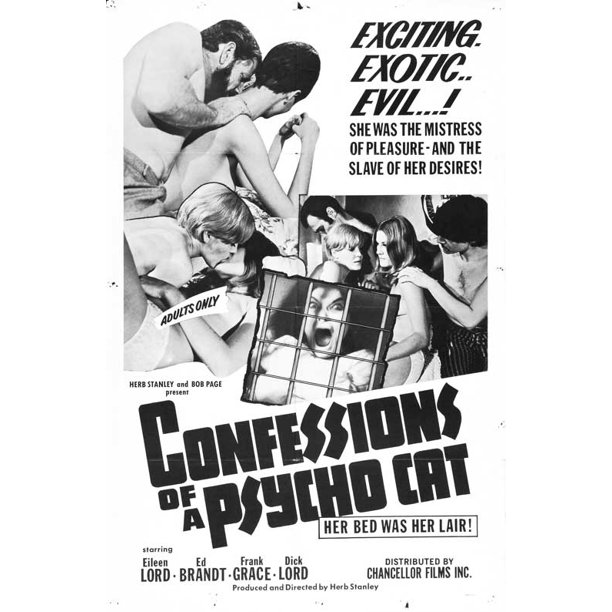
Another title mentioned in a different list of movies recommended by Senor Interior (in the 1986 tour booklet that contained list of faves from all four members of the band) is Confessions of a Psycho Cat (1968). This film was part of a major rediscovery (thanks to the great producer Dave Friedman letting one mail-order firm know about a trove of 16mm copies of pretty much forgotten titles) of sexploitation titles, and it is well worth a look. Lux liked it SO much that he wrote a song with the same title


The 9,000th version of the “Most Dangerous Game” scenario (in which humans are the prey that is hunted, not animals), this one features an insane female hunter pursuing three down-and-out figures on the streets of NYC: a washed-up actor, a junkie beatnik, and a former wrestling “champeen,” played by none other than Da Bull himself, Jake LaMotta (who really trades on that nickname here, being killed in a mock bullfight by the hunter, dressed to the nines in a torera outfit). It’s a quite amazingly nuts film and worthy of a full Funhouse episode. 


Time to flip the equation and move to the “high art” side of the film world. This is represented by a pair of episodes paying tribute to one of the biggest heroes in the Funhouse, namely Uncle Jean, aka Jean-Luc Godard. After his death, I knew I would have to look long and hard through his work and assemble a series of episodes paying tribute to his work, era by era. So far, I’ve assembled and aired two of these shows, and one episode discussing and excerpting scenes from A Vendredi Robinson, the 2022 Mitra Farahani film that offers us a last sustained look at JLG in his natural habitat (filmed in 2014-15 before he was gravely affected by a neurological condition). 


The first show covers the first six years of his most famous period, the Sixties, from 1960 to ’65. I discuss a few of the tenets of his work, display a few of the many magazines and books devoted to him, and then show scenes from nine of his first 10 features. (Including some that are truly iconic — and ripped off to no end — and some that show off specific aspects of his work.)


The second episode completes the overview of Godard Sixties features. (I’ll approach the anthology contributions, shorts, and the missing ’60s feature in a future episode.) Here I open with some more books/magazines and an anecdote illustrating what it was like seeing Godard’s most obscure work in a certain Manhattan museum.


From that point I move on to the period in his work that opened the way for an incredible amount of radically unusual films in the late Sixties/early Seventies. We move from his last classically “New Wave” film (MASCULIN FEMININ) to his post-“end of cinema” features in 1968. 


I plan to only put up a select few episodes online. (There have been over a thousand new shows in the 30 years we’ve been on the air.) The only way to see the show regularly for those outside of Manhattan is to catch it late Sat/early Sunday at 1:00 a.m. EST on the MNN stream on Ch. 3, the “Spirit Channel.”

Monday, April 17, 2023

The Funhouse interview: Balthazar Clementi on Pierre Clementi

Here are two excerpts from the Funhouse interview with Balthazar Clementi that explores the life and career of his father, French actor-filmmaker Pierre Clementi, best known in America for his scene-stealing roles in Bunuel’s Belle de Jour and Bertolucci’s The Conformist, as well as his starring turns in cult films like Bertolucci’s Partner, Marc’o’s Les Idoles, and Liliana Cavani’s The Year of the Cannibals

We covered a lot of ground in the hour in which we spoke; the result was three visually stunning Funhouse episodes that emphasized Pierre’s work as a filmmaker but also spotlighted a few of his best-loved film performances.

In this excerpt I start out mentioning the comparisons by film historians of Pierre's work to Kenneth Anger, most likely because they both used dense overlaid imagery in their films. We then discuss the in-camera process Pierre used to create those overlaid images. Balthazar maintained in a question after this that Pierre was directly influenced only by one filmmaker — his friend (whose films he appeared in), Etienne O’Leary, a Canadian who made a trio of influential short avant-garde films in France, and then stopped making films due to medical problems. (O’Leary also appeared in Clementi’s films, sealing the bond of mutual admiration.)


In this clip we talk about how Clementi’s life changed after his famous 1972 arrest in Italy in the early Seventies (on a trumped-up drug charge) that led to him losing a year and a half of his career while being in prison. Upon his release, he had even less interest in doing acting work for money’s sake and was known to literally give away the money he made.

The interview with Balthazar was done in conjunction with a festival of Pierre Clementi’s films at MoMA. The other tie-ins concerned the release of a limited edition “Integrale” box of Clementi’s films (containing the nine films on both Blu-ray discs and DVDs, with optional English subs; still available as of this writing) and the long-awaited English translation of Clementi’s 1970s memoir (and essay on the prison state in Italy) <i>A Few Personal Messages</i>, from the small press actually called Small Press.


The interview, which was audio-only on this occasion, was conducted in Central Park, a first for the Funhouse! Here is a pic of Balthazar and me after our talk. He was quite forthcoming in our talk (providing very personal remarks about his birth and his father's later life), for which I thank him. (Thanks also go to Ivan Galietti, for his great translation, heard on these clips.)