Friday, April 7, 2023

Notes on the screening of 'The Movie Orgy' (aka 'Son of Movie Orgy') at Anthology Film Archives — plus, the best 'Orgy' clips found online

There is nothing like the moviegoing experience. And there are movies that depend on that experience to be successfully enjoyed. One of these is Joe Dante and Jon Davison’s much-talked-about but too-little-seen movie-clip marathon The Movie Orgy (started in 1966; reshown and rebuilt for a decade after that).

The film fits in very comfortably with the Sixties ethos of nostalgia-loving and inserting b&w movie clips into weird places. Certain moments in it — where more famous old-time movie stars are seen “reacting” to other, unrelated footage (usually a B-feature with few recognizable faces) — is so Sixties that I’m not sure what today’s audience as a whole make of it. In fact, a lot of Movie Orgy moves along at a very fast clip, but it also incorporates the equivalent of abridged versions of various B-pictures, so it does end up telling complete stories, in fact several of them.

So what actually is the Orgy? It began as an idea for a movie “happening,” according to Joe Dante, based on the fact that colleges in the mid-Sixties were presenting showings of the serials of the ’30s and ’40s, with all the chapters shown in one marathon screening. Dante and Davidson thus created their own movie marathon, made up of various segments from B-features, plus numerous other items they had found on 16mm — scenes from more high-profile major-studio films from the past, TV episodes from the Fifties (with the spotlight on children’s TV), TV commercials, educational films, and even stag reels. 

The B features that we see a lot of include The Attack of the 50-Foot Woman, Tarantula, Earth vs. the Flying Saucers, and The Giant Claw. The non-monster pics include the high-key crime/car race drama Speed Crazy and the Albert Zugsmith epic College Confidential. (Not one of Steve Allen’s better moments.) A Western movie serial and some Western B-features are thrown into the mix — something an audience brought up in the Fifties would immediately relate to (but today’s younger viewers encounter the Old West primarily through video games, not an endless flow of low-budget oaters).

The younger Joe Dante.
I saw the Orgy the other evening at the invaluable Anthology Film Archives here in Manhattan (which is showing the compilation once more, on Monday, April 10). The film was shown at its present length, around four hours and 45 minutes. (Originally the “happening” version at the Philadelphia College of Art where Dante and Davidson went to school ran up to seven hours.) No admission charge was in place to see the film, as the clips in it were never licensed and it can only be shown in not-for-profit contexts.

My own reaction to Orgy is that it’s a load of fun but is overly long for something viewed with an audience that is passive. The filmgoers at Anthology seemed to enjoy it on the whole and did laugh at many of the gags created by the intercutting of footage (with some other items playing out to stone silence), but aside from laughter, the viewers were taking in the project as if it were a narrative film of its own. No friendly outbursts from this crowd — for a film that seemed to have been made for audience interaction of some sort. (Dante mentioned singalongs to the theme songs for the kids shows included in the compilation; my audience was mostly too young to know “M-I-C… See ya real soon!… K-E-Y ... M-O-U-S-E”)

It was very apparent that Orgy was a product of the Sixties and early Seventies, when movie viewers smoked pot in the theaters for even the straightest films (I remember this distinctly as a kid during that era), never mind a movie-clip extravaganza. Alas, no one is going to light up in a 2023 NYC movie theater. Nor did the Anthology viewers seem drunk in any way, or, in many cases, aware of who the old-time stars were who would pop in for “cameos” that no doubt got very big reactions back when the Orgy was playing for an audience steeped in old movies (thanks to repeated TV showings) and, most likely, drunk or stoned to the gills. (Dante has noted in interviews that he and Davidson did strike a deal with Schlitz beer, who had the compilation shown at various colleges with free beer given to anyone in attendance.)


So, given this more “reverent” than knowing crowd reaction, the film was indeed really wonderful for the first two hours, then seemed to move at a slower pace in the third and fourth hours (as the B-movie scenes lasted longer onscreen and more of their plots was offered), only to become wonderfully insane again in the last 45 minutes, as all the B-movie monsters seen earlier on finally met their terrible fates at the hands of the innocuous, nearly anonymous, heroes and heroines who defeated them with scientific know-how (or just a lotta dynamite).

The Orgy was clearly the creation of movie-crazed minds, so it initially seemed to not have a “point” other than sheer pleasure. As it moves on, though, one becomes aware that it is a wily deconstruction of 1950s American mores through the lens of a Nixon-era sensibility. (If that wasn’t apparent, not one but two of Nixon’s most famous pre-Presidency moments were included to be mocked by audience members, although none of that happened in this screening.)

On the whole, despite the overwhelming nature of the film and the absence of an interactive audience (although one gent was laughing up a storm at various points), I’m glad I saw Orgy — actually titled “Son of The Movie Orgy” in this digitized version prepared by Dante himself — as it truly is a piece of “incredibly strange” movie history. It also, like every film mash-up, from the blink-and-you’ll-miss-it edits in Chuck Workman’s montages of movie scenes to Godard’s masterpiece Histoire(s) du Cinema, makes the cinephile try to i.d. each sequence. (Orgy is very easy to figure out; Godard’s history of cinema requires additional research.)

And thus, some clips to convey what Orgy is about, and to spotlight some of the best “finds” in this stew of clips. First, an interview with Dante, who explains how the project came about, and how he brought it back to life in this century. 
Then a “trailer” for the film, which includes a glimpse at one of the oddest items in the whole thing, a film made by the British sketch comedy group The Establishment (to be shown in the nightclub of the same name). Peter Cook narrates (he owned the club), Eleanor Bron is the nurse, and Jonathan Miller (who was a doctor in real life) plays the surgeon. It's also been officially noted that the short film proper doesn't exist in the U.K. any longer, so this might be your only chance to get a glimpse of it. It begins at 2:10.


A quicker trailer shows the opening montage of movie stills, which definitely places the compilation in the late Sixties. (It’s like a film student’s crazed version of the Joe Franklin opening montage.)


One of the biggest boffo moments in the whole 4:45 came when an episode of “Andy’s Gang” appeared. A strange children’s show for any era, the series starred Andy Devine and Froggy the Gremlin, plus a little “band” comprised of taxidermied animals engineered to look like they were making music (decades before the Survival Research Laboratory!). This did completely crack up the Anthology audience.


Another sequence that did put the AFA audience into hysterics is this old classic. I loved Abbott and Costello as a kid but have had little impulse to rewatch their movies as an adult (not so with Fields and the Marxes — who are both in Orgy, and Laurel and Hardy). But the “Susquehanna Hat Company” routine has always made me laugh out loud. (And the end is the height of vaudeville anarchy as the shop owner takes an axe to his own goods.)


The most curious inclusions in Orgy — one could easily call them “spoilers” indicating the era that it was made — were the three instances of newer clips that were inserted. One already mentioned was the Establishment short film (seen in two fragments, one being a mock ad for the Labour party and the other being the operation sketch). Another was a closing “Thought for the Day” dispensed by a young priest whose Christ is falling off his crucifix and has to be reattached with a staple gun (reportedly a student film made by another student at the Philadelphia College of Art). 

The longest example of this is one of my fave clips, Funhouse favorite and interview subject Robert Staats giving the pitch for the “Fabulous Judeo-Christian Good Guy Kit” in Harry Hurwitz’s The Projectionist (1971). Staats is of course wonderfully funny (although the AFA audience laughed sporadically, as some of the quicker lines were darker ones that hint that the kit is only for those who *don’t* want to be actual good guys…). Dante and Davison not only show the mock-commercial in its entirety, but they keep Hurwitz’s follow-up: various images of Heaven culled from old movies. (Hurwitz was one of the all-time masters at incorporating vintage Golden Age footage into his nostalgia-drenched comedies.)


The piece de resistance in terms of the opposite of the above, real commercials that seemed ridiculously ill-conceived, was a Bufferin ad campaign with the tagline “strong medicine for sensitive people.” The sensitive people include a Black social worker having to relocate an old White couple; a mother whose husband is going a “Great Santini” number on their son, trying to make him macho with the gift of a rifle; a draft board member who has to deal with a small business owner (Dolph Sweet) begging him to not draft his only young worker; and a college administrator who is dealing with teenage protesters on his campus. 

The campaign is a stunner and, according to Dante, only ran once (or was shelved entirely after being shot and edited). It remains an amazing concept and a definite link to the late Sixties.


The other clip that was a humdinger but is sadly not online was one of those Art Linkletter moments where you realized that his humor was just as sadistic as Allen Funt’s (actually more so). Hosting a “stunt” game show, Linkletter tells us they found a woman with a phobia for mice. He’s going to ask her to reach into a box of rats to fetch a 10-dollar bill. The lady is brought out and is very disturbed by the prospect of rats brushing by her hand; she turns the offer down. 

Linkletter increases the money amount over and over until it reaches $100 and the lady agrees to reach in the box. At this point Linkletter, who has been holding a magician’s box with no back, moves it as if the rats are trying to leap out of the box toward her — but the “rats” in question are just pads over which a woman’s hair is arranged (called “rats” back in the ‘50s). We the audience knew this all along, and in classic sadistic game show fashion, the studio audience is laughing up a storm over the woman being in terror of rats. (Maury Povich’s “Phobia!” episodes thus had a precursor — and, again, Art L. is shown to be a devious guy [who of course hated hippies, blaming them for the death of his daughter, a story that the original Orgy viewers surely knew].) 

The most interesting thing about researching this piece was that I discovered one viewer who saw a longer cut of the Orgy stating two themes that were cut from the version I saw: the annoyance of child actors (conveyed through a montage featuring a plethora of kiddie material that Dante and Davison had access to) and the repetition of a slur for Japanese people that reflected the fact that movies of the Golden Age of Hollywood did have a harsh underside — conveyed in the version I saw by a clip where an upper-middle-class woman mocks her Black maid to her husband. 

Perhaps the way to get audiences in the 2020s to react like those in the ‘60s and ‘70s would be the most obvious one — provide them with free pizza (Dante notes over and over again in interviews that people would bring munchies to the showings of the film), CBD gummies (for a contemporary audience), or free liquid stimulants. (Schlitz not necessary.) 

Some info contained in this piece (esp. the identification of the newer pieces that weren’t made by Harry Hurwitz) came from a 2015 thesis on the film by David Ruane Neary that is posted online.

Friday, February 3, 2023

Saluting the centennial of Norman Mailer

Mailer in "mad
scientist" (filmmaker)
 mode.
Norman Mailer's centennial was this past Tuesday. While he's now thought of by many as a “dinosaur” because of the many incidents of him acting up in public (and private), Mailer was, above all, a great writer. His Executioner’s Song is perhaps the finest bit of “new journalism” ever (although it wasn’t as fun as Thompson or Wolfe, and did indeed work from a formula set down by Capote in In Cold Blood). It’s an incredible book that offers a very pointed and precise view of the American 1970s, as well as a compelling study of sudden violence and its aftermath.

His pure fiction varied from work to work — highs and lows, masterpieces and duds. But his journalism and essays are invaluable studies of American political and popular culture. Yes, he was a well-educated white Jewish urban intellectual who set out to write “the great American novel” and instead became a bad boy in the media and wound up saying some things he later renounced or rethought. 

Still, the passion he had for the written word still comes through in his work and his finest books (including Executioner’s, Armies of the Night, his writings on Kennedy and Ali, Harlot’s Ghost, and his last, The Castle in the Forest) will remain brilliant, whether or not people can bring themselves to read them because who he was is no longer fashionable. As has been noted often: if you search for pure virtue in the artists you enjoy, you’re going to have to get rid of the work of all the extremely talented and extremely fucked-up writers, musicians, filmmakers, fine artists, and performers.

Since Mailer’s books are all copyrighted and available wherever one consumes the written word (if one does consume the written word for more than 50 pages these days), I will run through his media image below, based on videos I posted to YouTube in the weeks after his death. This is not a thorough, or even a fair, representation of all that Mailer truly represented, but he did have some wild (and I do mean wild) moments in the media, and so one has to include the “wired” (by adrenaline, booze, or uppers) side of Norman as well as the philosophical one.

Casual Norman,
by Diane Arbus.
Mailer directed four movies, three of which were his attempt to make “underground” films and the final one — well, that’s the amazing Tough Guys Don’t Dance. I will start out with the one time I wanted to impart some of Norman’s thoughts so badly that I sat and typed out — yes, with mine own fingers! — a fragment from his article on television called “Of a Small and Modest Malignancy, Wicked and Bristling with Dots.” 

It’s a late 1970s piece in which Mailer remembers watching Steve Allen and Ernie Kovacs in the 1950s while high on pot and realizing that he understood what was really going on, on the boob tube. It’s an odd article, combining profundities about the “never well-done” medium and Norman revealing the polymorphous perversity in American society. 

The segment I wanted to share with the world is a vision of watching Steverino high on pot and meditating on what the women in the studio audience thought of having a big old microphone stuck in their face. It’s something that only Norman could’ve come up with. You can find the blog post here. 

Now, let’s go to the movies! First off, there was Mailer’s gangster drama Wild 90 (1968), which is, to be simple about it, a mess. As fine a writer as Norman was, he was ill-suited to the art of filmmaking. Firstly, in his Sixties trio of films he strived to emulate the off-kilter visuals of the experimental directors on the American “underground” scene, but he also wanted to have plots and characterization. Mekas and Brakhage could do the former, and Cassavetes and Clarke the latter, but no one could successfully do both. But Norman tried, three times, and in each case he allowed the actors to improvise — in the case of Wild 90, the whole film is nothing but Mailer and two of his buddies playing pretend-gangsters, quite awfully. 


Making this stew of insanity even better is the fact that Norman wore a boxer’s mouth guard while in-character to presumably make himself sound tougher. This made him hard to understand — and then the sound didn’t get recorded properly. The great D.A. Pennebaker was behind the camera, so the film looks striking in 16mm b&w, but Bob Neuwirth recorded the sound and fucked some of it up very badly. The official ratio quoted online is that “25%” of the sound is murky, but the whole damned thing sounds dreadful, and so it was subtitled for its release in the Eclipse box set of Mailer’s experimental films. 

So, why should you watch this little compilation I made of my favorite moments from the film? Because it’s amusing, but not in the way Norm and his two friends intended. Instead, we have tough guy Mailer using odd abbreviations like “the fyooch” (future) and “cock suck” (you know). The film is an absolute mess, but the scene where Norman tries to scare a growling dog is, again, just wonderfully crazy.


Mailer’s second film Beyond the Law (1968) was more ambitious and had some scenes that actually work (thanks to a cast of pro actors, including Rip Torn and Marsha Mason). His third (and last for a long while) film is the monumentally misconceived Maidstone (1970). 

Much has been said about the fight between Norman and Rip Torn, but the whole film is a stunning miscalculation — down to the very fact that Mailer expected his actors to come up with their own dialogue and for one team of performers to devise an assassination plot to kill his character. If you’re going to ask actors to improvise, you had better be Cassavetes or Mike Leigh behind the camera, because otherwise the results are going to be dreadful — but, luckily, Maidstone is saved by its (unintentional) humor. 

Case in point: a scene where Norman tries to seduce one of his exes by humming along with the radio and then attempting some scat singing (or whatever you want to call what he’s doing with his mouth). 

I saw Mailer’s experimental films in theaters more than once (yes, I’m devoted to high art *and* low trash), and one of my treasured memories is seeing Maidstone at the Thalia with my father. He stared laughing out loud when Norman started doing his humming noises in the film, and I had to caution him that Norman was in the theater and would probably come over and deck us one. (Years later, Norman chastised an Anthology Film Archives audience I was in for laughing at Rip Torn shaking his little hammer at the camera in the film.) Of course, I then began laughing and we both had to try to stifle our laughter while Norman continued his very special method of charming a lady.


In the years since I scored bootleg DVD-rs of Mailer’s three experimental films, the Eclipse box set did come out and provide us with unblemished copies, looking and sounding as good as these films possibly could. However, I will link to one more of the scenes I uploaded because it comprises what came after the infamous fight that Torn and Mailer had. Their impromptu insults of each other are sublime; Rip’s charge that he’s giving Mailer an ending for his film is entirely correct — and his coronation of Mailer as “king of shit” is a nice ad-lib. (Norman resorts once again to the “cocksucker” label.)


Pennebaker served as a cameraman on all three of the Mailer “undergrounds,” and he later captured a more vibrant Mailer in his film (assembled years later by his collaborator-wife Chris Hegedus) Town Bloody Hall (1979). Mailer’s 1971 article on feminism (which became the book Prisoner of Sex) annoyed feminists and so a gimmicky event was staged: Mailer would debate “the feminists” onstage at Town Hall in Manhattan. The result was a thorough mess but (again) a fascinating one. Some of Mailer’s verbal points were brilliant, but his manner was overbearing. The feminists ranged from the articulate (Germaine Greer, Sontag and Ozick in the audience) to the unbearable (Jill Johnston). 

Here, Norman is backed into a corner when forced to discuss his male protagonists and their penises.


Mailer stayed away from film for more than a decade and a half, but returned to it when the notion of adapting his novel Tough Guys Don’t Dance came up. The book is a taut little thriller with a classically Mailer-esque overlay of meditations on violence, masculinity, and confusion over identity. The screenplay he spun off it was a weird creation — the plot is the same as the novel, but he ginned up the melodrama, at some points to be taken seriously, at others to be intentionally over the top. 

He then was given the opportunity to direct the film from those purveyors of crap action-flicks who desperately wanted to be taken seriously as producers of arthouse material, Golan and Globus. The result is one of those films that was destined to have a cult from the moment it was released — a weird amalgam of intentional humor and really ridiculous melodrama, all overlaid over a noir plotline infused by the spirit of David Lynch, via music by the late, great Angelo Badalamenti and the Blue Velvet queen, Isabella Rossellini. 

There are dozens of imminently quotable lines of dialogue and some startlingly bizarre line readings: “How could you dig Big Stoop?” “Your knife… is in… my dog,” “Deep-six the heads,” and my personal fave (when O’Neal is asked how dealing drugs went), “I couldn’t get that heavy shit to flush.” It’s an incredible film that is entirely linear, unlike Norman’s Sixties experimental films, but the tone varies so often that one can’t help but be enthralled by its alien charm. 


My only encounter with Mailer was when I went up to him as he exited the subway at 53rd and Third Avenue. I noted I really enjoyed (no lie, that) Tough Guys Don’t Dance. He then asked quickly, “The book or the movie?” I said (again, no lie), “Both.” He then informed me that the movie had been nominated for several awards (these noms were for the Independent Spirit awards). I had no immediate questions at hand, and he did have a cagey, energy-filled bearing about him, so I just shook his hand and said goodbye. (Yes, Norman rode the subway from borough to borough.) 

Mailer was clearly aware the film was a hard sell and so he had this trailer made, where he read a series of audience reaction cards from preview screenings — which, I’d be willing to bet, were all written by Norman himself. The final one paves the way for his last novel, The Castle in Forest, in which an emissary of the Horned One narrates the tale of the young life of an Austrian named Adolf.


And because I really do have an abiding respect for Mailer the writer and thinker, here is a segment I posted from a French documentary that I believe hails from the late ‘90s. Mailer speaks about plastic and how it became the emblem of American society (part of the “triumph of the mediocre”). He then links that to a deadening of the senses and the American proclivity toward violence. When Mailer was feeling expansive in interviews and wasn’t playing a pro-wrestling heel (as he did on the infamous episode of “The Dick Cavett Show”), he was one of the great thinkers of the late 20th century.


And finally a montage I put together for the Funhouse TV show: Norman on Merv Griffin (as seen in that French documentary) physically in his “heel wrestler” persona, but eloquent as ever, noting how curse words used by authors couldn’t ever compete with the obscenity of the then-escalating Vietnam War. 

Then it’s back to Town Bloody Hall, where he is again argumentative and in full “heel” mode but does make some valid points (esp. how Germaine Greer was truly a unique figure in the feminist movement, as she acknowledged the fact that men were not leading happy lives as well — plus she was incredibly witty, which always helps selling one’s point of view). His last-minute joke about his dick is classic Norman in media mode: undercutting his own sincere and well-thought out words with a rather feeble verbal joust. 

From there it’s back to Tough Guys… for two sublimely high-key sequences (including the film’s most stunning moment, shown on the Funhouse TV series in the ‘90s every few months). In closing, it’s Norman on C-Span2’s “Book Talk” in 2001. He laments the dumbing-down of American culture. “We’re a country that hates questions that take longer than 10 seconds to answer.” (Yes, this was during G.W. Bush’s tenure in the White House.)


No matter what becomes fashionable in the world of academic endeavor as the years move on, I think that readers who encounter Mailer’s writing will be jolted by it, in the intellectual sense of that word. When Norman was speaking clearly and precisely he was an American sage, a gent who understood the internal workings of this nation like few others. 

Specific utterances by him or his donning of the “heel” persona in certain public spaces may continue to make for snap judgments among those who are triggered by anything controversial, anything that makes them uncomfortable (which is, let’s be honest, just about all complicated thought and the context that necessarily underpins complicated speech). Mailer challenged that, and I point you back to the clip above where he compares his least favorite synthetic material (plastic) and its similarity to p.c. speech. 

“America is a hurricane, and the only people who do not hear the sound are those fortunate if incredibly stupid and smug White Protestants who live in the center, in the serene eye of the big wind.”

Friday, December 30, 2022

Media Funhouse episodes on the Net

Back in August, just as the Media Funhouse TV show was about to enter its 30th year on the air (the show debuted on September 30, 1993), the cable access organization that airs the show, Manhattan Neighborhood Network, moved its HQ from 59th Street and 11th Ave. to 38th Street and 11th Avenue. At this point the live streams of MNN channels went dark and a third party organization began airing their shows — in a bizarre twist, the Standard Definition shows began airing in HD (and within an odd onscreen pattern of a letterbox-within-a-windowbox).

The last-mentioned aspect (and many other daily grinds) has kept me so busy that only now — now in a week when the live streams are in fact BACK ON-AIR (!) — have I had the chance to find a suitable “platform” to host a Media Funhouse online “channel” of the recent episodes that no one outside of Manhattan could see. (I take my viewership outside the borough as seriously as the ones inside the borough.) OK.ru is the site of choice, since Vimeo demands cold hard cash for every bit of space it allots a videomaker, the workings of DailyMotion are a puzzle, and YouTube has various wondrous stumbling blocks — most of them “international bans” — in place for those who create video montages.

OK.ru is the “YouTube of Russia.” To those who might think that “I’ll be *watched* if I go to that site!” I have a fast newsflash: You’re being watched on YouTube. You’re being watched (especially!) on Facebook. Your social media is being registered and logged everywhere at every time. Unless you go “off the grid” entirely, as long as you have an active presence online, you’re being watched. From your desktop computer, your work computer (again, especially), and most definitely your tablet and phone, you’re being watched. (And I've "unlocked" the embeds from ok.ru below, so you can click them and watch the videos through this blog entry.)

And, as for YouTube, the clips that were the points of contention were fascinating. The films of Bob Rafelson that everyone knows — his early work for BBS (his company with Schneider and Blauner) — were fine with YT. It was his later movies that are owned outright and that no one can EVER post sequences from. And with Godard it gets even hairier.

Godard mixes three overlaid
images with (at least) two audio tracks
in Histoire(s) du Cinema.
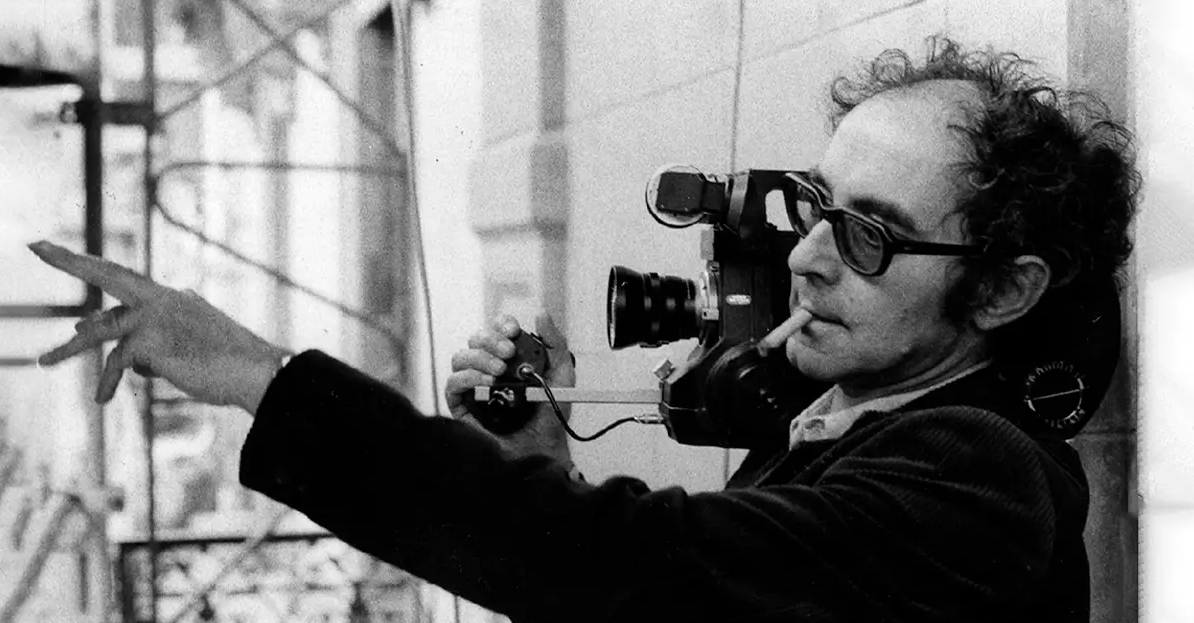
Uncle Jean (as I like to call him, based on his role in the film Prenom Carmen) was a “mix-master,” a sampler of longstanding. He used words from other writers, images from painters, and music from classical composers in his Sixties films, and by the Eighties was crafting video essays that were composed almost entirely of others’ work, reassembled by his hand (one of his first notable articles was called, “Montage, My Fine Care”). 

However, since he was using other people’s work so heavily, when you post HIS work on YouTube, you find that the original sources are banned — most notably, one German classical CD label does not want to monetize your clip (or, more accurately, Godard’s clip) with their sounds on it, they want you “banned” outright.

Godard also worked actively at one point with a record label that released the soundtracks of his films (complete, with every sound, every newly spoken word, and all the thousands of sounds he had taken from other sources on their discs). This has caused his “late-period” masterpiece Histoire(s) du Cinema to have its sound banned entirely from YouTube — at the moment you post a video including a clip from his video epic, you are “internationally banned” for using JLG’s sound (his name appears as the copyright owner), even though he was fond of putting “No Copy Right” at the end of his video essays and he publicly supported (to the tune of donating 1,000 euros!) a downloader who was under indictment, saying “There is no such thing as intellectual property.”

After facing this obstacle, there was only one way to go: away from U.S. video platforms. OK.ru truly fits JLG’s dictum and thus has not just hundreds, but thousands of films on it. It now has the “missing” episodes of my cable-access series, and I can think of no better company to be in than a crazy digital library of thousands of films. Here is the link to the Media Funhouse channel

Now, onto the shows:

I have new episodes paying tribute to Godard in the works, but first of all wanted to reshow older Funhouse eps in which I focused on his films. Firstly, there is part one of my interview from 2004 with Colin MacCabe, the film historian who wrote the first English-language biography of Godard.

MacCabe discusses his book in this interview but also answers questions about broader concepts in Godard’s work. He also in this episode discusses what it was like to work with Uncle Jean, as the producer on three of his video essays (and yes, I ask him about clearance of film clips!).


Moving back to the “consumer guide” aspect of the Funhouse, I also reshowed this episode, which found me reviewing and showing clips from three new releases: the Eclipse box of films by Godard’s one-time “Dziga-Vertov group” collaborator Jean-Pierre Gorin, and Godard’s own Film Socialisme and the mighty, mighty Histoire(s) du Cinema.


As for “unseen” Godard, I also have done various episodes on his video essays. I am quite proud of having shown Funhouse viewers one of his most beautiful short creations, “De l'origine du XXIe siècle” (2000) in its entirety in this episode. I include clips from other essays, but “origine” is a most exquisite view of the 20th century that proceeds backward chronologically, mixing newsreels of the realest atrocities with the most fantasy-based images from fiction films, concluding with perhaps the perfect metaphor for a century in which the action never stopped: the dance with the can-can girls in Max Ophuls’ Le Plaisir. (Godard leaves in all the spinning around, but cuts just as the hero falls down while dancing.) 


Another absolutely gorgeous Godard short is “Puissance de la Parole” (1988). Godard counterpoints a couple’s emotional breakup over the phone — with dialogue from James M. Cain’s The Postman Always Rings Twice — with an older man and a young girl discussing mankind’s need for knowledge — with dialogue from Poe’s prose poem “The Power of Words” about two deities (or angels, if you prefer) conversing about mortals. 

It’s a stunning work in terms of both its magical inscrutability (the Poe side) and its earthy humanity (the Cain breakup dialogue). Even more stunning is that this work of raw emotion and aesthetic beauty (which ends with the mingling of classical music with songs by Leonard Cohen and Bob Dylan) was commissioned as a commercial for a phone company. (Thus, the breakup over the phone.) 


The episode that I’m most proud of in this batch on ok.ru is the second part of my interview with Colin MacCabe, discussing various aspect of Godard’s work. Firstly, I remade this episode entirely — I edited from the original interview tape, leaving all of what MacCabe had said (I had initially cut a now-fascinating bit about Godard surely opposing the neo-liberalism that runs through current European politics) and using better copies of the film clips I had initially included in the episode. 

Secondly, there is the range of topics we covered in a short amount of time. They include the viewer’s response to Godard’s use of so many references (MacCabe’s answer to this is very instructive; it gives Godard fans an answer to those they may know who remark that Godard’s work is too layered to be comprehensible), Godard’s then-current political position, the use of autobiography in Godard’s essays and fiction films (including his appearances as “Uncle Jean” the crazy filmmaker), the seminal importance of Histoire(s) du Cinema to his output during the late Eighties and Nineties, the themes in his transitional work In Praise of Love, and, not forgetting, Godard’s much-ignored (or misunderstood) sense of humor.


I saluted Bob Rafelson first on this blog and then did three episodes on the show about him. The first episode covered his best-known period, in which he made films for his mini-studio BBS, aka the House The Monkees Built. Thus, we begin with Head and end with his non-BBS Stay Hungry.


The second episode in this series of shows covers his next three films, which came out at intervals (by this point, Rafelson had burned some bridges in the film industry, and he was also pursuing his biggest interest, traveling). So, we begin with his “comeback” in 1981, The Postman Always Rings Twice, and end with the film he proclaimed his favorite, the adventure saga/character study Mountains of the Moon (1990).


The third and last of this series of episodes covers Rafelson’s last four works for hire. These range from the screwball comedy Man Trouble (1992) to his underseen, terrific last film, No Good Deed (2002), starring Samuel L. Jackson. 


The next show focuses on a French romantic comedy-drama that hasn’t ever been available in the U.S., Adorable Liar, directed and cowritten by Michel Deville. The most intriguing thing about it is that the two very cute lead actresses later worked for Godard (whereas Deville had just worked with… Anna Karina!): Marina Vlady and Macha Meril. 

It’s a cute, slight film about two sisters from the provinces in Paris. One of them (Marina) lies to men a lot, to the extent that when she finally meets her true love — well, he just doesn’t believe her. Among the cast are two Funhouse faves when they both very young men: Pierre Clementi (in his movie role) and the great Michael Lonsdale. 


I was very pleased to interview Balthazar Clementi, the son of the actor-filmmaker Pierre Clementi, when he was in NYC promoting his father’s films as a director (plus the U.S. publication of his dad’s memoir, A Few Personal Messages). 

In this episode (the first of a projected three), we discuss his father’s filmmaking, which works as both a diary of his very busy life in the Sixties and Seventies (with his friends — Nico, Jean-Pierre Kalfon, Tina Aumont, Viva — and his costars — Deneuve, Piccoli, Klaus Kinski, Udo Kier — showing up in various candid moments) and avant-garde meditations on the periods in which the footage was shot. 


The final new episode (barring an Xmas show that isn’t good to post, for another year at least) was a discussion of, and scenes from, a lost major-studio film that was yet another fascinating failure from the era in which the major studios (MGM, in this case) were all trying to reproduce the success of Easy Rider.

The Magic Garden of Stanley Sweetheart (1970) is an incredible mess, but one of those messes from that insanely productive period in which even the failures make for compelling viewing. Here, the film boasts (besides wonderful NYC location footage) two items that make it one-of-a-kind: the first are two supporting players (folk singer Holly Near and psychedelic frontman turned gay standup comic Michael Greer) who are so good in their roles that they steal the film away from its lead, Don Johnson (in his first film role).

The second amazing aspect of the picture is the score. Certain “hard” bands were signed to MGM Records, so their music fits with the plot and images, but the light, bubblegum sound of the Mike Curb Congregation is also heard. Their cover of “Happy Together” is just lame, but the fact that the catchy-as-fuck “Sweet Gingerbread Man” (by Michel Legrand and Marilyn & Alan Bergman) is used in trippy, sexy scenes (including one right after Johnson has had a threesome with two his hippie girlfriends) is a mind-blower. The song would be better suited for Willy Wonka or Doctor Dolittle, but it wound up in this film and thus made for sublimely silly musical interludes. 


Again, the Media Funhouse channel on OK.ru can be found here.

As it currently stands, MNN has reached its new HQ and has put back into action its live streams. This is great news for me, as I welcome every like-minded viewer we can get in “the tent.” As of the day this blog post goes up, the streams at mnn.org are back up and working. The one that airs Media Funhouse at 1:00 a.m. late Saturday/early Sunday can be found here.

I have been informed that they are still fine-tuning these streams, but they look delightful as of this writing, so I can only hope they will remain up and working for a long time to come….

Wednesday, November 23, 2022

The annual viewing of Robert Vaughn mocked by clowns (A Thanksgiving ritual)

I have introduced this clip for nearly 30 years now, on the Funhouse TV show (which celebrated its 29th anniversary back in September of this year) and also on this blog. This year, we have emerged from on-again, off-again lockdown status to be where most of us knew we’d be back in 2020 — just getting on with our lives, with COVID sticking around basically forever, as plagues brewed up by man are wont to do. 

America’s economy is in a mess, there are various forms of crime on the streets, and people are diverting themselves at this minute by discussing a social media platform as if it is the end-all, be-all of human communication. The proxy war (between light-skinned foreign people) isn’t as news-worthy as it was, so pundits are busy wondering if the 2024 presidential election will simply be a do-over of 2020, with two deranged, empty old white guys battling it out. Our Gerontocracy = No. 1! 

Surely, the only way to deal with the abovementioned problems is to simply bask in the holiday glow of the former “man from U.N.C.L.E.” being mocked by clowns as he reads the U.S. Constitution at the Macy’s Thanksgiving Day Parade in 1986. By this time, I’ve seen it so many times I begin to simply look at the clowns rather than the rapidly-more-irritated Big Bob V. Watch as someone in the studio tries to “save” him by putting his head in the upper corner of the image and showing us a different image in the center of the screen. 

If anyone knows anyone who worked on the shoot for this parade, or who can tell us how angry Vaughn was when the segment was over, please get in touch. In the meantime — enjoy!


Friday, October 7, 2022

Media Funhouse guests speak about Godard

It’s been a few weeks since Uncle Jean (aka Jean-Luc Godard) died, and I do plan on writing something about his life and work for this blog. But in the meantime, I wanted to post what I initially thought of as “the end” of the piece, namely a collection of eight videos in which Media Funhouse interview subjects spoke about Godard. Two of the guests were admirers who happened to meet Godard as their indie filmmaking careers flourished; two were performers in his 1980s films (commonly thought of as his “comeback” films, although he never really left — he just stopped and then restarted making fiction films); three were collaborators behind the camera; and one wrote the first (and still best) biography of Godard in English.

I should explain that these interviews were done under various conditions. In some, I spoke to the guest under very tight time constraints, so my Godard-related questions were slipped in “under the wire.” In others we had ample time with the guest and so they could go on at length about their admiration for, or work with, Godard. The interviews were shot in conference rooms, hotel rooms, a Lincoln Center office, and one artist’s kitchen. I was very happy to get these responses about a filmmaker that clearly fascinated the interview subjects as much as he fascinated all of his diehard fans for the last six decades-plus, and I’m now happy to share them all in one package. 

*****

As an “appetizer,” two clips from different interviews with Hal Hartley, where I asked him about Godard and his influences. He had interviewed Godard for a U.S. filmmaking magazine and had the great experience of telling Uncle Jean that he went to one of Godard’s recent films with his actor-friend Martin Donovan, who “laughed at the wrong part” of the film. Godard’s answer? “There are no wrong parts.”

I used that as a springboard for an earlier question to Hartley in the ’96 interview and then slipped in a query about Godard before the end of the chat. In ’06 Hartley answered the question in a broader sense, discussing how important it is for filmmakers to have influences and to openly copy them, on the way to developing one’s own style. 

Leos Carax is one of the most talented directors around, but few know about his acting career. There hasn’t been much to it (six supporting roles of various size in films directed by others) — then again, his filmmaking career has consisted of only six (splendid) features so far. 

He made his acting debut on film (minus a bit as an extra in one of his own pictures) in Godard’s KING LEAR (1987). I asked him about his appearance in that film and also about his being influenced by the French New Wave.


Next up is Jane Birkin. Ms. Birkin acted only once for Godard, in SOIGNE TA DROITE (Keep Your Right Up, 1987). She had a small part, but I thought it was still important to ask her what that time spent with JLG was like, and she came up with a lovely portrait of a cranky, laser-focused man with a bad cold. (None of which should surprise a diehard Uncle Jean fan.)


Independent filmmaker Amos Poe discussed his paean to Godard, UNMADE BEDS (1976), in my interview with him. That film revolves around a guy in ’76 NYC who believes he’s living in a French New Wave movie at the turn of the Sixties.

That part of our chat was interesting, but an even juicier morsel came out later in our lengthy interview: Amos had been ripped off money-wise by Uncle Jean! Watch the clip for details, but the story involves Debbie Harry, Chris Stein, Robert Fripp, and a proposed remake of ALPHAVILLE.


The filmmaker Claude Miller served a long and fruitful apprenticeship assisting other directors in the 1960s. He was as an assistant director or production manager for Bresson, Truffaut, Demy, and Godard. I got reflections from him on three of those four, and here is his remembrance of time working with Godard on 2 or 3 THINGS I KNOW ABOUT HER (production manager, and he’s also seen as an actor behind a pile of books on a table in one sequence), LA CHINOISE (no official credit, but he said he worked on the film to me), and WEEKEND (assistant director).

He had fond memories of working with JLG, and he certainly was present at a great moment in Godard’s career — when he was making his “last” fiction films, before he went fully political (and non-fictional) for a decade.


D.A. Pennebaker was a consummate documentarian who shared quite a lot in my discussion with him, reviewing his older films while also promoting his more recent ones with his partner/wife Chris Hegedus. His time with Godard was spent making (with his partner Richard Leacock and Uncle Jean) a Godard project called 1 A.M. (ONE AMERICAN MOVIE). It was to be a sort of panorama of America on the brink of revolution, but Godard left the project after most of the footage was shot and abandoned the whole thing.

What Pennebaker edited together, called ONE P.M., does play like one of Godard’s “pitch” storyboards (drawn so he could get a notion of what he wanted, but also to cajole money out of producers). It’s a series of unrelated episodes, some documentary, some fiction: Rip Torn acts up a storm around NYC, Eldridge Cleaver is seen being wary of the filmmakers’ cameras, Tom Hayden gives lengthy speeches, and the Jefferson Airplane beat the Beatles to the punch by having a rooftop concert months before LET IT BE. (And getting chased off by the cops.)

In the meantime, we see Pennebaker’s footage of Godard staging and shooting some of the scenes — it’s by far one of the closest studies of Godard at work in the Sixties. Even though he’s not making a classic film, you can still see his imagination (and budding interest in radical politics) radiating all around him.


The last two interviews featured here gave me the most information about Godard as an artist (and as a person, although Birkin’s remarks can always be kept in mind). Cinematographer Caroline Champetier, who worked with JLG for a number of years on every project he did, from fiction features to video essays, provided some excellent insights about his working methods. Here we talk about her first film with him, SOIGNE TA DROITE, where she was behind the camera filming Godard as an actor (playing his “Uncle Jean” character – this time called “The Prince”).

She also rebuffs the notion that he was a master of lighting and instead calls him a “master of framing,” detailing how his very specific methods of framing an image made his visuals so distinct and readily recognizable.


And finally: The only full-length interview I did that was entirely concerned with Godard was with film critic and historian Colin MacCabe, whose biography “Godard: Portrait of the Artist at Seventy” had just been published. (The first biography in English and, as I said above, still the best one in this language.) When I spoke to him in early 2004, a lot of Godard’s “late period” films had yet to come out on DVD (and there was no such thing as the “underside of the Internet” where rare foreign films with English subs were lurking, ready to be grabbed and watched).

I had seen Godard’s film and video work of that time at select screenings at rep houses and (mostly) MoMA, so I was able to talk about it with Mr. MacCabe, but I wasn’t sure if my viewership had, so I spoke with him here about Godard’s perception of his audience and how one should watch his brilliant eight-part sensory overload, HISTOIRE(S) DU CINEMA (made from 1988-98). 

Mr. MacCabe, who had not only interviewed Godard many times and wrote the biography but also produced three of his video essays, was quite generous with his knowledge of his subject and gave me some very valuable answers about how to take in the essays, which are indeed the masterworks of the last three decades of Godard’s career (along with a few of the final fiction films). This is part of a much longer chat.