Saturday, April 6, 2013

Up, Beyond, Beneath: Deceased Artiste Roger Ebert

I will be praising Roger Ebert by the end of this piece. I say that in order to forestall the reader thinking I'm the cruelest bastard in the world, writing an unflattering obit about a man who very publicly battled a dread disease. I will say upfront that I admired the way that Ebert fought against cancer and, although it eventually did kill him, he triumphed far longer than most would have predicted. He is an example to us all in that regard.

But, since he was a writer first and foremost – something even he clearly tended to lose track of in his overarching desire to be back on television – let me discuss the writing. Roger Ebert was a newspaperman and that colored his writing. He was prone to recount the plot, I mean really recount the plot of a movie in his reviews. Until the advent of his Net-obsession and the refinement of his writing about film – TV needing to leave the equation for him to grow – he also was a classic newspaper reviewer, with plenty of bottled opinion and declarative sentences that could be read in piecemeal fashion.

His obits seemed to indicate that he fell into film reviewing when the main reviewer for the Sun-Times left the paper. Thus, he had to follow the newspaper format for reviewing, and the majority of his work in print has the feel of reviews written for a daily newspaper – the pieces stand as an interesting record of the time they were written in, but I don't believe it is work we will return to in the way we reread James Agee, Otis Ferguson, Robert Warshow, Manny Farber, or the “Glimmer Twins” of the Sixties, Pauline Kael and Andrew Sarris (not forgetting Bazin, Durgnat, and the folks overseas). That said, I have a copy of an interview with Groucho he did for Esquire somewhere in my living space, and I would reread it readily not because of Roger's writing, but because it contains quotes from Groucho.

His writing did mature when he was forced to express himself solely in print and TV was not a part of his daily activity. I think, though, that the years I had spent first eagerly watching, and then just as eagerly avoiding, his TV appearances blunted my potential interest in his criticism. (If readers want to recommend pieces by him that they consider exemplary, the comments field is below.) The fact that he had such stern and “concerned” opinions about major studio crap made me lose faith in his ability to discern the wheat from the chaff, great cinema from a good night at the multiplex.

And the TV show... oh, that TV show and what it spawned. I did love Sneak Previews for the few years that it aired on national PBS – more on that below. But as Gene Siskel and Ebert went to work for Tribune and then for Disney, the show rapidly descended into cartoon status. Both men clearly knew what their roles were and played them to the hilt. They had to agree at some points, bicker at others, rhapsodize about the “power of movies” at some points (usually when a piece of Spielbergian crap was being discussed), and soundly condemn what they felt was exploitative.

Perhaps that was the first sign of cracks in the facade – the campaign both men went on to condemn slasher movies. I'm not defending slasher movies, I hate 'em, I don't EVER go to see them. But Siskel and Ebert went on a tear about the goddamned things, and (of course!) drew more attention to them than they ever would have had as marginal entertainment. My only experience to date with I Spit on Your Grave, a movie I have no desire to ever see, was from their protracted discussion of what a digusting movie it was.

Here is a full episode of Sneak Previews that is all about the mistreatment of women in movies. Ride that high horse, boys!


The topic might've made a nice “theme piece” (the kind of thing that Arts and Leisures sections are made of), but hearing them go on and on (and on and on) about movies they thought were shit both fascinated and bored me. If they hated the movies so much, why not ignore them outright? Well, it allowed both gentlemen to be “outraged,” a position that Ebert had already been heading toward in his famous review of Night of the Living Dead where he focused on an audience of children who were traumatized by the film.

The piece on NOTLD was so wholesome that it wound up in Readers Digest. On his website he notes that the piece was indeed about the audience and not the film (then why the endless plot synopsis?), and he actually thought (or came around to think) that the film deserved 3 1/2 stars out of 4. So Ebert was capable of writing a piece that apparently condemns a film, but... he really liked the film.

I remember an appearance he and Siskel made on Tomorrow back during their very public and attention-grabbing we-hate-slasher-pics campaign. Tom Snyder asked Ebert to explain how he could condemn slasher movies when he had written Beyond the Valley of the Dolls, where a woman fellates a gun before her brains are blown out. Roger's answer? “Well, that's funny.” I AGREE that BVD is funny – in fact I think it's a masterwork of camp (more below) – but that didn't strengthen his position as a moral arbiter, it made him look like a hypocrite.


Ebert had won a Pulitzer Prize in 1975 for his film criticism, making him the first critic to receive such a distinction (evidently the Pulitzer people didn't dig weekly reviewers like Sarris or Kael; the former being a brilliant theorist on cinema and the latter a really great writer). Clearly, though, when he and Siskel became national celebrities, Ebert's life changed for good. He and Siskel were the only movie reviewers besides Rex Reed who were ever invited on talk shows as “celebrities.”

The thumbs up/thumbs down thing, which was single worst dumbing-down of film crit since the invention of the star rating, and their bickering shtick were their twin trademarks. It got old very fast for some of us, but the show remained a hit essentially until Siskel died in 1999. Then Ebert went searching around for a replacement and wound up simply slotting in another reviewer from the paper he worked at (so much for diversity).

In 2002, he encountered his first troubles with cancer. He suffered from, in succession, cancer of the thyroid, salivary glands, and the jaw. As I've said already, his recovery from these awful, debilitating, and life-altering experiences is to be admired.

What was a concern, though, was his evident desire to still be on TV every week. He found a way to speak again when his voice was gone and decided to demonstrate this new technology to his wife (to let her hear his “new voice”) for the first time on Oprah. Not for Roger the private moment.

His return to weekly TV in 2011 with Ebert Presents: At the Movies was equally bizarre (he appeared in one segment per show, gesturing and speaking with the aid of a flat-voiced computer). The fact that he attempted to remain an active reviewer while recovering from cancer was laudable and heroic; his seeking to be on TV on a weekly basis again was a sadly vain act, akin to Dick Clark's final appearances on New Years Eve.

But the man is gone now, so I want to celebrate what he did that I really, really enjoyed. There are the first few years (from '78 to around '82) of Sneak Previews, in which Siskel and he did some extremely valuable work promoting independent features like Errol Morris' Gates of Heaven (I owe my love of Morris' work to Sneak Previews, and for that I am in Ebert's debt). They championed the film several times on the show and no doubt brought it greater attention than it would have received otherwise – and it is indeed the masterwork they said it was.

Another episode I remember fondly from 30 years ago (!) was “performers that should've won an Oscar." It was a really fascinating show, in which S&E touted Malcolm McDowell in Clockwork (a film that Ebert hated, btw), Shelley Duvall in Altman's perfect Three Women, and Gazzara in The Killing of Chinese Bookie, among others. The latter was VERY important to me, because at that time Cassavetes was “hiding” that film (read: no distribution, except in Europe) and the only chance I got to see it was on Sneak Previews where it was highly praised in two episodes by Ebert.

Those first few years of the show were indeed true bliss – the reviews of mainstream movies I could take or leave (of course that was still the period when a latter day “maverick” movie like Raging Bull was appearing at local area theaters). It was the special features and special episodes they featured that made the show memorable in its initial incarnation.

I still remember fondly their trashing of the ridiculous kung fu opus The Mean Guillotine (aka The Flying Guillotine), in which a garbage can with a propeller blade in it cut off people's heads. A year or two later I discovered the wonder that was Michael Weldon's Psychotronic book and magazine, but at the turn of the Eighties, truly Siskel and Ebert were trailblazers for praising indie films that were being under-distributed, promoting *excellent* performances in misunderstood movies, and showing us clips from low-trash wonders (their “skunk of the week,” turned “dog of the week” – or was it the other way 'round?).

At the point when the show was growing in popularity I was also discovering the repertory house circuit in NYC (and, of course, the writings of Sarris, Kael, and the abovementioned immortal film critics). I began to love the films of renegade softcore deity Russ Meyer, in particular the insanity of Beyond the Valley of the Dolls (1970), his merciless send-up of Hollywood melodramas, “rise and fall” music movies, and, most importantly of all, Sixties pop culture.
Finding out the film was written by Ebert was a major revelation – suddenly the “extremely square guy in the sweater and glasses” on TV acquired a degree of coolness that I found hard to reconcile, until I later read some interviews with him. BVD, as its cult of fans call it, is a really savage satire of many things, and it brilliantly prefigures all the later satires of the Sixties (the line “This is my happening and it's freaking me out” was copped a million times).

There are so many elements in BVD that were later stolen that one can easily lose track of the instance in which life imitated art – the character named “Z-Man” (John LaZar) is a Phil Spector-ish wunderkind pop producer (“the teen tycoon of rock”) who turns out to be a homicidal maniac at the film's conclusions (in a spree of the craziest fucking moments Russ ever put on film). Ebert did audio commentary honors for the DVD release, but never mentions this fact (although I believe Spector had been arrested by the time he recorded the commentary), focusing instead on the inspiration for Z-Man's odd “murder party” (obviously the Manson murders).
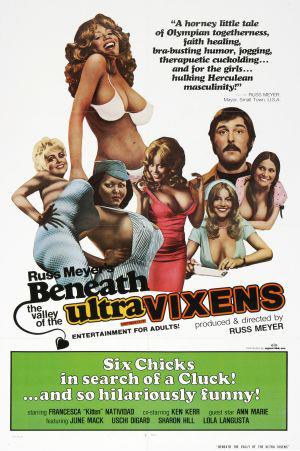


Ebert became Russ's central scripter in his later years, sitting out the two meagerest films, Supervixens (1975) and Blacksnake (1973), and writing Up! (1976), Beneath the Valley of the Ultravixens (1979), and the unproduced Who Killed Bambi?, which was to star the Sex Pistols (he made the script available on his blog). The films got much, much sillier and cartoonlike as they went along, but the work of Russ was NEVER like any other filmmaker (esp. not in the “adult” world).

Thus, it was the unexpected sides of Ebert that made the greatest impression on me: his wonderfully camp work with Russ; his promoting “forgotten” films on TV when no one else was doing it; and the articles and blog entries he wrote in recent years when he returned to writing full time. His final triumph over cancer was an important one, since he will be remembered.
*****


You can find ample amounts of Siskel and Ebert reviews on YouTube – I looked through page upon page of entries and not a single one blew my mind (no one evidently taped the special theme eps, except for that freaking “women in danger” show). So I offer you the episode of The Incredibly Strange Film Show on Russ, in which Ebert is one of the talking heads:


I will tackle his three Meyer movies backwards, first Beneath the Valley of the Ultravixens, featuring the wonderful and bountiful Miss Francesca “Kitten” Natividad (another Kitten sequence from the film can be found here):


For reasons I won't go into, several posters on YT have put up the opening scene of Up!, in which Adolph Schwartz (aka Hitler) suffers endless sexual indignities.


The problem with showcasing a great piece of Ebert's comic writing from BVD is that Fox LOVES to pull movie footage off of YT (as I well know, from the instances in which my interview clips about their films, adorned with short sequences from the films, have been “internationally banned”). The melodramatic ending of the film is here. Thus, I could only find two sequences in which Ebert's dialogue is included. First this slice of melodramatic plotting (“I'm a capitalist, baby!”):


And this gorgeous montage that leads into “Come with the Gentle People.” The problem here is that Ebert's audio commentary on DVD found him explaining that Russ himself wrote the narration for the craziest montage sequences. My assumption is that, since the dialogue over this montage is cross talk between two characters, it might have been Roger's creation:

Friday, April 5, 2013

Frank over Franco?: Deceased Artistes Jess Franco and Frank Masi

I take my schlock seriously. And so I do differentiate between schlock that is entertaining and the kind that is... well, so bad it's just bad. I already aired my feelings about Jess Franco on this blog when I paid tribute to Lina Romay, but I feel I should touch upon his work again at the time of his passing — and then discuss the legacy of a man who was completely sincere, but achieved some blessedly wonderful kitsch/schlock.

To cite from my piece on Franco in the Romay obit: What is my problem with Franco’s cinema? Well, just about every cult moviemaker who has a great reputation I feel has gotten that reputation because their films are either quality works of cinema (Corman, Metzger, Meyer, Sarno, Jose Mojica Marins), or because their work is bad but fun to watch (Herschell Gordon Lewis, Doris Wishman, Mike Findlay, and of course Ed Wood).

I have seen a handful of Franco’s films, and while I find that his soundtracks are often terrific, the films themselves are crashing bores — which is about the single worst thing that exploitation can be. To elaborate, I absolutely love women’s prison pictures and have seen most of them over the years. I have found it rather stunning that Franco’s WIP pictures are extremely dull, even compared to some of the cheesiest straight-to-video items that came out in the Nineties.

I can’t say any more, except to note that the films Franco made in the Sixties and Seventies are at least worth a look for their psychedelic moments and their soundtracks. And thus I salute Franco in the format that suits his work best: the trailer. The trailer for his films are often much better than the films themselves — and the scores were just terrific.

Here is a fan’s trailer gallery of a dozen juicy coming attractions, and here is the trailer for the slowwww-moving but, again, well-scored Venus in Furs (1969):


Franco’s trio of women’s prison films are all represented online, with the trailer for Barbed Wire Dolls here and the entirety of Women in Cellblock 9 here. The trailer for the best of the three pics, 99 Women (1969) shows off its great slumming cast — Maria Schell, Mercedes McCambridge, Herbert Lom — as well as its typical Franco sadism:


Franco adapted a few pieces by the Marquis de Sade. His film Eugenie: Story of Her Journey Into Perversion (1970) is an adaptation of the Marquis’ “Philosophy in the Bedroom” starring Marie Liljedahl (of Joe Sarno’s Inga), Maria Rohm, and Christopher Lee:


A slice of baroque weirdness from Vampyros Lesbos (1971), driven by nudity, a set that’s barely there, and, natch, music:


Finally, two clips that show the best and worst of Franco. First the worst: this slice from Exorcism, aka “Lorna the Exorcist” (1974). Shoddiness rules (in underground films the misapplied eyebrow pencil would be an “effect” — here it’s just ridiculous). It goes on and on and just gets sillier and more awful (read: pure Franco):


I’ll close out with a fan-created clip that shows off Franco’s best side: the showcasing of his first muse, the gorgeous Soledad Miranda, and a terrific score by Manfred Hubler and Sigi Schwab. The film is She Killed in Ecstasy (1970):


*****

To move on to kitsch that is consistently entertaining, I turn to the television show hosted and produced by another gent who died in the last week, Philadelphian turned Brooklynite Frank Masi. He was a singer who hosted the Manhattan access show Stairway to Stardom, a talent contest program that has acquired a national (worldwide?) cult since clips from it were posted on YouTube.

Many blog entries have been written about STS (I did one back in 2007, saluting… well, we’ll get to her below). The two most important pieces done on the show, though, come from the year that YouTube exploded, 2006. The first was an NPR segment on the show in which curator Mitch Friedman discussed his fixation on the program.

Friedman and his friend Doug Miller watched the show for the first time in the 1980s (it ran roughly from 1979 to the early Nineties, according to articles) and eventually came up with a plan to watch the whole series: contact the host-producer Frank Masi, say they were doing a documentary on public access (a lie), and suddenly the wealth of earnestly sincere kitsch that was STS was theirs. Friedman has paid back Masi’s trust in him by making the show a cult item through posting the clips on YouTube.

The second seminal piece on the show appeared later in 2006 on The Village Voice blog. By this point there were two STS tribute nights at a Williamsburg, Brooklyn, club and celebrities had professed their love of the STS clips on YT, including Marshall Crenshaw, John C. Reilly, and Bjork.

In case stars watching old access as kitsch entertainment appeals to you, it should be noted that Alec Baldwin recently told “voice of her generation” Lena Dunham on his NPR show “Here's the Thing” about smoking pot and watching “Stairway to Stardom” when he was younger – Dunham, in turn, tweeted about it later on, after she evidently took a tip from Alec and watched Masi's brainchild on YT.

Friedman interviewed Masi in 1993 on video, presumably for that documentary that never existed. Masi's reminiscences are stream of consciousness here, roaming all over the map. I could've done with more about the actual show and Masi's experiences in putting it together (perhaps that's because I'm always interested in other access producers' tales of triumph, and woe); by part three of this chat, Frank is talking about his cooking and his aptitude as a bowler, but there are some good fringes-of-show-biz stories:


Masi mentioned that tapes of his show were requested by someone at Metromedia a few years before Star Search showed up on that syndicated outlet. It's not certain that anything was lifted from STS for that show – one must remember that Major Bowes and later Ted Mack pioneered the “Amateur Hour” concept on the radio and then on television (Bowes started it in '34; Mack ended it in '70).

Whatever the case may be, it's often stated by everyone who writes about STS that it is a lot more entertaining than any of the talent contest shows that are currently on the networks. Certainly STS is a lot more unpredictable and goes places that those slicker shows never would (with some acts “preaching” in their songs, children singing tunes meant for adults, and people performing their own startlingly unusual compositions).

So I salute Mr. Masi, who was entirely sincere about his program and did have an old show-biz attitude about the acts he introduced, who ranged from fairly talented to mildly deranged. But only clips can elaborate exactly how weird things could get on the Stairway....

The title was sung by Masi at one point in the series, but at another there was this colorful montage:


There have been a few shows on access that have charged their guests “fees” to come on the air (money is allowed to change hands in leased access, but is verboten on public access). Here is the “ad” that ran during STS in which original cohost Evie Day, a big band singer, mentions “production fees” the guests will have to pay. In the video interview embedded above, Masi maintains that he only charged his guests for a short while on the show, and then he began to pay studio costs himself and let the acts appear for free:


Masi was a histrionic singer who really wanted to “sell” his songs. He recorded some singles and albums (mentioned, again, in the video interview above) and occasionally lip-synched to recordings on the air (as he does here). His STS performances are mostly, live, though, and he did tend to do certain songs over and over again, as can be seen in this montage of clips of him singing “(What Can I Say) After I Say I'm Sorry?”:


Perhaps his affected reading of a lyric is his rendition of “Don’t Get Around Much Anymore.” This will give you a taste of some hardcore Masi:


He closed out STS episodes bringing all the acts back out onto camera and having them join him for a song. Here the show closes with a rousing “God Bless America”:


A montage of acts from “Stairway to Stardom” set to Masi singing “The Way We Were.” (There is an alternate version of the song, performed on an early episode of the absolutely wonderful access show “Beyond Vaudeville,” to be found here at the 4:00 mark). Yeah, this stuff gets big laughs among the hipster contingent (and some of the material is very funny or just jaw-droppingly unusual), but there is something touching about this little clip, which I'm assuming was assembled by Mitch Friedman:


As a final farewell, I have to offer up a trio of items from the show, three people whose acts Masi exposed us to. If I had to go with a Holy Trinity of interestingly odd STS acts, I'd go with the dramatic monologue delivered by Precious Taft,


the mime and general weirdness of the late Don Costello,


and the unsurpassable, all-around double threat that is Lucille Cataldo (who has never had her clips taken off YT, but is, according to Friedman, not thrilled to have the show brought up to her). I assume most of my readers will have seen this already, but on the off-chance that there is someone who hasn't, please, please feast on “Hairdresser, Hairdresser.” And a final godspeed to Mr. Masi for bringing us Lucille:


Sunday, March 31, 2013

Avast, ye Christian pirates!

There is nothing, and I mean nothing, stranger than Christian children's enterainment (which fits snugly into the category of Krazy Kristian Kitsch, as I like to call it). I used to present it regularly on the Funhouse TV show on Easter weekend, but the new stuff just ain't as special as the older programs and home videos. One of the items I was happy to show on the program more than 15 years ago was a children's TV show that was first seen by most of us on a VHS compilation called “Perverse Preachers, Fascist Fundamentalists, and Kristian Kiddie Kooks,” created by the editor of the zine called “Zontar the Magazine from Venus” (whose blog is here). Please meet Captain Hook!


There are various sites that offer information about the good Captain, but it all boils down to this: his name was Von R. Saum, a gent from Scott, Ohio, who lost his arm and leg at the age of 17 in a motorcycle accident in 1960. This accident led him to Christ and a “Christian pirate” ministry (!) aimed at kids.


Various newspaper items online note that he officiated at various funerals and was indeed an ordained minister. The other piece of info I discovered is his mother's gravestone (the Internet is insane); the accompanying info lists Von's death as happening in 1993 at the age of 50. Thus his “Captain Hook Crusades” ministry is now shut down.


Happily for us, he left behind a kiddie television show (see below) and not one but TWO LPs. The second record was uploaded by the 365 Days Project at the WFMU blog. The first one (image at top of this blog post) was uploaded by the wonderful Baikinange on her blog; that one has liner notes by Colonel Sanders!


In this "intro" segment from his show, Capt. Hook tells us the story of his motorcycle accident. The show ran in Ohio and, apparently, Indianapolis; according to some online commenters this was in the Seventies, but the rap segment below definitely would signal the Eighties. He is ably assisted by not one but two pirate pals (Fish Hook and Seaweed Sam), and Mrs. Hook, who reminds us that “God is not a child abuser.” [Insert your own priest joke *here*.] The “Christian Pirate Puppets” are also on hand – most of which are Muppet ripoffs, but one is a ventriloquist's dummy (more on him below):


Can this get better? Of course, it can, it's triple-K, kats and kitties. The dummy, named “Sharkey,” performs a white-boy rap, while his two human-being shipmates dance around like idjits. Why is the dummy repeatedly saying “Look at all those cute girls”? I have no idea, but it makes the bit even creepier.


“Sail with Jesus and you'll never lose!”


The next item, uploaded by Zontar, has under 500 hits on YT, while viral-vids get millions and millions and are not one-millionth as weird or funny. The Captain and Fishook conduct an “autopsy” on a sinner (presumably the carcass of Sharky). The Captain instructs his assistant to cut the sinner apart and informs us of the potential sins that can be committed with each part of the human anatomy. Done with utter sincerity, and not a bit of irony – exactly the way it should be.


“Cut that ear off with that saw...”


Happy Easter, all!

Monday, March 25, 2013

Garden of Earthly Delights: Andy Kaufman, the Abrasive Genius (part one of two)


Andy Kaufman was a “child of television,” and — although those who saw him live rave about the experience — it was on television that he made his greatest impact. He enjoyed provoking and irritating his audience, but also betrayed a serious love for the inanities of television, from its variety-show excesses to its emphasis on childlike, simple emotions. Perhaps the most striking thing about his work is how it was insanely childish and incredibly sophisticated at the same time.
I write this a few weeks after a major celebration of Kaufman's comedy took place here in NYC. A gallery show of his costumes, notebooks, correspondence, and many personal possessions was supplemented by more than a week's worth of video presentations, hosted by fans and Andy's co-conspirators, at another gallery. The cumulative effect was fascinating, since the work of a resolutely and often intentionally abrasive comedian was discussed in earnest detail and put in a much larger context.
It would be hard to think of another comedian who could be celebrated in such a way – many movie and TV comics are honored with film festivals at rep houses or month-long showings of their old programs at the Paley Center, but to have a display of costumes and notebooks, as well as moderated discussions among “downtown artist” folk, points up how really unusual and genre-bending Kaufman's work was.
Those of us who were watching it at the time knew something really weird was going on. I remember first seeing Andy on Van Dyke and Company doing his “foreign man” bits (with jokes that just laid there, a character who seemed brain-damaged and juvenile, and this unknown comedian coming in at various points to “interrupt” the proceedings). As even a cursory look at the Kaufman “archives” on YouTube shows, he did a *lot* of talk show appearances, and although he did repeat certain bits, he concocted special bits that were done only once for certain appearances, like this "homeless" bit on the Letterman morning show.
As a young fan of his work, I often wondered what the fuck he was doing, but the laughs far outweighed the head scratching. Sometimes it was definitely something recognizable as “comedy,” but when he embarked on the “Intergender Wrestling Champion” and Tony Clifton bits, they seemed interminable and had no payoff.
One of the joys of watching his work on video and online these days is discovering the “punchlines” for some of his long-stemmed pieces of shtick. The intergender business had its payoffs revealed in the Carnegie Hall tape (in which he finally did something with the bit that was conventionally funny – downing spinach to get Popeye-like strength) and the I'm From Hollywood documentary (in which you see the well-executed finale of his wrestling career). The Tony Clifton provocation had its own payoff, in that Andy wasn't always in the makeup, a fact that was finally sprung on the public in a memorial special hosted by his siblings and Taxi costars.
The Kaufman gallery tributes showed that he really did a create a world of his own, through his standup, his talk-show appearances, and especially his concept specials. The threads that run through all the material are a spoofing of conventional show-business and a confounding of audience expectation. His unexpected death at 35 seemed to make no sense at all, but fit into a larger scheme of insanely talented performers who kick off before their time — most because of self-destructive tendencies and addiction, and others because they’re just too special to stick around for long.
In this part of my tribute to the “abrasive genius,” I want to pay tribute to his “bigger” creations (that are not Tony Clifton or intergender wrestling). I can best do this by describing the joys to be found at the show that recently closed at the Maccarone gallery. The show was held in a large room with the pieces exhibited in vitrines. The first things one saw were his personal papers – letters, passport, diaries, etc – then went on to his costumes, his record collection (more on that in the second part), and other objects (tape boxes, notes with phone nos. for contacts at Saturday Night Live, items reflecting his interest in transcendental meditation).
The highlight of the papers was surely his fan letter to Elvis, handwritten when he was college age. Steve Allen once wrote that when he first met Andy he wasn't sure if he was a big fan of his work or mocking him – the letter to Elvis runs along similar lines, since it is an *overwhelming* fan note in which Andy used quotation marks for emphasis. When he mentions being a “big Elvis fan,” the quotes do lend a weird note of irony. I'm sure he meant it, but setting something in quotes means you're being ironic or sarcastic.
The other weird aspect of the letter (one true to Andy's style as an anti-comedian) is his telling Elvis that he would love to replace him someday. One can only imagine the King's response, had he read this feverish fan letter from a young man who swears he writes papers in school on Elvis's movies. Andy cites two or three of Presley's worst films as some of his faves, so one gets the impression that Andy's taste in pop culture found him deeply loving some really cornball stuff (thus the delicate “balance” in a lot of his standup between mocking something and paying tribute to it).
Andy clearly didn't like to type, as only his stories are typed (there was even a handwritten resume on display). I haven't read his fiction and poetry – which was indeed published long after his death and now is out of print and fetching inflated prices on eBay – but he clearly was inspired by the Beat writers, as the items that were featured in the Maccarone show were redolent of Kerouac at his wordiest.
Andy's note to the Maharishi also is a curious item. He wrote to say that he loved TM, but it wasn't changing his life entirely, he was still descending into sadness. (It must've worked better for him in subsequent years, as he continued to practice it until his death.) The strangest notes in the collection weren't from Andy, however. They were housed alongside a group of jokey/angry/self-promoting notes from women who wanted to wrestle him (which were published in a book edited by his girlfriend, Lynne Marguiles).
The women challenged him to matches, writing in the same style he used when he put down women in his “intergender wrestling” bits. The weirder letters were from men who picked up on Andy tapping into a familiar wrestling trope, a “hair match” in which the loser has to have his/her head shaved bald. This excited some of the viewing audience who wanted Andy to beat a woman in the ring and then have her shaved bald (a pic of the fetchingly chrome-domed Persis Khambatta in the first Star Trek film were included with one note). One can only imagine the laughs that Kaufman got from the fact that he had fired up the libidos of some gents who were even kinkier than he (for an exploration of his sex life, see his friend Bob Zmuda's bio, Andy Kaufman Revealed!).
The gallery show also included a homespun feature in which visitors could sit down at a round table in the center of the room and talk to people who knew Andy at some point in his life. I would've loved to have chatted with Carol Kane or the most surprising name on the list, Prudence Farrow – whom I have to assume had some connection to Kaufman through his TM fascination. The day I went the guests were Andy's brother Michael and the “Bunny Ranch” owner Dennis Hof (a gallery employee informed us Andy was a regular customer at the Bunny Ranch....).
The piece de resistance of the show a notebook of performance ideas that Andy jotted down in '73-'74. Among them were these (all paraphrased here):
Bring out bald men who look like “Great Neck executives” (then a list of names of famous bald men who looked the way he wanted – “Mel Cooley,” Milt Kamen). Have them play congas in a men's room in separate stalls.
Go on Carson and get married, sincerely, but do an “Alice Toklas” (Andy referring here to the Peter Sellers movie, I Love You, Alice B. Toklas) and make sure the commercial breaks interfere with the ceremony. Wind up never getting married.
 Come onstage with Bobby Fischer and play chess with him for the whole show.
(the single best item and one I'm sure he could've carried off with much deadpan certainty) Come out on stage, say "Let Us Pray," and then just lead the audience in prayer the whole time.

The video and panel discussion presentations at Participant Inc will be discussed in my next blog entry, but here is a list of the “essential” Kaufman complete shows, as preserved on tape and now available (for the moment) on YT for free.

First is the show called “Uncle Andy's Funhouse” that aired as “The Andy Kaufman Special” late night on ABC in a 90-minute timeslot (the YT poster has put up the full version with the original commercials and sporadically sizzling audio). The show was shot in '77 but didn't air until '79; it includes some of his most famous bits, including the Foreign Man/Elvis transformation and his wonderful, truly manic conga drum version of “It's a Small World After All.”

The items specific to this show are his oddly touching chat with Howdy Doody, the introduction of the “angry Andy” (which basically became the Clifton character), “Has-been Corner,” and an odd framing device which finds the Foreign Man watching the show as it is being aired (he thinks it's pretty awful).

One of the oddest artifacts to show up in the era of VHS was a documentary called The Real Andy Kaufman, which chronicles Andy doing his full act at Kutchers Hotel in the Catskills and not going down all that well with the audience. This is an interesting opportunity to see his live act and also to see him literally knowing that the audience ONLY wants to see him doing “Latka” and Elvis. And so he brings up his entire family (with both grandmothers!) onstage to provoke them ever further:


The documentarian Seth Schultz conducts an interview with him after the show, in which Andy seems truly offended that the audience didn't enjoy the show (they were “downright rude!”). One assumes that he was used by this time (1979) to appearing before nightclub and college audiences who got what he was doing. How he thought the intergender-wrestling bit would go over with a resort-hotel audience is anyone's guess, but this one of possibly only a handful of times that he was seen with his guard down, for at least a minute or two:


His Carnegie Hall show is uniformly agreed to be possibly THE high water mark of his career. It's a full-fledged stage show that he financed himself and, as noted above, he provided contexts for all of the bits, including the intergender thing and Tony Clifton:
In 1981, he hosted an episode of the Midnight Special that included all of his “greatest hits,” but also included video of his very odd stint working as a busboy at a deli-restaurant while he was starring on Taxi, as well as two special guests he clearly chose for the occasion: Freddie Cannon and Slim Whitman:
Possibly my single favorite thing that Andy participated is the video My Breakfast with Blassie, in which he has breakfast at a Sambo's restaurant with the one and only “fashion plate of wrestling,” the classy one, Fred Blassie. The film contains my fave moment featuring his partner in crime Bob Zmuda (it is gross and stupid, but never fails to make me laugh) and many, many bits of wisdom from Fred to Andy:
While Breakfast is definitely in my Pantheon of favorite Kaufman creations, his last TV special, which aired on Soundstage in 1983, is perhaps his most extreme subversion of the TV medium (making him only one of a handful of comedians who picked up where Ernie Kovacs left off). The show begins suddenly, showing the end of the program and then restarting – instead of Latka watching the program, this time it's an old couple in a tacky living room (“he's playing with the medium... leave it on”).
His nod to Winky Dink and You (playing with a “magic screen” three years before Pee-Wee did it) and onscreen argument with his real-life ex Elayne Boosler are both mind-bogglingly weird sequences, but nothing is as good as the end, where he tells us all off and then “angry Andy” gets counseling from Latka (who is also a sarcastic son of a bitch).
I'll outline a number of extremely wonderful rarities in the second part of his blog entry, but this special is perhaps the best example of Andy toying with his audience's minds while he screwed with the cliches of television talk-shows.